

Listen: the breakdown
Market briefing: An outdated Rain contract flaw drained $1.1 million from Solana card programs, hitting Avici hardest, while BTC held near $78,078 and the attacker laundered funds through Tornado Cash.
- An outdated Rain contract flaw drained $1.1 million across multiple Solana card programs.
- Avici lost $500,800 from 1,685 users and its token fell 49 percent.
- Self-custodial wallets were untouched and Avici promised full refunds on compromised balances.
An outdated Rain contract just leaked $1.1 million from Solana card programs. Is this an isolated bug, or one more crack smart money is happy to see?
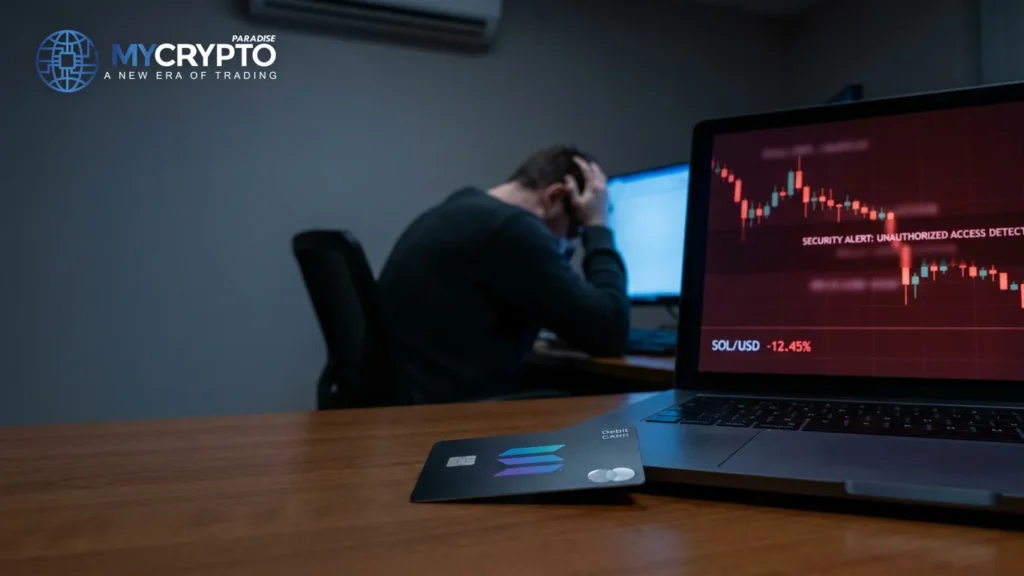
A flaw in an outdated Rain contract drained $1.1 million from multiple Solana card programs. The money did not vanish through some exotic new attack. It leaked through old code that someone forgot to retire.
Avici took the heaviest hit. The exploit pulled $500,800 from 1,685 Avici users, and the AVICI token dropped 49 percent within the day. For those holders, a card balance became a headline.
The attacker moved with practiced calm. They converted the stolen stablecoins into SOL, bridged the SOL to Ethereum, then pushed the funds through Tornado Cash. That is a well-worn laundering route, not improvisation, which tells you this was planned rather than opportunistic.
Avici moved quickly to contain the damage. The team stated that self-custodial wallets were unaffected, so the breach was confined to the card program layer, not user-controlled keys. It also promised that all compromised card balances will be fully refunded.
That refund pledge matters, and we take it at face value. But a promise to make users whole does not erase the deeper signal. A live product shipped on top of a contract nobody had audited recently, and the market only learned this after the money was gone.
BTC sat near $78,078 while this played out. ETH held around $2,455 and SOL near $105. The majors barely blinked, which is exactly the kind of quiet that rewards a closer look.
Old code and thin trust in altcoins
The transmission here is not about $1.1 million. That sum is a rounding error against BTC at $78,078. The mechanism that matters is confidence, because confidence is the only collateral holding thinly traded altcoins up.
When an outdated contract drains real user funds, every holder of a small Solana-ecosystem token quietly re-reads their own risk. They ask who audited the thing they are sitting in. Most cannot answer, so they trim exposure, and that trimming shows up as selling pressure across names that had nothing to do with Rain.
This is how a contained bug becomes a broader macro effect. FUD does not respect the boundaries of the affected program. It spreads to the whole neighborhood, thinning liquidity in exactly the assets that can least afford it.
The refund promise cushions the immediate panic for the 1,685 affected users. It does little for the thousands watching from outside who now price Solana-ecosystem tokens with a slightly higher risk premium. That premium is the real cost. It sits on every altcoin bid, and it arrives at a moment when retail is only just re-entering. Fresh money meeting fresh fear is not a stable mix, and it hands the initiative to whoever is patient enough to wait for the wobble.
How the fear filters down the risk curve
AVICI absorbed the direct blow, down 49 percent as the exploit and the token unwind fed each other. That is the first-order damage, and it is done.
The second-order path runs through the Solana ecosystem. SOL itself held near $104.92, up on the day, so the network did not crack. But smaller card-linked and app-layer tokens now carry a heavier discount for contract risk, and that discount does not lift quickly.
BTC and ETH sit above all of this, and their calm is the point. BTC near $78,078 and ETH near $2,455 barely moved, which means the majors are not pricing this hack as a systemic event. They are treating it as ecosystem noise.
That divergence is the tell. When altcoin fear rises while BTC stays flat, capital is not leaving the market in a panic. It is rotating up the quality curve, out of fragile names and into the deepest, most liquid assets.
That rotation is the quiet friend of a distribution phase. It concentrates liquidity where large holders can offload into it, and it thins the very tokens retail loves to chase. The hack did not cause this structure. It simply gave the structure another reason to keep grinding.
The signals that separate contained from contagious
The first thing to watch is whether the refund actually lands. Avici promised full reimbursement on compromised card balances, and delivery on that promise is what keeps a bug from becoming a run. Confirmation looks like refunds processed and AVICI stabilizing off its lows.
Invalidation of the calm looks different. If other Solana card programs or app-layer protocols disclose the same outdated-contract exposure, the story stops being about Avici. A second or third disclosure would widen the risk premium across the ecosystem and pressure SOL directly.
Watch SOL's $104.92 area as the honest gauge. As long as SOL holds and only the small tokens bleed, the damage stays contained. A break lower in SOL would signal the fear is generalizing.
Then watch BTC. The majors near $78,078 have shrugged this off so far. That composure is your baseline. If BTC stays steady while altcoins wobble, the up-the-curve rotation thesis holds.
The deeper watch item is behavioral, not technical. Does retail treat this as a reason for genuine diligence, or does it forget by the weekend and pile back into the next unaudited card token? The market has run this experiment many times, and the results are usually not flattering. Which answer we get will tell you how much fear smart money still has left to absorb.
Reading the exploit through the distribution lens
The ParadiseTeam reads this hack as a data point inside a larger structure, not as a standalone trade trigger. Our working bias remains that smart money is distributing at these levels, absorbing retail buying while confidence is thin.
An exploit like this fits that thesis cleanly. It manufactures fresh FUD in the Solana ecosystem precisely as retail re-enters, and fear delivered onto re-entering buyers is the raw material a distribution phase feeds on.
With BTC near $78,078 as of 04:39 UTC, our attention stays on the larger reset we have flagged toward the $55,000 to $44,000 exchange-of-hands zone. This hack does not move that map. It simply strengthens the case that altcoin confidence is fragile enough to accelerate the trip if BTC leads lower.
On positioning, the mechanism to respect is where stops sit. Panicked AVICI and small-token holders park stops below obvious lows, and those are the pools that get swept when fear is fresh.
Our read stays probabilistic, not certain. The bearish tilt holds while altcoin FUD rises into BTC's calm, which reads as distribution rather than accumulation. It would flip only if BTC reclaims strength and the ecoystem shrugs the hack off entirely, turning fear into a local bottom instead of a warning.
Track it live: our Crypto Fear and Greed Index and the live crypto funding rates both update in real time, so you can watch this shift for yourself.
Related coverage
For exact entries, targets, and stop losses with full risk management, that is what ParadiseFamilyVIP is for. New to reading these moves? Start with our crypto trading strategies guide.
ParadiseTeam is monitoring the market situation closely, and we are taking these developments into consideration while building our trading tactics inside ParadiseFamilyVIP.
Crypto trading involves substantial risk. Prices are volatile and you can lose money. This article is educational and is not financial advice. Past performance does not guarantee future results.
After the Rain contract hack, where does Solana ecosystem risk go next?
This is how 25 Paradisers are calling it. Tap your call.
No calls on this one yet. Tap yours to be the first.
Free account, no password. Members just sign in.
Follow this topic: Solana news






Join the discussion 17
this idea of altcoin risk is overblown I think. a flaw like this is a specific problem with one contract not a systemic issue across the chain.
This is less about altcoin risk and more about poor contract auditing, no? The number of transactions on Solana alone makes this a small blip in the grand scheme.
Fatima, I understand your emphasis on auditing. However, the concentration of value in certain altcoins amplifies the impact of such flaws disproportionately, making "altcoin risk" a relevant distinction in my view.
Marco, a flaw in the *contract* is the issue here, not whether it's an altcoin. The same vulnerability could exist on any chain if not properly audited, regardless of its market cap. This is about due diligence, full stop.
its always the contract risk or the rug pull but what about the level that matters what was the stop
what was the stop" 🤯 jessica, people on my street lost school fees 🎒 because the "stop" was a scammer's pocket, not a price chart 💔. that's the level that matters.
its not the specific contract that bothers me andres, its the 1.1 million, which is hardly "overblown" from my perspective. it suggests insufficient audits before deployment.
It’s hard to ignore that some of these issues only come to light *after* the money is gone. I always try to look at when the code was last audited, but even that's not foolproof, is it??
i get what you mean lena but i always think of it as a risk we take going in you know 🤔 like its on us to do the digging before, not just afterwards
I agree that we take on risk. But how can we "do the digging" on an audit that happened months ago if new code gets introduced? What does that even look like, practically speaking??
i mean, another day another contract flaw right? andres is right this isnt *just* an altcoin thing, it's any smart contract. always a new way to lose money 🤔.
Ricardo, it's such a familiar ache when it hits close to home, isn't it? 😥 Keep going meu amigo, we learn from every one! 💪
Makes me think of when I used to trust those older parts for one more trip... a small crack, then the whole system goes. Andres, it's about checking everything.
The specific contract vulnerability, not the altcoin itself, seems to be the primary load path failure here. A robust audit trail for all smart contracts remains crucial.
It reminds me of the old SWIFT message flaws. The market always finds a way to exploit, and a well-structured contract should anticipate that.
yeah its the smart contract risk always but maybe not altcoin specific, as andres says. i remember some of my old perp trades on solana, had to watch funding rates like a hawk for these exact kind of unexpected basis blowouts.
Tobias, that's fair about smart contract risk not being exclusive to altcoins. The challenge then becomes the auditability and ongoing maintenance of those contracts, especially for newer projects.