


Listen: the breakdown
Market briefing: Pendle has detailed how shared collateral largely negates liquidation risk on a hedged ETH perp strategy, a structural upgrade rather than a price catalyst. BTC held near $82,732 and ETH near $2,446 as the note landed, with the market unmoved by the feature itself.
- Pendle's shared collateral lets two offsetting ETH perp legs share one margin pool, largely negating liquidation risk.
- It is a capital efficiency and risk upgrade, not a price catalyst; ETH stayed near $2,446 and BTC near $82,732.
- Honest read: structural maturity for sophisticated traders, neutral for crypto prices in the near term.
Pendle just detailed how shared collateral can largely negate liquidation risk on a hedged ETH perp strategy. But does smarter risk tooling actually change anything for crypto prices?
Pendle has spelled out how its shared collateral feature works for a hedged ETH strategy, and the detail matters more than it first looks.
The structure is simple to describe. A trader opens a long ETH perpetual on one crypto exchange and a short ETH perpetual on another. Both legs draw on the same shared collateral. When ETH moves, the gain on one leg offsets the loss on the other, so the collateral swings largely cancel out.
That design does not remove liquidation risk entirely, and Pendle was careful to say so. But it shrinks the worry that stalks delta-neutral traders: a sharp ETH move wiping out one leg before the hedge can help.
Pendle V2 built its name as a leading spot yield trading platform. This clarification extends that reach into the perpetuals that sophisticated traders bolt onto yield positions. It is plumbing, not a price catalyst.
ETH itself barely noticed. The token traded near $2,446 as the note landed, up about 2.3 percent on the day. The feature targets neutrality by design, so it was never going to send ETH anywhere.
Still, the timing is telling. Volatility has rattled the wider market, and QNT fell roughly 15 percent over the week while XVG shed about 9 percent. In that climate, traders hunt for tools that keep them in the game rather than bets that promise to win it.
Capital efficiency is the quiet theme here. Shared collateral lets one pool back both legs, freeing margin that would otherwise sit idle.
Shared collateral and the liquidation cascade
The transmission here is subtle, so let us be honest about it. This is not a catalyst that moves BTC or ETH on the day. Its effect runs through market structure, not through a sudden wave of buying.
Start with liquidation mechanics. Forced liquidations are the fuel of violent crypto moves. When leveraged positions blow up, exchanges sell into thin books, and cascades feed on themselves. Anything that reduces forced selling softens those cascades at the margin.
Shared collateral for hedged legs does exactly that. A trader whose two perps offset each other is far less likely to get force-sold during a spike. Fewer fragile positions mean fewer dominoes when volatility hits.
Scale that logic across a platform. If more capital runs delta-neutral with robust collateral, a chunk of open interest (OI) becomes less twitchy. That is a small stabiliser for ETH perp markets, and ETH perps sit close to the heart of crypto liquidity.
There is a second channel: capital efficiency. Shared collateral frees margin, and freed margin can be redeployed, which keeps liquidity circulating rather than locked against stress.
None of this lifts price by itself. The honest read is that it improves the machinery beneath price. Mature tooling tends to attract sticky, professional capital over time. And professional capital is patient capital. It does not panic-sell the first red candle, which is precisely the behaviour that deepens drawdowns.
A neutral feature meets a jumpy tape
Read through to prices, and the impact stays measured. This story does not hand BTC a reason to run or a reason to fall. It is neutral for crypto on its own facts.
BTC was trading near $82,732 as of 02:37 UTC, up about 1.4 percent on the day. A Pendle collateral tweak does not touch that tape directly. Bitcoin takes its cue from macro liquidity and its own positioning, not from an ETH perp feature.
ETH is the closer link, yet even here the effect is indirect. The strategy is built to be delta-neutral, meaning it profits from yield spreads, not direction. So it adds utility to ETH without adding directional demand. ETH near $2,446 reflects that neutrality.
Where it does matter is confidence in ETH as collateral. The more ways ETH can be put to work safely, the stickier it becomes in professional portfolios. That is slow-burn support, not a spark.
Alts are the furthest from this news, and the data shows why. QNT dropped roughly 15 percent on the week, while XVG fell about 9 percent. Capital is rotating toward risk tooling and away from thinner names. That rotation is the real tell. In a jumpy tape, money favours strategies that survive volatility over tokens that merely promise upside.
So the cascade here is faint. BTC unmoved, ETH marginally reinforced, alts untouched by this specific note. The structural drift points toward a maturing, more risk-aware market.
Adoption and funding will tell the story
What confirms this as a genuine structural positive rather than a passing note? Watch adoption, not price.
The first tell is whether open interest in these hedged structures actually grows. If traders route more capital into shared-collateral delta-neutral setups, the platform's utility claim holds. If usage stays flat, it was a nice feature that few needed.
Watch ETH perp funding rates too. Persistent, orderly funding on both legs suggests the delta-neutral trade is working as designed. Wild funding swings would hint the hedge is harder to hold than the marketing suggests.
Then there is the stress test. Every risk tool meets its real exam during a violent candle, not a calm one. The honest question is how shared collateral behaves when ETH gaps hard in minutes. Pendle itself flagged that liquidation can still happen, so the claim is largely negated risk, not zero risk.
Invalidation would look like forced liquidations hitting supposedly neutral positions during the next ETH spike. That would puncture the core promise fast.
For the broader tape, keep the context honest. ETH held near $2,446 and BTC near $82,732 as this landed, so there is no price signal to chase from the news itself.
The cleaner read is patience. Structural upgrades reveal their worth over weeks of usage data, not in a single session.
If volatility returns and these positions hold without cascading, that is the quiet confirmation that matters most.
What shared collateral means at these levels
The ParadiseTeam reads this feature as neutral for direction but useful for how you survive the current tape.
Context first. BTC was near $82,732 as of 02:37 UTC, sitting between the support we track at $78,000 to $79,800 and resistance clustered at $85,000, then $88,400 and $90,000. ETH hovered near $2,446. This Pendle note changes none of those levels.
What it does change is the toolkit for trading through chop. We see smart money absorbing retail selling, with spot cumulative volume delta (CVD) printing higher highs and higher lows. In that environment, risk-defined hedged structures let patient capital stay positioned without getting flushed.
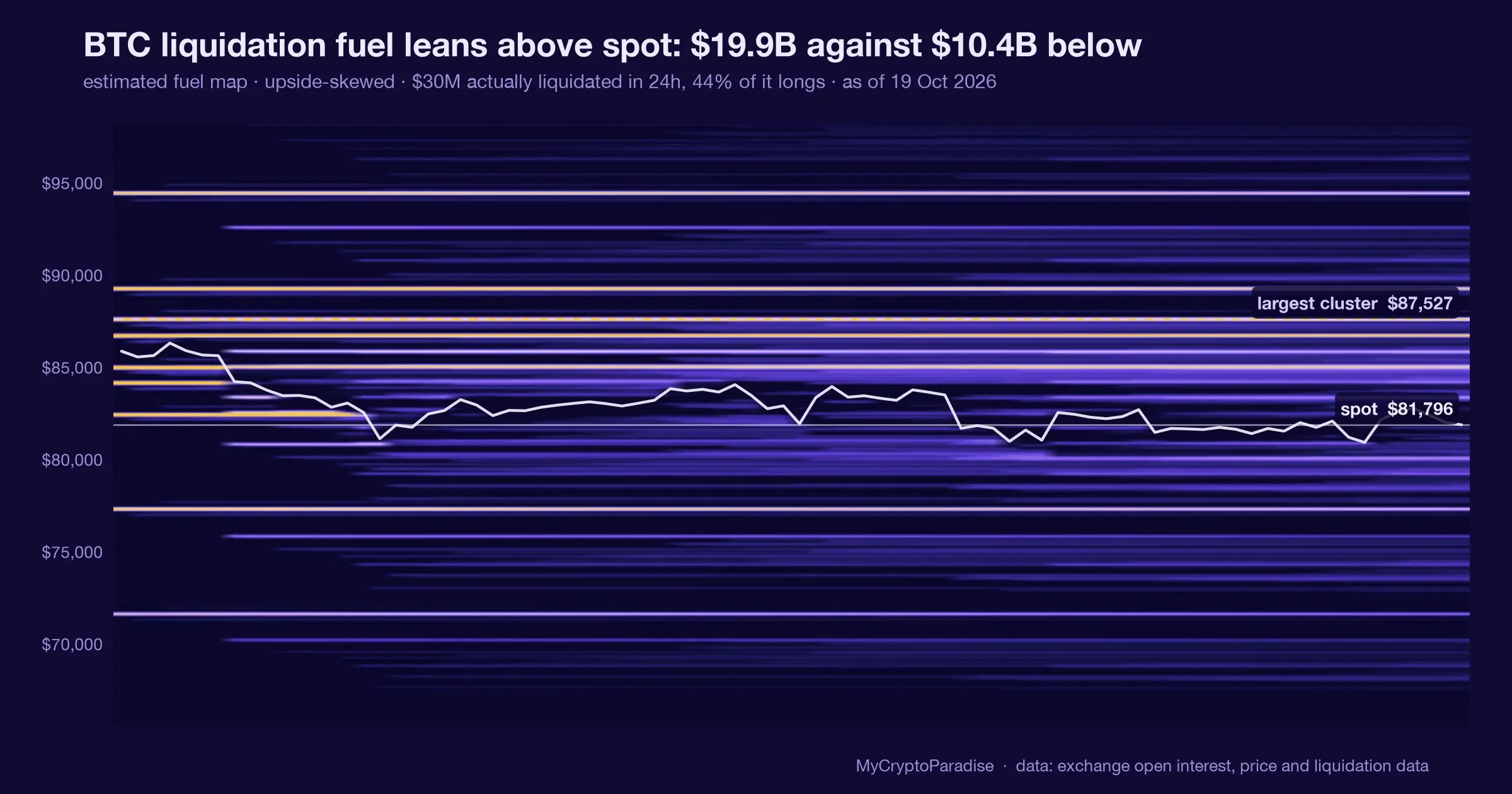
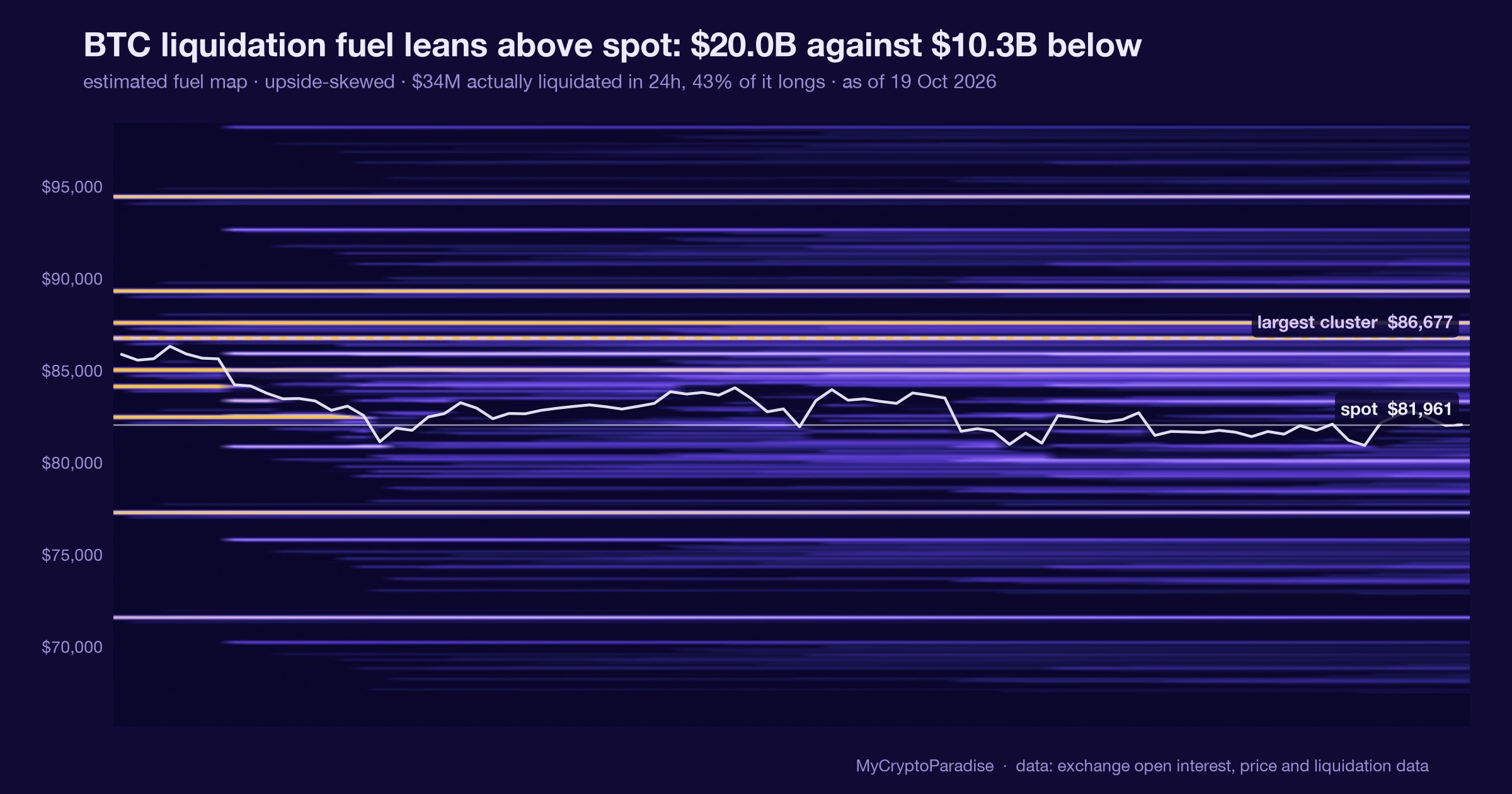
That is the mechanism we care about. Overleveraged longs remain vulnerable near $79,000, and overleveraged shorts sit between $85,000 and $90,000. A clean liquidation sweep either way is still on the table. Tools that reduce forced selling simply mean fewer traders become the liquidity for that sweep.
Our standing bias leans bullish on lower timeframes while the $78,000 to $79,800 zone holds. A reclaim and defence of the current neutral zone keeps the path toward $90,000 open. But bias is not a signal, and this story is not a directional call. We treat it as evidence the ecosystem is maturing, nothing more.
Manage risk-to-reward (R:R) first, size for the gap risk ETH still carries, and never confuse a risk tool with a guarantee.
The read behind this: we framed this story through our own market analysis, Can Bitcoin Rally Back to $90K?
Track it live: our live crypto funding rates and the crypto liquidation heatmap both update in real time, so you can watch this shift for yourself.
Related coverage
For exact entries, targets, and stop losses with full risk management, that is what ParadiseFamilyVIP is for. New to reading these moves? Start with our crypto trading strategies guide.
ParadiseTeam is monitoring the market situation closely, and we are taking these developments into consideration while building our trading tactics inside ParadiseFamilyVIP.
Crypto trading involves substantial risk. Prices are volatile and you can lose money. This article is educational and is not financial advice. Past performance does not guarantee future results.
Will shared-collateral, delta-neutral ETH strategies draw real capital from here?
This is how 1 Paradiser is calling it. Tap your call.
No calls on this one yet. Tap yours to be the first.
Free account, no password. Members just sign in.











Join the discussion
No comments yet. Members, share how you are reading this.