

In short
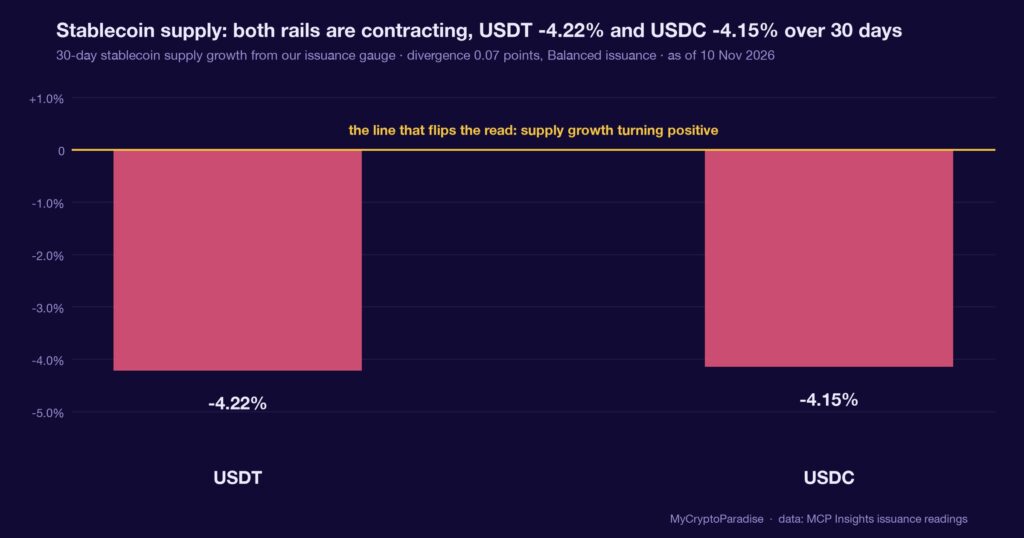
The kimchi premium is what buyers on Korean exchanges pay over the global Bitcoin price, and it is a clean read on offshore retail appetite. On 10 November 2026 our MCP Insights kimchi-premium data put it at 1.53 percent, a 92nd-percentile reading our model tags as building FOMO. Against that, the US tape is hollow: our Coinbase premium gauge sits slightly negative, and the source feed flags 30 straight days below zero. Dry powder is draining. Our MCP Insights stablecoin issuance data shows USDT 30-day supply at minus 4.22 percent and USDC at minus 4.15 percent. We called this a divergence, not a top: offshore crowds chasing while US spot and stablecoin fuel contract is a warning, not an instruction to act. Both premium series carry a model-estimate flag, so we quote no calibrated frequency. This piece shows you how to read the kimchi premium yourself, against the fuel behind it.
A premium is a crowd paying to be early
The kimchi premium is the gap between the price of Bitcoin on Korean won exchanges and its price everywhere else. Korea runs capital controls, so arbitrage cannot close the gap instantly, and the spread becomes a thermometer for one specific crowd.
When that premium widens, Korean buyers are paying up to own Bitcoin now rather than wait. It measures urgency, not value. The same mechanism runs in reverse: a discount means that crowd is the one reaching for the exit.
A premium tells you who is in a hurry. It never tells you they are right.
On 10 November the urgency sat offshore, not onshore
Per our MCP Insights kimchi-premium data, Bitcoin traded at a 1.53 percent premium on Korean venues on 10 November 2026, a 92nd-percentile reading on both the daily and weekly windows. Our model tags that heat as building FOMO.
The US tape told the opposite story. Our Coinbase premium gauge printed minus 0.016 percent, a gap of about minus 12 dollars, with the prior session US-led to the downside. The source feed notes the Coinbase Premium Index has held negative for 30 consecutive days.
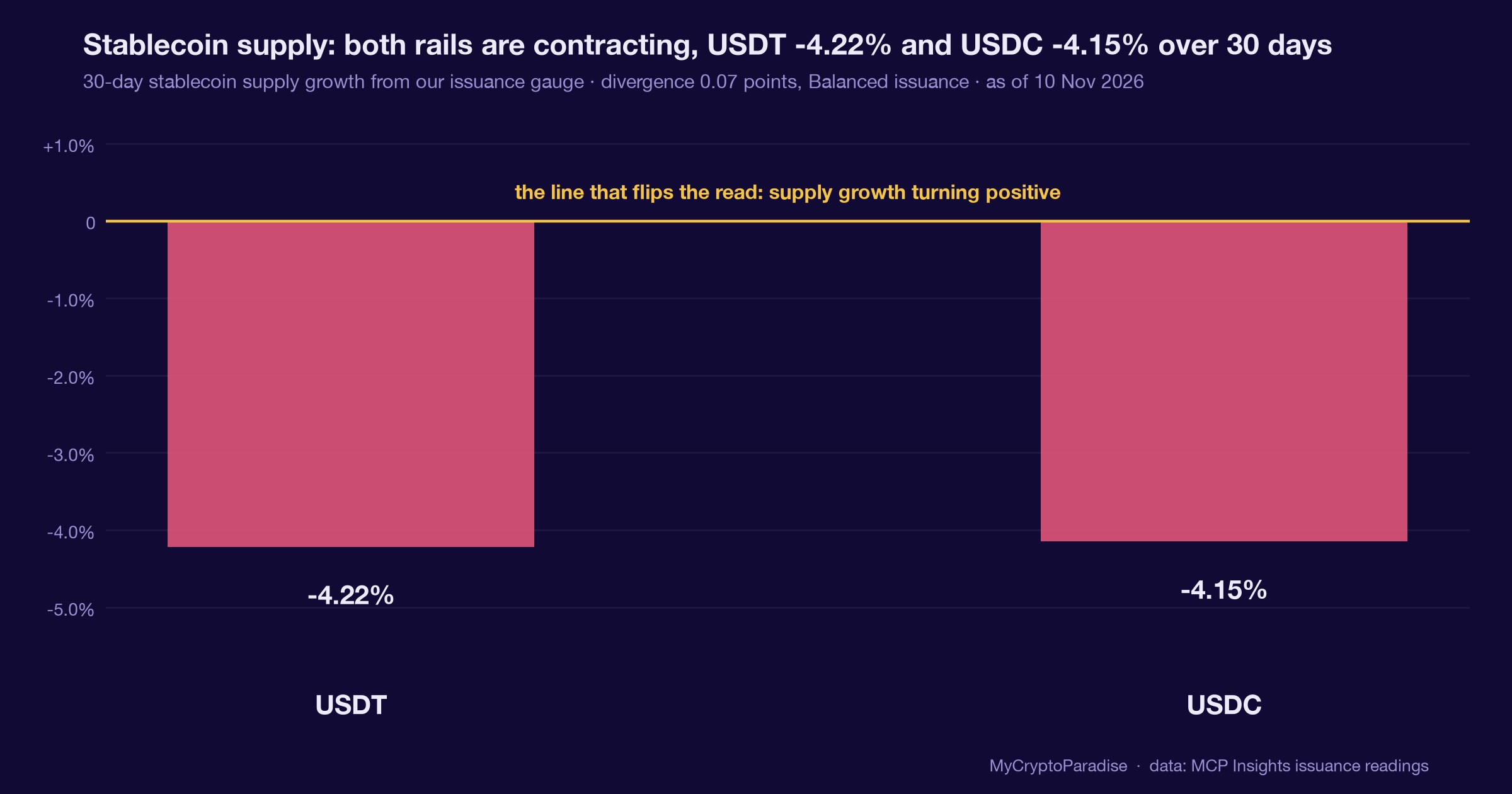
Behind both, the fuel is draining. Our MCP Insights stablecoin issuance data shows USDT 30-day supply at minus 4.22 percent and USDC at minus 4.15 percent, a balanced drain of about 0.07 points between them.
The source feed adds context we cannot source ourselves: USDT market value fell 6.6 billion dollars over 60 days, and apparent Bitcoin demand contracted by 284,000 coins in 30 days, the sharpest drop since early 2025.
One crowd is paying up while the money that funds the next bid shrinks. Divergences are where risk hides.
What is different here
The ParadiseTeam does not read a stablecoin headline and stop there. We pull the kimchi and Coinbase premiums, the issuance curve and the funding carry from our own tools, then ask which crowd is paying to be early and whether the money exists to prove it right.
A contraction is not automatically a bottom
The tempting read is that a sharp demand contraction marks a floor. Deep washouts have coincided with local bottoms before, and the source feed makes that point itself.
But base rates are not wired for this setup on our side, so we quote no frequency: a pattern recalled without a count is a story, not a probability. The two conditions a bottom usually needs are both missing here, with stablecoin supply still falling and US spot yet to turn.
This is one input, not a verdict. The kimchi premium sits alongside funding, the Coinbase premium and stablecoin issuance, and today it is the reading that disagrees with the others.
A bottom built from offshore FOMO and draining dry powder is a hope, not a base. The money has to show up first.
The side paying the premium is the exposed one
Funding frames who carries the risk. Our cumulative volume delta (CVD) read, a model estimate still short of its calibration gate, shows perpetual funding near 9.4 percent annualized with longs paying shorts, and an order-flow state stuck in churn between clear directions.
So the leaning crowd is long and offshore, paying a daily carry to hold that lean into contracting liquidity. Korea’s premium at the 92nd percentile marks the crowd most exposed if the bid does not arrive.
Our absorption gauge gives nothing to argue against that. No episode is active, and the climax read sits in a no-edge zone, so there is no sign of large buyers stepping in to absorb supply.
When the eager money is also the paying money, the tape does not owe it a rescue.
Reading the kimchi premium yourself, step by step
- Open our kimchi premium gauge and read the current spread, then check its daily and weekly percentile rather than the raw number.
- Pull up the Coinbase premium gauge beside it: a positive US print and a positive offshore print agree, a split does not.
- Check our stablecoin issuance read for the 30-day supply change in USDT and USDC, the dry powder behind any bid.
- Read perpetual funding on our funding rates page to see which side pays to hold its lean, longs or shorts.
- Write down the level or condition that would flip your read before you act, then size the lean as one input.
The step people skip is the percentile: a 1.53 percent premium means little until you know it sits at the 92nd percentile of recent months.
Every number above is checkable against the live data. Start with the Bitcoin ETF flow tracker, then cross-read the Coinbase premium gauge and the MCP Insights hub.
Act and invalidate
| Scenario | What confirms it | What kills it |
|---|---|---|
| Offshore FOMO cools | Kimchi premium falls toward its median | US premium turns positive first |
| Demand stays absent | Stablecoin supply keeps contracting | USDT and USDC issuance turn higher |
| The washout marks a floor | Coinbase premium turns US-led positive | Funding stays negative with no bid |
Posture: The higher-probability stance for most is patience: a defensive, no-trade posture while offshore FOMO leads and the dry powder behind any bid keeps shrinking. The lean turns constructive only when US spot and stablecoin supply confirm it.
Frequently asked questions
What is the kimchi premium?
It is the gap between Bitcoin’s price on Korean won exchanges and its global price. Capital controls keep arbitrage from closing it instantly, so the spread works as a thermometer for Korean buying urgency, up when that crowd chases and down when it retreats.
Does a demand contraction mean a bottom?
Not on its own. Sharp contractions have lined up with local bottoms before, but a bottom usually needs stablecoin supply to stabilize and spot buying to return. On 10 November 2026 neither condition was present, so the washout read stayed unconfirmed.
Why is the Coinbase premium negative?
A negative Coinbase premium means Bitcoin trades slightly cheaper on a US dollar venue than offshore, a sign US spot demand is soft. Our gauge printed near minus 0.016 percent, and the source feed counts 30 straight days below zero.
How much stablecoin dry powder has drained?
Our MCP Insights issuance read shows USDT 30-day supply down 4.22 percent and USDC down 4.15 percent. The source feed adds that USDT market value fell about 6.6 billion dollars over 60 days, shrinking the cash that funds new demand.
Is this reading a reason to trade?
No. It is one input, not a trade. The kimchi premium sits alongside funding, the Coinbase premium and issuance, and all four carry model-estimate flags here. The honest posture for most readers is patience until US demand confirms the move.
Crypto trading involves substantial risk and is not suitable for everyone. Nothing here is financial advice; it is education only. Never risk more than you can afford to lose.
The private Extras feed, where the kimchi premium, Coinbase premium and stablecoin issuance reads update with their invalidation levels attached, is part of PRO Paradiser, the intelligence layer behind the ParadiseFamilyVIP strategies.










Join the discussion
No comments yet. Members, share how you are reading this.