


Listen: the breakdown
Developing story update (October 10, 2026, 03:49 UTC):
GoPlus Security: #Ledger devices bought through reseller CryptoBillis were tampered. Funds deposited on those units were drained. Loss is about $90M.
This is not a one-off. GoPlus reminder: buy hardware wallets only from official channels check the packaging and seal verify authenticity and activation status on the official site. Wallet makers should also ship tamper-response as standard – including wiping keys if the device is opened – to cut off this class of risk.
Main attacker addresses (per Specter and tanuki42):
Bitcoin:
bc1qjqgwejnp8dc0x2938x9n9954hj97t82unx49dl
bc1qqnkwurxs99xkx5t4yffqhq3u6qwy0qpjyujtm9
bc1qgqheemzla77pesl227hdtgf5ykz62d0zvld26n
Tron:
TK6DWNpNe1w2iJRNFpU8aHdrPTATxvXT6C
TBkcUMYC7CkTK99tkTnaStQVBastfrs9d9
TCGE3xp6YGRKXxDZiLfysgJW3f22KfMNsW
TSDWtuZ2pARUVz4v3PkL2hi3iXPjowAr5a
EVMs:
0x69c8f401cfc6cd40ac94691d6d7c48e3b7a47841
0x033636e45d519bebb7b5c2520ca6ce56fbdb4f7a
0x83aeac166f6832ae3500000a24510a95a052a599
Developing story: This story is still unfolding. We are tracking it and will update this article as more details are confirmed.
Market briefing: Ledger is investigating wallet-draining reports among users in Southeast Asia, with one onchain estimate above $86 million. BTC held near $83,080 and ETH near $2,490, showing no clear reaction yet.
- Ledger is investigating wallet-draining reports concentrated among users in Southeast Asia.
- One onchain estimate puts losses above $86 million, still a single unverified figure.
- BTC held near $83,080 and ETH near $2,490, with no distinct move tied to the story.
Ledger, the largest hardware wallet maker, is investigating wallet-draining reports with losses estimated above $86 million. So is cold storage still the safe choice?
Ledger said it is investigating a wave of wallet-draining reports. The complaints cluster among users in Southeast Asia. One onchain analyst put the losses above $86 million.
Treat that number with care. It is an estimate, not a confirmed tally, and it rests on a single read of the chain. We report the investigation as fact and the figure as what it is: unverified until a second source or clear on-chain confirmation surfaces.
The reason this stings is simple. Hardware wallets exist to keep private keys offline and out of reach. People buy them precisely so this does not happen. A draining event tied to the brand that leads the category lands differently from a routine exchange breach.
We also do not yet know the vector. The drains could trace to compromised devices, phishing, a user-side supply issue, or something narrower than the core product. Those are very different stories, and the honest position is that the cause is still emerging.
The industry spent years telling retail to self-custody and skip the exchange. The lesson now arrives with an asterisk.
Structurally, this is a trust story more than a price story. It questions the one layer most holders assumed was settled. That is why it travels through sentiment faster than through order books, and why the early market reaction has been quiet rather than violent.
A trust shock aimed at cold storage
The transmission here runs through confidence, not liquidity. A hardware wallet is the last line of defense for self-custody holders. When that line looks porous, the damage is psychological before it is financial.
That matters because retail behavior hinges on a single belief: your keys, your coins, your safety. Shake the safety half of that promise and some holders hesitate to move funds off exchanges. Others freeze entirely. The friction is subtle, but it works against the slow migration toward self-custody that crypto has spent years encouraging.
Crucially, this is a contained incident, not a protocol failure or an exchange insolvency. No blockchain broke. No large pool of pooled customer funds is at stake across the market. So the macro channel is thin.
There is no forced seller here, no cascade of liquidations driven by the drains themselves, and no direct hit to BTC or ETH supply. That is why the price tape barely registered it.
What it does feed is the broader mood. Markets already sit on a soft footing, and a security scare adds one more reason for the marginal buyer to wait. Trust erodes quietly and rebuilds slowly.
So we frame the weight honestly. The first-order effect is negative for crypto confidence and for hardware-wallet trust specifically. The second-order effect on BTC and ETH prices, on the evidence so far, is small.
Trust erosion without a liquidity cascade
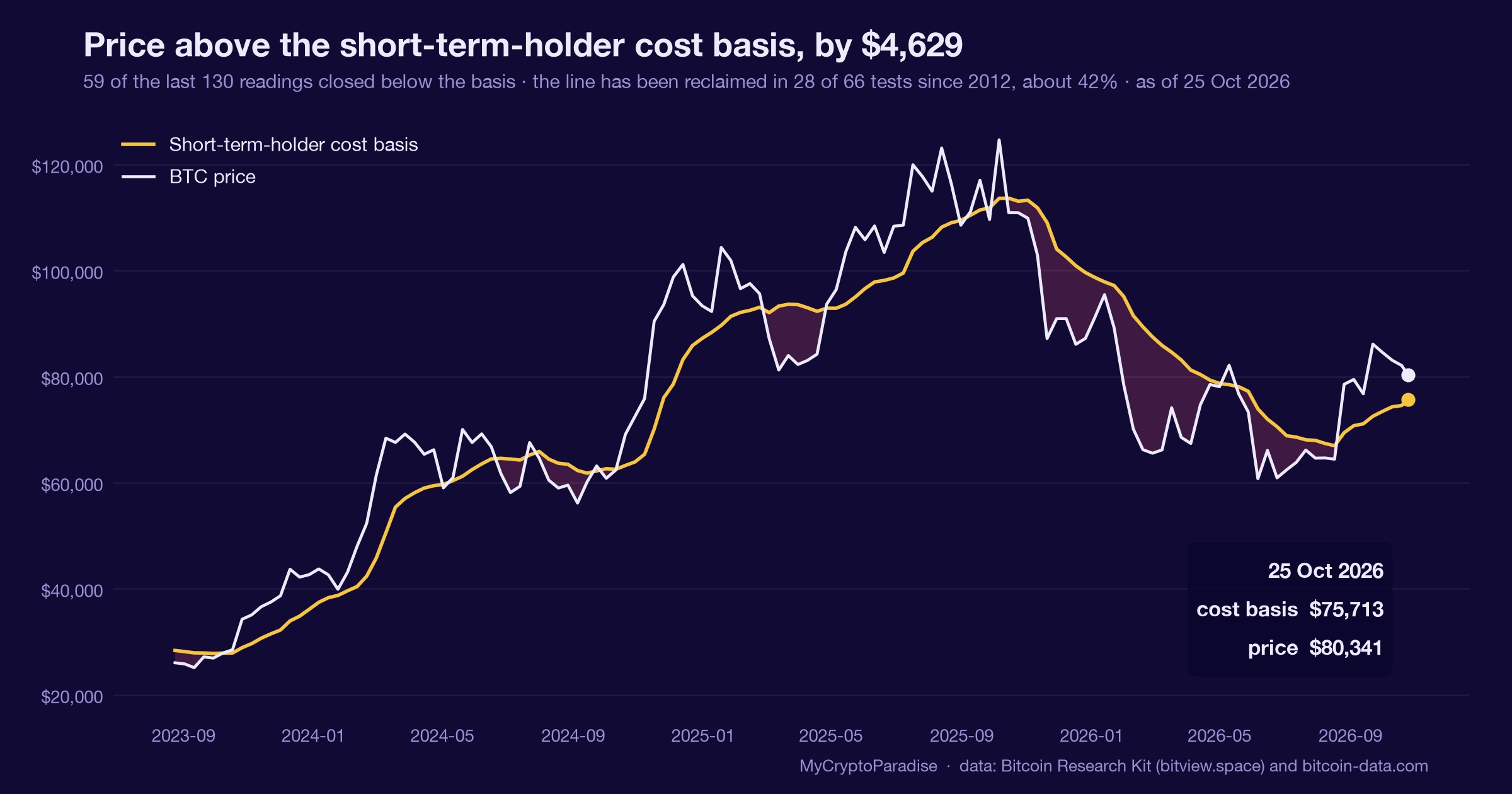
Start with the tape, because it tells the real story. BTC was trading near $83,080 as of the reading, up about 0.6% on the day. ETH sat near $2,489.97, down roughly 1.6%. Neither showed a distinct move tied to this news.
That absence is the point. A security scare confined to specific devices does not create the forced flows that move a $1 trillion-plus asset. There is no liquidation cascade to chase, no pooled custody at risk across exchanges, no supply shock to price in. So the cascade logic that usually runs driver to BTC to ETH to alts mostly stalls at the first step. BTC stays anchored to macro liquidity, not to one wallet brand's bad week.
Where a bearish tilt does live is sentiment. Trust shocks sap the marginal retail bid. Buyers who might have added here get one more reason to sit in stablecoins and wait. That thins demand at the edges rather than dumping supply onto the book.
Alts are the most exposed if fear spreads, because smaller-cap holders lean heaviest on self-custody and react hardest to safety scares. If the story widens, expect the drag to show in alt breadth before it touches BTC.
For now the read is restrained. The direction is bearish on confidence, but the market has priced almost none of it, which means the risk is a slow bleed in mood, not a sharp repricing.
Signals that turn a scare into contagion
The first thing to confirm is the number. Above $86 million is one analyst's estimate from a single read of the chain. A second independent confirmation, or clear on-chain tracing of the drained addresses, would turn an estimate into a fact and raise the stakes.
The second is the vector. If Ledger identifies a narrow cause, isolated phishing, a specific compromised batch, or a third-party integration, the story stays contained and the trust hit fades fast. If the cause points at something structural in the product, it widens quickly.
Watch scope next. Reports confined to Southeast Asian users read as a targeted campaign. Reports spreading across regions would reframe this as a systemic concern and justify real caution for self-custody holders everywhere.
Invalidation of the bearish tilt is straightforward. A contained cause, a revised-down loss figure, and a clear fix returning quietly would neutralize the sentiment drag within days. Trust stories that get explained tend to vanish from the tape.
Confirmation of the downside is the opposite set: corroborated losses, an unresolved vector, and a widening victim pool. That combination would start to weigh on self-custody demand and, at the margin, on alt sentiment.
One honest caveat. There is no single confirmed same-day catalyst behind the soft tape, so we treat the broader weakness as our interpretation of a market already drifting, not as proof this scare caused it.
Reading a custody shock against soft support
First, the practical point, because it outranks any chart. If you hold a Ledger, the ParadiseTeam view is blunt: this is a check-your-own-wallet moment, not a watch-the-candles moment. Verify your device and your recovery setup before you think about positioning. Custody safety is separate from any directional call.
On the tape, BTC was trading near $83,080 at the reading, pressing against the $82,000 support the ParadiseTeam tracks, with $84,000 as the prior shelf just above. A trust scare does not, by itself, break or defend a level like this. Liquidity does.
Set this against our standing macro read. The ParadiseTeam remains macro bearish, watching for a move toward the deeper $55,000 to $44,000 reaccumulation band where smart money, mostly parked in USDT, is waiting to absorb capitulation. Reclaiming $88,000 is what would challenge that caution. So we fold this news in as a sentiment input, not a new driver. It is one more reason the marginal retail buyer stays cautious while funding and crowded longs still look stretched.
For risk, keep it simple. Define your SL (stop-loss) by structure, not by headlines, and size for a market that can bleed slowly on thin confidence. A security scare rarely sets the low; it just dulls the bid on the way there.
The edge stays the same. Patience beats reaction when the story is about trust, not forced flows.
The read behind this: we framed this story through our own market analysis, Bitcoin Crashes to $82K: Reversal Next?
Track it live: our Crypto Fear and Greed Index and the crypto liquidation heatmap both update in real time, so you can watch this shift for yourself.
Related coverage
For exact entries, targets, and stop losses with full risk management, that is what ParadiseFamilyVIP is for. New to reading these moves? Start with our crypto trading strategies guide.
ParadiseTeam is monitoring the market situation closely, and we are taking these developments into consideration while building our trading tactics inside ParadiseFamilyVIP.
Crypto trading involves substantial risk. Prices are volatile and you can lose money. This article is educational and is not financial advice. Past performance does not guarantee future results.
Does the Ledger drain scare dent self-custody demand from here?
How 30 Paradisers are calling it
The first call is still open
Free account, no password. Members just sign in.








Join the discussion 16
thats a lot of value lost and this keeps happening... the trust erosion, especially for new entrants, seems like the bigger number to track here.
Another one?! 😳 Always tells my gf "babe, the future is here!" and now this. How do we explain this to normies man?! 🤦♂️
carlos, i don't know, this is the future, right? 🤷♂️ stuff always breaks early. means there's a problem to fix.
that's a lot of value to disappear without a clear external breach. i wonder if the connect kit's vulnerability was exploited primarily through social engineering, rather than just a technical backdoor.
yeah, it's why I only ever trade weekly closes. four-hour noise isnt a signal, people! 🤦♀️ so much drama.
It is always a shame when these things happen, especially when I think of all the people I've helped set up their first hardware wallets. Self-custody is the only way to truly secure your sats.
This is why I only trade the weekly close, Ben. All that four-hour noise isn't a signal. 🤷♀️
Ben, it truly is a shame, but seeing people understand how to verify and hold their keys is always a good thing.
a good reminder to always review the full transaction details, especially for new connections. that added layer of scrutiny acts like a secondary safety check.
So it's not the device itself, but the connect function that's the vulnerability... makes you wonder if these browser extensions are truly isolated enough.
yes, the surface area expands with every integration.. its never just one thing, always a chain.
The trust implications are significant, but this is why we teach people to verify their own security layers, including transaction details on the device itself. Olivia's right about self-custody.
Katya, you're right to emphasize that… it's what gives us real peace of mind, knowing we're in control. Nothing else feels as solid.
Oh no, another one 😟. Moving my coins to my own wallet after the FTX thing felt like locking my own front door for the first time 🔒. Gotta be so careful out there! ➡️
Jaysus, 86 mil, that's proper dodgy 😬. How many people are actually impacted by this, I wonder 🤔? Hope no one here got caught out by it! 🤞
yeah, i saw that too 😤. its the kinda thing that makes you just wanna keep it on the exchange, you know? 🤷🏽♀️