


Listen: the breakdown
Market briefing: New data shows only 8.2% of the $50.1 billion in tokenized assets actually sits in DeFi, with T-bill funds barely on-chain at all. BTC was near $58,499, down 2.2% on the day, as of 11:44 UTC.
- Only 8.2% of $50.1B in tokenized assets is deposited in DeFi
- US T-bill tokenized funds keep just 0.4% of $13.9B on-chain
- Whitelist and compliance rules gate most of that capital out
The tokenized assets pitch sounds enormous: over $50 billion now lives on-chain. So if the number is that big, why does almost none of it actually reach DeFi?
The tokenization story has a headline number and a footnote. The headline reads $50.1 billion in tokenized assets sitting on-chain. The footnote, which fewer people quote, says only 8.2% of that capital is actually deposited in DeFi protocols.
The gap is even wider where the money is biggest. US T-bill tokenized funds carry a $13.9 billion market cap. As of the October review, just 0.4% of that was deposited in DeFi.
So more than ninety cents of every tokenized dollar sits parked, visible on-chain but doing nothing on-chain. The reason is not demand. It is permission.
Most of these funds run behind whitelist and compliance gates. Only pre-approved wallets can hold or move the tokens, which rules out the open, permissionless pools that make DeFi liquid in the first place. The asset is tokenized. The access is not.
That distinction matters more than the big round number. A tokenized T-bill that cannot touch a lending market adds a line to a dashboard, not liquidity to the system. The plumbing is still walled off from the taps everyone keeps pointing at.
This is a structural read, not a same-day catalyst. No single event moved price around it. But it quietly corrects a story that retail has been pricing in for months: that a tokenization wave is about to flood DeFi with institutional capital. The on-chain numbers say that flood is still mostly held behind a gate.
Compliance gates, not demand, cap the flow
The mechanism here is permission, and permission is a slow variable. Whitelist rules decide which wallets can ever hold a tokenized fund. If the open DeFi pools are not on that list, the capital simply cannot enter them, no matter how attractive the yield looks.
That breaks the transmission chain people assume. The bullish version goes: tokenize real-world assets, route them into DeFi, deepen on-chain liquidity, lift activity and total value locked. Each step sounds automatic. The first step clears compliance. The second one does not.
US T-bill funds are the cleanest example. They are the largest, most trusted slice of this market, and they keep 99.6% of their value off DeFi rails. The safest tokenized capital is also the most tightly gated. That is not an accident of this cycle. It is the design.
So the near-term read-through to on-chain liquidity is small. A $50 billion figure implies a firehose. The 8.2% that is actually plumbed in behaves more like a trickle.
For the broader market, that reframes a popular narrative. Tokenization is real and growing, and over time the walls may open through permissioned pools and clearer rules. But the capital is not standing at the door waiting. It is sitting inside a different building, and the connecting corridor is still mostly closed.
Why this barely moves the liquidity needle
For crypto prices, the direct impact of this data is close to zero, and that is the honest read. BTC was trading near $58,499, down 2.2% on the day, as of 11:44 UTC. ETH sat near $1,639, down about 3%. None of that is this story talking.
The weakness today is the market's own, driven by positioning and sentiment, not by a tokenization report. On the hour, BTC barely flinched, down 0.33%, while ETH ticked up 0.18%. A structural adoption stat does not push a candle.
Where it does matter is the narrative layer that sits underneath alt valuations. DeFi tokens have long carried a premium tied to the promise of institutional capital arriving on-chain. This data trims that premium a little. If 90%-plus of tokenized money cannot legally reach these protocols, the implied future flow shrinks.
That is a slow, quiet drag, not a liquidation event. BTC leads, ETH follows, and the DeFi alts that lean hardest on the tokenization thesis feel the most narrative pressure. But pressure on a story is not the same as pressure on a price today.
The practical takeaway is simple. Treat this as a reason to stop over-counting tokenized assets as pending DeFi liquidity. The capital is on-chain in name. It is not in the pools, and until the gates move, it does not support bids anywhere.
The signal that would unlock the capital
The number to watch is the deposited share, not the market cap. The $50.1 billion headline will keep climbing as more funds tokenize, and that growth will get celebrated. It tells you almost nothing about on-chain liquidity on its own.
The figure that would actually change the thesis is that 8.2%. If deposited share into DeFi starts rising meaningfully, especially from the T-bill funds now stuck at 0.4%, the gate is opening. That would be a genuine structural shift, and it would deserve attention.
Watch the rails, not the press releases. The real unlock looks like permissioned or compliant DeFi pools that whitelisted wallets can legally use. Credible frameworks that let regulated funds lend, borrow, or provide liquidity on-chain would be the confirmation signal.
The invalidation of the bullish tokenization-into-DeFi story is simpler. It is continuation. If the deposited percentage stays flat or drifts lower while the total market cap balloons, the gap is widening, and the narrative is running ahead of the plumbing.
Be wary of the big-number updates that skip the footnote. A new all-time high in tokenized market cap will read as bullish adoption and change nothing about liquidity if the deposited share does not move with it.
For now, the base case is slow. Compliance timelines rarely surprise to the upside. The honest expectation is that this gap closes gradually, if it closes, and that any claim of an imminent DeFi flood should be checked against the on-chain deposit numbers first.
Why the tokenization hype outruns the plumbing
The ParadiseTeam reads this as a sentiment correction, not a trade trigger. It removes one of the louder bullish stories propping up DeFi and alt valuations, and it does so with on-chain data rather than opinion. That matters in a tape that is already defensive.
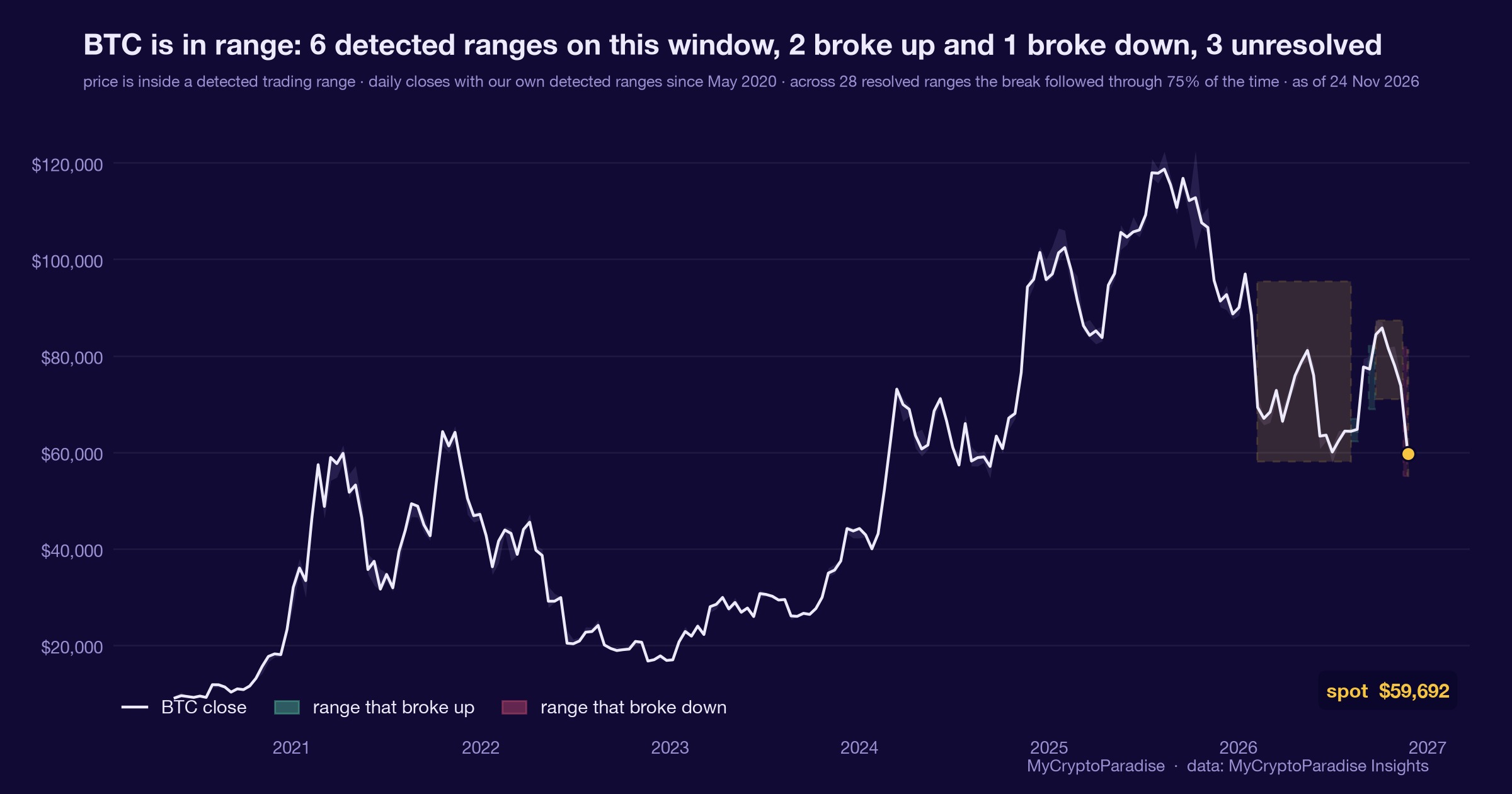
Step back to the structure we are working with. Our broader view stays cautious: $64,000 flipped from support into resistance, and the risk remains skewed toward a deeper flush before this is over. BTC near $58,499 as of 11:44 UTC sits well under that level, in a market still in fear rather than true capitulation.
Into that backdrop, a weak adoption print is not a reason to chase anything long. It is a reason to discount the idea that institutional tokenized money is about to rescue on-chain liquidity. That rescue is gated, and gates move slowly.
So we treat tokenization-driven bullish narratives with the same skepticism we apply to this whole bounce. Strength in DeFi tokens on this theme should be watched for selling into it, not bought into. The capital that would justify those bids is still behind a whitelist.
None of this sets a level for BTC. It sharpens the lens. Until the deposited share actually climbs, the ParadiseTeam keeps the standing bias intact: respect $64,000 as resistance, watch for forced selling, and keep positioning risk-first. Probabilities, not promises. The plumbing decides, not the press release.
The read behind this: we framed this story through our own market analysis, Bitcoin Bounce Was Leverage, Not Smart Money.
Track it live: our Crypto Fear and Greed Index and the live crypto funding rates both update in real time, so you can watch this shift for yourself.
Related coverage
For exact entries, targets, and stop losses with full risk management, that is what ParadiseFamilyVIP is for. New to reading these moves? Start with our crypto trading strategies guide.
ParadiseTeam is monitoring the market situation closely, and we are taking these developments into consideration while building our trading tactics inside ParadiseFamilyVIP.
Crypto trading involves substantial risk. Prices are volatile and you can lose money. This article is educational and is not financial advice. Past performance does not guarantee future results.
Will whitelist walls open tokenized funds to DeFi in any real way soon?
How 2 Paradisers are calling it
The first call is still open
Free account, no password. Members just sign in.











Join the discussion
No comments yet. Members, share how you are reading this.