

Listen: the breakdown
Market briefing: A New York federal judge refused to let Gemini and the CFTC unwind a $5 million settlement, keeping the penalty and injunction live. Crypto barely noticed, with BTC near $82,111 and up 1.9 percent on the day.
- A U.S. federal judge denied a joint Gemini and CFTC request to undo a $5 million settlement
- The settlement, reached in January 2025, stays in force because Gemini entered it voluntarily
- The payment and injunction remain, while BTC held near $82,111 with no meaningful reaction
A judge just refused to erase a Gemini settlement that both the firm and the regulator wanted gone. So why did crypto barely blink at the Gemini settlement news?
A U.S. federal judge has declined to tear up a Gemini settlement, even though the firm and its regulator both asked him to.
Judge Alvin Hellerstein in New York denied a joint request from Gemini Trust Co. and the Commodity Futures Trading Commission to undo a $5 million settlement. The two sides wanted it gone. The court said no. That is a rare sight: a company and the agency that sanctioned it standing together, and a judge refusing to oblige either.
The reasoning was simple and hard to argue with. Gemini had entered the settlement voluntarily back in January 2025. The judge concluded that a deal a party chose to sign is not something the court should quietly unwind later because sentiment changed.
So the payment stays. The injunction stays. Nothing about the original terms moves.
What changed is not the money, which was already small by exchange standards, but the signal. A settled enforcement outcome in crypto now looks durable even when both parties later lose their appetite for it. That matters more for the industry's legal expectations than for anyone's balance sheet. And the market treated it exactly that way, with BTC trading near $82,111 and up roughly 1.9 percent on the day, indifferent to a courtroom in lower Manhattan.
A voluntary deal the court would not unwind
The transmission from this ruling to crypto prices is deliberately thin, and that is the point worth understanding.
This is an entity-specific legal outcome. It confirms that one firm's January 2025 settlement remains binding. It does not change interest rates, dollar liquidity, or the flow of capital into digital assets. There is no new money entering or leaving the system because a $5 million penalty stayed on the books.
What it does reinforce is a backdrop. Regulatory enforcement in crypto is being upheld by the judiciary, not softened by it. A consistent legal framework is being applied to digital asset firms, and settled matters are proving hard to reopen.
For the broad market, that is close to neutral information. Traders already price in an environment where U.S. regulators act and courts back them. One more confirmation of the status quo adds little to that expectation.
The nuance is that durability cuts both ways. A framework that holds firms to their signed deals is also a framework that holds its own rules steady. Predictability, even strict predictability, is something institutional capital tends to prefer over chaos.
So the structural read is calm. This is a reminder, not a regime change. The headline reads heavier than its actual weight on liquidity, which is why the price tape stayed quiet while the legal commentary did not.
Why the price tape stayed quiet on this
The liquidity cascade from this ruling is essentially flat, and the order book shows it.
Start with BTC. A $5 million settlement at a single firm does not move Bitcoin liquidity. BTC sat near $82,111, up about 1.9 percent over 24 hours, on drivers that have nothing to do with a Manhattan courtroom. The ruling landed and the chart ignored it.
ETH tells the same story, only greener. It traded around $2,446, up roughly 4.1 percent on the day, outpacing BTC on its own flow rather than on anything the judge said. If this news mattered to Ethereum, the tape would not look like this.
Alts followed the majors, not the headline. Without a systemic shock, there is no risk-off wave for them to catch. An entity-specific enforcement outcome simply does not cascade. This is the honest read, and we note there is no single confirmed same-day catalyst behind the broader bid. The 24-hour green is interpretive on our part, not a verified reaction to this ruling.
The mechanism is absence of a mechanism. Smart money is not repositioning around one firm's settlement, because the news carries no liquidity consequence for the asset class. Retail sentiment across public forums reads mixed and largely unfocused on it. When neither the professional bid nor the crowd treats a story as material, the price stays flat, and that flatness is the real market verdict here.
The regulatory signal to track from here
What to watch next is not the price reaction, because there was not one, but the precedent this sets.
The confirmation signal is durability. If more settled crypto enforcement matters prove hard to reopen, firms will treat signed deals as final from day one. That slowly raises the cost of settling and changes how companies negotiate with regulators. It is a slow-burn industry effect, not a trade.
The thing that would change the read is scope. Watch whether this stays a one-off tied to Gemini's voluntary agreement, or whether courts start citing it when other firms try to revisit their own settlements. Narrow stays neutral. Broad becomes an industry theme worth tracking.
For crypto prices specifically, the invalidation of our neutral stance would be any sign this ruling feeds a wider enforcement wave that threatens exchange operations or custody. There is no evidence of that today. The payment and injunction here are contained to one firm.
Keep the market drivers and the legal story in separate columns. BTC near $82,111 and ETH near $2,446 are moving on liquidity and flow, not on this decision. So the practical watch list is short. Track whether the precedent spreads, whether regulators grow bolder with it, and whether any future case actually touches customer funds or trading access. Until one of those turns, this remains a legal footnote the market has already filed away.
Reading a quiet print against crowded longs
The ParadiseTeam reads this as a non-event for positioning, and the more useful discussion is the tape it landed on.
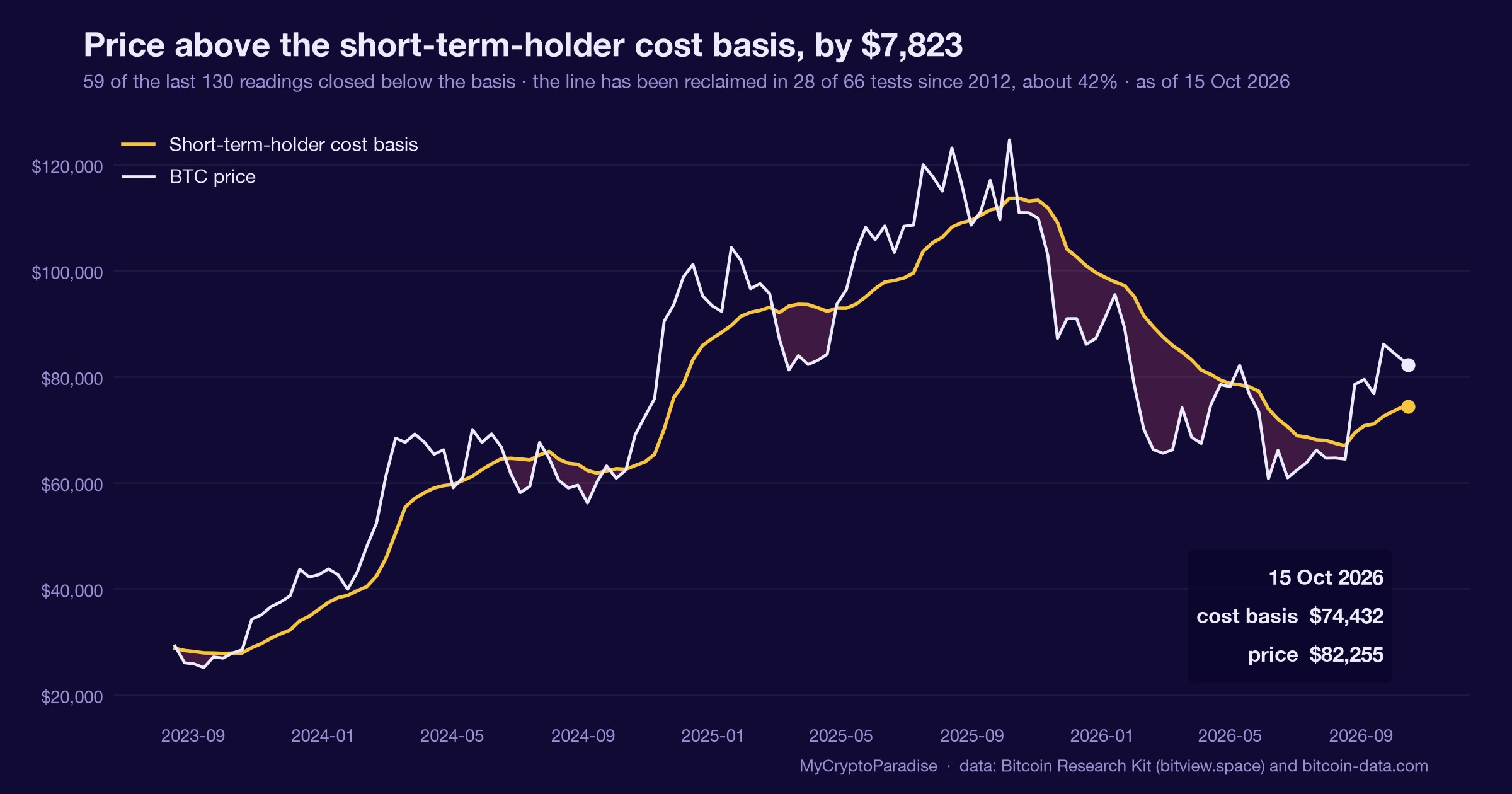
With BTC near $82,111, our standing lens still frames the near term as cautious. Retail longs look crowded, funding has leaned positive, and we carry bearish volume and momentum divergences on the higher timeframes. A contained legal story does not change any of that, so we do not let it color the structural read either way.
The levels we care about sit far above this noise. We treat $78,000 as near support and $90,000 as the resistance and target that any continuation must reach. $99,000 stands above that as heavier resistance, with $76,000 as our swing stop-loss reference on the downside.
Here is the honest part. A quiet print like today does not confirm strength. In our framework, strength into the $90,000 zone while longs stay crowded would more likely be distribution into retail than a clean breakout.
We are still waiting on the real tells: lower bearish volume on any dip, aggressive spot buyers stepping in again, and price reclaiming the channel's lower trend line as support. None of those is settled by a courtroom. So our posture is patience. This ruling changes no level and no bias. We watch whether smart money absorbs supply at support, or whether crowded longs get squeezed first, because that, not a $5 million settlement, decides the next move.
The read behind this: we framed this story through our own market analysis, Can Bitcoin Hold Its Final Support?
Track it live: our live crypto funding rates and the Crypto Fear and Greed Index both update in real time, so you can watch this shift for yourself.
Related coverage
For exact entries, targets, and stop losses with full risk management, that is what ParadiseFamilyVIP is for. New to reading these moves? Start with our crypto trading strategies guide.
ParadiseTeam is monitoring the market situation closely, and we are taking these developments into consideration while building our trading tactics inside ParadiseFamilyVIP.
Crypto trading involves substantial risk. Prices are volatile and you can lose money. This article is educational and is not financial advice. Past performance does not guarantee future results.
Will upheld crypto settlements like Gemini's push firms to stop settling with regulators?
This is how 1 Paradiser is calling it. Tap your call.
No calls on this one yet. Tap yours to be the first.
Free account, no password. Members just sign in.
Follow this topic: Crypto regulation news











Join the discussion
No comments yet. Members, share how you are reading this.