


Listen: the breakdown
Developing story: This story is still unfolding. We are tracking it and will update this article as more details are confirmed.
Market briefing: Israel is reportedly weighing crypto to counter future sanctions, even as it warns that US military aid may end. Bitcoin held near $81,547 and barely moved on the report.
- Israel is reportedly studying crypto as a hedge against future sanctions.
- The same report warns that US military aid to Israel could eventually end.
- BTC held near $81,547 and ETH near $2,404, with almost no immediate reaction.
A sitting government is reportedly eyeing crypto to counter sanctions, while warning that US military aid may end. Does state-level demand quietly rewrite Bitcoin's long game?
Israel is reportedly weighing crypto as a tool to counter future sanctions. The same message carried a warning: United States military aid may eventually end. For a nation that leans on that support, the subtext is blunt. A state is studying financial escape routes before it actually needs them.
This is a report of intent, not a policy on the books. No wallet has moved. No reserve has been announced. We treat it as a signal about where state thinking is drifting, not a confirmed program. That honesty matters when you position around it.
The idea itself is not new. Nations under pressure have long hunted for rails that sit outside the traditional banking system. What changes is who is now saying it out loud, and why. When the conversation reaches a head of government, the Overton window has already moved.
Bitcoin held near $81,547 as the report circulated, up a fraction over 24 hours. Ethereum sat close to $2,404 and looked equally unbothered. Social chatter was thin, forum views mixed. Markets rarely reprice a sentence about what a government might one day do.
That gap between a bold statement and any balance-sheet action is the whole story.
We have already covered sovereign and institutional rails this week, from tokenized funds to a fresh spot Bitcoin listing abroad. This piece is different. It is about demand born from necessity, not convenience, and that is a slower, heavier kind of flow.
How sanctions pressure pushes states toward crypto
The transmission here is political before it is financial. Sanctions work by cutting a target out of the dollar system. Any asset that settles without a bank's permission becomes attractive the moment that threat appears. Crypto is the most liquid version of that asset.
For a state, the appeal is neutrality. Bitcoin does not check a passport. It does not freeze on a policy memo. A government that fears losing access to aid or correspondent banking starts to view a borderless reserve as insurance, not speculation.
That reframes crypto from a risk asset to a strategic one. Over a long horizon, that shift is the deepest bullish driver there is. Demand that comes from survival does not care about the weekly chart.
But the timeline is the catch. State adoption moves in quarters and years, not sessions. A reserve has to be debated, built, and defended before a single coin is bought. The market knows this, which is why the price shrugged.
There is also a mirror effect. If one pressured state explores this route, others watching their own exposure take notes. The narrative compounds quietly. Each new official who says the word out loud lowers the cost of the next one saying it.
So the macro read is simple. This does not move liquidity today. It widens the pool of potential structural buyers tomorrow. We log it as a brick in the adoption wall, not a trigger.
Why liquidity reads this as slow demand
Start with what did not happen. BTC moved less than half a percent on the hour, ETH barely more. No volume spike, no funding lurch, no stampede. When a genuine liquidity event hits, order books feel it inside minutes. This one did not.
That tells you the flow is theoretical for now. The bullish case rests on future state buying, and future buying cannot bid today's book. So the immediate impact on BTC is close to zero, by design.
Bitcoin would absorb any real sovereign demand first. It is the deepest, most liquid, most politically defensible holding for a nation. A state is not accumulating a basket of microcaps to dodge sanctions.
Ethereum would catch a second-order bid only after that BTC story matures. Settlement and tokenization narratives help ETH, but a reserve conversation starts and often ends with Bitcoin.
Alts sit furthest down the chain. They need risk appetite and spillover liquidity, neither of which a slow policy story provides. On this specific driver, expect alts to stay quiet until BTC actually breaks range.
The honest summary: this is a narrative input, not a liquidity input. It strengthens the floor under the long-term thesis without adding a dollar of bid to the current tape. Treat the price calm as information, not disappointment. The market is correctly pricing a maybe, not a done deal.
From a statement into actual on-chain flows
The first thing to watch is language turning into mechanism. A statement about considering crypto is cheap. A budget line, a custody plan, or a named reserve structure is not. Any of those would upgrade this from narrative to policy.
Watch for other pressured states echoing the same idea. Confirmation here is a pattern, not a single voice. If two or three governments float the same reserve logic inside weeks, the adoption thesis hardens fast.
On-chain is the honest referee. A genuine state program eventually leaves a footprint: large, patient accumulation that does not chase price. We would look for steady absorption, not a violent candle. Quiet buying is the tell.
Invalidation is just as clear. If officials walk the comment back, or it stays a one-line remark with no follow-through, the story dies as a market factor. Then it becomes trivia, not a driver.
Price itself is a weak tell on this one, so do not lean on it. Because the flow is long-dated, BTC can trade entirely on other catalysts while this slowly develops in the background. So the near-term watchlist stays practical. Does the comment get formalized, does it spread, does the chain show real accumulation? Until one of those lands, we hold the read as a long-term tailwind and let today's range trade on its own technicals.
What sovereign demand means near the $81K floor
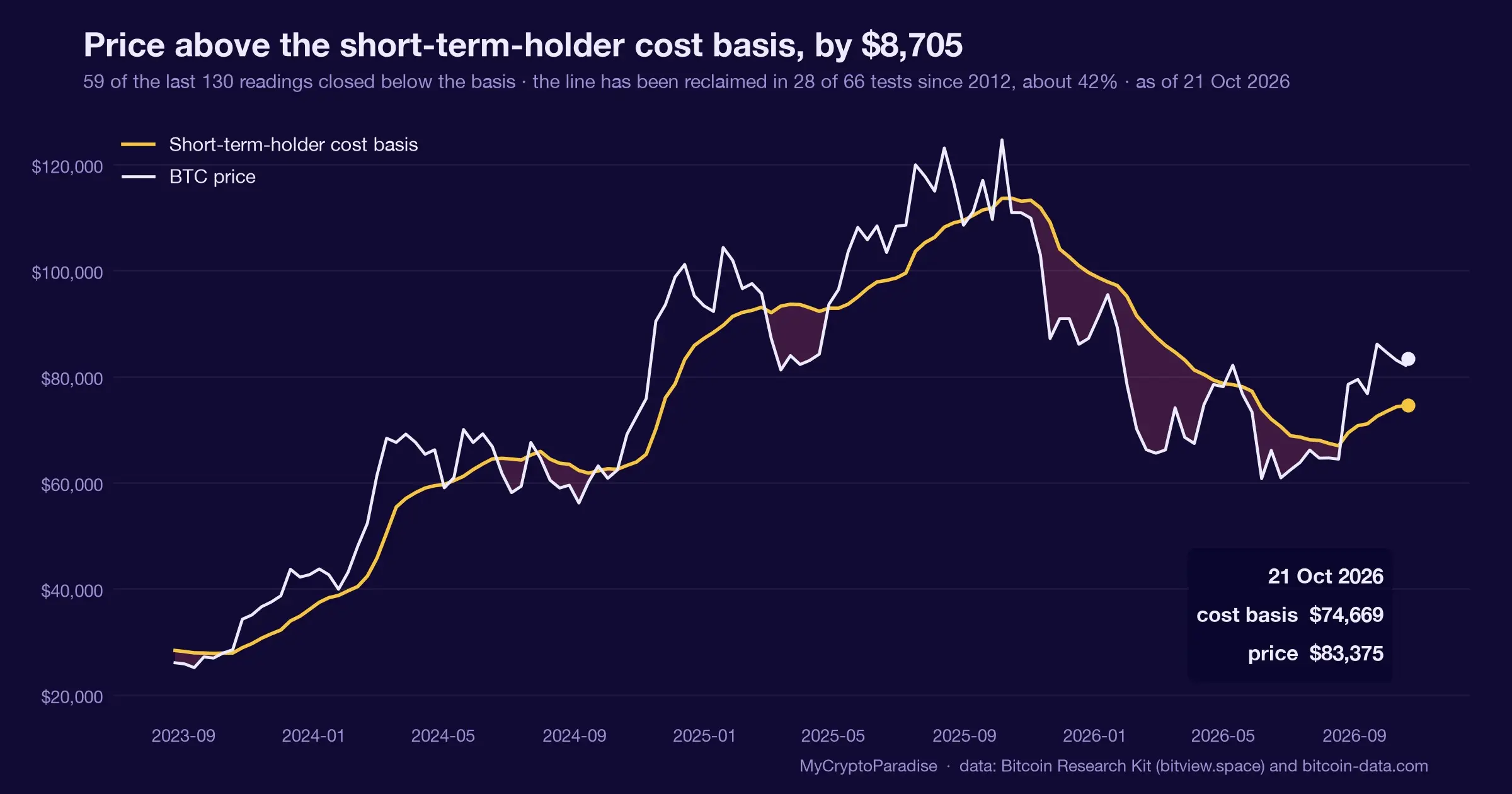
The ParadiseTeam frames this as a slow structural positive layered onto a tape that is still fighting its own battle. BTC traded near $81,547 as the report landed, parked right on the $80,000 to $81,000 zone that marks the 0.618 retracement. That is the line that matters now.
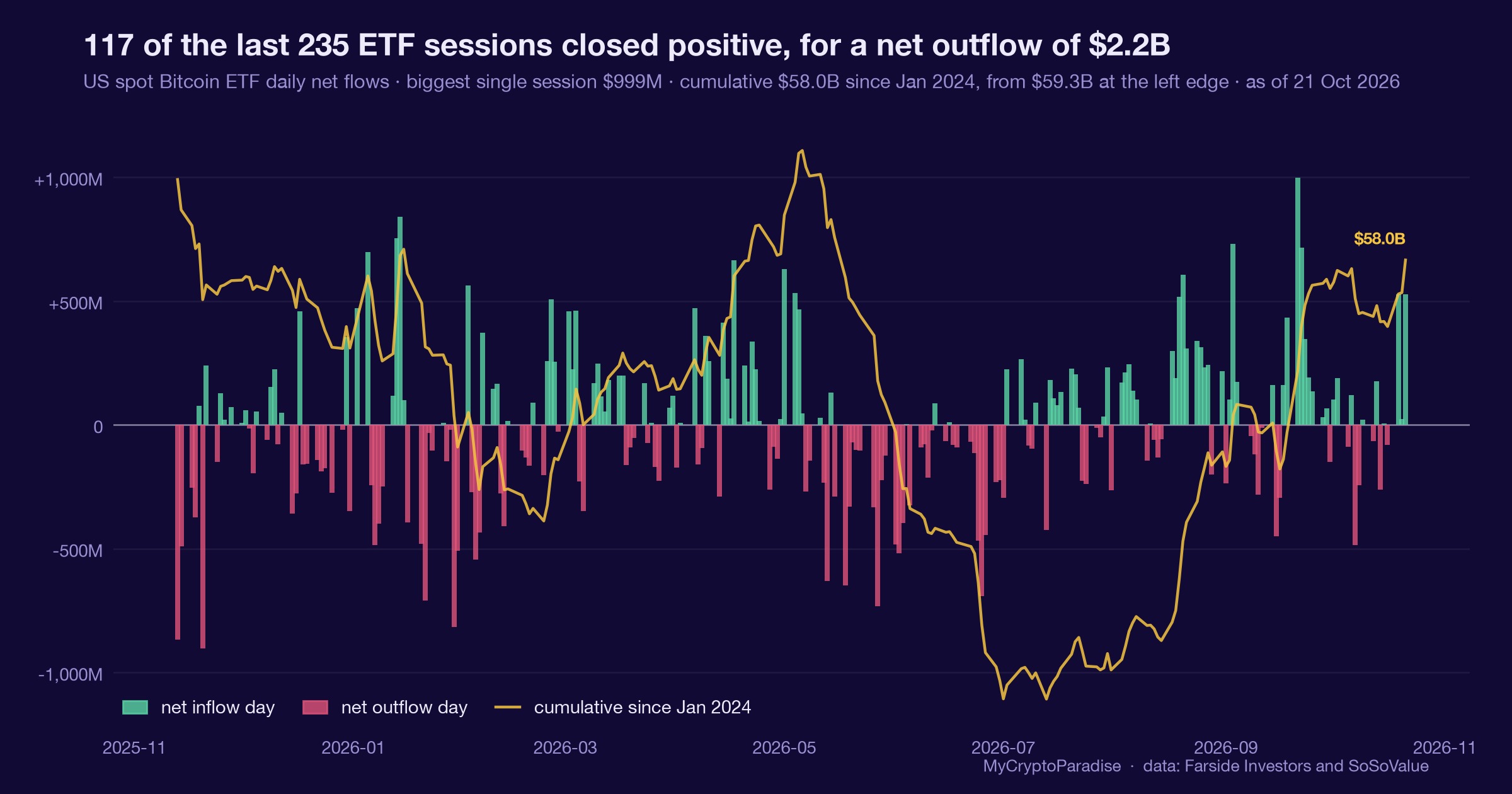
This news does not defend that level. On-chain data does. Right now smart money is absorbing supply, with roughly 56% of tracked flow buying while retail stays fearful and sidelined. A sovereign-demand headline simply gives that accumulation a longer story to lean on.
Hold the structure and $79,000 becomes the hinge. Lose it as support and the higher-timeframe picture cracks. Reclaim it cleanly and the path toward $85,300 and $90,000 reopens.
We stay honest about the bigger map. On high timeframes our bias remains cautious, with a scenario that reaches toward the $44,000 region still on the table. A long-dated adoption narrative does not erase that risk.
Strength into $85,300 or $90,000 is where we would expect sellers to reappear. Good news into resistance often becomes exit liquidity for the patient. So the read is layered, not contradictory. Near term, smart money is quietly buying fear at support, and this story feeds that. Longer term, we respect the downside and treat rallies into resistance with suspicion, not euphoria.
The read behind this: we framed this story through our own market analysis, Can Bitcoin Still Make a Higher High?
Track it live: our live crypto funding rates and the Crypto Fear and Greed Index both update in real time, so you can watch this shift for yourself.
Related coverage
For exact entries, targets, and stop losses with full risk management, that is what ParadiseFamilyVIP is for. New to reading these moves? Start with our crypto trading strategies guide.
ParadiseTeam is monitoring the market situation closely, and we are taking these developments into consideration while building our trading tactics inside ParadiseFamilyVIP.
Crypto trading involves substantial risk. Prices are volatile and you can lose money. This article is educational and is not financial advice. Past performance does not guarantee future results.
Will more states turn to crypto to counter sanctions this cycle?
This is how 3 Paradisers are calling it. Tap your call.
No calls on this one yet. Tap yours to be the first.
Free account, no password. Members just sign in.









Join the discussion
No comments yet. Members, share how you are reading this.