

Listen: the breakdown
Developing story update (November 09, 2026, 02:53 UTC):
Hut 8 has now attached a concrete number to the AI expansion: the company says it fully commercialised its Beacon Point campus by signing a second 352 MW lease. That turns the earlier headline into a committed, revenue-bearing hosting footprint rather than an unquantified ambition.
For traders the read is unchanged in direction: this is a balance-sheet and capital-return choice, with Bitcoin sale proceeds funding buybacks, not evidence of bearish conviction on BTC. BTC is near $75,200 and shows no discernible move tied to the news, and based on our sources there is no clear retail or whale reaction linked specifically to it.
What to watch now: Whether the dollar value of the BTC sales funding buybacks is disclosed, which would show if any supply reaches the market.
Developing story update (November 09, 2026, 01:50 UTC):
Hut 8 has now confirmed the specifics behind the AI campus story: it says it fully commercialised its Beacon Point site by signing a second 352 MW lease, firming up the earlier, vaguer talk of expanding commitments.
The company is funding part of its share buyback through sales of its own Bitcoin holdings. For traders, this stays a corporate capital-allocation move rather than a broad market signal: BTC’s price action in the window was negligible, so there is no evidence of distribution pressure tied to this specific sale.
What to watch now: Watch whether further confirmed Bitcoin sale sizes or additional lease disclosures emerge from Hut 8.
Market briefing: Hut 8 just fully commercialised its Beacon Point AI campus with a second 352 MW lease, while funding share buybacks partly by selling Bitcoin. BTC traded near $75,236, down about 0.7% on the day, with no visible reaction to the news.
- Hut 8 signed a second 352 MW lease, fully commercialising its Beacon Point AI campus and lifting aggregate base-term contract value.
- The company is funding share buybacks partly by selling Bitcoin from its treasury, a small company-level source of sell-side supply.
- BTC sat near $75,236, down 0.66% on the day, with no attributable price reaction to this corporate story.
Hut 8 is selling Bitcoin to fund buybacks while its AI campus fills up. So is this miner diversifying away from BTC, or quietly handing the exit to someone else?
Hut 8 just told the market two things at once. It fully commercialised its Beacon Point AI campus with a second 352 MW lease. And it is funding share buybacks partly by selling Bitcoin from its own treasury.
That second lease matters on paper. It lifts the aggregate base-term contract value across the company's AI leasing business. In plain terms, more of the campus is now under long contract, which is the diversification story every miner wants to tell this cycle.
The wrinkle is the funding. A Bitcoin miner is now treating its stack of coins as a corporate piggy bank, selling them to buy back its own shares.
We covered a near-identical move earlier today from Riot, which sold over 20,000 coins to fund AI contracts. Hut 8 extends that thread rather than starting a new one. What is new here is the mechanism: the Bitcoin is leaving the treasury not to build datacenters, but to shrink the share count.
There is a certain honesty in it. For years these firms sold the idea that holding Bitcoin on the balance sheet was the whole point. Now the balance sheet is a place to raise cash from.
None of this moved spot. BTC traded near $75,236 as of the data in hand, down about 0.66% on the day, showing no reaction we can pin to this story. This is a single company decision, not a market-wide liquidity event, and we want traders to read it as exactly that size.
Miners turning their Bitcoin into cash
The transmission here is small, and we will say so plainly. One mid-cap miner selling treasury Bitcoin to fund buybacks does not shift aggregate market liquidity. It is incremental sell-side supply from a single balance sheet, not a signal about where the whole market is headed.
But the pattern underneath is worth a trader's attention. More than one miner is now monetising its Bitcoin stack for corporate finance needs, independent of spot price. When a company buys back shares, it is telling the world those shares are cheaper than the alternatives. Funding that with Bitcoin says, at least at the margin, that the coin is the thing to spend.
That is a quiet shift in who holds coins and why. The treasury Bitcoin narrative was always part conviction, part marketing. The marketing survives in the press release; the conviction is what gets sold when cash is needed.
Stacked across the sector, these decisions add a slow, structural drip of miner supply into the market. No single sale is large. The direction is one way.
For Hut 8 specifically, the AI lease is the real commercial positive. It pulls revenue away from pure mining and toward contracted datacenter income. That is the part that strengthens the company. The Bitcoin sale is the funding tool, not the strategy, and the two should not be confused when you read the headline.
A drip of supply the tape ignores
On price, this barely registers, and that is the point. BTC sat near $75,236, down 0.66% on the day, with no move we can attribute to Hut 8. A company-level treasury sale of undisclosed size is noise against daily spot volume.
So the BTC read is simple: a small, one-way drip of miner supply, far too minor to bend the trend by itself. It does not rescue bulls and it does not break bears. It is a background flow, not a catalyst.
For ETH and the broader alt complex, the pass-through is effectively zero. This is a Bitcoin miner selling Bitcoin to buy its own equity. There is no credit event, no leverage unwind, no liquidity shock to cascade down the risk curve.
Where it does matter is cumulatively. If you are tracking supply pressure, miner treasuries have shifted from holders to occasional sellers. That changes the character of the float over months, not hours.
The honest market-impact verdict is neutral. The AI leasing growth is good for the company and irrelevant to spot. The Bitcoin sale nudges supply the wrong way for bulls, but at a scale the tape cannot feel. Those two forces roughly cancel for a trader positioning in BTC today.
Treat it as information about sector behaviour, not a reason to change a position. The driver here is corporate, and it stays corporate all the way down the chain.
Signs the miner selling habit spreads
The thing to watch is not Hut 8's next candle. It is whether this becomes a sector habit. We have now seen two miners in one day fund corporate needs by selling treasury Bitcoin, and clusters like that are how a pattern confirms.
Watch for disclosed sale sizes. Our research gives us no figure here, which keeps the supply impact unknowable and small. If future filings start quantifying large treasury draw-downs, the drip becomes something worth modelling.
Confirmation that this is structural looks like more miners announcing buybacks funded by Bitcoin, quarter after quarter. Invalidation looks like the opposite: miners pausing sales, or raising cash through equity and debt instead of touching the stack.
On the AI side, watch whether contracted leases actually convert to recognised revenue. A signed lease is a promise. The commercial positive is real only when the campus is powered, occupied and paying. The gap between a glossy lease announcement and booked cash is where a lot of this cycle's optimism lives.
For the coin itself, keep your eye on the market-structure levels, not this story. BTC near $75,236 is doing its own thing. A single miner's buyback plan will not decide whether support holds.
So the tell is simple. One company selling Bitcoin for buybacks is a footnote. A dozen doing it, with real numbers attached, is a slow supply story. Until the numbers arrive, it stays a footnote.
What steady miner sales mean for supply
The ParadiseTeam reads this as a corporate footnote, not a reason to trade. On its own facts it is neutral: good AI news for Hut 8, a small Bitcoin sale against it, and nothing the broad tape can feel.
Set it against where price actually sits. BTC was trading near $75,236 as of the data in hand, just under the $76,000 support that marks our invalidation line. That level, not a miner buyback, is what matters for positioning right now.
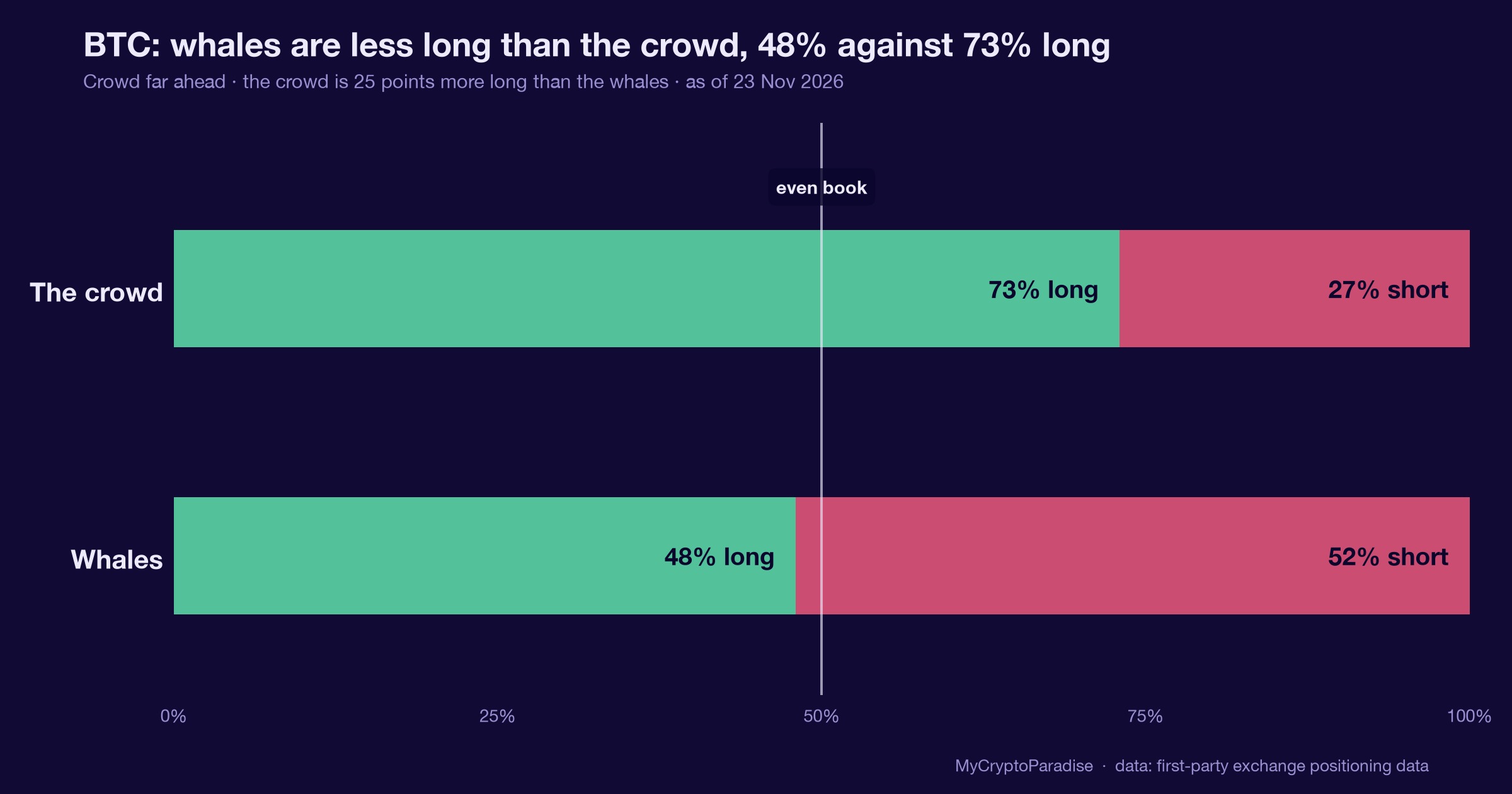
Our standing read is a tug-of-war. Whales have been net buying the dip over the past 24 hours, absorbing sell pressure, while the Fear and Greed index sits near 20. A trickle of miner supply from Hut 8 is exactly the kind of flow that patient accumulation quietly soaks up. So we do not let this story move our map. The path of least resistance still leans toward a possible short-covering squeeze toward the $81,700 to $82,500 liquidation cluster, where over 2 billion in shorts sit exposed.
Below, the $70,000 to $71,000 band is the downside magnet if $76,000 fails to reclaim on rising volume.
Remember the bigger frame, though. That squeeze, if it comes, is relief inside a dominant daily and weekly bearish structure pointing toward $44,000 eventually. We treat strength as a chance for shorts to get hunted, not proof of a trend change. Miner sales like this one are a slow headwind, never the trigger.
The read behind this: we framed this story through our own market analysis, Bitcoin Squeeze to $82K or Crash to $44K?
Track it live: our live crypto funding rates and the Crypto Fear and Greed Index both update in real time, so you can watch this shift for yourself.
Related coverage
For exact entries, targets, and stop losses with full risk management, that is what ParadiseFamilyVIP is for. New to reading these moves? Start with our crypto trading strategies guide.
ParadiseTeam is monitoring the market situation closely, and we are taking these developments into consideration while building our trading tactics inside ParadiseFamilyVIP.
Crypto trading involves substantial risk. Prices are volatile and you can lose money. This article is educational and is not financial advice. Past performance does not guarantee future results.
Do miners selling treasury Bitcoin for buybacks become a real supply story?
How 31 Paradisers are calling it
The first call is still open
Free account, no password. Members just sign in.





Join the discussion 26
ok but the bit about the AI campus being the reason this is fine is what gets me 🤔 a miner dumping its bitcoin to chase AI sounds less like confidence and more like someone heading for the exit 😬
liam the exit read is fair but a miner funding buybacks while the campus is still ramping could also just be a timing thing, so i'd want to see whether the sold btc keeps flowing out over the next few monthly hashrate and treasury prints before calling it either way
Fair read on the exit angle. I'd also ask how the mining book holds up if the campus fills slower than planned, since that decides whether the coin sales are a bridge or a habit.
yeah and the AI campus being "fine" doesnt really answer why they need to sell the coins to buy back stock.... if the campus is that strong, the coins would be the thing to hold 😬
and when i pulled up their filings the buyback line only looked sane because the bitcoin was sitting on the books at market, so id want to see how much of that cash is coming from fresh mined coins versus the treasury they already hold
Ahmed, the filings question is fair, but I'd flip it. Before we ask where the cash comes from, what's the plan if the treasury gets drawn down and the miner's margins compress at the same time? Which risk limit triggers the sale, and who checks it?
that treasury vs fresh coins split is what i'd want to see too.... also wondering if the buyback timing lines up with when the campus capex lands, or if i'm overthinking it 🐶
so if the miner is selling coins to buy back its own stock, who is actually absorbing the sell pressure here? the buyback side makes sense to me but the miner dumping its own bitcoin to do it feels like shifting the risk to the open market, not removing it. might be missing something!!
Rahul, I'd see it as the risk moving to whoever is buying the stock back, not the market in general 🤔 The miner sells BTC to the open market, and the buyback fills from shareholders who chose to sell. Where do you think the pressure really lands? 👀
the miner selling bitcoin to fund buybacks is the part i keep staring at, because when a miner sells coins to retire stock instead of holding them, you usually see it in exchange inflow data a few weeks before the filings catch up. curious if anyone has pulled the on-chain transfers to hut 8 wallets yet
Sorry if this is obvious!! but Mei, do you think the exchange inflow data would show up before the filings, or would the timing be too messy to read? I'm still learning how to tell those apart.
hmm i'd push back a bit mei, exchange inflows could just as easily be paying down debt or funding the AI build-out 🤔 timing alone doesnt prove the buyback link till the filings show the use of funds 👀
honestly what I watch is whether the campus lease income keeps pace with the coins going out.... my wife thinks I'm reading a tax form when I check the treasury numbers at dinner
ok but i watch the tenant announcements more than the BTC sales tbh 👀 after the farm that rugged on me in 2021 i wanna see who is actually paying rent for that campus 🤔!!
every time a miner sells coins to cover buybacks i end up thinking about it in sats, like how many thousand sats a share is actually backed by after the sale. still reckon they'd have been better off holding, but thanks for the write up.
so the buyback is funded by coins they just mined, but how long can a miner keep doing that before the coins it sells are the only thing keeping the stock up. asking bc i dont really know where that line is
Sorry if I'm missing something obvious.... but I thought I understood the miner side until I read this. Hut 8 selling bitcoin to buy back its own shares is wild to me, I keep thinking about my old forklift crew, who always said you don't sell your own tools to pay for a shiny new rack 😅
What I watch is whether campus revenue covers the buyback before the coin sales taper off, since that tells me which one is actually funding the other.
Lukas, I'd flip it. Campus revenue is still a forecast, while the Bitcoin sales are happening now, so the coins are the funding source until the lease income proves otherwise.
Lukas, the bit I'd add is the taper timing 👀 if campus revenue lags the sales, the buyback is basically running on the coins they already mined, and that's when I start getting nervous 📉
ok so i teach 4 year olds and when one kid trades their snack for a bigger toy i have to explain it really slowly.... my question is whether the ai campus is paying them back yet or just looks nice on the slide 😅
wait where do they actually say how many coins get sold per month, or is it just whenever the buyback needs cash? id want that written down before i trust any of the ai campus numbers
honestly the part that gets me is "funding buybacks" with the coins they just mined, like the miner is basically paying shareholders in its own bitcoin?? i'm not sure that's the same thing as the campus being the actual business 🤔
yuki yes and the buyback math only works if the btc sold is cheaper to hold than the ai revenue is to build, which is a bet on the campus not the miner!! 🤔
Not sure its the campus that matters most here yuki. Buybacks funded by selling coins is still a sale, and the question for me is whether the campus revenue is covering the sell pressure or just sitting next to it.
Yuki, I see the buyback thing as the same kind of move, just with a different receipt. Whether the coins came from mining or a treasury, the shareholders still get the value, so the real question is whether the campus earns it back 😅