


Listen: the breakdown
Market briefing: The Fluidkey hack traced $1.58M lost to a logging-tool flaw that fired transfers the moment users opened the app. BTC sat near $58,527, down 5.6% on the day, but that selloff runs separate from this contained incident.
- $1.58M traced stolen after a Fluidkey logging-tool flaw
- Attacker triggered transfers simply when users opened the app
- Private keys stayed on devices, yet the funds still left
The Fluidkey hack just traced $1.58M gone, and the twist stings. Private keys never left user devices, yet the money still moved out. So what actually failed here?
The Fluidkey hack has traced $1.58M in stolen funds. The cause was not a cracked private key. It was a flaw in a logging tool.
That flaw let an attacker trigger transfers whenever users simply opened the app. No seed phrase leaked. No device was seized. The keys stayed exactly where they belonged, on the users' own hardware, and the money still walked out the door.
This is the uncomfortable part for the self-custody crowd. The comforting creed says not your keys, not your coins. Fluidkey users held their keys the whole time. It did not save them, because the weakness lived one layer up, in the app and its logging, not in the vault itself.
So the loss is real and the trust damage is real. But the scale is small. A $1.58M exploit against a single privacy-wallet tool is a contained event, not a systemic one.
The backdrop makes that easy to forget. BTC was trading near $58,527 at the time of writing, down 5.6% on the day, with ETH off 7.2%. The whole market was bleeding.
It would be tidy to pin that drop on the hack. It would also be wrong. The selloff dwarfs this incident by orders of magnitude and clearly pre-dates it. We see no single confirmed catalyst behind the wider move, so we will not manufacture one. The Fluidkey story and the macro drawdown are running on two separate tracks.
When keys stay home but money leaves
The lesson here is about trust, not liquidity. The self-custody model rests on one promise: control your keys and you control your coins. Fluidkey users did exactly that, and an app-layer flaw still moved their funds.
That matters because it shifts where the risk actually sits. The threat was not someone stealing a seed phrase. It was ordinary software behaving badly while users did nothing more dangerous than open an application they trusted.
For the broader market, the transmission is thin. $1.58M does not ripple into exchange flows or global liquidity. It will not bend a funding rate. On its own, this event changes nothing about the macro picture driving BTC and ETH lower.
Where it does carry weight is sentiment around lightweight wallet tools. Every app-layer exploit chips at confidence in the convenient, newer products people reach for. Retail tends to read a single headline and quietly assume the whole category is fragile.
That is the real second-order effect. Fear about tooling compounds fear about price, even when the two have nothing to do with each other. A nervous holder in a down market does not parse the difference between a niche logging bug and a systemic break.
So we treat this as a reputational negative for one tool and a sharp reminder for everyone running similar lightweight wallets. Self-custody protects the key. It does not automatically protect the app wrapped around it.
A $1.58M loss that stayed contained
Read against the tape, this hack barely registers. BTC near $58,527 and ETH near $1,616 were both sliding hard on the day, and neither move needs a $1.58M wallet-tool exploit to explain it. So there is no cascade to trace from here into BTC. The stolen funds are a protocol-level loss, not a market-wide one. We see no evidence the incident touched exchange order books or forced any wider deleveraging.
ETH tells the same story. Its 7.2% drop is part of the broad risk-off session, not a reaction to a privacy-wallet bug most traders had never priced in. The correlation people might reach for simply is not there.
Alts inherit the macro weakness, as they always do when BTC and ETH fall together. That weakness is top-down and liquidity-driven. It is not flowing up from a single niche tool losing a modest sum.
The honest framing is that this is a bearish footnote inside a bearish day, and the two are only sharing a calendar. The hack dents trust in one corner of the self-custody world. The selloff is doing its own, far larger thing elsewhere.
Where the event can still bite is confidence. If holders of comparable wallet tools start pulling funds to colder storage, you get small, scattered outflows from the convenience layer. That is a behavioural drip, not a liquidity shock, and it stays well inside the margins of a market already moving on bigger forces.
Where the damage could still spread
The first thing we are watching is containment. The claim is a single logging-tool flaw inside one product. If that holds, the story stays small and fades fast.
The invalidation would be scope. If the same class of flaw turns up in other lightweight wallet tools, this stops being a Fluidkey problem and becomes a category problem. That is the version worth real attention.
We also want to see what happens to the traced funds. Tracing is not recovery. Stolen crypto that has been followed on-chain still has to be frozen or returned, and plenty never is.
Any official response from the tool itself matters too. A clear post-mortem, a patch, and a credible account of how transfers fired on app-open would limit the reputational bleed. Silence would do the opposite.
On the macro side, confirmation and invalidation are simpler. If the broad selloff keeps running without any thread back to this hack, our read that the two are unrelated holds. If, improbably, the exploit widened into something that spooked exchange flows, we would revisit that. We do not expect to.
The practical watch item for traders is behaviour, not price. Watch whether nervous users in a falling market start migrating off convenience wallets toward hardware storage. That would be the only measurable market footprint this event leaves, and even then a faint one.
Until then, we file it as a security negative that stays in its lane.
Why this hack barely moves the tape
The ParadiseTeam view is blunt: do not let a $1.58M headline distract from the fight that actually matters right now. This hack does not move a single level we care about on BTC.
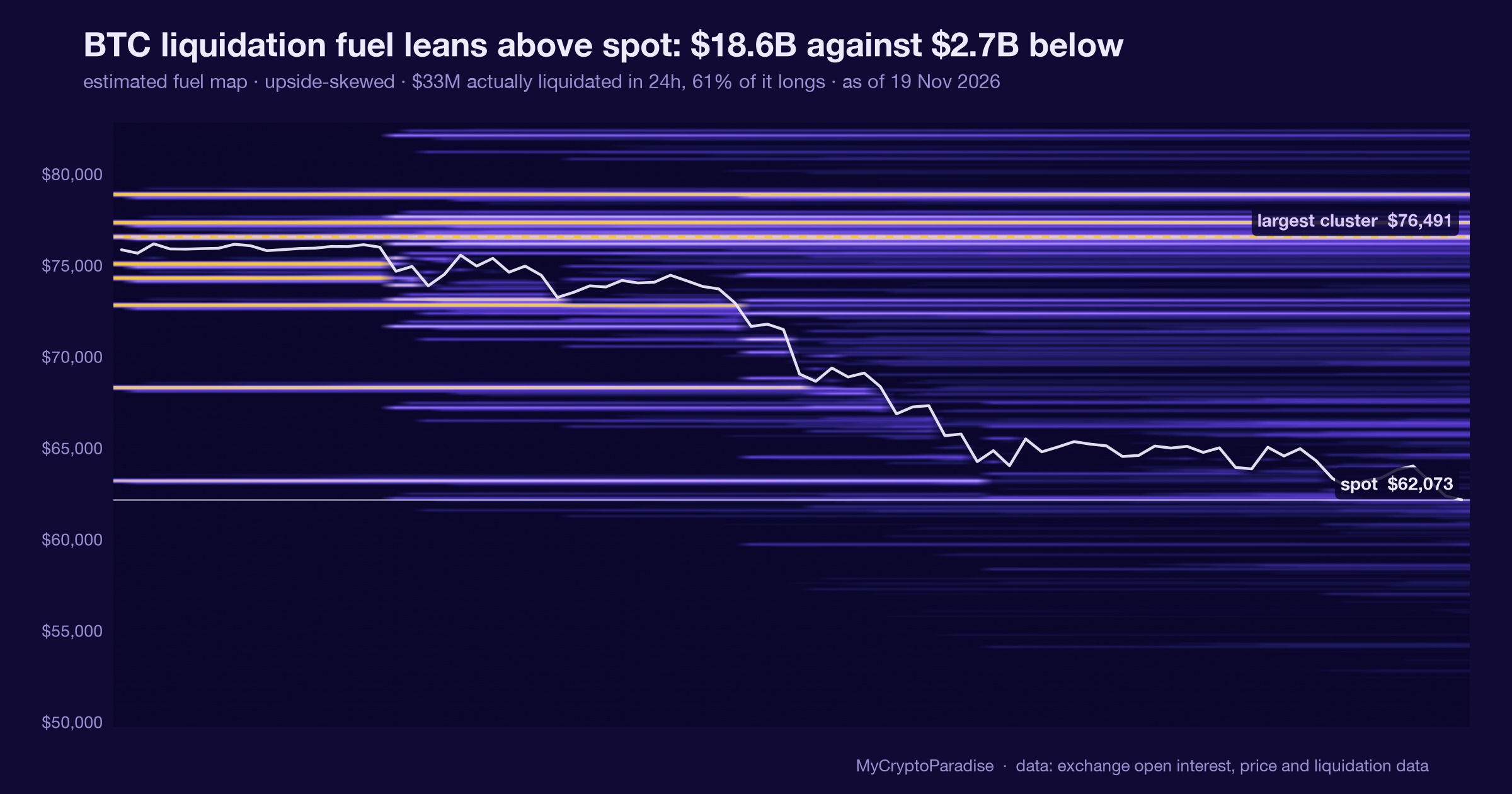
The real battle is at structure. The $62,000 zone that whales defended twice has given way for now, and BTC was trading near $58,527 at the time of writing, sitting between that lost support and the $55,000 to $44,000 exchange-of-hands area below. That is where smart money versus retail plays out, not in a privacy-wallet bug. Whales were absorbing supply at support while retail capitulated into shorts after chasing the selloff lower. A relief squeeze stays plausible if enough shorts stack up above price.
But we hold our standing caution. The higher-degree trend is still a downtrend below major resistance, so any bounce is fuel for a relief move, not proof of reversal.
Confirmation of a genuine turn still needs an impulsive push and a reclaim back through resistance toward $64,700 with real volume. Without that, strength keeps meeting sellers.
So here is the clean separation. The Fluidkey hack is a trust story for one tool and a reminder to check your own app layer, nothing more. The macro drawdown is the thing on the screen that will pay or cost you. Trade the levels, not the sideshow, and keep risk small while price works out whether $55,000 holds.
The read behind this: we framed this story through our own market analysis, Bitcoin Traders Turn Bearish at $62K Support.
Track it live: our Crypto Fear and Greed Index and the live crypto funding rates both update in real time, so you can watch this shift for yourself.
Related coverage
For exact entries, targets, and stop losses with full risk management, that is what ParadiseFamilyVIP is for. New to reading these moves? Start with our crypto trading strategies guide.
ParadiseTeam is monitoring the market situation closely, and we are taking these developments into consideration while building our trading tactics inside ParadiseFamilyVIP.
Crypto trading involves substantial risk. Prices are volatile and you can lose money. This article is educational and is not financial advice. Past performance does not guarantee future results.
Will app-layer flaws like Fluidkey's push users off lightweight wallets?
How 1 Paradiser is calling it
The first call is still open
Free account, no password. Members just sign in.












Join the discussion
No comments yet. Members, share how you are reading this.