


Listen: the breakdown
Developing story update (November 21, 2026, 00:14 UTC):
AI Investment Concerns Trigger Market Selloff as Nasdaq 100 Posts Worst Week Since 2020
based on our sources U.S. stocks tumbled on November 20 as concerns over the sustainability of AI investment, slowing data center expansion and tech earnings prospects intensified. The S&P 500 fell 3.7%, marking its seventh consecutive daily decline and entering correction territory. The Nasdaq 100 dropped 5.6%, posting its worst weekly performance since March 2020. Nvidia plunged 14%, while a semiconductor stock index fell 11%.
The selloff spread to cryptocurrencies, precious metals and emerging markets. Bitcoin declined 5.1% to approximately $58,333, Ether fell 8% to $1,601, and spot gold dropped 2.8%. The U.S. 10-year Treasury yield declined 11 basis points to 4.93%. Analysts said the market downturn reflected investors reassessing the pace of AI infrastructure development, financing prospects for related projects and expectations for tech earnings growth.
Market briefing: Bitcoin was trading near $58,818, down about 5.2% on the day, after sliding to a reported four-month low. The same day, Anthropic staged a record stock debut and a high-profile fund bought over $90 million of its shares.
- BTC fell to a reported four-month low on a third straight down day
- Anthropic's record stock debut drew more than $90 million from one fund on day one
- A U.S. Senate bill trimmed prediction markets, adding to a risk-trimming mood
Source: U.S. Senate
Bitcoin slides to a four-month low while Wall Street throws cash at Anthropic. Is crypto quietly losing the race for speculative capital right now?
Bitcoin printed a reported four-month low this session. Price was trading near $58,818 as of the latest read, down roughly 5.2% on the day. That marks a third straight down day, and the tape feels heavy.
The backdrop made the drop louder. The same day, Anthropic staged a record stock-market debut. A high-profile fund bought more than $90 million of its shares on day one of trading.
Capital, it seems, found a shinier place to be.
Separately, the U.S. Senate passed a bill banning prediction markets from offering bets on death and war. It is a narrow regulatory item, not a crypto rule. But it lands inside a broader mood of trimming speculative avenues.
Here is the honest part. None of these three headlines is crypto-specific. An AI equity debut, a fund's purchase, and a prediction-market bill do not obviously explain a Bitcoin-specific slide.
So we will not pretend they do. What we have is a cluster of loud headlines arriving around an already-weak tape. That is a coincidence of timing, not a confirmed single catalyst, and we will frame it that way.
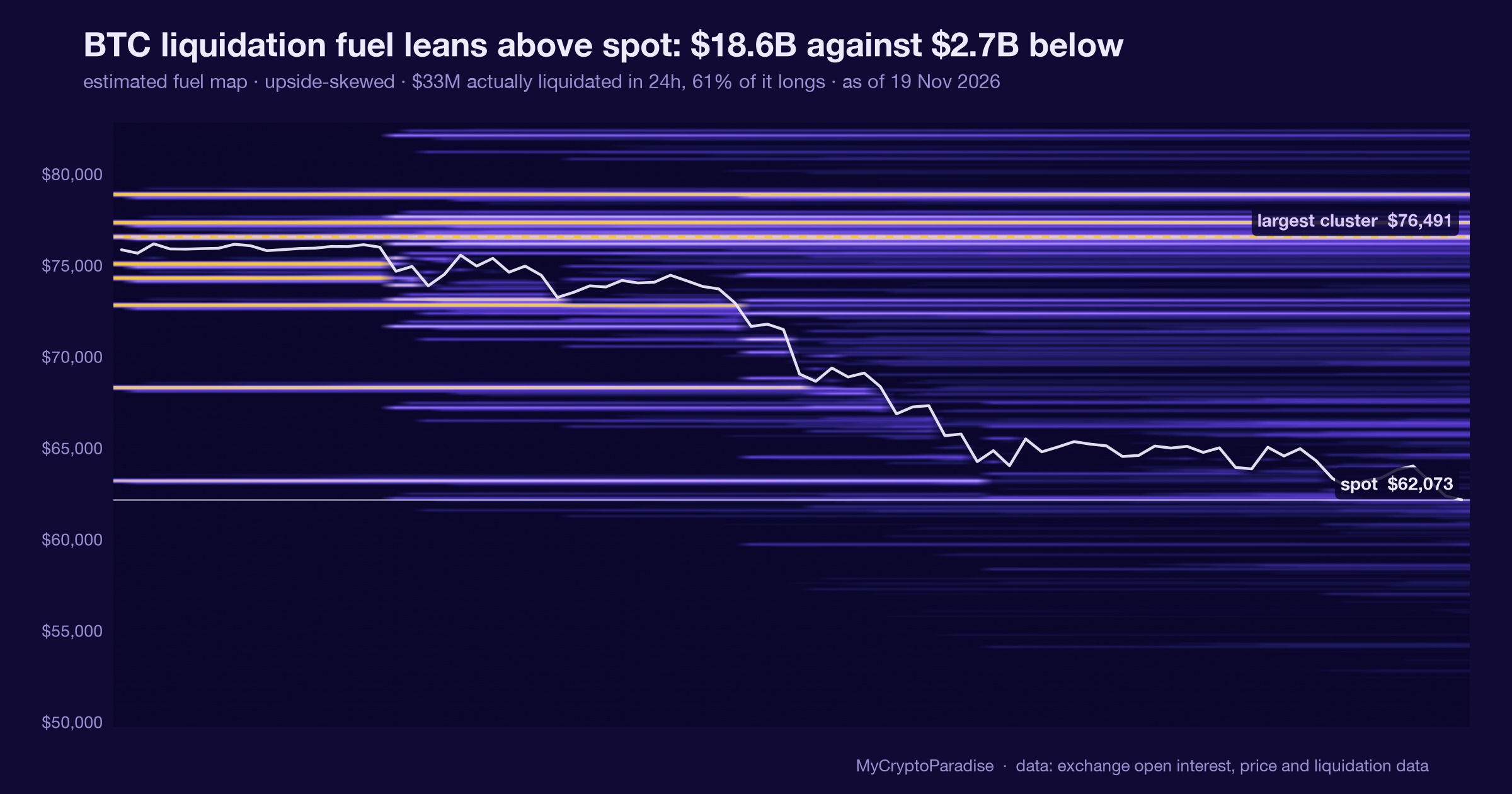
Structurally, the move still matters. The reported decline would carry price through the $62,000 zone that many had described as defended by large buy walls. If this low is real and holding, that zone failed to hold on this occasion. The question now is whether the floor returns, or whether sellers keep the initiative.
Why risk capital drifted away from crypto
The mechanism here is attention and capital, not a direct shock. A blockbuster AI debut gives speculative money a fresh, exciting story. When one fund commits over $90 million on day one, it signals where the hot flow wants to sit.
That matters for crypto because speculative capital is finite in the short run. It chases the loudest narrative. Right now that narrative wears an AI equity badge, not an orange coin.
So the transmission runs like this. A hot equity story pulls risk appetite toward Wall Street. Crypto-specific liquidity thins as attention rotates. A thinner bid lets ordinary selling push price further than it would on a deep tape.
The Senate's prediction-market bill reinforces the tone. It does not touch Bitcoin directly. But it trims the menu of speculative outlets, and it signals a climate less friendly to pure gambling on outcomes.
Taken together, the read is less a crypto crisis and more a reallocation. Risk money has other shiny places to go.
That distinction is the whole point. A reallocation can reverse quickly when the new story cools. A genuine fundamental shock does not. Markets routinely confuse the two, usually at exactly the wrong moment. For traders, the task is to avoid treating a rotation of mood as proof that Bitcoin's structure has broken.
How the slide ripples from BTC to alts
Bitcoin led the move lower, and that order matters. BTC sets the risk tone for the whole asset class. When the leader prints a four-month low, the rest rarely escapes.
ETH tends to follow BTC on these risk-off legs, often with a slightly sharper beta. A third down day in Bitcoin usually drags Ether through its own nearby support. The capital that leaves BTC does not rotate into ETH here, it leaves crypto entirely.
Alts sit at the end of the chain, and they feel it most. Thin books mean small sells move them hard. When the speculative crowd is busy buying an AI debut, the marginal alt bid simply is not there.
The absence of a clean catalyst is itself a signal. This looks like distribution into a weak tape, not a single violent event. Price slid through the $62,000 zone that buyers had defended, rather than the zone absorbing the selling.
That is the bearish tell on this specific leg. We see no gathered evidence of accumulation behind this move down. Sentiment around it reads mixed, not conviction in either direction.
So the near-term impact leans lower-for-longer until proven otherwise. A reclaim of lost ground would change the picture. Absent that, every bounce risks meeting fresh supply from holders who wanted out higher and now take the exit they can get.
What tells us the low holds or fails
The first thing to watch is whether the reported four-month low actually holds. A low is only a floor once price stops making new ones. One session does not confirm a bottom.
Confirmation would look like a reclaim of the $62,000 zone with real buying behind it. We want to see bids absorb supply, not just a thin wick up. Open interest, meaning the total of outstanding positions, should build on longs that survive a retest, not on chased entries that liquidate fast.
Invalidation of any recovery is simpler. Continued lower lows, and a clean failure to reclaim $62,000, keeps sellers in charge. That would open the road toward the deeper $55,000 area and below.
Pay attention to funding too. If retail keeps piling into shorts after the fall, the market can hunt those stops with a squeeze higher. That squeeze is a relief move, not a trend change, until structure proves otherwise.
Also watch whether the AI equity story keeps commanding the headlines. If that attention cools, speculative capital can drift back toward crypto. If it stays loud, the rotation pressure persists.
The clean tell is behaviour at the reclaimed level. Bitcoin reclaiming $62,000 and holding it tells one story. Losing $55,000 tells the opposite. We let price settle that, rather than guess ahead of it.
What the four-month low signals for liquidity
The ParadiseTeam reads this through smart money versus retail, and the honest answer is that this leg lacks a clean accumulation signal. Our standing lens had whales defending $62,000 with long-standing buy walls. On this move, price slid through that zone instead of being absorbed there. So we treat $62,000 as a level that failed on this occasion, not one confirmed to be holding. With BTC near $58,818 at the latest read, the defended floor sits above price, now acting as overhead supply.
That flips the burden onto buyers. To rebuild the bullish case, they need to reclaim $62,000 and then press toward the $64,700 resistance node. Until that happens, strength likely meets sellers who were trapped higher.
There is still a short-term squeeze risk, and we respect it. Our lens flagged retail capitulating into shorts as funding softened. If enough shorts stack above price, market makers can run them higher in a sharp relief move.
We would fade the temptation to call that a reversal. The higher-degree structure stays bearish while price trades below major resistance. A short squeeze inside a downtrend is fuel, not a trend change.
The invalidation of the bearish structure is specific. We want a five-wave impulsive push reclaiming $64,700 with expanding volume. Absent that, the deeper $55,000 to $44,000 area remains on our map. This is analysis, not advice.
The read behind this: we framed this story through our own market analysis, Bitcoin Traders Turn Bearish at $62K Support.
Track it live: our live crypto funding rates and the Crypto Fear and Greed Index both update in real time, so you can watch this shift for yourself.
Related coverage
For exact entries, targets, and stop losses with full risk management, that is what ParadiseFamilyVIP is for. New to reading these moves? Start with our crypto trading strategies guide.
ParadiseTeam is monitoring the market situation closely, and we are taking these developments into consideration while building our trading tactics inside ParadiseFamilyVIP.
Crypto trading involves substantial risk. Prices are volatile and you can lose money. This article is educational and is not financial advice. Past performance does not guarantee future results.
Does BTC reclaim $62K before it loses $55K?
Settles on BTC's first hourly close above $62,000 or below $55,000, at the latest Sat 28 Nov.
How 1 Paradiser is calling it
The first call is still open
Free account, no password. Members just sign in.
An education game, not trading advice.










Join the discussion
No comments yet. Members, share how you are reading this.