


Listen: the breakdown
Market briefing: US spot Bitcoin and Ether ETFs have seen nearly $1 billion in outflows, erasing October's initial gains. Bitcoin was trading near $82,497 as of the latest data, reflecting significant institutional capital flight amidst a challenging macro environment.
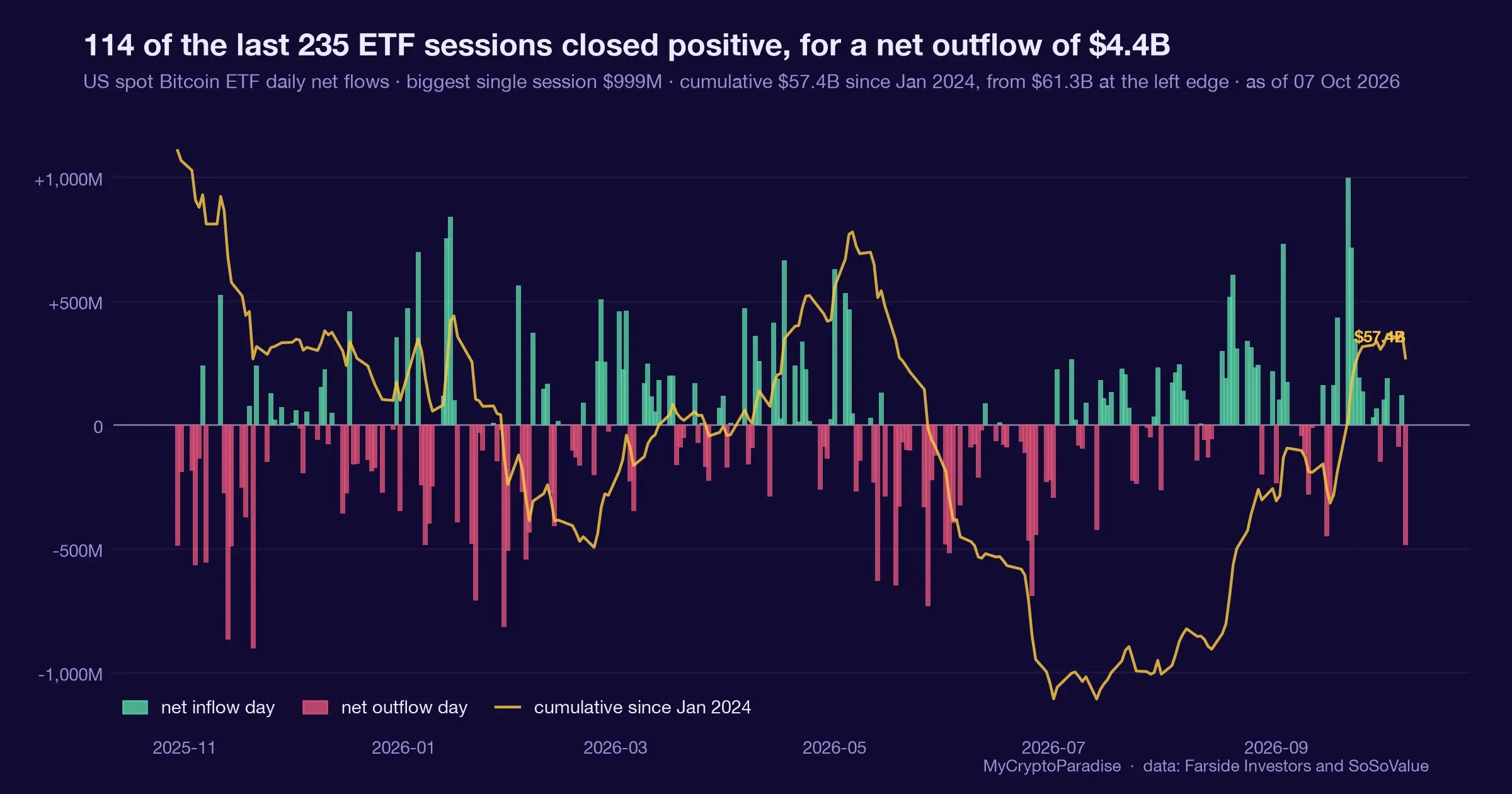
- US spot Bitcoin ETFs recorded $484.9 million in net outflows on October 8, the largest since June 25.
- These outflows erased all October inflows, pushing Bitcoin ETFs to approximately $163 million in net monthly outflows.
- US spot Ether ETFs saw $160.9 million in withdrawals on October 7, extending their outflow streak to seven sessions.
US spot Bitcoin and Ether ETFs are facing substantial outflows, nearing $1 billion and wiping out all October inflows. Is institutional capital exiting the crypto market?
US spot Bitcoin ETFs recorded a significant $484.9 million in net outflows on October 8. This marked the largest single-day outflow for these funds since June 25, signaling a notable shift in institutional activity. This substantial withdrawal completely erased the $321.6 million in October inflows that Bitcoin ETFs had accumulated. Consequently, these funds moved into a net outflow position of approximately $163 million for the month.
The pressure was not isolated to Bitcoin. US spot Ether ETFs also experienced considerable withdrawals, with $160.9 million flowing out on October 7. This extended their outflow streak to seven consecutive trading sessions.
Further compounding the situation, October 9 saw continued outflows. US Bitcoin ETFs recorded a net outflow of $244.1 million, marking their second consecutive day of withdrawals. Ether ETFs also saw a substantial 47,511 ETH leave the funds on the same day, alongside 5,461 BTC from Bitcoin ETFs. This sustained capital flight points to a clear reduction in institutional demand for crypto assets.
Macro headwinds fuel institutional crypto exit
These significant outflows from crypto exchange-traded funds (ETFs) are unfolding amidst a broader risk-off environment in traditional markets. Investors are reacting to a confluence of macro factors that suggest tightening liquidity and increased caution.
One key driver is the 'Hormuz shock,' which has pushed Brent crude oil prices above $101. Higher energy costs often fuel inflation concerns and can lead to reduced consumer spending and corporate profits, impacting overall economic sentiment.
Simultaneously, the 10-year Treasury yield is hovering near a 24-year high. Elevated bond yields make less risky assets more attractive, drawing capital away from speculative investments like cryptocurrencies.
Together, these macro conditions create an environment where institutional investors typically de-risk their portfolios. The substantial and sustained outflows from both Bitcoin and Ether ETFs reflect this sentiment, indicating a clear institutional capital flight. This reduction in demand from large players directly impacts the overall liquidity available for crypto assets, placing downward pressure on prices.
Liquidity drain impacts Bitcoin, Ethereum prices
The direct consequence of these large ETF outflows is increased selling pressure across the crypto market, starting with Bitcoin and Ethereum. As institutional capital exits these regulated products, it reduces the overall demand side of the market.
Bitcoin was trading near $82,497 as of the latest data, showing a 0.7% decline over 24 hours. This price action directly reflects the negative pressure from the recent outflows, including the largest single-day outflow since June.
Ether has experienced even more sustained pressure, with a seven-session outflow streak culminating in significant withdrawals. This prolonged reduction in institutional exposure to ETH suggests a weakening floor for its price, potentially leading to further downside.
Reduced liquidity in the dominant assets, Bitcoin and Ethereum, typically cascades to the broader altcoin market. When large institutional players pull back, overall risk appetite diminishes, leading to reduced trading volumes and increased volatility for smaller cap assets. This creates an environment where 'buy the dip' retail sentiment might absorb selling pressure, potentially setting up for further capitulation.
Monitoring sustained capital flows and market levels
Traders should closely monitor whether these ETF outflows become a sustained trend or if they are a temporary reaction to macro pressures. A third consecutive day of significant outflows for Bitcoin ETFs would confirm a stronger bearish bias for institutional sentiment.
Conversely, a stabilization or reversal in these outflow figures, particularly if accompanied by renewed inflows, would signal a potential shift in institutional demand. This would be a key indicator for market participants.
Beyond crypto-specific flows, attention should remain on the broader macro environment. Any easing of the 'Hormuz shock' or a retreat in the 10-year Treasury yield from its current highs could alleviate the risk-off sentiment. Such a shift might encourage institutions to reconsider their crypto allocations.
Watch for price action at key support levels, especially for Bitcoin around $82,000. A break below this level could accelerate selling. For invalidation of the current bearish pressure, we would need to see a strong rebound in ETF inflows and a significant reclaim of higher price levels, confirming renewed institutional conviction.
Reading institutional shifts through ETF data
The substantial ETF outflows align squarely with the ParadiseTeam's macro bearish bias, reinforcing the expectation of a significant dump towards reaccumulation zones. This institutional capital flight confirms that smart money is actively reducing exposure to risk assets.
Bitcoin was trading near $82,497, just above the current key support level of $82,000. These sustained outflows increase the probability of a break below this support, pushing prices towards our anticipated macro bottom reaccumulation zone of $55,000-$44,000.
The ParadiseTeam has largely maintained positions in USDT, patiently waiting for this type of institutional distribution and subsequent retail capitulation. Our strategy involves aggressively reaccumulating Bitcoin in the $55,000-$44,000 'exchange of hands zone,' absorbing selling pressure from less informed market participants.
Retail sentiment, characterized by positive funding rates and crowded long positions, appears positioned to absorb this institutional selling. We anticipate that this 'dump money' will eventually capitulate, providing the liquidity needed for smart money reaccumulation. A confirmed breakdown below $82,000 would validate the current bearish momentum and strengthen the conviction for targeting lower price levels.
The read behind this: we framed this story through our own market analysis, Bitcoin Crashes to $82K: Reversal Next?
Track it live: our Crypto Fear and Greed Index and the live crypto funding rates both update in real time, so you can watch this shift for yourself.
Related coverage
For exact entries, targets, and stop losses with full risk management, that is what ParadiseFamilyVIP is for. New to reading these moves? Start with our crypto trading strategies guide.
ParadiseTeam is monitoring the market situation closely, and we are taking these developments into consideration while building our trading tactics inside ParadiseFamilyVIP.
Crypto trading involves substantial risk. Prices are volatile and you can lose money. This article is educational and is not financial advice. Past performance does not guarantee future results.












Join the discussion
No comments yet. Members, share how you are reading this.