

Listen: the breakdown
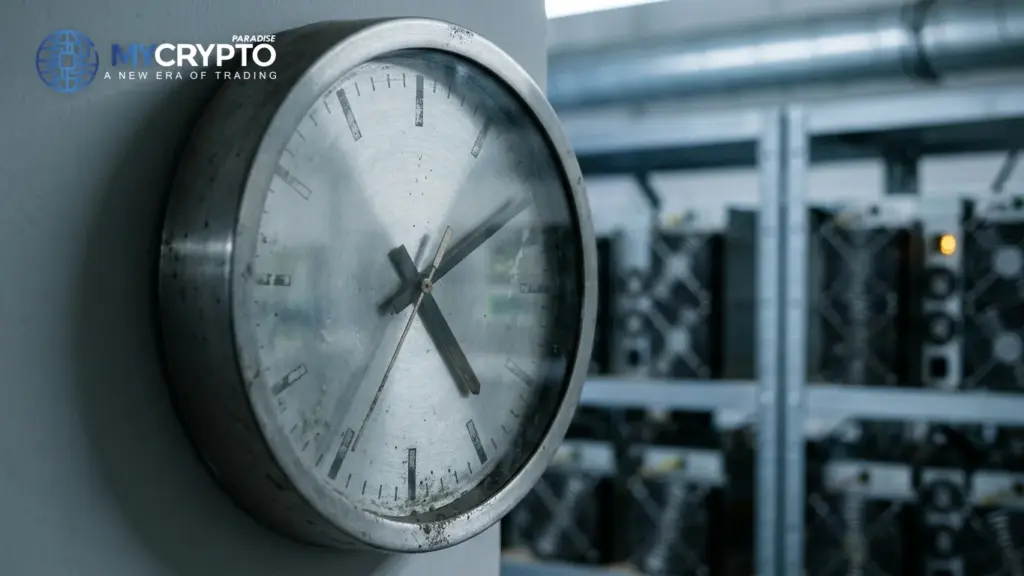
Market briefing: Bitcoin ran 98 minutes and 19 seconds without a block on November 26, the longest gap since July, yet BTC sat near $61,439 and barely moved as of 13:50 UTC.
- Bitcoin went 98 minutes and 19 seconds with no new block, between 977,697 and 977,698.
- It ranks 69th longest since 2011 and the third gap of this size this year.
- Price stayed flat on the hour and modestly green on the day, no visible reaction.
Bitcoin just froze for 98 minutes and 19 seconds between blocks, the longest gap since July. Payments and deposits waited. So why did the price not care?
Bitcoin stopped producing blocks for 98 minutes and 19 seconds on November 26. That is the longest gap since July, and the stall sat between blocks 977,697 and 977,698.
For anyone trying to move coins during the window, the network simply paused. Payments and exchange deposits stayed unconfirmed. There was briefly no fresh block space to bid fees into, which is an unusual thing to watch in real time.
It sounds dramatic. It is not, historically. This ranks as the 69th longest block gap since 2011, and the third gap of this size this year alone. The all-time record remains 141 minutes, set back in October 2011, when Bitcoin was a curiosity rather than a trillion-dollar asset.
Block production is probabilistic, not scheduled. Miners search for a valid block roughly every ten minutes on average, but averages hide long tails. Sometimes the dice run cold and a block takes far longer than the target. This was one of those runs.
Here is the part that matters most for traders. Through the entire episode, the market did not blink. BTC was essentially flat on the hour, down just 0.08 percent, and modestly green on the day.
So the honest framing is simple. The plumbing seized for a while, and the price action ignored it completely. Those are two very different stories, and conflating them is how people talk themselves into trades that the chart never asked for.
Block variance versus a genuine flow event
This was a network-level event, not a capital event. That distinction decides whether it belongs in your risk model at all.
Block timing comes from mining variance. It reflects how quickly miners happen to find the next valid block, not how money is moving on or off exchanges. A long gap tells you the dice ran cold, nothing more.
The empty block space is the tell. For a short window there was no new capacity to bid fees into, so the fee market briefly had nowhere to clear. That is a detail about mempool and miner activity. It is plumbing, not positioning.
Contrast that with the events that actually move liquidity. ETF flows, large unlocks, exchange solvency, a rate decision: those change the supply and demand for the asset itself. A slow block changes none of them. The coins, the holders and the order books were identical before and after.
This is why the transmission chain dead-ends almost immediately. Mining variance delays on-chain settlement, settlement delay inconveniences a few people mid-transfer, and then the signal stops. There is no macro effect and no liquidity effect to pass through to price.
Markets price information, and this gap carried almost none. A reminder that Bitcoin headline count and Bitcoin price sensitivity are rarely the same thing. The loudest network story of the day can sit entirely outside the chart that traders actually get paid on.
Flat tape right through the 98-minute freeze
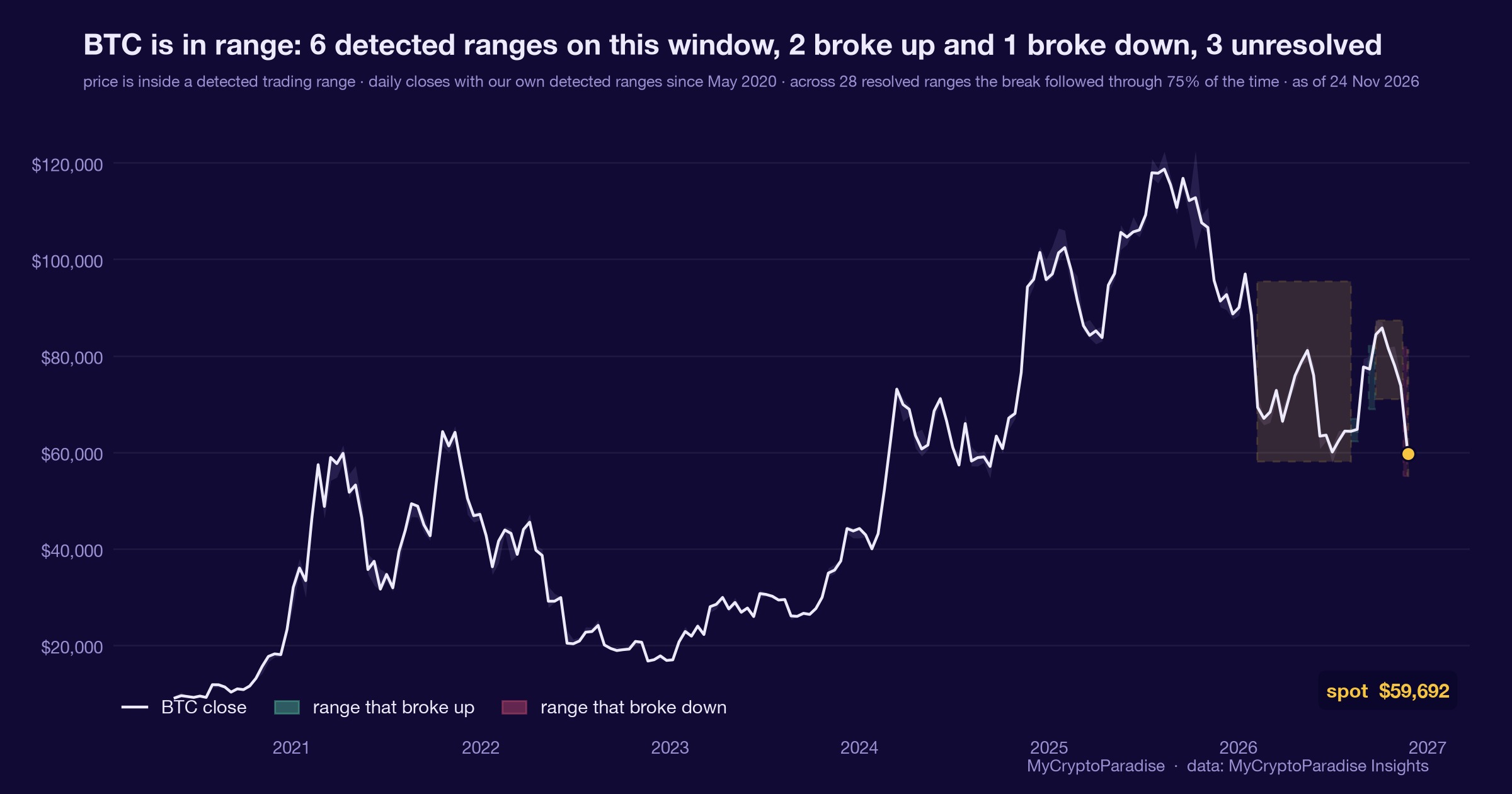
The cleanest evidence here is the absence of a reaction. BTC was trading near $61,439 and up about 0.9 percent on the day as of 13:50 UTC, with the hourly change a rounding error at -0.08 percent. That flatness is the whole story for pricing. A real liquidity shock leaves fingerprints: a spike in open interest (OI, the total value of outstanding derivatives contracts), a lurch in funding, a visible shift in CVD (cumulative volume delta, net aggressive buying minus selling). This gap left none of them.
BTC simply held its range while the block clock ran long. There was no cascade into ETH, and no follow-through into alts, because there was nothing to transmit. Majors and smaller caps traded on their own order flow, indifferent to the mempool.
For anyone holding spot, the practical impact was limited to timing. A deposit or withdrawal initiated during the window waited longer for its confirmation. That is an operational nuisance, not a reason to adjust exposure.
The absence of a wick in either direction is itself informative. If smart money saw this as a threat, we would expect defensive selling. If retail panicked, we would see a flush and a reclaim. We saw neither, which argues strongly that both camps read it as noise and moved on.
So the market impact is close to zero, and we should say that plainly rather than manufacture drama. Not every network anomaly is a trade.
When a slow block would start to matter
A single long gap is noise. A pattern of them would be the thing to watch, and that is a cleaner line than it first appears. This was the third gap of this size this year, which still sits well inside normal variance. If these clusters became frequent and clustered tightly, the question would shift from luck to cause: is hash rate dropping, are miners going offline, is something structural changing. That has not happened here.
Watch hash rate and difficulty, not the single timestamp. Sustained hash rate declines, or a run of difficulty drops at adjustment, would be the real signal that network security economics are under pressure. One slow block tells you nothing about that trend.
Mempool behaviour is the other tell. When blocks resumed, transactions cleared and fees normalised. If confirmation backlogs and fee spikes started lingering for hours rather than minutes, that would be a genuine congestion story worth pricing. It did not here.
Invalidation of the no-story read is simple. It would take repeated oversized gaps, a measurable hash rate exodus, or a persistent settlement backlog to turn this from trivia into a risk factor. None of those conditions are present.
Until they appear, the correct action on this specific event is to log it and keep trading the chart in front of you. The plumbing held, the block came, and the network did exactly what the record books say it occasionally does.
Why a stalled block barely touches liquidity
The ParadiseTeam reads this as a non-event for positioning, and we would rather be honest about that than dress it up. Nothing in the evidence shows coordinated buying or selling around the gap. Both smart money and retail largely ignored it.
That said, the backdrop we are trading has not softened. BTC was near $61,439 as of 13:50 UTC, and the level that matters sits above: $64,000 has flipped from support into resistance after a shooting star rejection on the daily. A slow block does nothing to change that structure.
So we treat any strength here with the same caution we held before the gap. Our broader view still leans toward a flush, with $44,000 as the primary target lower and $34,000 possible on confluence. Smart money finished distributing near the top and is waiting to absorb forced selling that has not arrived yet.
Retail is in fear, not capitulation. A quirky network headline does not shake weak hands loose; a bearish engulfing daily close or genuine forced selling would. This event moves none of those needles.
Practically, the ParadiseTeam keeps risk anchored to price, not to plumbing. We watch whether $64,000 rejects again or flips back to support, and we size against invalidation, not against a slow block. R:R (risk-to-reward) is set by the chart, and this story leaves the chart untouched.
The read behind this: we framed this story through our own market analysis, Bitcoin Bounce Was Leverage, Not Smart Money.
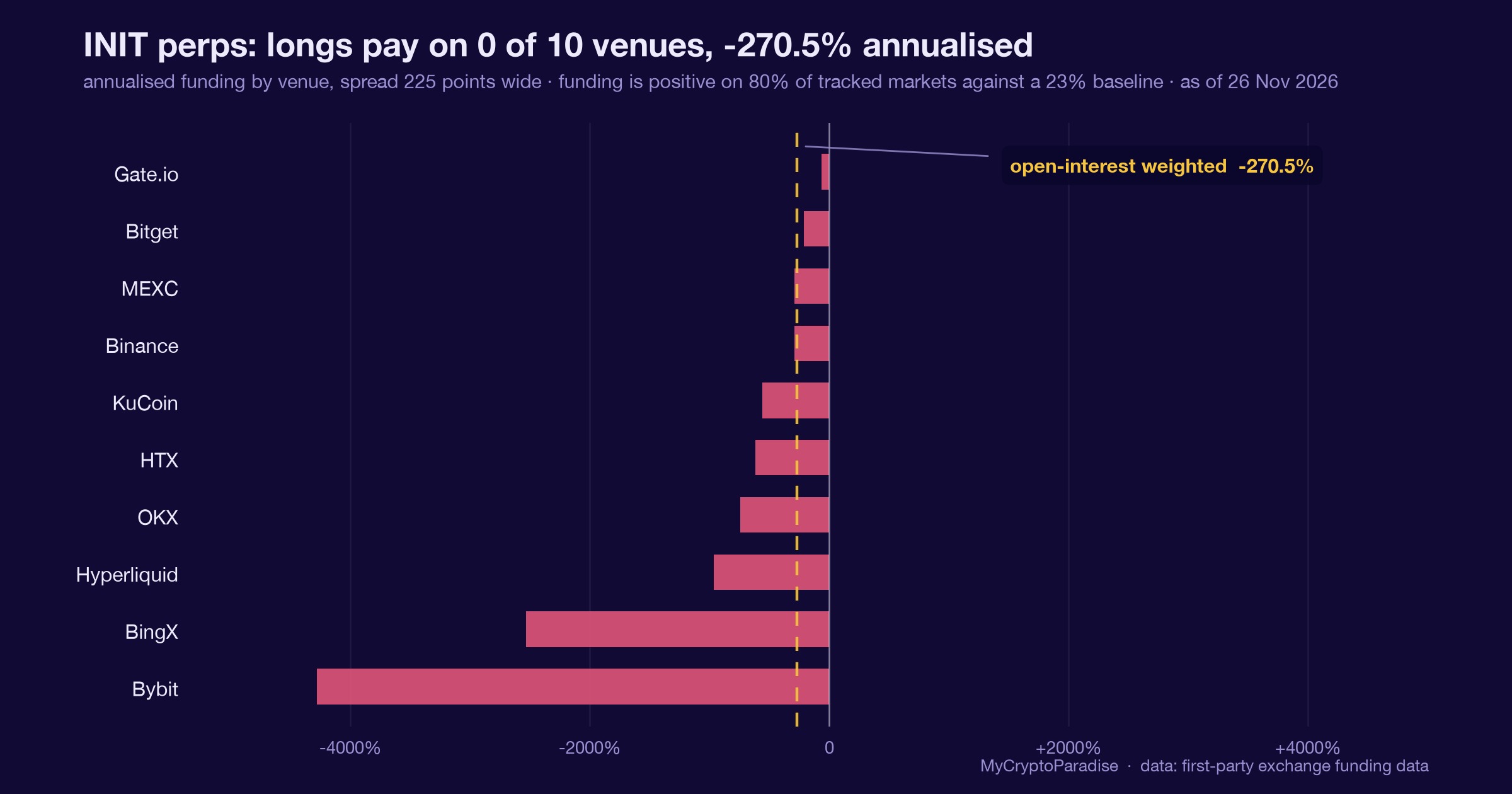
Track it live: our live crypto funding rates and the Crypto Fear and Greed Index both update in real time, so you can watch this shift for yourself.
Related coverage
For exact entries, targets, and stop losses with full risk management, that is what ParadiseFamilyVIP is for. New to reading these moves? Start with our crypto trading strategies guide.
ParadiseTeam is monitoring the market situation closely, and we are taking these developments into consideration while building our trading tactics inside ParadiseFamilyVIP.
Crypto trading involves substantial risk. Prices are volatile and you can lose money. This article is educational and is not financial advice. Past performance does not guarantee future results.
Does this 98-minute block gap mean anything for Bitcoin traders?
How 1 Paradiser is calling it
The first call is still open
Free account, no password. Members just sign in.









Join the discussion
No comments yet. Members, share how you are reading this.