

In short
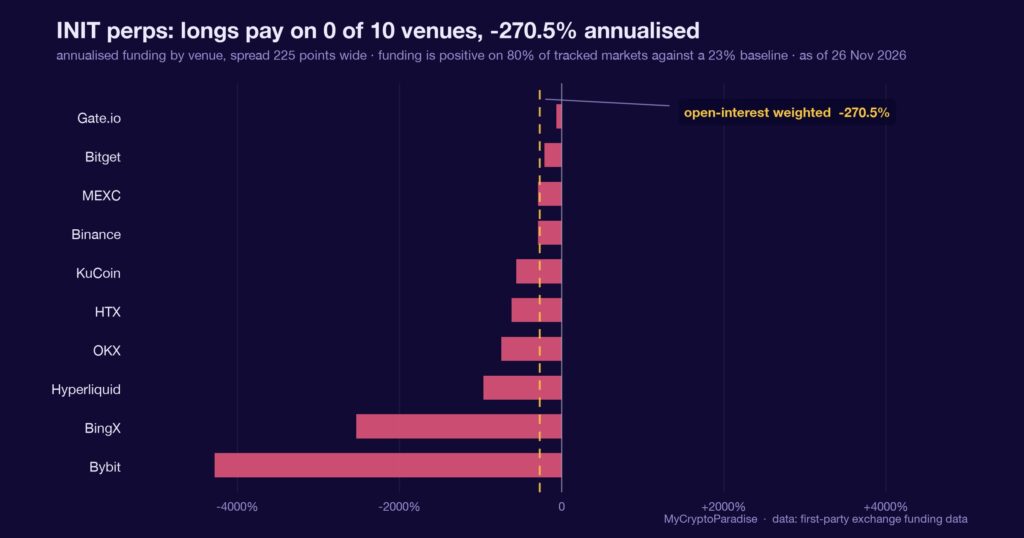
Funding is the recurring payment that keeps a perpetual futures price tied to spot: when it runs negative, shorts pay longs to hold their positions. On 26 November 2026 our MCP Insights funding-extremes reading puts INIT at the most stretched negative rate on the board, with shorts paying 270.5 percent annualized (APR). The raw feed read minus 320 percent; our recon series has it lower, and the series wins. We call this a single-name dislocation, not a market regime, and explicitly not a trade for most. The aggregate stays calm: Bitcoin funding sits near neutral at 4.14 percent, and 80 percent of 2,190 tracked markets fund positive. When we called the earlier November extremes noise rather than a turn, the balanced core held. This piece shows you how to read funding extremes yourself, and where the fragility actually sits.
Negative funding is the short side paying rent
A perpetual futures contract has no expiry, so an exchange uses a funding payment to keep it tethered to the spot price. When more traders lean short than long, the contract trades below spot and funding turns negative: the shorts pay the longs at every interval to keep the position open.
An extreme negative rate therefore describes a crowd, not a direction. It says a large amount of leverage has gathered on one side and is paying a toll to stay there. The toll is the tell.
Crowded positions are fragile precisely because they are crowded. The side that is paying to hold is the side with the most to lose if price moves against it, and that fragility is the whole of what an extreme print measures.
A rate that bleeds you daily is a position with a clock on it, not a conviction.
On 26 November the toll sits on INIT
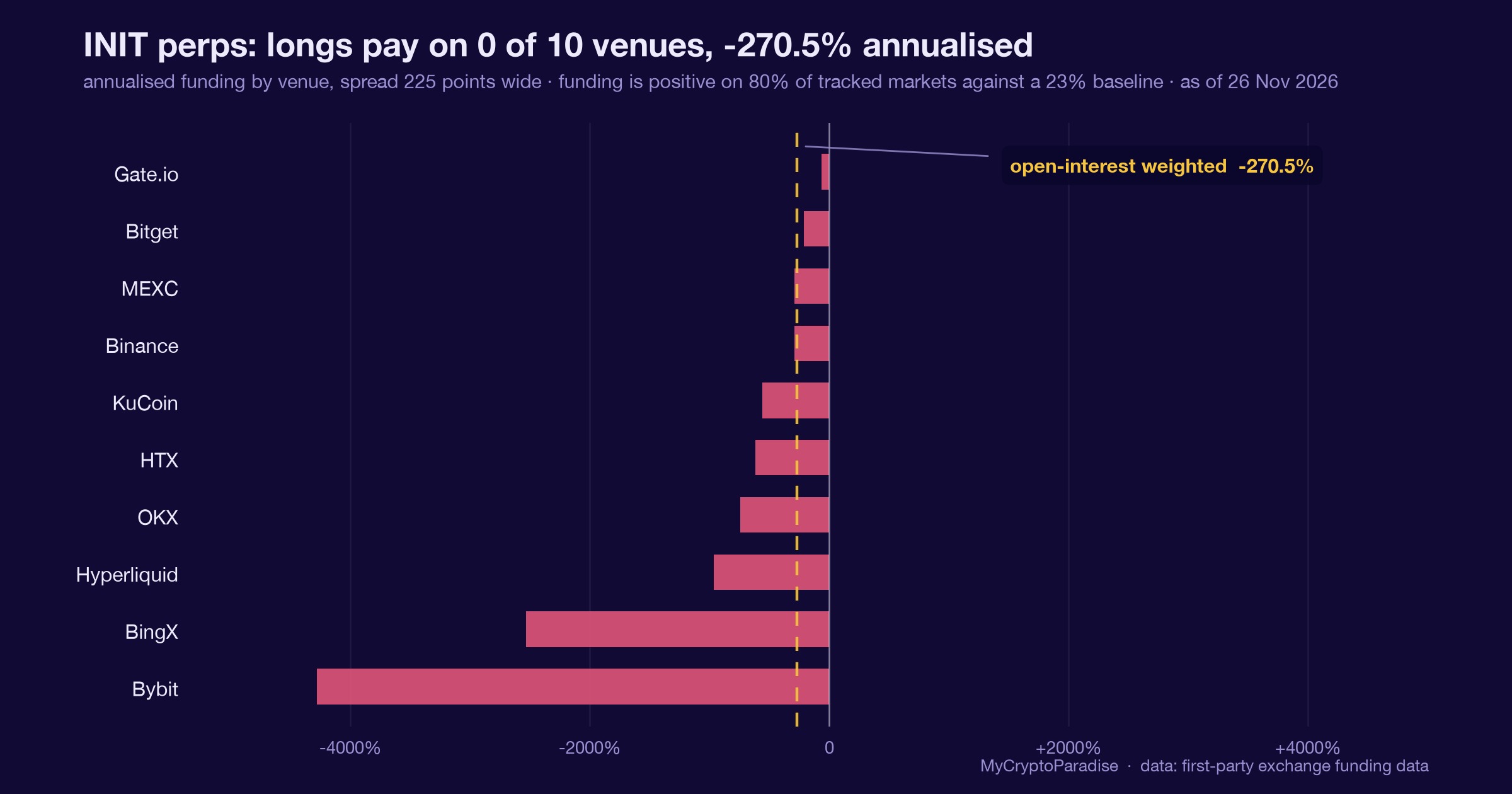
Per our MCP Insights funding-extremes series on 26 November 2026, INIT carries the most stretched negative funding on the board: shorts pay 270.5 percent annualized (APR) to hold. The source feed printed minus 320 percent; our recon series reads minus 270.5 percent, and where they disagree our series wins.
The opposite tail is tame by comparison. The most long-paid market, ARIA, has longs paying 71.78 percent APR, less than a third of INIT’s rate. One side of this board is paying far more than the other.
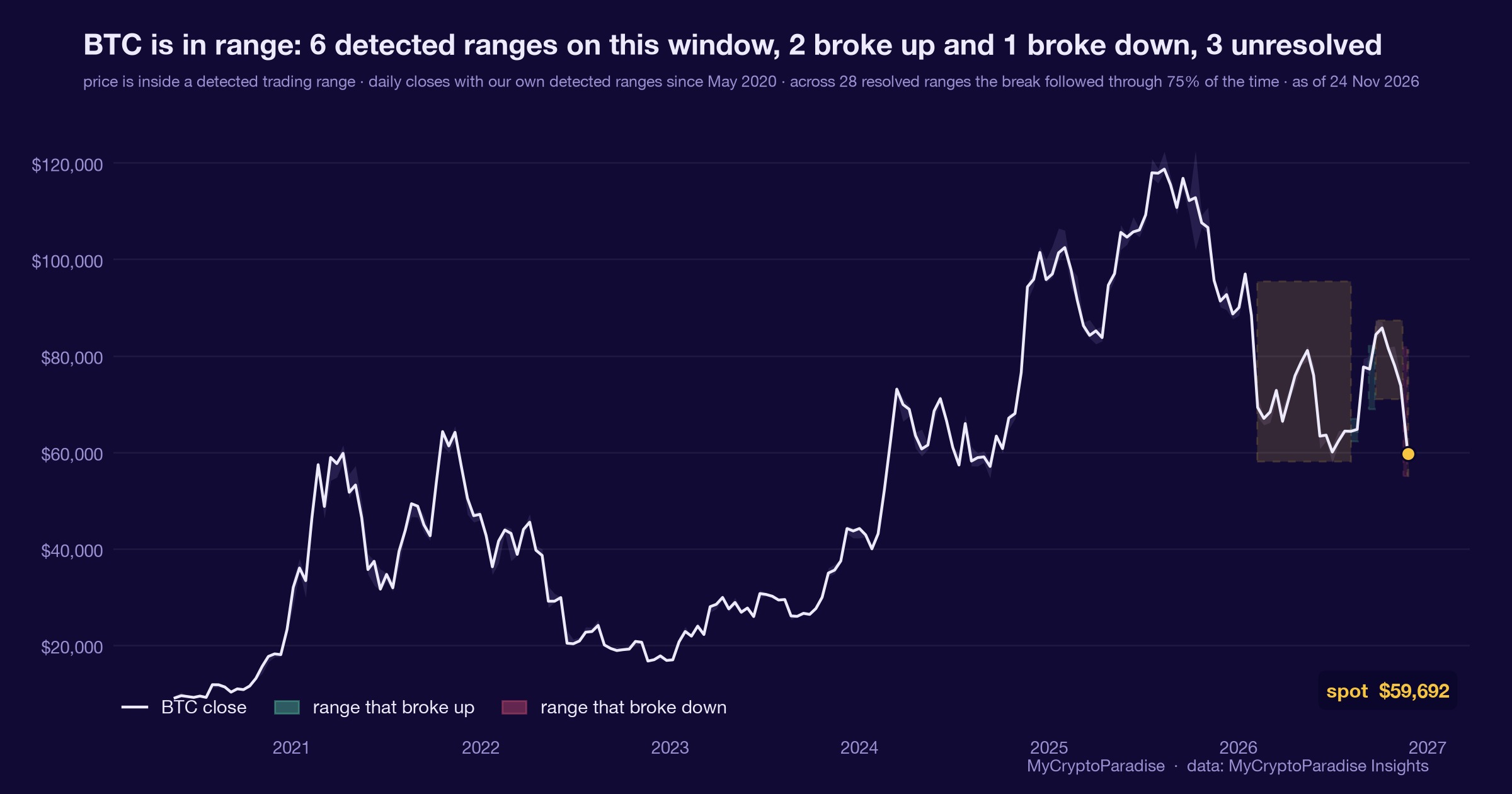
The core is calm. Bitcoin funding sits at 4.14 percent APR, which our series labels balanced with squeeze fuel low, against roughly 22.0 billion dollars of open interest (OI) and spot near 60,791 dollars.
Ethereum funding is 6.02 percent APR, mild long crowding, and 80 percent of 2,190 tracked markets fund positive at a 6.45 percent median. INIT is one fire on an otherwise quiet board.
What is different here
The ParadiseTeam reads a funding extreme as a map of where leverage is fragile, not as a timer for a bounce. The difference is that we attach the breadth number to every single-name print: one outlier only becomes a regime read when market-wide funding breadth moves with it.
An extreme rate is not a squeeze guarantee
The obvious misreading is that a short crowd paying this much carry must squeeze upward, and soon. It can. It can also stay crowded for weeks while the rate grinds lower, or resolve downward if price keeps falling and the shorts are simply right.
We have no calibrated base rate wired for funding-extreme regimes: the historical lake is not connected yet. So we will not tell you that extremes like this resolve higher in some share of past cases, because we have not measured it, and a number with no error bar is decoration, not evidence.
What the reading does support is narrower and firmer. The shorts are the side paying to be wrong here, and that is where the fragility sits. This is one input, and it sits alongside funding breadth, open interest and the balanced BTC core, which today all say the market as a whole is not stretched.
A single extreme print names the fragile side; it does not name the day the fragility breaks.
The November extremes have stayed single fires
This is the third extreme-funding single name our tape has flagged this month, and the pattern has held each time. On 6 November a short crowd paid roughly 450 percent on one micro name; on 11 November two tails ran hot at once. In both cases we called the aggregate neutral, and the balanced core held.
So the honest grade on the method is that it has correctly refused to turn a tail into a regime call. That is a quieter result than a winning trade, and it is the one worth publishing: the edge here is in what we declined to extrapolate.
None of that is a forecast for INIT itself. It is a track record on the frame, which is that an outlier rate is a single-name event until the breadth number moves with it, and the breadth number has not moved.
Reading a funding extreme yourself, step by step
- Open our live funding rates tool and sort the board by annualized rate (APR) to find both tails at once.
- Note the single most negative name and its rate: that is the crowd currently paying the most to stay short.
- Check the aggregate funding breadth, the percent of markets funding positive, to see whether the extreme is isolated or shared.
- Compare the extreme against the Bitcoin and Ethereum core rates: a calm core means the outlier is a single-name event.
- Mark the invalidation before acting: the rate normalizing toward neutral, or breadth moving with the outlier, changes the read.
The step people skip is the breadth check: without it, a single screaming rate looks like a market signal instead of the isolated outlier it almost always is.
Every number above is checkable against the live data. Start with the live crypto funding rates, then cross-read the MCP Insights hub and the Crypto Fear and Greed Index.
Act and invalidate
| Scenario | What confirms it | What kills it |
|---|---|---|
| Short squeeze on INIT | Rate normalizes as price lifts | Price falls, shorts proven right |
| Single-name noise | Breadth stays near 80 percent positive | Breadth turns with the outlier |
| Market-wide short stretch | BTC funding turns negative | BTC core holds near balanced |
Posture: For the broad market this is a no-trade reading: the core is balanced and the extreme is isolated. Any edge lives on INIT alone, where the shorts carry the fragility, and it is worth one line of risk, not a position.
Frequently asked questions
What does negative funding actually mean?
Negative funding means a perpetual futures contract is trading below spot, so the exchange makes short holders pay long holders at each interval. It signals that leverage has crowded onto the short side, and that crowd is paying to keep its positions open.
Does an extreme funding rate predict a bounce?
Not on its own. An extreme negative rate marks where the fragile, paying side sits, but it does not set a timing. The crowd can stay crowded for weeks, and without a wired base rate we quote no historical frequency for the outcome.
Why trust your number over the source feed?
The raw feed printed minus 320 percent while our recon series read minus 270.5 percent. Our series reconciles across venues and wins where the two disagree, which is why we publish the lower figure and flag the gap rather than hiding it.
Is the whole market short-stretched right now?
No. Bitcoin funding sits near neutral at 4.14 percent annualized, Ethereum shows mild long crowding, and 80 percent of 2,190 tracked markets fund positive. The INIT extreme is a single fire on a board that is otherwise balanced and quiet.
How would this read be invalidated?
The read flips if funding breadth moves with the outlier instead of staying near 80 percent positive, or if the Bitcoin core turns negative. Either change would lift the extreme from a single-name event toward a genuine market-wide short stretch.
Crypto trading involves substantial risk and is not suitable for everyone. Nothing here is financial advice; it is education only. Never risk more than you can afford to lose.
The private Extras feed, where the funding-extremes board, the breadth read and the BTC core rate update intraday with invalidation levels, is part of PRO Paradiser, the intelligence layer behind the ParadiseFamilyVIP strategies.










Join the discussion
No comments yet. Members, share how you are reading this.