

In short
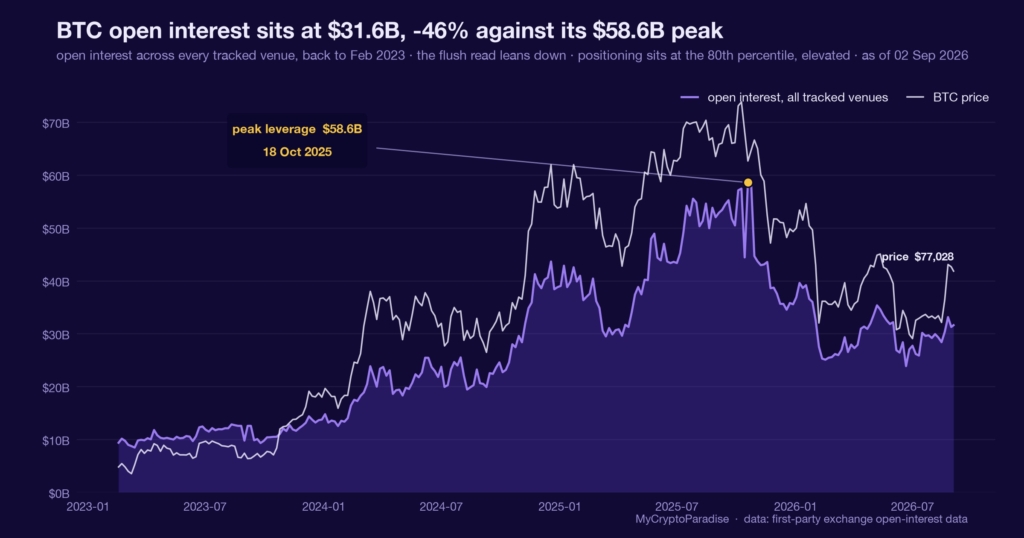
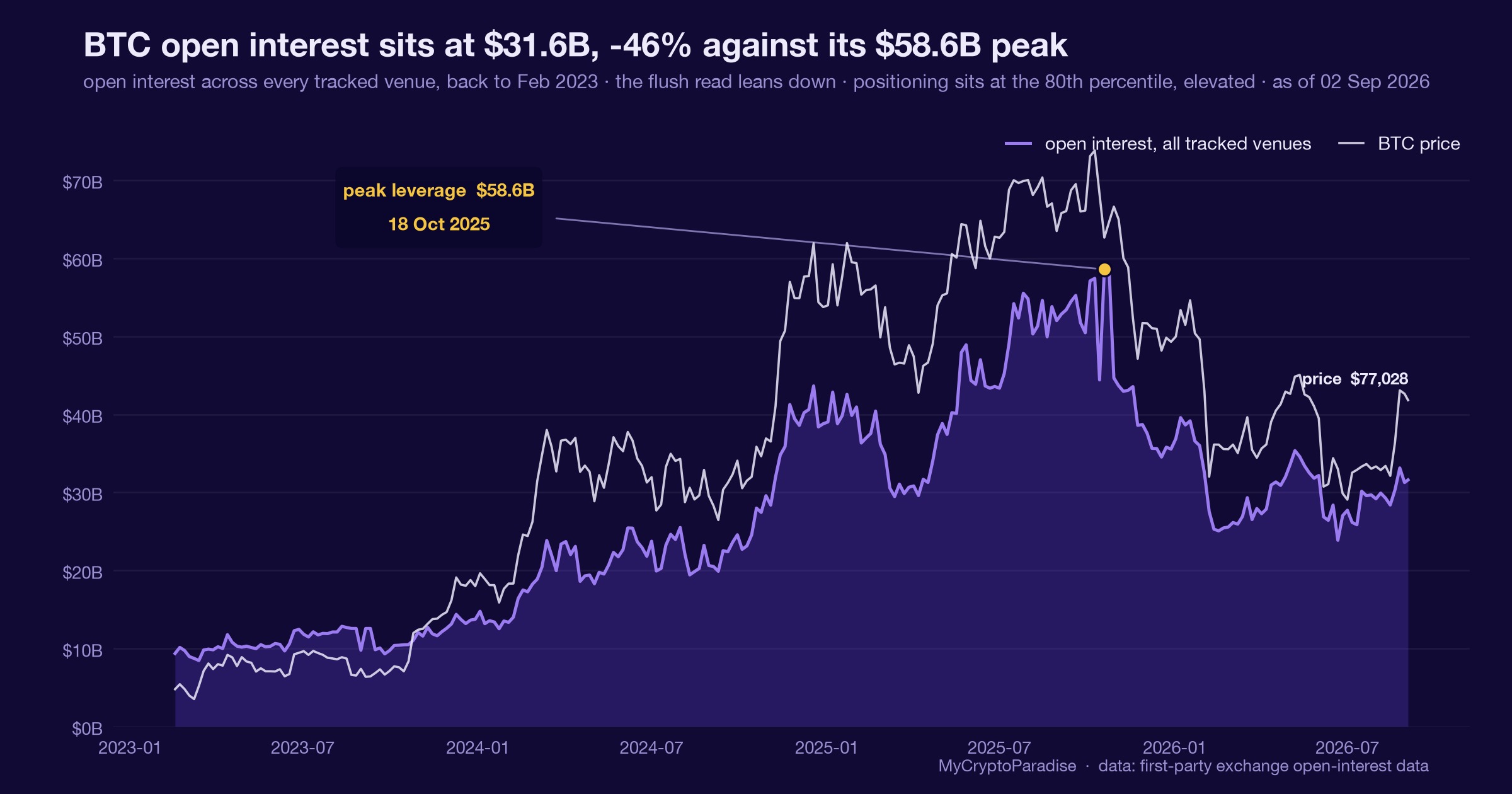
Open interest (OI) is the total value of derivatives contracts left open, so a rise in it means fresh leverage has entered, not that money has changed hands. On 31 August 2026 the MCP on-chain feed flagged roughly $1.0 billion of new BTC open interest, a 3.95 percent jump, on a flat price. Our own MCP Insights data reads OI at $31.6 billion, the 80th percentile of its range, with 89 percent of the book long and longs paying 7.33 percent annualized to hold. We called this neutral, explicitly not a top: our divergence gauge says OI is still tracking price, not building against it. The lean is defensive, because a book this one-sided is downside flush fuel, and our flush gauge admits its confidence gate has not passed. This piece shows you how to read an open-interest build yourself, and what would flip this read.
Key facts
- BTC spot at the reading
- $77,028
- BTC open interest
- $31.60B
- Where that sits in its own history
- the 80th percentile, elevated
- Long share of the build
- 89%
- What would prove this read wrong
- A daily BTC close that breaks decisively higher while the long share falls back from 89 percent toward balance and funding cools from 7.33 percent annualized, turning the added leverage into confirmed follow-through rather than downside flush fuel.
- Reading taken
- 02 September 2026
- Source
- Our MCP Insights tools, from first-party exchange data
A build is new leverage, not new conviction
Open interest counts the contracts still open, so when it climbs, traders have added positions rather than closed them. A rising figure on its own says nothing about direction. It says only that more money is now leveraged to the outcome.
The mechanism people miss is that leverage cuts both ways. Every new long needs someone to eventually sell to, and every position carries a liquidation price. A build stacks fuel on the tape; it does not decide which way the fuel burns.
A gauge that tells you leverage rose has told you the tank is fuller, not where the car is headed.
The 31 August build was almost entirely long
On 31 August 2026 the MCP on-chain feed reported roughly $1.0 billion of new BTC open interest, a 3.95 percent increase, while price barely moved around $77,028. Those flow figures are the feed’s; the standing picture is ours.
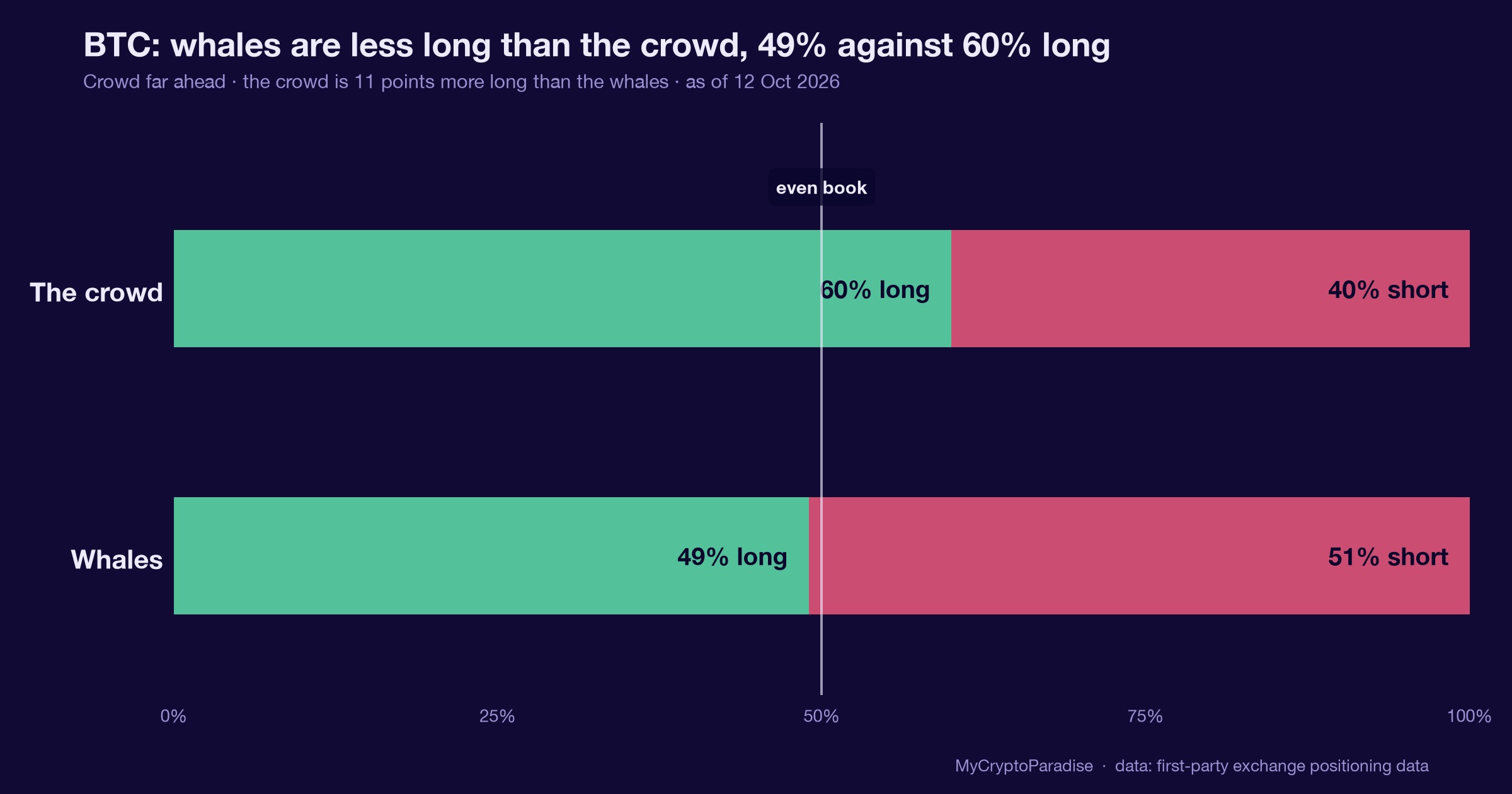
Per our MCP Insights open-interest data, the total now reads $31.6 billion, sitting in the 80th percentile of its range, a band we mark elevated. The book is lopsided: 89 percent long against 11 percent short, a skew reading of 39 that we label a long-heavy build.
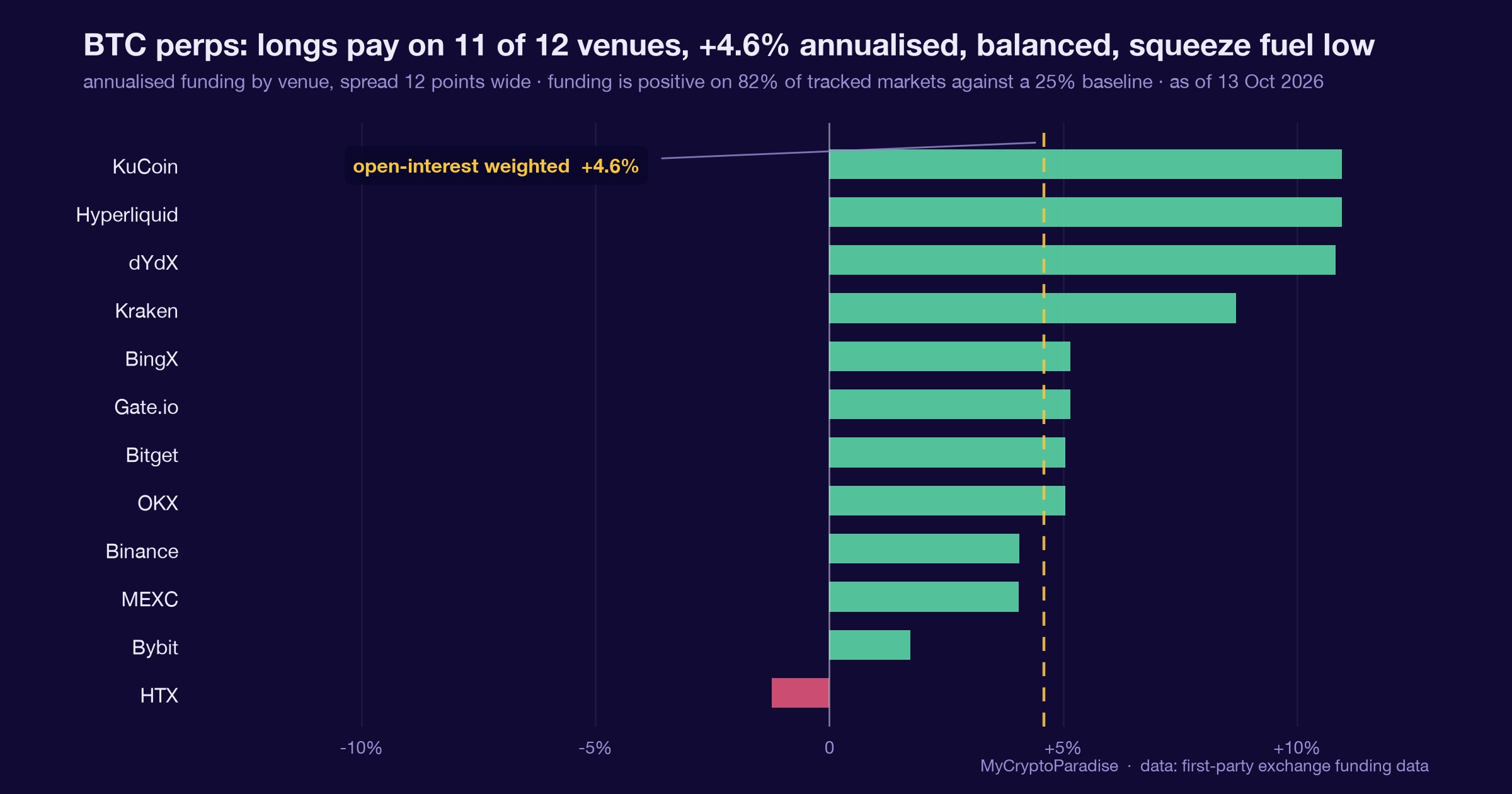
Longs are paying to stay there. Funding runs at 7.33 percent annualized, with longs paying shorts, and Ethereum tells the same story further along, its open interest stretched at the 96th percentile with 88 percent of the book long.
One-sided positioning at an elevated percentile is not a forecast. It is an inventory count, and the inventory is almost all on one side.
What is different here
The ParadiseTeam does not read a build as a direction. We check the flow figure against our own open-interest percentile, side-split and funding, then against a divergence gauge that says whether leverage is tracking price or detaching from it, before the number becomes a story.
Building fast does not mean breaking out
The tempting read is that fast-building leverage on a quiet tape is coiled energy about to release upward. That is the framing, not the data. A build with flat price is as consistent with a crowd leaning the wrong way as with one about to be proven right.
Our divergence gauge is the check here, and it does not confirm the alarm. It reads open interest as still tracking price, not detaching from it, and it does not flag a crowded or unconfirmed build. The leverage rose with the market, not against it.
The scary version of a build is the one where positioning detaches from price. This one, so far, has not.
Where the flush gauge admits it is guessing
Our open-interest flush gauge leans toward a drawdown, meaning it expects some of this leverage to unwind and price to revert. It also flags that reading as estimated and tells you its confidence gate has not passed, so we carry it as a lean, not a level.
Base rates for open-interest builds are not wired into our data yet, so we quote no historical frequency here: to invent one would be decoration, not evidence. This is also one input. It sits alongside funding, spot absorption and the liquidation map, and today it is the reading that flags crowding while the others stay quiet.
A gauge that admits its gate has not passed is more useful than one that always finds a signal.
The one-sided book is the risk, not the direction
State the imbalance plainly: 89 percent of this leverage is long, and those longs are paying 7.33 percent annualized to hold. A book that lopsided at the 80th percentile of open interest is downside flush fuel, because it is the crowded side that gets liquidated first when price moves against it.
That is a statement about where the stops sit, not about where price goes. Both outcomes are live.
The read flips from defensive to confirmed if price breaks higher while the long share falls back from 89 percent toward balance and funding cools from 7.33 percent. That would turn added leverage into follow-through rather than fuel.
A crowded book is a probability weight on risk, not a direction. It is worth exactly one line of your risk plan.
Reading an open-interest build yourself, step by step
- Confirm the build is real: check that total open interest actually rose on your own feed, not just one venue’s headline number.
- Read it against price: a build with flat price means new leverage, so ask which side that leverage is on.
- Check the side-split and funding: a book heavily long and paying to hold is crowded, not confirmed.
- Locate the percentile: elevated open interest means more fuel on the tape and thinner room before positions get squeezed.
- Set the invalidation before you act: name the price and positioning shift that would flip a crowded read into a confirmed one.
The step people skip is the side-split. A build looks bullish until you see that 89 percent of it is long and already paying to stay there.
Every number above is checkable against the live data. Start with the aggregated open interest, then cross-read the MCP Insights hub and the Crypto Fear and Greed Index.
Act and invalidate
| Scenario | What confirms it | What kills it |
|---|---|---|
| Crowded longs flush | OI drops as price reverts lower | OI holds and price breaks higher |
| Build confirms the move | Price breaks up, funding cools | Long share stays 89% as price stalls |
| Leverage keeps tracking price | Divergence gauge stays neutral | Side-split detaches from price |
Posture: Defensive on the crowded long side, without calling a top: a one-sided book at elevated open interest is fuel for a downside flush, and the highest-probability move for most is smaller size until the side-split rebalances or price confirms the build.
Frequently asked questions
What does rising open interest actually mean?
It means traders have opened more derivatives contracts than they have closed, so fresh leverage has entered the market. It does not signal direction on its own. A rise only tells you more money is now positioned for the outcome, on one side or the other.
Is a $1 billion open-interest build bullish for Bitcoin?
Not by itself. On 31 August 2026 that build was 89 percent long with funding positive, which is crowded rather than confirmed. A build turns bullish only if price breaks higher while the long share falls back toward balance.
Why does the long/short split matter here?
Because the crowded side gets liquidated first. With 89 percent of the book long, a move lower forces those longs out and adds selling, which is why a one-sided book at elevated open interest reads as downside flush fuel.
What is funding, and why does 7.33 percent matter?
Funding is the periodic payment leveraged traders make to hold a position. At 7.33 percent annualized with longs paying shorts, the crowd is paying to stay long, which raises the cost of a book that is already one-sided.
What would prove this crowded-long read wrong?
A daily close breaking higher while the long share falls back from 89 percent toward balance and funding cools from 7.33 percent. That would turn the added leverage into confirmed follow-through rather than flush fuel waiting to unwind.
Crypto trading involves substantial risk and is not suitable for everyone. Nothing here is financial advice; it is education only. Never risk more than you can afford to lose.
The private Extras feed, where the open-interest percentile, long-short split and funding gauge update intraday with their invalidation levels attached, is part of PRO Paradiser, the intelligence layer behind the ParadiseFamilyVIP strategies.









Join the discussion
No comments yet. Members, share how you are reading this.