

In short
DVOL is Deribit’s bitcoin implied-volatility index: the annualised price swing the options market is paying to hedge against. On 13 November 2026, bitcoin traded near $68,860, roughly 17 percent below its 20 October high, yet our MCP Insights option-chain snapshot read DVOL at 39.68. That is a calm number for a deep drawdown. We called this neutral, explicitly not a reversal cue: a compressed volatility reading describes expected magnitude, not direction. The companion skew sits in its 89th percentile, so puts stay bid even as headline volatility sags, and the two disagree. Our pin model stays parked at 19 graded expiries against a pre-registered 40, and recent weeklies delivered outside their max-pain zones, so we quote no pin rate. This piece shows you how to read a volatility-compression tape yourself, without mistaking quiet for safe.
Implied volatility prices motion, never direction
Implied volatility (IV) is the price of expected movement. When traders buy options, they pay for the right to be protected against swings, and that premium rises when motion is feared and falls when calm is assumed.
DVOL, Deribit’s bitcoin volatility index, distils that premium across the option chain into one annualised number. It answers a single question: how large a move is the market paying to hedge, in either direction?
A low reading is not a forecast that price holds. It is a statement that the crowd is paying little to be wrong, which is a very different thing.
The 13 November tape prices a calm drawdown
Per our MCP Insights Deribit option-chain snapshot, bitcoin sat near $68,860 on 13 November 2026, about 17 percent under its 20 October high, with DVOL reading 39.68. For a slide of that depth, that is an unusually quiet premium.
The nearest weekly expiry, settling 20 November, carries $1.12 billion of notional open interest (OI), a put-to-call ratio of 1.18, and a max-pain strike of $74,000 that sits roughly 7 percent above spot. The gamma center rests lower, near $70,519.
Our volatility zone for that expiry spans $70,093 to $77,907, and spot opens below its floor. The crowd gauge grades a neutral 47, yet skew sits in its 89th percentile and open interest in its 100th.
The headline says calm; the skew says someone still pays up for downside. A gauge that quietly disagrees with itself is worth more than one reporting a single, tidy mood.
Quiet volatility is not an all-clear
The obvious misread is to treat a sub-40 DVOL as permission: low fear, therefore the bottom is in. That inverts what the number says. Compressed volatility prices a smaller expected move, not an upward one.
The skew data cuts against the calm directly. With puts bid into their 89th percentile, the chain is quiet on magnitude while still charging a premium to insure the downside, and those are not the same message.
This is one input. It sits alongside funding, open interest and spot absorption, and today it is the reading that looks calmest while the skew beside it refuses to agree.
A market can be calm and wrong at once. Low priced volatility removes the panic bid, not the risk, and complacency is the cheapest thing a chain ever sells.
What is different here
The ParadiseTeam does not read a low volatility number as an all-clear. We cross it against the skew percentile, the gamma center and our own calibration state, so a calm headline that hides bid-up downside puts gets caught rather than traded, and a parked score stays parked.
The skew is the half that still pays to hedge
A divergence only matters when one side is paying for it. Here the headline volatility has sagged, but the skew premium, the extra cost of puts over calls, sits in its 89th percentile on our gauge.
That split tells you where the money leans. Sellers are comfortable writing broad volatility cheaply, yet buyers still bid specifically for downside protection, and the two positions coexist inside the same calm print.
Open interest at its 100th percentile says the positioning is crowded, not sleepy. A quiet DVOL on a packed book is not an absence of risk; it is a lot of risk priced as though it will stay orderly.
The side paying to be wrong tells you more than the side relaxing. When the cheap half and the expensive half point opposite ways, the expensive half is the one sizing your downside.
Our own pin model has not earned a rate
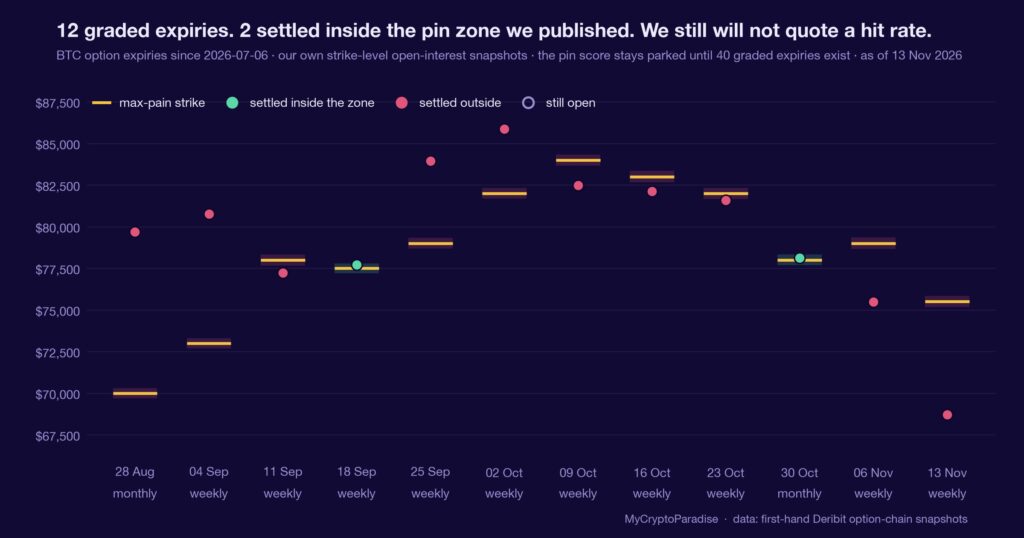
Honesty first: this volatility read runs as a model estimate that has not cleared its calibration gate. Our strike-OI archive opened on 6 July 2026, which is young, and the pin score stays parked.
The receipts say why. We have 19 graded expiries against a pre-registered minimum of 40, and the first honest grade is not due until 20 November 2026. Nineteen is not a sample; it is a ledger still filling.
Recent weeklies underline the caution. The last several expiries delivered outside their max-pain zones, some by wide margins, so the gravity center is a map we are still checking, not a rule we trade.
A number with no error bar is decoration. We would rather publish a parked score than dress nineteen receipts as a probability they cannot yet support.
Reading the options volatility tape yourself, step by step
- Start with DVOL or any implied-volatility index, and read it as expected magnitude, never as a direction the market is promising.
- Compare that calm against the drawdown: a quiet premium during a deep slide is the tension worth investigating first.
- Pull the skew percentile next, because a low headline with bid-up puts means the chain disagrees with its own calm.
- Locate max pain and the gamma center, then note whether spot sits inside or below the expiry’s volatility zone.
- Check the calibration state: a parked or estimated score means you read the tape as context, not as a settled probability.
Most readers stop at the headline volatility number and never pull the skew. The percentile beside it is where the disagreement hides, and the disagreement is the whole read.
Every number above is checkable against the live data. Start with the Crypto Fear and Greed Index, then cross-read the MCP Insights hub and the live crypto funding rates.
Act and invalidate
| Scenario | What confirms it | What kills it |
|---|---|---|
| Calm holds, range grinds | DVOL stays near 40, spot drifts | DVOL spikes past the zone high |
| Hidden downside bid pays | Skew climbs, puts keep bidding | Skew drains back under median |
| Pin gravity reasserts | Spot drifts toward $74,000 by expiry | Daily close below $70,519 gamma |
Posture: The highest-probability posture for most is no trade: a compressed volatility read sizes risk, it does not open a position. Stay defensive while spot holds below the zone floor, and treat a DVOL spike as the thing that changes the regime, not a daily wiggle.
Frequently asked questions
What does a low DVOL reading actually mean?
It means the options market is paying little for expected movement, in either direction. A low DVOL compresses the premium on swings; it does not predict that price rises or that a bottom has formed. Magnitude and direction are separate questions.
Is a 17 percent drawdown with calm options bullish?
Not by itself. Quiet volatility removes the panic bid but not the underlying risk, and our skew reading shows puts still bid into their 89th percentile. The tape reads as neutral: a smaller expected move, with downside insurance still changing hands.
What is max pain and why is it above spot?
Max pain is the strike where the most option value expires worthless, a rough gravity center for an expiry. Ours sits at $74,000, about 7 percent above spot, which means option positioning leans higher than price currently trades, nothing more than that.
Why will you not quote a historical frequency here?
Because our base-rate lake is not wired and our pin model has not cleared its gate. We hold 19 graded expiries against a minimum of 40, with the first honest grade due 20 November 2026. Nineteen receipts cannot carry a probability.
How should a trader use this volatility read?
As one layer, not a trigger. It sizes risk rather than opening trades: a compressed premium argues for patience, and a DVOL spike past the zone high is the condition that would change the regime. For most, the honest action is none.
Crypto trading involves substantial risk and is not suitable for everyone. Nothing here is financial advice; it is education only. Never risk more than you can afford to lose.
The private Extras feed, where the DVOL volatility read, the max-pain zone and the options skew update with their invalidation levels, is part of PRO Paradiser, the intelligence layer behind the ParadiseFamilyVIP strategies.







Join the discussion
No comments yet. Members, share how you are reading this.