





Technical Analysis Patterns
In short
The rising wedge pattern is a bearish reversal pattern in technical analysis, characterized by two converging upward-sloping trend lines connecting higher highs and higher lows. It indicates that buying momentum is weakening and a price decline is likely. Traders confirm the pattern when the price breaks below the lower trend line.
The rising wedge pattern is a technical analysis pattern that forms two trend lines, one connecting the higher highs and another connecting the higher lows. These trend lines converge as the price moves higher, forming a wedge-like shape. The rising wedge is the technical opposite of the falling wedge pattern.

The rising wedge pattern is a bearish pattern and a reversal pattern. It suggests that the bulls are losing control of the market, and the bears are about to take over.
To trade the rising wedge pattern, you need to identify it on the chart and then wait for confirmation of the pattern. The confirmation occurs when the price breaks below the lower trend line of the pattern, indicating that the bears have taken control of the market.
Parts of a Rising Wedge Pattern
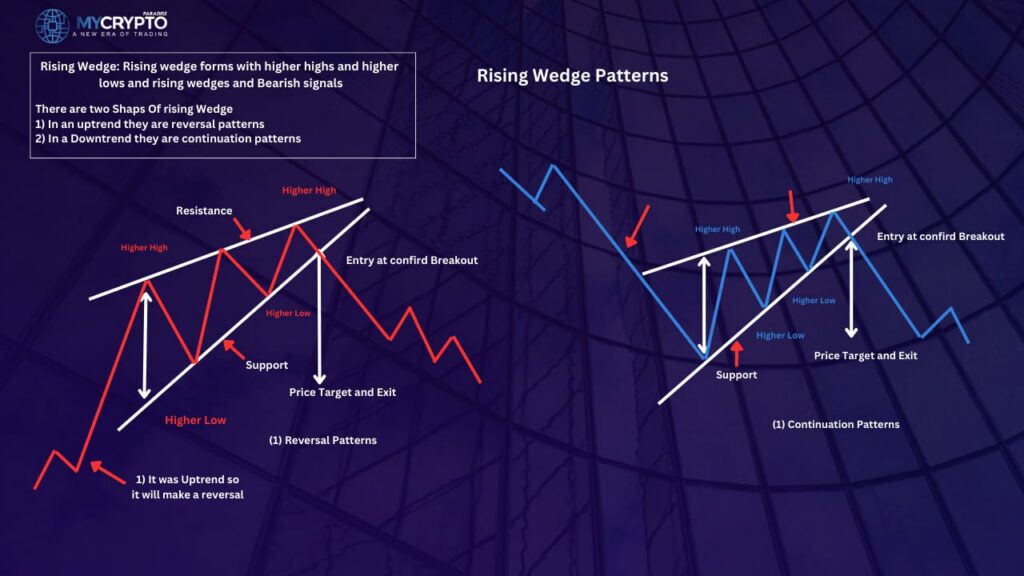
There are several parts of a rising wedge pattern that traders need to be aware of:
Upper trend line: This is the line that connects the higher highs of the price action. It slopes upward and acts as a resistance level. As the price moves higher, the upper trend line also moves higher.
Lower trend line: This is the line that connects the higher lows of the price action. It slopes upward and acts as a support level. As the price moves higher, the lower trend line also moves higher.
Convergence point: This is the point where the upper and lower trend lines meet, forming the wedge-like shape.
Volume: Volume is an important factor to consider when analyzing a rising wedge pattern. In general, the volume tends to decrease as the pattern develops, which can be a sign of weakening bullish momentum.
Breakout: The breakout is the point where the price breaks below the lower trend line of the pattern. This is typically considered confirmation of the pattern and a signal for traders to enter short positions.
Target: The target of a rising wedge pattern is typically the height of the pattern measured from the convergence point to the first point where the lower trend line intersects the price action after the breakout. This target represents the potential move of the price after the pattern is confirmed.
In summary, the rising wedge pattern is a bearish reversal pattern that is formed by two trend lines that converge as the price moves higher. Traders should pay attention to the upper and lower trend lines, convergence point, volume, breakout, and target when analyzing this pattern.
When trading the rising wedge pattern, it’s essential to keep in mind that it is a reversal pattern. As such, it’s important to use it in conjunction with other technical analysis tools to confirm the direction of the trend. Additionally, it’s important to have a solid risk management plan in place, including a stop loss and take profit targets.
Tips On Trading the Rising Wedge Pattern
Here are some tips on trading the rising wedge pattern:
Confirm the pattern: Before entering a trade, make sure to confirm the pattern by a breakout below the lower trend line.
Use other indicators: It’s always a good idea to use other technical indicators in conjunction with the rising wedge pattern to confirm the direction of the trend. For example, you could use moving averages, momentum indicators, or support and resistance levels.
Set stop-loss orders: As with any trade, it’s important to set stop-loss orders to limit your losses if the trade doesn’t go as planned. When trading the rising wedge pattern, consider placing your stop-loss order above the upper trend line of the pattern.
Take-profit orders: Similarly, it’s important to have a plan for taking profits. You could consider setting your take-profit order at the next support level.
Monitor the volume: Pay close attention to the volume as the pattern develops. A decrease in volume could be a sign of weakening bullish momentum and could indicate that the bears are about to take control of the market.
Consider the overall market: If the overall trend is bullish, the rising wedge pattern may not be as reliable, and you may want to look for other patterns or indicators to confirm your trade.
Conclusion
The rising wedge pattern can be a powerful tool for trading cryptocurrencies, but it’s important to confirm the pattern and use other indicators to confirm the direction of the trend. By setting stop-loss and take-profit orders and monitoring the volume and overall market conditions, traders can increase their chances of success when trading the rising wedge pattern.
ParadiseFamilyVIP members combine market insights with expert trading strategies, which is how we have recorded huge success in our over seven years of professional crypto signals services.
What is different here
Most guides stop at the theory. The MyCryptoParadise team shares the live trades, and the reasoning behind each one, inside ParadiseFamilyVIP. Everything here is education, not financial advice.
Crypto trading involves substantial risk and is not suitable for everyone. Nothing here is financial advice; it is education only. Never risk more than you can afford to lose.












Join the discussion
No comments yet. Members, share how you are reading this.