

Listen: the breakdown
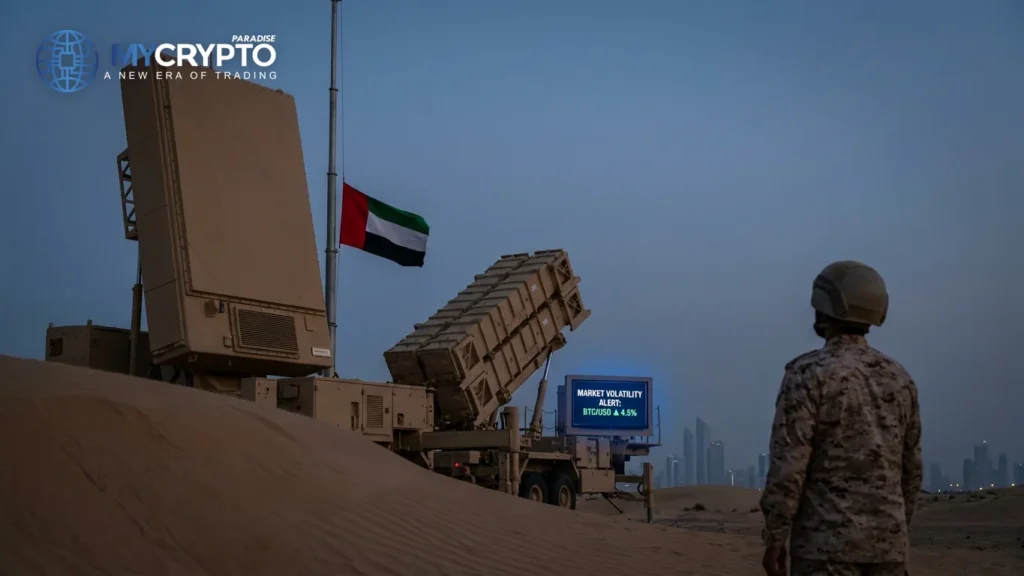
Market briefing: UAE air defenses detected an Iranian missile threat, yet Bitcoin held near $64,517 with barely a wobble. The reaction says more than the headline.
- UAE air defense detected missiles identified as Iranian.
- BTC held $64,517 (+0.7%); ETH near $1,913, both flat on the news.
- No single confirmed catalyst moved crypto; support at $62,500 stays the real story.
A UAE missile threat is the kind of headline that once shook markets. So why did the crypto reaction to this missile threat barely register at all?
UAE air defense systems detected a missile threat, and the intercepted missiles were identified as Iranian. On paper, that is a serious escalation in a region already primed for tension. Markets built on fear should have twitched hard.
They did not. Bitcoin sat at $64,517, up 0.7% over 24 hours and 0.2% on the hour. Ethereum held $1,913.21 with the same quiet numbers. The most dramatic headline of the session produced one of the flattest tapes.
That gap between drama and price is the story here. When a genuine geopolitical shock lands and risk assets simply shrug, the shrug itself carries information. It tells us where the market's real attention sits, and it is not on the Gulf.
We want to be honest about causation. There is no single confirmed same-day catalyst driving crypto right now, so treating this missile threat as the reason for anything would be dishonest. It is one input into a nervous mood, not the lever pulling price.
Instead, the market is trading its own internal map: liquidity, technical support around $62,500, and the slow tug of broader macro. The missile threat adds to a backdrop of unease without changing the levels that actually matter. Read that way, the non-reaction is the signal, and everything below follows from it.
Why a real shock moved nothing
Geopolitical escalation usually runs through a familiar chain. A threat raises risk aversion, capital rotates toward perceived safety, liquidity tightens, and speculative assets like crypto feel it first. That is the textbook transmission mechanism.
This time the chain broke early. The missile threat did lift the general temperature of fear, but it never reached crypto liquidity in any measurable way. BTC and ETH both moved less than half a percent on the hour, which means the risk-off impulse simply did not transmit.
Why does that matter structurally? Because it tells us the market is being governed by internal mechanics, not external headlines. When price ignores a genuine shock, dominant drivers sit elsewhere: technical support, positioning, and macro liquidity that changes on a slower clock than the news cycle.
There is a quieter lesson in the calm. Markets that refuse to panic on scary news are often markets where weak hands have already sold. The people left holding are harder to frighten, so the usual fear trade finds no fresh sellers to feed on. So the real takeaway is not the missile. It is the confirmation that crypto's near-term fate hangs on the defense of levels like $62,500, on liquidity conditions, and on macro trends that a single regional flashpoint does not override.
How the flat tape reads across majors
Start with Bitcoin, because BTC still sets the tone. At $64,517 with a 0.7% daily gain, BTC absorbed the headline without a liquidity flush. No cascade of stops, no violent wick, just a market holding its ground above the zone that matters.
Ethereum told the same story in miniature. ETH at $1,913.21, also up 0.7%, tracked BTC almost tick for tick. When the second-largest asset mirrors the first this closely, it signals that no independent shock is repricing the space; everything is moving as one correlated block.
Alts, by extension, had no reason to break rank. In a session with no liquidity cascade, altcoins simply follow BTC's lead, and BTC's lead was quiet. Without a catalyst forcing dispersion, the whole complex drifts together.
That correlation is the tell. A true risk-off event tends to hit the longer tail hardest, as leverage unwinds from the riskiest names outward. We saw none of that fragmentation, which argues the missile threat never triggered forced selling anywhere in the stack.
So the impact, honestly stated, is minimal price impact and maximal informational value. The event confirmed that liquidity around current levels is stable and that the market's stops and attention sit around BTC support, not around a Gulf headline. The cascade everyone braces for on days like this simply did not arrive.
What confirms calm and what breaks it
The first thing to watch is whether $62,500 keeps holding as support. That level, not the missile threat, is the market's real pivot right now. A clean defense there keeps the cautious structure intact; a decisive break below it changes the conversation entirely.
Watch the follow-through on any further escalation, too. If the geopolitical situation deepens and crypto still refuses to sell, that repeated non-reaction strengthens the case that sellers are exhausted near current prices. Confirmation is behavioural, not just a level.
On the invalidation side, be honest about what would prove us wrong. A sharp risk-off leg that finally drags BTC below support on rising volume would mean the shock did transmit, just on a delay. Volume expansion into weakness is the warning we respect.
We would also watch for the opposite trap. If BTC pushes up into resistance on thinning momentum while retail turns euphoric, that stall would look less like strength and more like distribution. Bullish tape into exhaustion is its own kind of risk.
For now the read is deliberately unforced. With no single catalyst and price barely moving, patience beats prediction. The market is telling us the decisive move has not happened yet, and days like this reward the trader who waits for the level to break rather than the headline to shout.
What the non-reaction says about positioning
The ParadiseTeam reads today through the lens of a cautious medium-term bullish bias, where smart money quietly defends support while retail stays fearful. This missile threat fits that frame without changing it. It adds to the extreme-fear mood, but it did not produce the capitulation that patient buyers are waiting to absorb.
With BTC near $64,517 and the key line at $62,500 still intact, nothing about this event moved our levels. That is precisely the point. When a scary headline fails to force a flush, it usually means the panic sellers have already gone, and the remaining supply is held by hands that do not spook easily.
Here is where the edge lives. Bearish-sounding news landing at or near strong support, with retail already nervous, is often the setting where larger players accumulate rather than dump. But today produced no flush to accumulate into, so the ParadiseTeam sees no reason to force a directional call.
Stops matter more than stories. The relevant stops sit below $62,500, and until that zone genuinely breaks, this remains a hold-and-defend structure, not a trend to chase. So our stance stays neutral and risk-first. We watch the support, we watch who capitulates, and we let the market, not the missile, tell us when the real move begins.
Track it live: our Crypto Fear and Greed Index and the crypto liquidation heatmap both update in real time, so you can watch this shift for yourself.
Related coverage
For exact entries, targets, and stop losses with full risk management, that is what ParadiseFamilyVIP is for. New to reading these moves? Start with our crypto trading strategies guide.
ParadiseTeam is monitoring the market situation closely, and we are taking these developments into consideration while building our trading tactics inside ParadiseFamilyVIP.
Crypto trading involves substantial risk. Prices are volatile and you can lose money. This article is educational and is not financial advice. Past performance does not guarantee future results.
With a missile threat ignored, where does BTC go from here near $62,500 support?
This is how the Paradisers are calling it. Tap your call.
No calls on this one yet. Tap yours to be the first.
Free account, no password. Members just sign in.








Join the discussion
No comments yet. Members, share how you are reading this.