

Listen: the breakdown
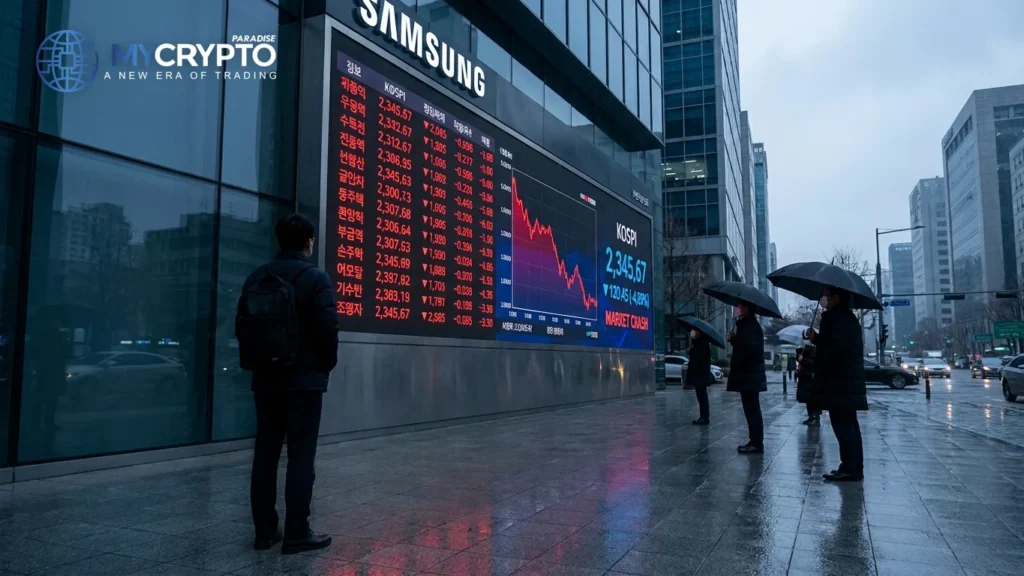
Market briefing: South Korea's KOSPI crashed 6% and tripped a circuit breaker as a US chip selloff tore through Asia overnight. Yet BTC sits near $64,399, barely moving, which tells you a lot about who is actually panicking.
- The KOSPI crashed 6% and triggered a circuit breaker, with every sector red.
- Samsung fell 7%, SK Hynix 8.6% and SK Group 11% as the US chip selloff spread.
- BTC held near $64,399 with no immediate contagion, keeping the focus on $62,500 support.
South Korea's KOSPI crashed 6% and hit a circuit breaker as a US chip selloff spread through Asia. So why is crypto barely flinching?
South Korea woke up to a market in free fall. The KOSPI opened down 5% at 6,528, then losses accelerated until the index was off 6% and every sector had turned red.
The drop was violent enough to trip a circuit breaker. The exchange halted program selling to slow the bleeding, a mechanism reserved for genuine panic rather than an ordinary bad day.
The damage clustered in the names you would expect. Samsung fell 7%. SK Hynix sank 8.6%. SK Group plunged 11%. These are the companies at the heart of the global chip supply chain, so when a US chip selloff tears through overnight, Seoul feels it first and hardest.
This is a story about semiconductors and risk appetite, not about crypto directly. But it matters to crypto anyway, because a circuit breaker in a major Asian market is a clean read on global fear. When one of the world's most export-sensitive indices seizes up, capital everywhere starts asking what else is fragile.
Here is the part that should catch a trader's eye. While Seoul was halting trade, BTC sat near $64,399 and ETH near $1,913, both essentially flat. The single most important fact this morning is not the 6% crash. It is the non-reaction beside it.
Markets that refuse to fall on scary news are telling you something. We spend the rest of this piece working out what.
How a chip selloff signals global fear
The transmission chain here is macro, not mechanical. A US chip selloff hit Asia overnight, and South Korea, home to Samsung and SK Hynix, is the most chip-exposed major market on earth. So the KOSPI became the amplifier for a global growth scare.
When a circuit breaker fires, it does more than pause one index. It broadcasts a signal that risk is being repriced everywhere at once. Traders in every asset class read that halt and quietly move their own stops higher up the risk ladder.
That is how equity stress reaches crypto, even without a single crypto headline. Global risk aversion tightens liquidity. Leveraged players face margin pressure across their whole book, and crypto is often the most liquid thing they can sell to raise cash fast.
But notice the word we keep using: potential. There is no confirmed same-day catalyst linking Seoul's crash to a crypto move, and honesty demands we say so. This is our interpretation of a fragile macro backdrop, not a proven cause.
The deeper point is about correlation regimes. Sometimes crypto trades as a pure risk asset and falls with equities. Sometimes it decouples and trades on its own supply and flow dynamics. This morning looks like the second case, at least so far.
That distinction is the whole game. If the correlation switches back on, a Seoul-style shock becomes a crypto shock. If it stays off, this remains someone else's crisis.
Why the crypto tape stayed quiet
Start with the liquidity picture, then work down the risk curve. A halted equity market pulls capital toward cash and safety, which usually drains liquidity from the riskiest corners first. In a normal contagion, BTC leads the fall, ETH follows harder, and alts get liquidated worst of all.
That cascade simply did not fire this morning. BTC held near $64,399 and ETH near $1,913, both flat on the day. The classic contagion sequence needs a first domino, and BTC declined to fall over.
When the obvious contagion trade fails to trigger, that itself is information. It suggests the marginal seller in crypto is not the same panicked hand dumping Samsung and SK Hynix in Seoul.
ETH matters as the confirmation tell here. In a real deleveraging wave, ETH typically underperforms BTC and drags the alt complex down with it. A flat ETH says the leverage flush many feared has not arrived.
Alts are where any hidden stress would show first, because they are thin and reflexive. For now they are not screaming, which fits a market absorbing an external shock rather than generating its own.
None of this means crypto is immune. It means the correlation is dormant, not dead. A quiet tape into a loud macro event is exactly the setup smart money likes, because retail reads the KOSPI headline and sells the very support that patient capital wants to buy.
What confirms contagion versus a clean decouple
The single cleanest tell is whether crypto starts to move with equities on the next leg of the chip selloff. If Asian and US futures extend lower and BTC finally cracks with them, the correlation has switched back on and this becomes a crypto story too.
The level that decides it is $62,500. As long as BTC defends that support, the equity shock stays contained and the decoupling thesis holds. A clean, high-volume break below $62,500 would be the invalidation, signalling that global deleveraging has finally reached us.
Watch ETH for early warning. If ETH begins leading lower and underperforming BTC, that is the fingerprint of a leverage flush spreading through crypto, and it usually shows before the BTC break confirms it.
Keep one eye on the recovery in Seoul as well. If the KOSPI stabilises after the circuit breaker and buyers step back in, the global fear pulse fades and crypto's calm gets validated cheaply.
Sentiment is the trap to avoid. Retail is already in extreme fear and holding trapped long positions, so a scary equity headline can push them to capitulate near support, which is precisely the wrong place to sell. So the checklist is simple. Contagion confirmed: correlation returns, ETH leads down, $62,500 breaks on volume. Decouple confirmed: BTC holds $62,500, ETH stays firm, KOSPI stabilises and the crypto tape stays boring while the world panics.
What the non-reaction says about positioning
The ParadiseTeam reads this event through one question: did the crypto seller show up? So far the answer is no, and that shapes everything.
Our working line in the sand is $62,500. This Seoul shock does not move that level, it stress-tests it. As long as BTC defends $62,500 while a major equity market is tripping circuit breakers, the market is quietly telling us that patient buyers, not panicked ones, hold the marginal bid near support.
That is the smart-money-versus-retail core of this story. Retail sees a 6% KOSPI crash, feels the extreme fear it already carries, and treats global instability as proof the floor is about to give. Trapped longs are the most likely sellers into that emotion. Smart money watches the same headline and sees liquidity building right where it wants to accumulate.
BTC near $64,399 as of this reading gives us room above support to observe rather than chase. We are not reading this as a signal to press either direction, because the honest verdict is neutral: an external shock with no confirmed crypto catalyst.
What would change our mind is mechanical, not emotional. A volume break of $62,500 with ETH leading down flips this from a contained equity event into genuine contagion. Until that happens, the edge is patience: let retail donate the panic, and respect the level that has not broken.
Track it live: our Crypto Fear and Greed Index and the live crypto funding rates both update in real time, so you can watch this shift for yourself.
Related coverage
For exact entries, targets, and stop losses with full risk management, that is what ParadiseFamilyVIP is for. New to reading these moves? Start with our crypto trading strategies guide.
ParadiseTeam is monitoring the market situation closely, and we are taking these developments into consideration while building our trading tactics inside ParadiseFamilyVIP.
Crypto trading involves substantial risk. Prices are volatile and you can lose money. This article is educational and is not financial advice. Past performance does not guarantee future results.
Does BTC hold $62,500 as the equity selloff plays out?
This is how the Paradisers are calling it. Tap your call.
No calls on this one yet. Tap yours to be the first.
Free account, no password. Members just sign in.






Join the discussion
No comments yet. Members, share how you are reading this.