


Listen: the breakdown
Developing story update (November 05, 2026, 12:06 UTC):
New quarterly data reinforces the share-shift story behind Tron’s widening USDT lead: based on our sources, Tron posted a record stablecoin transfer volume of roughly $2.18 trillion in Q3 alongside a holder base that has grown to about 76.53 million. The headline supply figures are unchanged, with Tron near $93 billion and Ethereum around $68 billion.
For traders, this is confirmation of a slow, multi-quarter migration of stablecoin activity onto Tron’s rails rather than a fresh catalyst. ETH is still higher on the day, so the market is not pricing this as acutely bearish in real time; it reads as longer-run market-share erosion for Ethereum’s settlement dominance.
What to watch now: Whether Tron's quarterly transfer-volume and holder growth keeps compounding versus Ethereum DeFi/TVL stabilising.
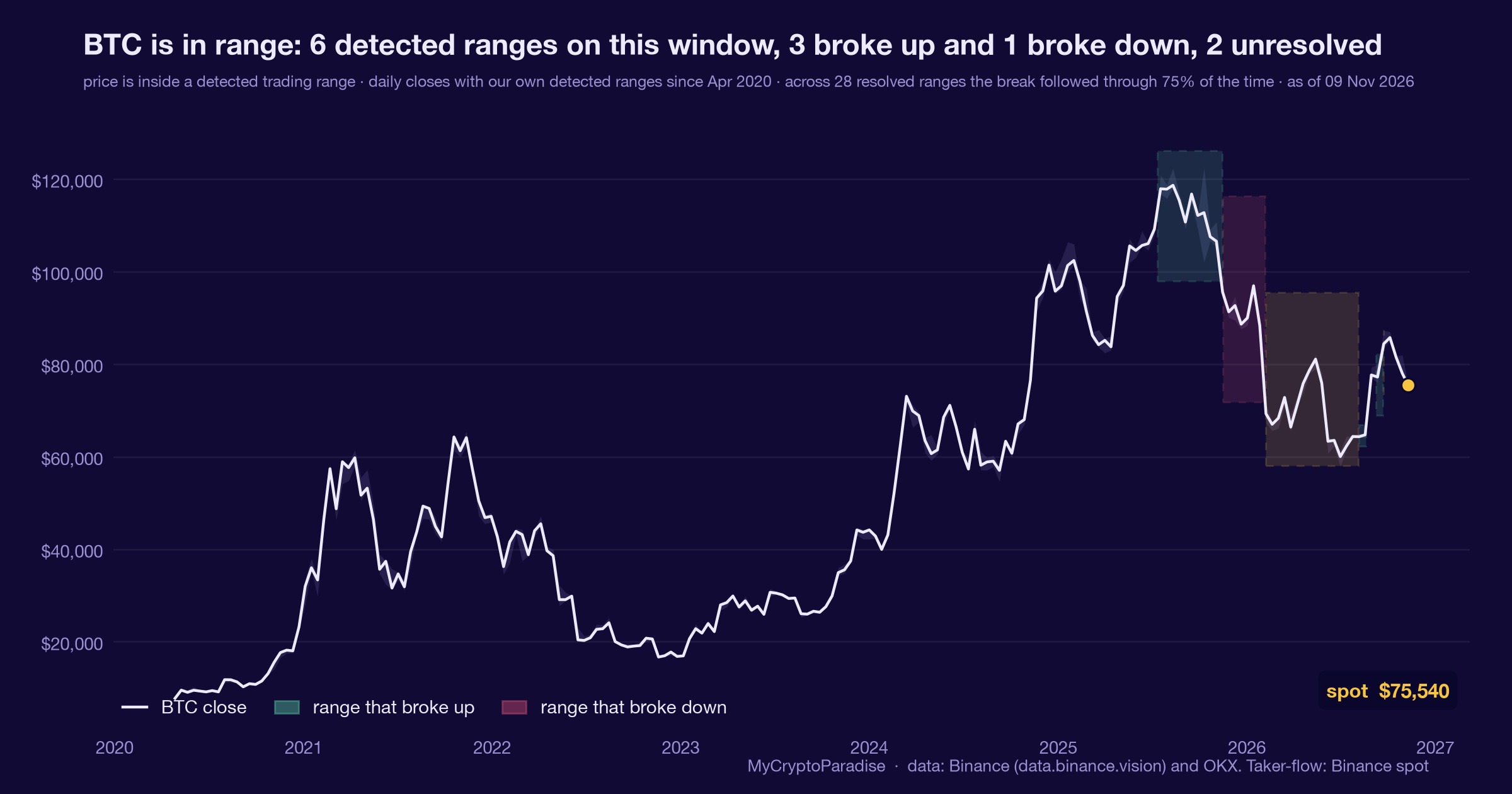
Market briefing: Tron's USDT supply has reached roughly $93 billion, a record $25 billion ahead of Ethereum. It reads as a settlement shift, not a catalyst, with BTC trading near $80,261.
- Tron's USDT supply has climbed to roughly $93 billion
- Its lead over Ethereum widened to a record $25 billion
- Ethereum's USDT supply fell to around $68 billion from a near $89 billion peak
Tron's USDT supply just stretched its lead over Ethereum to a record $25 billion. The dollars did not leave crypto; they changed chains. So what is this quiet migration really telling traders?
The stablecoin map is being redrawn, quietly. Tron's USDT supply has climbed to roughly $93 billion. Its lead over Ethereum now sits at a record $25 billion.
Ethereum tells the other side of the story. Its USDT supply has fallen to around $68 billion. At the peak it carried nearly $89 billion. So more than $20 billion in Tether has drained off one chain's books over time. The dollars did not leave crypto. They simply changed address.
This is not a single-day flow event. It is a slow, multi-month drift in where USDT actually settles. Lower transfer costs and deep liquidity on Tron keep pulling issuance its way. Users follow the cheapest, busiest road, as they always have.
Worth being clear about one thing. ETH traded near $2,418 and rose about 3.82% on the day. That candle is not a reaction to this supply data. Nothing in the evidence ties the two together.
What we have is an infrastructure story, not a catalyst. A record gap in where stablecoins live says plenty about the plumbing. It says very little about today's price.
A $25 billion gap measured in usage
USDT is the working capital of crypto trading. It is the chip most traders move in and out of positions with. So where that supply concentrates shapes where the deepest, cheapest execution lives.
A record $25 billion lead means Tron now hosts the larger pool of that working capital. Settlement and transfers increasingly clear there. For high-volume flows, especially across emerging markets, cost per transaction matters more than any loyalty to a chain.
Ethereum losing over $20 billion of USDT from its peak is not a solvency issue. The Tether is still redeemable, still dollar-backed, still real. What changed is the rails, not the reserves.
The macro read is modest, and we will be honest about that. This is a distribution of usage, not an injection of new money. No fresh capital entered crypto because a transfer settled on one chain instead of another.
That distinction matters for how you weight the headline. A supply gap widening is structural news. It tells you about long-term settlement preference. It does not tell you the next move in BTC or ETH.
Settlement share moves, spot prices do not
Spot markets did not flinch at this data. BTC was trading near $80,261, up about 2.2% on the day, as of 11:16 UTC. That strength has its own drivers, none of them this supply print.
The honest answer on direct price impact is close to none. Stablecoin supply migrating between chains reflects where dollars sit, not whether new dollars arrived. No net liquidity enters or leaves crypto when USDT settles on Tron rather than Ethereum.
For BTC, the read is neutral. The record gap changes nothing about spot demand today. It is a map of the plumbing, not a flow into the asset.
For ETH, the nuance is sharper. Losing USDT share on its own chain is a slow headwind for Ethereum's settlement narrative. But it is not a token-price event, and the 3.82% daily gain is unrelated. ETH can rise while its stablecoin share slips; the two run on different clocks.
Alts feel even less. Where USDT is minted does not decide whether the long tail pumps or bleeds. If anything, the story is a reminder that liquidity depth and transaction cost quietly steer flows that headlines rarely notice.
Signs the stablecoin migration keeps widening
Watch whether the gap keeps widening. A record $25 billion lead confirms the trend only if the next readings extend it. One snapshot is a data point; a direction needs several.
The confirmation is more USDT issuance landing on Tron while Ethereum's share keeps slipping. That would mark settlement preference hardening, not a blip. Emerging-market transfer demand and fee pressure are the forces to track.
The invalidation is a reversal in net issuance. If Ethereum's USDT supply stabilises or climbs back toward its old peak, the migration stalls. Lower Ethereum fees, or a shift in where large issuers mint, would do it.
Keep this apart from spot price entirely. ETH's candle and BTC's day say nothing about the supply trend, and the supply trend says nothing about them. Conflating the two is the easy mistake here. So the thing to monitor for this story is the dashboard, not the chart.
Also worth watching whether rising Tron dominance draws any regulatory attention to where dollar-denominated settlement concentrates. That is a longer arc, but it is the real second-order question.
The chain shift against a crowded bounce
The ParadiseTeam treats this as context, not a trigger. A stablecoin supply gap does not move BTC, and we are not pretending otherwise. The value here is what it tells us about where liquidity actually lives.
Our standing read of the broader tape stays cautious. BTC near $80,261 sits inside a bounce we are watching, not trusting. The weekly and daily structure still leans bearish, with any recovery toward the $90k area a place where selling can reappear.
That caution matters because retail sentiment is warming fast while whales keep offloading. Roughly 67% of whales sold in the past 24 hours, near a 90-day extreme. Longs are crowded and funding is elevated, which is how late-cycle enthusiasm gets absorbed.
So read a record Tron lead headline for what it is. It is not fuel for the bounce and not a reason to chase. Deep stablecoin liquidity on one chain is a settlement fact, not a bid under spot.
If BTC does press higher, the levels we care about sit near the 4-hour resistance at the 0.786 retracement, not in a stablecoin dashboard. Below it, the structure still points lower before any durable turn. This story changes none of that. In short: a useful map, the wrong compass for today's price.
The read behind this: we framed this story through our own market analysis, Bitcoin Longs Pile In While 67% of Whales Sell.
Track it live: our live crypto funding rates and the Crypto Fear and Greed Index both update in real time, so you can watch this shift for yourself.
Related coverage
For exact entries, targets, and stop losses with full risk management, that is what ParadiseFamilyVIP is for. New to reading these moves? Start with our crypto trading strategies guide.
ParadiseTeam is monitoring the market situation closely, and we are taking these developments into consideration while building our trading tactics inside ParadiseFamilyVIP.
Crypto trading involves substantial risk. Prices are volatile and you can lose money. This article is educational and is not financial advice. Past performance does not guarantee future results.
Does Tron's USDT lead over Ethereum keep widening from here?
How 39 Paradisers are calling it
The first call is still open
Free account, no password. Members just sign in.
Follow this topic: Stablecoin news












Join the discussion 37
ngl i watched that gap widen for months and thought nah, should of looked closer 🤦 these days i check where the stables are sitting before i even glance at prices 👀
yeah same here liam.... i only started checking the stables first after my tutoring money kept getting eaten by fees between semesters. what do you look at first now, the total supply or where it's actually moving?
Still thinking about my brother's transfers home, which is why I care more about whether those corridors stay this cheap than which chain wins 👀 Tron's lead only matters to me if people are actually sending money with it 🌍
honestly the part that gets me is how sticky usdt on tron is, people move the money in and then just leave it there. a $25b lead is less about who is faster and more about where the float sits, and thats the number i keep staring at
Honestly this is the part that gets me, my family first held dollars in a USDT wallet because naira kept melting 😭 so a record lead just means more people finding the same thing we did, no need to rush the chart reading 📈
Agree with the read, though I stopped trusting the headline number a long time ago. Old habit from my banking years: I want to see where the balances sit and how fast they move before I believe any lead.
Still learning this side of things, so forgive me.... when a gap gets this big, does it change which chain people use for small transfers, or is it mostly exchanges moving money around? Stablecoins are what kept my tutoring money from melting between semesters, so I read every number twice.
ok i keep a monthly tab of where my usdt sits by chian, debit and credit style, and tron's column is the one that keeps getting heavier 😄
ok this is actually a smart way to track it 😄 do u also log the fees on each chain, or just the balances... still learning which chain is which lol
lowercase start, sorry if this is dumb, but when you say the monthly tab gets heavier on tron, is that the balance sitting there or more like the flow moving through? i honestly cant tell from the outside 😅
wonder if the gap is mostly stablecoins parked between trades rather than real payments, cause those look identicle on chain. does anyone have a split? a record number feels like a signal but i'd want transfer volume before reading into it.
Honestly the lead only means something to me once I split out the transfers. I pulled the raw chain data into a sheet last month, and filtering out exchange wallets shrank the picture quite a bit..
Wish I'd started watching this shift months ago, I was too nervous to look at anything back then!! Still, calling a bigger number a lead makes it sound like a race, and I'm not sure what the finish line is?? Sorry, probably missing something obvious.
Pushing a number like $93 billion on one chain still tells me less than the engine room does.... a big tank level means nothing if you never checked the valves. Before I'd call Tron's lead a sign of anything, I'd want to see who's actually redeeming.
I keep wondering how a $25 billion lead gets measured when the supply figure is itself a self-reported total from the issuer. Would someone point me to the on-chain counts that match the $93 billion before I take the headline at face value?
Right, and that's the part that gets me. a self-reported total is only as good as the issuer's own books. i'd want to see the on-chain balances line up with that $93b before i trust any lead number, especially with how fast those minted counts can move 🤔
not sure a $25 billion gap tells us where people are actually moving.... i keep wondering how much of that just sits on tron because its chep to hold, not because anyone's using it 🤔 what would show real use?
Hannah, that's the part that gets me. On a night shift we'd call it a full tank that's mostly ballast.... Fees are low, so the volume looks big on paper. Maybe the test is whether the balances keep moving when the fees aren't the reason.
Whether that lead means much depends on how many of those coins sit idle versus get moved again, and I'd like to know if anyone has a decent way to tell the difference.
honestly the ship channel taught me that the number on the manifest is never the whole story, you count what is physically in the box. kept a notebook for years. not saying that applies here but i still look at the chain before i look at the headline
Tommy, the manifest line is a good one, but I'd say the box is only half the count. A bigger USDT float on Tron could also mean more people parking dollars where they can move cheaply, which is a different story from speculative demand. Which of the two do you think the chain data is actually showing?
tommy, you didnt answer the question. the chain shows the float grew. it does not show why. so the "cheap to move" story and the "speculation" story look the same on the ledger. i count what is in the box, and right now the box cant tell us which one it is. so i would not call it either one yet
Ok this is wild Tommy... so you count what's actually in the box, got it.... but does anyone know if the USDT on Tron gets redeemed as often as it gets minted? 🤔
wait so if most of the USDT is on Tron now.... does that make sending small amounts cheaper for regular people too? still learning what a wallet even does 😅
Honestly my family paid bank fees for twenty years to send money across borders, so seeing cheap transfers take this much share still makes me smile 😊 Curious if people here move their stablecoins on Tron for the fees or just because everyone else does 🤔
Fair point on the bank fees, Olivia.... but I'd argue the fee savings are only part of why people pick Tron. Most of the volume I see is traders who just need the coin to move where the liquidity already is.
Not sure a bigger USDT number on one chain tells me much, since issuance can climb for reasons unrelated to actual use. I'd want to see transaction activity on each network first.
calling it a record just sounds like a scoreboard to me, a bigger number doesnt say whether anyone is actually moving money on it. what level would you look at before you care
owning a dollar that still buys the same bread next month is the closest thing i have to a savings plan lol. a stablecoin lead this size says a lot about where people from home are parking value, and i'm glad that's getting easier for families.
honestly the timestamps on those USDT mint events are what i'd check first, a $25B lead can look different depending on which week you pull it. logistics brain says a lead like that is just a count until you see when the tokens actually moved.
ok but what matters is who can actually redeem at size on a bad day, and a supply lead doesn't show that. The article treats the $25 billion gap as a shift in where liquidity sits, and I'm not sure it is.
the 25b gap is what i'd look at, not the 93b headline. a lot of that issuance could be treasury minting that doesnt map to anyone actually trading on tron, so i'd want the chain-level flows before i'd call it a shift
Still remember the first time USDT let my family move money when the banks in Beirut wouldn't.... Tron pulling ahead on raw supply is one number, but I'd want to see where those dollars actually sit before calling it a shift.
so the 25b lead is what gets me, a gap that size on one chain says more about where people park dollars than where the price is going. fwiw i'd want to know how much of that is just bridged supply sitting still
the 93b number is just issuance, it doesnt tell me whether anyone is actually using it to trade. where in the plan does a record lead get turned into a reason to act
Fair point on the record not being a plan. Also worth asking whether that $25b gap is mostly one exchange's liquidity, since that changes what the number tells you. Anyway, I'm still waiting on a weekly close to confirm anything 🙂
Fair question, Anna. For me the headline is only the start. I'd watch whether new issuance keeps coming week over week, since a stock that stops growing tells me more than the record does 🙂