


Listen: the breakdown
Developing story update (October 30, 2026, 05:07 UTC):
GoPlus Security: Exploit Breakdown: Polymarket User Asset Theft
On October 29 (UTC), user assets were stolen on Polymarket’s international site, Polymarket[.]com. A supply-chain compromise of third-party performance monitoring provider DebugBear’s RUM script delivered malicious code to user pages. The code abused users’ trading and signing permissions.
Onchain analysis shows that the primary attack path involved 710 DepositWallets and 731 addresses, with approximately $2.71 million in losses. Address counts do not represent unique users.
Polymarket subsequently stated that it had fixed the issue and restored service, pledging full reimbursement for affected traders. Refer to subsequent official announcements for actual reimbursement progress.
Attack flow:
1. The malicious script was delivered through:
cdn.debugbear[.]com/C7xcKKrjUnXK.js
2. It read Polymarket session and account context, traversing React state to locate the existing trading client and signer.
3. It constructed malicious orders, ERC-1155 batch transfers, or EIP-712 DepositWallet batch messages, requested signatures through the existing signer, and submitted the operations to the Polymarket relayer.
4. USDC.e was swapped into POL through Relay Router and sent to the primary consolidation address hardcoded in the malicious script.
5. Funds were then distributed across multiple addresses. Some were bridged to Ethereum, swapped, and consolidated into ETH.
How DebugBear was initially compromised-and exactly which publishing permissions were abused-has yet to be disclosed in an official postmortem.
Attacker’s primary consolidation address:
0x3F99139F1C5854bb628c2e576Aaf638e99dFfc18
Security recommendations:
1⃣ If you used Polymarket[.]com during the affected window, close old tabs and access the site again on a trusted device through official channels. Do not continue using the trading client from a potentially compromised page.
2⃣ Preserve evidence and check all assets, including stablecoins, POL, and ERC-1155 positions. Save transaction hashes, signature prompts, and browser records to support subsequent reimbursement and investigation.
3⃣ Revoke session keys and onchain approvals you no longer need. Check for anomalous ERC-20/ERC-1155 approvals. Revoking approvals cannot recover assets already transferred out.
4⃣ Watch for phishing scams exploiting the incident. Trust only information published through official channels. Never give passwords, verification codes, private keys, or seed phrases to supposed “reimbursement support,” and never pay “unfreeze” or “verification” fees.
Developing story update (October 30, 2026, 03:34 UTC):
BIZINSIDER: Binance and Polymarket are investigating potential hacks. The former says it's frozen around $3 billion
Developing story update (October 30, 2026, 01:02 UTC):
WASHINGTON EXAMINER: Polymarket halts trading after 'security incident' siphons $2.65 million in minutes
Developing story: This story is still unfolding. We are tracking it and will update this article as more details are confirmed.
Market briefing: Polymarket trading has been disrupted, with users and on-chain sleuths reporting more than $2.6 million in losses. BTC was near $78,920, down 2.9% on the day, but the tape looks like broad risk-off, not a Polymarket spillover.
- Users report Polymarket trading disrupted with losses above $2.6 million
- No confirmed mechanism links the disruption to today's BTC and ETH weakness
- Majors slid on their own, with ETH down 4.2% underperforming BTC
Source: Polymarket
Polymarket trading disrupted, users reporting over $2.6M in losses, while BTC and ETH slide in parallel. So is this the catalyst behind the red tape, or a separate story?
Polymarket trading has been disrupted. Users and on-chain sleuths report losses now exceeding $2.6 million. That figure comes from community reporting, not an independently audited account. We treat it as reported, not confirmed. The disruption is real and still developing, so details may change as more wallets get traced.
Polymarket is a prediction market. People stake capital on event outcomes, and that capital sits inside smart contracts. When a platform like that malfunctions or gets exploited, the pain is immediate and personal. Money that was supposed to settle a bet simply does not.
Here is the part worth slowing down for. This landed on a red day across crypto. BTC was trading near $78,920, down 2.9% over 24 hours. ETH was near $2,258, down 4.2%, underperforming BTC.
It is tempting to connect the two. A scary headline and a falling market feel like cause and effect. They rarely are.
We see no evidence tying the Polymarket disruption to broader crypto liquidity. No on-chain trail links those user losses to the BTC and ETH selloff. The majors appear to be sliding on their own, on a broad risk-off tape, with ETH leading the weakness as it often does when risk appetite drains.
So this is a platform-integrity story first. It matters for anyone with prediction-market exposure. It is not, on the evidence in hand, the reason your portfolio is red today.
Platform risk versus the broader tape
Platform integrity is the quiet foundation under every crypto trade. You rarely think about it until it breaks.
When a prediction market reportedly loses users $2.6 million through disruption, the damage is not just the dollars. It is the trust. Traders begin to ask whether the next platform they use will settle correctly, and that question spreads.
That is the real transmission mechanism here, and it is slow, not sudden. Infrastructure failures do not drain macro liquidity. They drain confidence. Confidence is harder to rebuild than a balance sheet, which is why these stories linger long after the price has moved on.
But we have to be honest about scale. Polymarket is one platform. $2.6 million is painful for those affected, yet it is a rounding error against daily crypto volumes. It does not move BTC. It does not move ETH.
The macro picture today is separate and larger. Both majors are down hard, ETH more than BTC. That pattern, with the higher-beta asset falling faster, is the signature of broad risk-off, not an isolated platform event.
So why does this still matter for you? Because the market is already nervous, and nervous markets punish any crack in trust harder than calm ones would. A platform wobble on a green day gets shrugged off. The same wobble on a red day feeds the fear that is already in the room.
Two red stories, one honest read
Let us separate the two threads cleanly, because conflating them is how traders get the day wrong.
Thread one is the broad selloff. BTC near $78,920, down 2.9%. ETH near $2,258, down 4.2%. This is the market that actually moves your account, and it is driven by a risk-off tape, not by Polymarket.
Thread two is the Polymarket disruption. Real, developing, and worth watching if you hold prediction-market exposure. But it is a contained event with no proven reach into BTC or ETH liquidity.
In a normal liquidity cascade, a driver hits macro, macro hits liquidity, and liquidity hits BTC first, then ETH, then alts. That chain does not run here. The disruption never reaches the macro layer, so there is nothing to cascade.
What the story does feed is tone. On a day when majors are already bleeding, a fresh integrity failure adds to the sense that something is off. That is a mild bearish weight on sentiment, not a mechanical hit to price.
Watch ETH leading BTC lower. That is the clearest tell that today is about broad risk appetite, not a single platform. When the higher-beta asset falls faster, money is leaving risk broadly.
The practical takeaway is discipline. Do not trade the BTC chart off a Polymarket headline. One is a sentiment footnote. The other is the tape you actually have to navigate.
Signals that separate cause from noise
First, watch whether the $2.6 million figure holds, rises, or gets revised. Community estimates in the first hours often move. A confirmed on-chain accounting would firm this from developing toward settled, and a much larger number would widen the trust damage.
Second, watch for any official platform statement on the mechanism. Was this a bug, an exploit, or a settlement failure? The answer decides whether this stays contained or spreads to similar platforms.
For the broader tape, the signals are different and more important for your book. Watch whether ETH keeps underperforming BTC. If that gap widens, the risk-off read is confirmed, and this stays a market-wide move rather than anything Polymarket caused.
Invalidation of the risk-off read would be a sharp, broad bounce across majors with ETH recovering faster than BTC. That would say buyers are stepping back into risk, independent of any headline.
The thing that would genuinely change this story is evidence of contagion. If other prediction markets or connected protocols report stress tied to the same cause, the integrity worry stops being isolated. We see no such evidence yet.
So the honest frame is this. One story is developing and narrow. The other is the whole market under pressure. Keep them apart, and you read the day correctly. Merge them, and you will blame the wrong thing for your red screen.
Reading today's selloff without the scapegoat
The ParadiseTeam view is simple. Do not let a dramatic platform headline rewrite your BTC thesis.
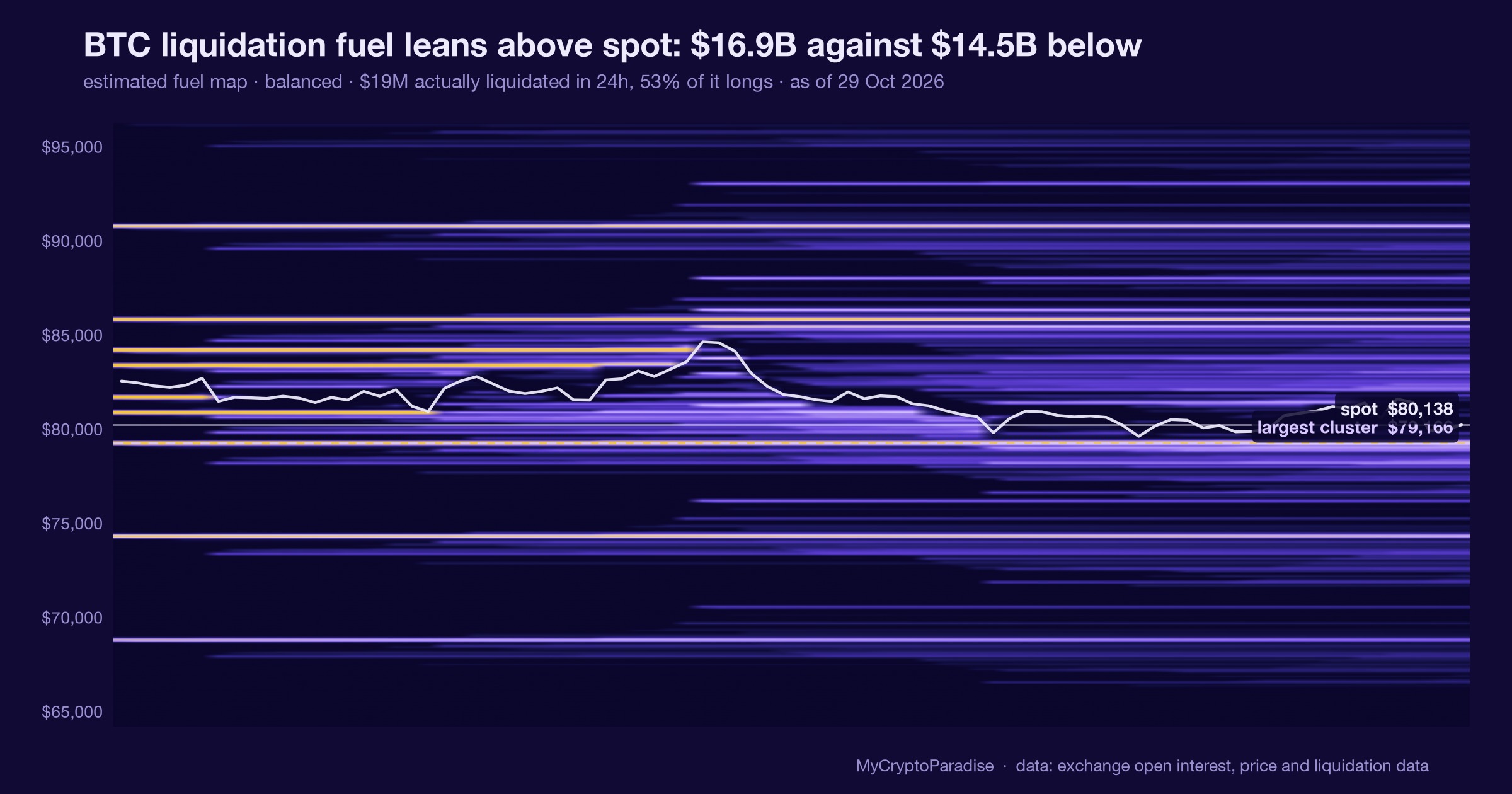
BTC was near $78,920 as of the readings in hand, sitting below the round $80,000 level it recently lost. That lost round number is the near-term pivot that matters far more to your positioning than any prediction-market story.
Reclaiming $80,000 with conviction would suggest buyers are defending this area and the broad selloff is stalling. Losing ground from here, with ETH still leading lower, would say risk appetite is draining further and the tape has more to give.
We want to be clear about who benefits from the confusion. Retail reads a scary $2.6 million headline, sees a red screen, and ties them together. That emotional link is exactly the kind of noise that fuels panic selling into weakness.
Smart money does the opposite. It ignores the footnote and watches the structure: the $80,000 reclaim, whether ETH stops bleeding faster than BTC, whether volume confirms any bounce.
Our standing caution still applies. In a risk-off tape, strength can meet selling at prior resistance, so an aggressive bounce into the levels lost today deserves scepticism, not celebration. So keep your R:R (risk-to-reward) honest and your SL (stop-loss) defined. Trade the BTC chart in front of you, not the headline about a platform you may not even use.
The read behind this: we framed this story through our own market analysis, MCP Tokens: Play Free, Unlock Selected MCP AI Indicators on TradingView.
Track it live: our Crypto Fear and Greed Index and the crypto liquidation heatmap both update in real time, so you can watch this shift for yourself.
Related coverage
For exact entries, targets, and stop losses with full risk management, that is what ParadiseFamilyVIP is for. New to reading these moves? Start with our crypto trading strategies guide.
ParadiseTeam is monitoring the market situation closely, and we are taking these developments into consideration while building our trading tactics inside ParadiseFamilyVIP.
Crypto trading involves substantial risk. Prices are volatile and you can lose money. This article is educational and is not financial advice. Past performance does not guarantee future results.
Does Polymarket's disruption meaningfully dent prediction market trust from here?
How 11 Paradisers are calling it
The first call is still open
Free account, no password. Members just sign in.











Join the discussion 3
Ok so the book froze and then everything dumped on top 😅 my 2021 self would've just held and called it a dip lol, not proud. Still feels like the platform part got buried under the BTC mess 👀
honestly i watch the platform side first, cause if the book is frozen then the selloff is just noise on top. wonder how many of that 2.6m was people who couldnt get out in time
Ah so was the Polymarket glitch a platform thing or did the whole selloff just pile on top of it?? Trying to figure out if I should be worried about my own positions 😅