


Listen: the breakdown
Market briefing: A Hyperliquid whale's leveraged ETH long was fully liquidated for roughly $44 million as Ethereum slipped under $2,100. Bitcoin was trading near $74,253 at the time, down 2% on the day.
- A Hyperliquid whale's ETH long across two accounts was fully liquidated, roughly 56,667 ETH
- Realized losses came to about $44.8 million as ETH broke below the $2,122 to $2,130 band
- Hyperliquid's own liquidity vault absorbed around $87 million of the position
A Hyperliquid whale liquidation just erased a nine-figure ETH long in one slip below $2,100. So when the exchange's own vault ends up holding the bag, who really pays?
A large ETH long on Hyperliquid is gone. The position, spread across two tracked accounts, held roughly 56,667 ETH. It was fully liquidated when Ethereum broke below the $2,122 to $2,130 band, with a recorded mark price near $2,125.
The damage was blunt. Realized losses across the two accounts came to about $44.8 million. A long that was described in nine-figure terms took hours to build and minutes to erase.
The detail that matters sits one layer deeper. Hyperliquid's own liquidity vault, the pool that backstops liquidations, absorbed around $87 million of the position. When a leveraged bet unwinds this fast, someone has to take the other side of the unwind, and here the exchange's own vault stepped in.
The numbers themselves are still being argued over. One set of trackers puts the loss near $44.8 million, another near $48.47 million, and a separate report counts a different roughly $140 million blow-up of BTC and ETH longs in the same window. Hours later, the on-chain crowd still cannot agree on how many accounts were actually run over.
This lands inside a rough session. ETH was down about 5.3% over 24 hours. We will not pretend a single clean catalyst explains that move, because the evidence does not show one. What the evidence does show is forced selling: an over-leveraged long caught on the wrong side of a fast break, flushed out as the market deleveraged around it.
How one liquidation band drains a nine-figure bet
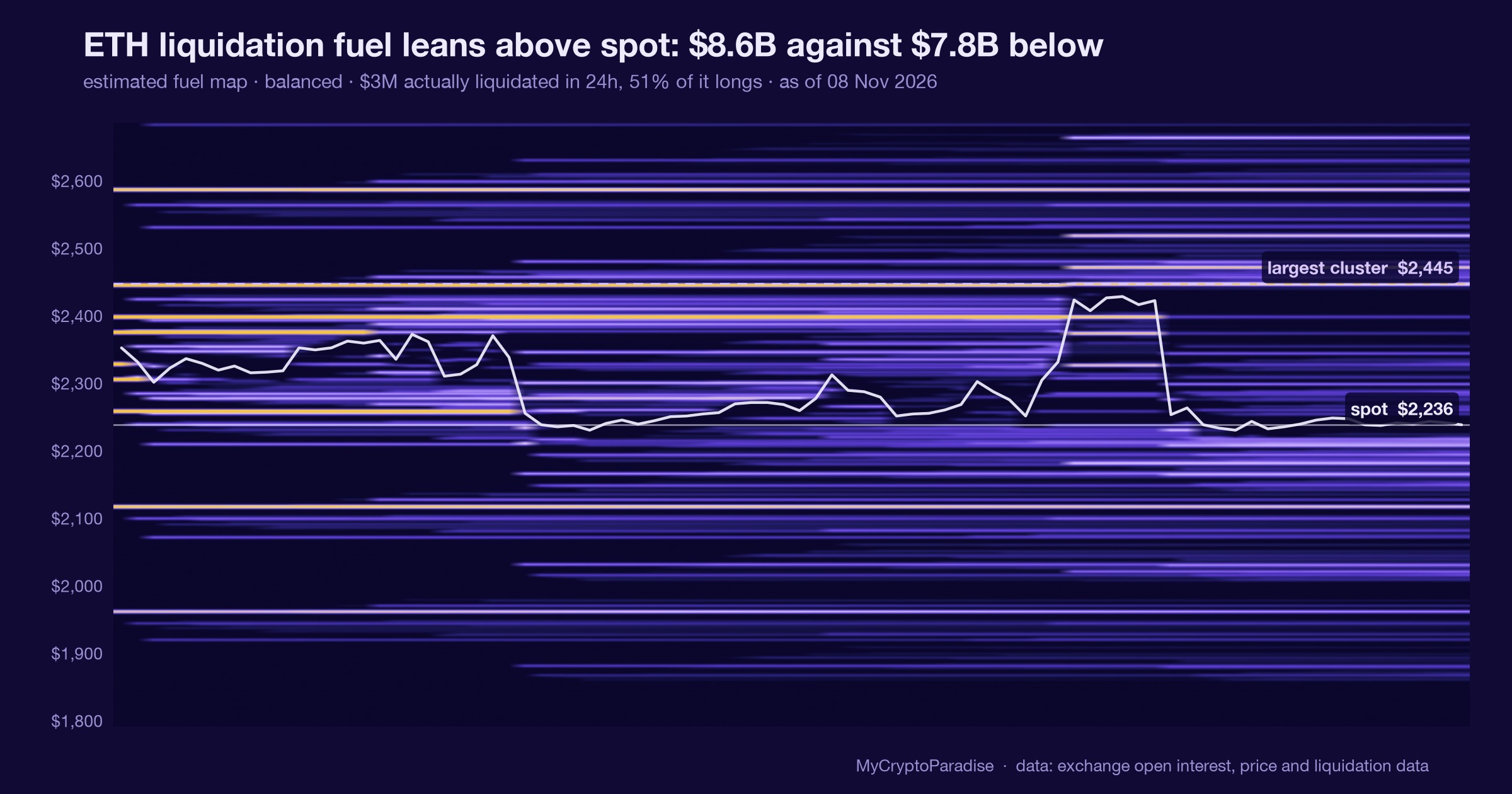
Leverage is the transmission mechanism here, not news. There was no fresh regulatory shock, no hack, no macro print tied cleanly to this move. What there was: a crowded ETH long resting above a known liquidation band, and a market that slid straight through it.
Once price touches a liquidation level, the position stops being a view and becomes an order. The exchange closes it into whatever liquidity is there. That forced sell adds to the very move that triggered it, which is how a 5.3% day turns into a cascade for anyone leaning the wrong way with size.
The vault detail is the part most readers skip and should not. When Hyperliquid's own liquidity pool absorbs $87 million of a liquidated long, the deleveraging is real and heavy, not a cosmetic wick. The system worked as designed, which is precisely why it hurt.
There is a quieter lesson in the accounting. Different trackers still disagree on the loss total hours later. In crypto, even the size of the wreck is a matter of opinion for a while.
For traders the takeaway is structural. Liquidation bands are not background noise. They are where price is drawn when momentum and crowded positioning point the same way, and they explain why a market can fall faster than any single story would justify.
Forced ETH selling and the knock-on risk for longs
Start with the asset at the center. ETH took the direct hit, trading near $2,112 after the break, down roughly 5.3% on the day. The liquidated long did not cause the decline, but it fed it, converting a drop into extra supply at the worst moment for other leveraged longs.
The second-order risk is the cluster. When one large long gets run over below $2,100, nearby stops and liquidation levels sit in the same zone. A separate blow-up of BTC and ETH longs in the same window fits that pattern. Deleveraging rarely happens in isolation; it chains through correlated perpetual futures (perps) markets.
Bitcoin carried the weather, not the wound. BTC was trading near $74,253 as of 06:59 UTC, down about 2% on the day. The deeper pain was concentrated in ETH, but a soft Bitcoin tape gives leveraged alt longs no cushion to lean on.
Alts inherit this mood last and worst. When open interest (OI) in ETH perps flushes, risk appetite thins across smaller tokens that trade as high-beta ETH. Liquidity drains toward the majors first.
Net of it all, this is forced selling, not accumulation. On the facts we have, a single large trader was flushed out in line with a broader down day, not a smart-money bid stepping in to catch a defended level.
Signs the deleveraging has run its course
Watch whether ETH stabilizes above the band it just broke. A reclaim of roughly $2,125 that holds on a retest would suggest the forced selling has cleared and the weak longs are out. That is the constructive outcome, and it needs price to actually close back above the level, not just tag it.
Failure looks different. If ETH keeps pressing under $2,100 with open interest still elevated, more longs sit exposed, and another liquidation leg becomes the path of least resistance. Falling price on rising leverage is the setup that keeps feeding itself.
Track open interest, not just price. A sharp drop in ETH perp OI alongside a steadying price tells you the deleveraging is done. OI staying high while price grinds lower tells you the market has not finished flushing.
Keep one eye on the funding and the vault. If Hyperliquid's liquidity pool quietly offloads the ETH it absorbed into any bounce, that supply caps upside.
Finally, respect the uncertainty in the numbers. The loss total is still disputed, and a separate larger liquidation may or may not be the same event. We treat the clean, confirmed facts as facts and flag the rest as still-forming color. Confirmation is a level that holds; invalidation is a level that keeps breaking.
Reading this flush through the leverage map
The ParadiseTeam frames this as a leverage event, not a trend signal. A crowded ETH long met its liquidation band and became forced supply. Nothing in the facts shows a smart-money bid catching it, so we read it as capitulation by one over-sized trader, consistent with the broader down day.
Apply our standing map to it. BTC was near $74,253 at 06:59 UTC, already sitting below the $76,000 support we track as the key invalidation level. That $76,000, once support, now reads as resistance to reclaim. Below price, the $70,000 to $71,000 zone holds a visible long-liquidation cluster, and this ETH flush is a preview of how that cluster could trigger if BTC follows.
There is a tension worth naming. Our medium-term bias stays bearish toward lower targets, yet whales have been quietly net buying the dip, and a short-covering squeeze toward the $81,700 to $82,500 cluster remains possible if shorts crowd in. This liquidation does not change that tug-of-war; it just reminds over-leveraged longs where the trapdoors are.
So we hold the bearish read on this story while staying alert. Forced selling confirms the active downtrend, but it also thins the longs, which is often how a relief squeeze gets its fuel. We let the levels decide. A $76,000 reclaim shifts the short-term tone; losing $70,000 to $71,000 confirms more downside. Risk-first, size small, and never fund someone else's vault.
The read behind this: we framed this story through our own market analysis, Bitcoin Squeeze to $82K or Crash to $44K?
Track it live: our Crypto Whale Alert and Tracker and the live crypto funding rates both update in real time, so you can watch this shift for yourself.
Related coverage
For exact entries, targets, and stop losses with full risk management, that is what ParadiseFamilyVIP is for. New to reading these moves? Start with our crypto trading strategies guide.
ParadiseTeam is monitoring the market situation closely, and we are taking these developments into consideration while building our trading tactics inside ParadiseFamilyVIP.
Crypto trading involves substantial risk. Prices are volatile and you can lose money. This article is educational and is not financial advice. Past performance does not guarantee future results.
After this ETH flush, where does Ethereum go from here?
How 1 Paradiser is calling it
The first call is still open
Free account, no password. Members just sign in.
Follow this topic: Crypto liquidation news










Join the discussion
No comments yet. Members, share how you are reading this.