


Listen: the breakdown
Market briefing: FinCEN just severed MEXC from the US financial system, accusing it of helping Iran, North Korea and Russia dodge sanctions. BTC sat near $75,812 and barely flinched, but counterparty risk rarely shows up on the chart until withdrawals freeze.
- FinCEN accuses MEXC of aiding Iran, North Korea and Russia in evading sanctions
- MEXC cut off from the US financial system in a venue-specific regulatory action
- BTC near $75,812 and ETH near $2,228 stayed flat, with no broad market repricing yet
Source: U.S. FinCEN
FinCEN just cut MEXC off from the US financial system over alleged Iran, North Korea and Russia sanctions evasion. So is your exchange the real risk on your screen?
FinCEN has moved to sever MEXC from the US financial system. The accusation is serious: that the exchange helped Iran, North Korea and Russia evade sanctions. This is not a price story. It is a plumbing story. A US regulator reaching across borders to cut one exchange off the dollar rails is a compliance event aimed at a single platform, not a broad liquidity shock to crypto.
The market agreed, at least on the surface. BTC was trading near $75,812, down a fraction on the day. ETH held near $2,228. Majors did not blink.
That calm is the trap worth examining. Regulatory actions against exchanges tend to arrive quietly and land slowly. The headline hits, the chart shrugs, and then the real cost surfaces later as withdrawal delays, banking frictions and a scramble to move funds somewhere with cleaner access.
We treat the sanctions-evasion allegation as the confirmed fact it is, and the wider read as our analysis. What changed is confidence in offshore, lightly-regulated rails, not the supply and demand for BTC itself.
For traders, the uncomfortable truth is simple. Your profit and loss lives on a screen, but your money lives on someone else's balance sheet. When a regulator decides that balance sheet is a problem, the chart is the last place you find out.
A regulator severing an offshore rail
The transmission here runs through trust, not through spot flows. FinCEN cutting MEXC off from the US financial system does not drain BTC liquidity directly. It drains confidence in the kind of exchange that operates at the edge of Western oversight.
That matters because crypto still leans heavily on offshore, non-KYC-style rails for leverage and depth. KYC means know-your-customer, the identity checks regulated platforms run. When one large venue loses dollar access over alleged state-sanctions evasion, every user on similar platforms quietly asks the same question: am I next in line if the regulator keeps walking down the list. That question is the real contagion vector. Not price, but perceived counterparty risk.
The macro frame stays contained for now. There is no single confirmed same-day catalyst moving the whole market, so we are honest that the broader read is interpretive. BTC and ETH are flat, which tells us the event is being priced as idiosyncratic to MEXC rather than systemic.
But regulatory pressure compounds. One cutoff invites speculation about which exchange faces scrutiny next, and that speculation alone can nudge funds toward more compliant platforms. Capital does not need a crash to move. It just needs a reason to prefer the safer door.
So the structural shift is subtle. Liquidity may slowly migrate toward regulated exchanges, thinning depth on the venues under a cloud and widening the gap between the compliant and the questionable.
Counterparty fear before any chart moves
Start with where the pressure actually sits. The immediate liquidity effect is local to MEXC and its users, who now face withdrawal and counterparty risk rather than a market-wide drawdown.
BTC is the tell. At roughly $75,812 and essentially flat, it is signalling that spot demand for Bitcoin itself is untouched by this specific action. If this were a systemic liquidity shock, majors would already be repricing. They are not.
ETH mirrors that calm near $2,228, down less than half a percent. The alts that usually amplify any genuine exchange-solvency fear are not showing a coordinated flush either. So the honest read is that no measurable spillover into BTC or ETH spot liquidity has appeared so far. The damage, for now, is reputational and operational, concentrated on one platform.
Where the slow bleed can start is the second-order fear. If users on comparable offshore exchanges rush to withdraw, thin order books on those venues can gap, and forced selling into shallow liquidity can print nasty local wicks that have nothing to do with Bitcoin's real bid.
That is how a compliance headline becomes a price event: not through BTC, but through the leveraged positions parked on the exchanges people suddenly distrust. The cascade, if it comes, flows exchange-first, then into the majors as collateral gets liquidated. We see no sign of that cascade yet, which is exactly why it is worth watching rather than assuming.
Signals separating contained from contagious
The first signal is withdrawals. Watch whether MEXC processes outflows cleanly or whether delays appear. Frozen or throttled withdrawals would turn a regulatory headline into a genuine solvency scare, and that is the moment counterparty risk starts showing up on the chart.
The second is the breadth of the action. This stays contained as long as FinCEN's move reads as a one-platform compliance case. It escalates if the scrutiny visibly extends toward other offshore exchanges, because that is when funds start relocating en masse.
On the majors, the confirmation of contagion would be ugly and specific. A sharp, cross-exchange drop in BTC and ETH with widening spreads and liquidation spikes would tell us the fear has jumped from one balance sheet to the whole leverage stack.
Invalidation of the bearish fear is simpler. If BTC holds its current footing, withdrawals clear normally, and no second exchange is named, this fades into a contained regulatory episode that history files under routine.
Open interest is the quiet gauge here. OI, the total value of open derivative positions, concentrated on the affected and similar platforms is the exposure most at risk if confidence cracks.
So the real watch item is not a candle. It is operational: can users move their money freely. As long as the answer stays yes, the chart keeps telling the truth that this is MEXC's problem, not Bitcoin's. The day that answer changes is the day the market stops shrugging.
What the MEXC cutoff means for liquidity
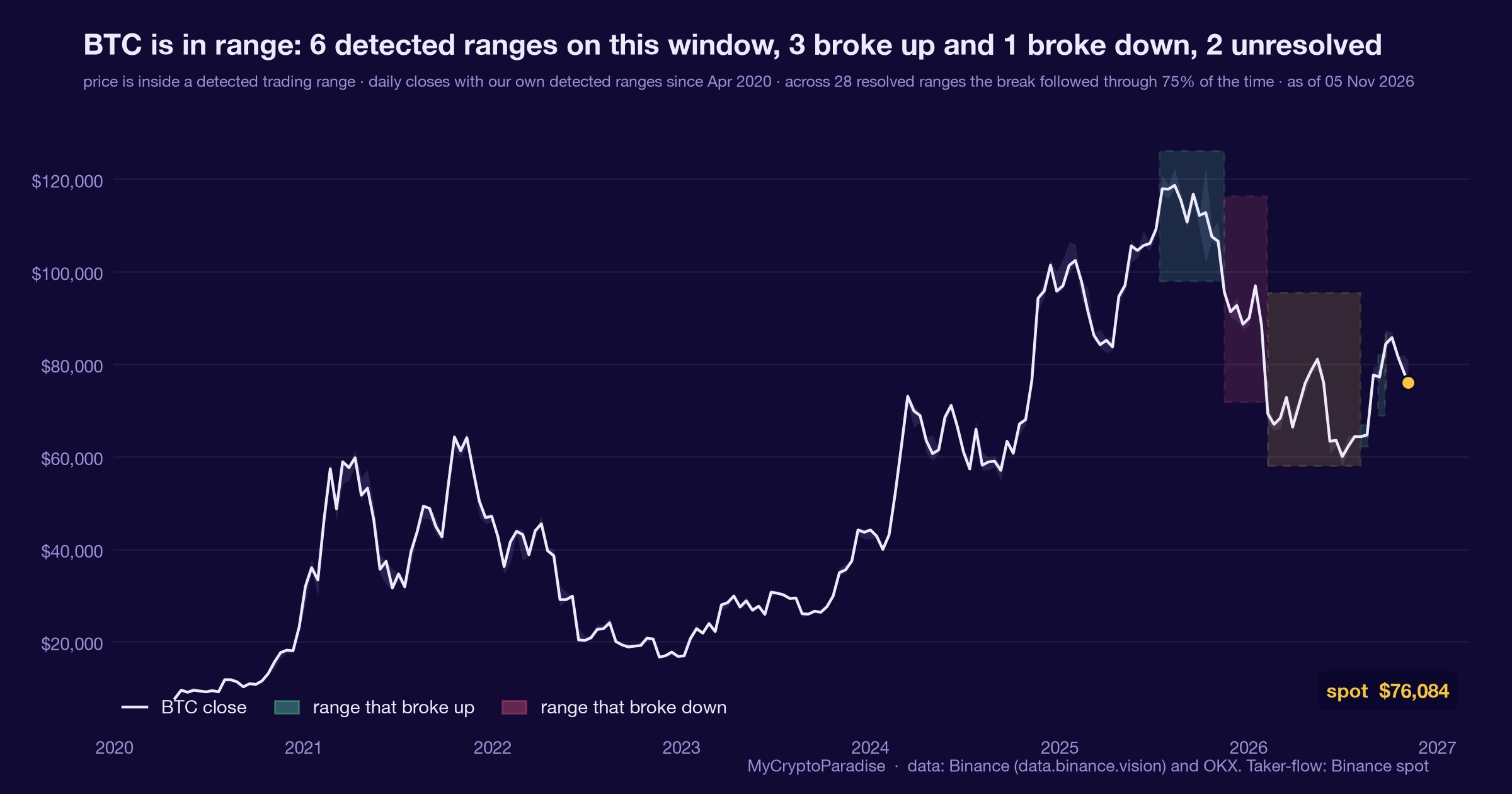
The ParadiseTeam reads this as a counterparty-risk event first and a directional one second. With BTC near $75,812, the story sits right on top of the $76,000 level we have flagged as structurally decisive. That proximity matters. $76,000 is the invalidation line in our current framing, and whales have been quietly net buying this dip, absorbing sell pressure rather than chasing it lower. A regulatory scare landing here is the kind of fear that can shake loose coins into waiting bids.
So the near-term lean is a tug-of-war. The path of least resistance still points toward the $81,700 to $82,500 liquidation cluster, where a large pool of short liquidations sits, if the squeeze fuel ignites. But any strength meeting that zone is relief and short-covering, not a trend change.
To the downside, the $70,000 to $71,000 cluster is where longs get hunted if this fear actually spreads beyond MEXC. That is the level this specific headline threatens if withdrawals freeze and contagion talk builds.
The retail risk is concentration. The ParadiseTeam's standing caution is that over-leveraged positions parked on questionable exchanges are the ones that get liquidated first in a crackdown, not the Bitcoin thesis itself.
Our practical frame: this event does not change BTC's levels, it changes where you hold your BTC. Counterparty risk is the trade this story is actually about, and it is priced in reputation long before it prints on a candle.
The read behind this: we framed this story through our own market analysis, Bitcoin Squeeze to $82K or Crash to $44K?
Track it live: our live crypto funding rates and the Crypto Fear and Greed Index both update in real time, so you can watch this shift for yourself.
Related coverage
For exact entries, targets, and stop losses with full risk management, that is what ParadiseFamilyVIP is for. New to reading these moves? Start with our crypto trading strategies guide.
ParadiseTeam is monitoring the market situation closely, and we are taking these developments into consideration while building our trading tactics inside ParadiseFamilyVIP.
Crypto trading involves substantial risk. Prices are volatile and you can lose money. This article is educational and is not financial advice. Past performance does not guarantee future results.
Does the FinCEN action against MEXC spread to other offshore exchanges?
How 2 Paradisers are calling it
The first call is still open
Free account, no password. Members just sign in.










Join the discussion
No comments yet. Members, share how you are reading this.