


Developing story update (July 03, 2026, 01:41 UTC):
Update: The push back above $62,000 is now being tied to a shift in the macro backdrop. Softer US employment figures and more dovish signals from the Federal Reserve appear to be adding fuel to the bounce off the $57,735 area.
For traders this matters because it means the squeeze that liquidated over $606 million in leveraged shorts is not purely on-chain driven. A weaker jobs picture and a softer rate path tend to support risk assets, so the same whale accumulation of 270,000 BTC now has a macro tailwind behind it rather than fighting it. It raises the probability that the defense of the $57,500 to $59,000 zone holds, though nothing here is guaranteed and leverage can reverse quickly.
What to watch now: Whether follow-through macro data keeps the dovish rate expectations intact and price holds above the $60,500 area.
Developing story update (July 03, 2026, 01:19 UTC):
Update: The rebound above $62,000 followed a deeper drawdown than first reported, with Bitcoin touching a 21-month low near $58,000 before whales absorbed the supply.
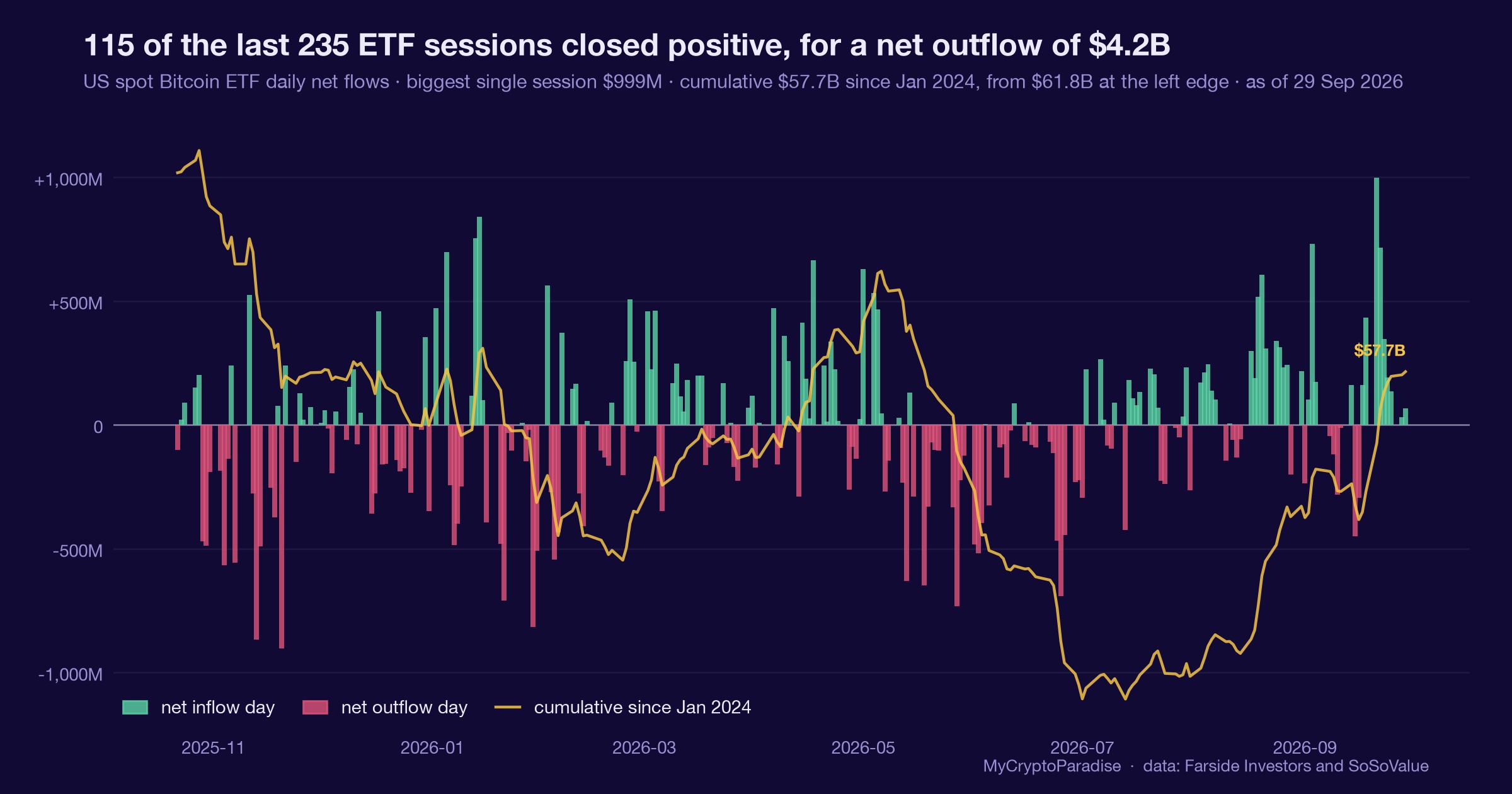
Fresh data also shows spot Bitcoin ETFs shed roughly $4.5 billion in June, the largest monthly outflow since these products launched. That points to institutional distribution running alongside the whale accumulation, so the squeeze higher is happening against a backdrop of heavy ETF selling rather than broad institutional buying.
What to watch now: Whether ETF outflows slow or reverse, which would confirm institutions are following whales back in.
Developing story update (July 03, 2026, 00:58 UTC):
Update: The broader liquidation picture is now clearer. More than $606 million in leveraged positions were wiped out across the move, with the previously noted $130 million in short losses sitting inside that total.
The run also followed a sharp reset. Bitcoin printed a year-to-date low near $57,735 roughly 48 hours earlier, and the whale accumulation that preceded the squeeze built over about two weeks around the $59,000 level, one of the larger accumulation spikes on record.
What to watch now: Whether price can hold above the reclaimed $62,000 area or slips back toward the $59,000 accumulation zone.
Developing story update (July 02, 2026, 23:55 UTC):
Update: The scale of June’s institutional exit is now quantified. Bitcoin ETFs bled roughly $4.5 billion over the month, the heaviest monthly outflow since these products came to market. That helps explain why sentiment sat so fearful into the low near $57,735 and why leverage crowded onto the short side.
For traders, this reframes the squeeze rather than changing the levels. The same wallets absorbing supply near $59,000 were buying into peak institutional selling, which is the classic setup for forced shorts to get cleared once price reclaims a threshold like $62,000. Watch whether ETF flows stabilise from here, as a slowdown in outflows would remove a persistent source of overhead supply.
What to watch now: Whether daily ETF flows turn from heavy outflows toward neutral or inflows in the days ahead.
Developing story update (July 02, 2026, 22:53 UTC):
Update: fresh data shows spot Bitcoin ETFs bled roughly $4.5 billion in outflows during June, which helps explain why so much of the market leaned short into the recent lows.
That backdrop strengthens the read on the move above $62,000. With institutional ETF flows negative and retail positioned for more downside, the whale accumulation near $59,000 absorbed supply into weak hands, and the rebound forced those crowded shorts to cover.
What to watch now: Watch whether ETF flows turn positive in the days ahead, which would confirm demand is broadening beyond on-chain whales.
Developing story update (July 02, 2026, 22:12 UTC):
Update: the squeeze ran wider than first reported. Total leveraged liquidations have now passed 606 million dollars across the move, well beyond the 130 million dollars in short losses we flagged at publication, confirming how heavily the crowd was positioned for more downside.
Fresh on-chain reads place the 270,000 BTC of whale buying tightly around the 59,000 dollar level, near the recent 57,735 dollar low, and characterize it as the largest accumulation spike on record. That points to a firmer demand floor under price rather than a one-off bounce, though follow-through still needs to hold above the low-60,000s.
What to watch now: Whether BTC can hold above the low-60,000s after a 606M+ liquidation flush, or fades back toward the 59,000 accumulation shelf.
Developing story update (July 02, 2026, 21:11 UTC):
Update: The move higher has now forced roughly $130 million in short positions to close as leveraged bets on further downside were squeezed out. This is the mechanical follow-through we flagged: whales absorbing supply into retail fear, then a macro nudge from softer US jobs data tipping over-leveraged shorts.
For traders, the takeaway is unchanged. Chasing strength with high leverage into a squeeze is where the pain tends to land. The healthier read is watching whether accumulation holds on any pullback rather than the size of the liquidation number itself.
What to watch now: Whether whale accumulation holds on the next pullback, or if the squeeze was a one-off flush of shorts.
Developing story update (July 02, 2026, 20:50 UTC):
Update: The ETF outflow picture behind this move has now been quantified. June saw roughly $4.5 billion leave the spot Bitcoin ETFs, the heaviest single month of outflows since these products launched. That is the fear side of the divergence we flagged.
The read does not change. While paper hands exited through the ETF wrapper, whale wallets absorbed about 270,000 BTC over the same two-week window, with price probing a low near $58,000 before reclaiming $62,000. When record ETF selling is met by steady spot accumulation, it more often signals an exchange of hands than a broken trend, though nothing is guaranteed and leverage can still force sharp two-way swings.
What to watch now: Whether spot whale accumulation keeps absorbing ETF outflows or the outflow pace accelerates and overwhelms it.
Developing story update (July 02, 2026, 19:05 UTC):
Update: Fresh flow data adds a wrinkle to the spot accumulation story. Bitcoin exchange-traded funds saw more than $290 million in outflows, even as Ether and Solana products drew inflows.
For traders, this points to rotation rather than broad de-risking: whales are absorbing spot supply while some institutional money rebalances toward other majors. The setup stays constructive, but it likely needs a decisive break of the $62,700 and $65,000 resistance to confirm continuation, otherwise consolidation risk remains.
What to watch now: Whether BTC ETF outflows reverse or continue while price holds above $60,000, and a decisive break of $62,700 then $65,000.
Listen: the breakdown
Market briefing: Bitcoin pushed above $62,000 and now trades near $61,674. Whales quietly added 270,000 BTC over two weeks while $130 million in shorts were forced out.
- Whales accumulated over 270,000 BTC across the past two weeks
- Bitcoin above $62,000 forced $130 million in short losses
- Weak US jobs data eased rate-hike fears and lifted risk appetite
Bitcoin pushed above $62,000 while whales quietly absorbed 270,000 BTC and $130M in shorts were wiped out. So who was really buying the fear?
Bitcoin pushed above $62,000 this week. It now trades near $61,674, up more than 4% from its recent lows.
We have covered this bounce from two angles already today: extreme fear at the lows, and shorts squeezing as Fed optimism returned.
Here is what is new. Over the past two weeks, whales accumulated more than 270,000 BTC.
That is not a headline chase. That is patient, sustained spot buying while retail was busy panicking.
Then weak US jobs data arrived. It softened inflation fears and eased worries about aggressive rate hikes.
Risk appetite returned, and the price moved. As it broke $62,000, leveraged shorts got caught.
Around $130 million in short positions were liquidated. Traders who bet on further downside became the fuel for the move up.
There is no single confirmed catalyst behind the exact timing. That part is our interpretation, not a proven fact.
What we can state plainly is the setup. Large holders bought spot into weakness, and macro gave the crowd a reason to cover.
The result was a familiar one. The people most confident about lower prices paid for the rally they were betting against.
Why weak jobs data lifted risk appetite
The driver here is liquidity, and liquidity starts with the Federal Reserve.
Weak US jobs data softened inflation fears. It also eased expectations of aggressive rate hikes.
When rate-hike fears fade, money gets cheaper in the market's mind. That tends to lift appetite for risk assets like Bitcoin.
This is the transmission chain in plain terms. Softer macro leads to looser expectations, which leads to more speculative flow.
But macro alone does not move price on a single day. It needs a coiled market to react against.
That is what the 270,000 BTC of accumulation provided. A thin supply of willing sellers sat under a crowd of leveraged shorts.
So the same news landed with force. A softer rate outlook met a market already primed to squeeze.
This is why the read matters more than the number. The jobs print did not create the move by itself.
It released tension that was already built by weeks of quiet spot buying. The macro was the trigger, not the whole story.
Markets rarely reward the obvious explanation. The interesting question is never the news itself, but who was positioned before it arrived.
How the squeeze rippled from Bitcoin outward
The first effect showed up in Bitcoin's own derivatives. Shorts betting below $62,000 were forced to buy back, adding pressure to the upside.
That $130 million in liquidations is not just a loss number. Each forced buy-back becomes demand that pushes price higher.
Spot accumulation is the anchor underneath it. Whales holding 270,000 BTC provide a floor that futures selling struggles to break.
That combination matters. Spot buying is real money; futures shorting is often borrowed conviction.
When the two collide, the borrowed side usually blinks first. This time it did, near $130 million worth.
Ethereum tends to follow this rhythm with a lag. A Bitcoin short squeeze eases pressure across the majors and lifts sentiment.
Alts sit further out on the risk curve. They react last, and they react hardest, in both directions.
So a Bitcoin-led relief move can spill into Ethereum and then into smaller caps. That spread is where retail often chases late.
We would caution against reading this as a clean trend. A squeeze is a mechanical event, not proof of sustained demand.
The rally's quality depends on what happens after the shorts finish covering. That is the part the liquidation number cannot tell you.
What confirms the reaccumulation and what breaks it
The key question now is whether spot demand stays after the squeeze fades. Squeezes provide fuel, not a foundation.
Watch spot volume for genuine absorption of supply. Sustained buying, not just short covering, would confirm the accumulation story.
Watch funding rates closely. If they stay negative, more shorts are crowding in, which keeps squeeze fuel on the table.
Watch whether whale holdings keep growing. Continued accumulation past 270,000 BTC would strengthen the reaccumulation read.
Now the invalidation side, stated honestly. This is where risk lives.
If price fails to hold above $60,000, the move looks like a squeeze that ran out of buyers. That would weaken the bullish case quickly.
A sharp drop back toward the recent lows near $57,500 would matter. It would suggest spot demand was thinner than the bounce implied.
Also watch for exhaustion signs at resistance. A stall with fading volume often marks distribution, not continuation.
Our macro anchor stays the same throughout. Everything traces back to rate-hike fears easing and liquidity conditions.
If jobs or inflation data flips that narrative, the risk-appetite tailwind weakens. Then this rally loses the macro leg it was standing on.
What the whale buying signals for BTC liquidity
Here is the ParadiseTeam read, applied to this specific event.
Our current lens is cautious. We have been watching for an exchange of hands in the $44,000 to $55,000 zone before any real reversal toward $79,000.
This week's push above $62,000 sits above that zone. So we treat the move as strength to test, not strength to trust yet.
The 270,000 BTC of accumulation fits our smart-money picture. Large holders absorb spot supply while retail bets on downside with borrowed money.
The $130 million short liquidation is that dynamic in action. Fearful, leveraged retail became the exit liquidity for the squeeze.
We are watching the $60,500 area as near-term resistance. Holding above it keeps the reaccumulation case alive.
The $57,500 buy wall is our line beneath price. Losing it would put the lower $44,000 boundary of our zone back in the conversation.
Stops now sit awkwardly for both sides. Short stops cluster just above; long stops sit below $60,000.
What confirms our read is spot volume absorbing supply near current levels. What invalidates it is a fast reversal back into the low $57,000s.
Probabilities, not promises. We favor patient reaccumulation over chasing a squeeze that has already paid out.
For exact entries, targets, and stop losses with full risk management, that is what ParadiseFamilyVIP is for. New to reading these moves? Start with our crypto trading strategies guide.
ParadiseTeam is monitoring the market situation closely, and we are taking these developments into consideration while building our trading tactics inside ParadiseFamilyVIP.
Crypto trading involves substantial risk. Prices are volatile and you can lose money. This article is educational and is not financial advice. Past performance does not guarantee future results.








Join the discussion
No comments yet. Members, share how you are reading this.