

Crypto Staking Explained
In short
The best staking coins in 2026 are those with sustainable yields backed by real network usage, strong adoption, and liquidity, rather than solely high APY from inflation. Tokens like Ethereum, Solana, Cosmos, Avalanche, Cardano, and Polkadot are notable examples due to their rewards being linked to actual network activity. This approach helps stakers preserve purchasing power over time, distinguishing sustainable rewards from those that are essentially inflation masked as yield.
In 2026, the concept of passive income in the cryptocurrency space has gained both appeal and misunderstanding. Each market cycle brings a wave of claims about high yields and automated rewards. There are tokens that are said to work for you while you sleep.
However, as the market continues to mature, one fact becomes evident: not all staking rewards hold the same value. Some rewards are sustainable because they are linked to actual network activity while others are essentially inflation masked as yield. This distinction is important, especially for those investors who are focused on preserving capital over merely achieving short-term gains. In the realm of cryptocurrency, it is easy to earn yield, but maintaining purchasing power proves to be more challenging.
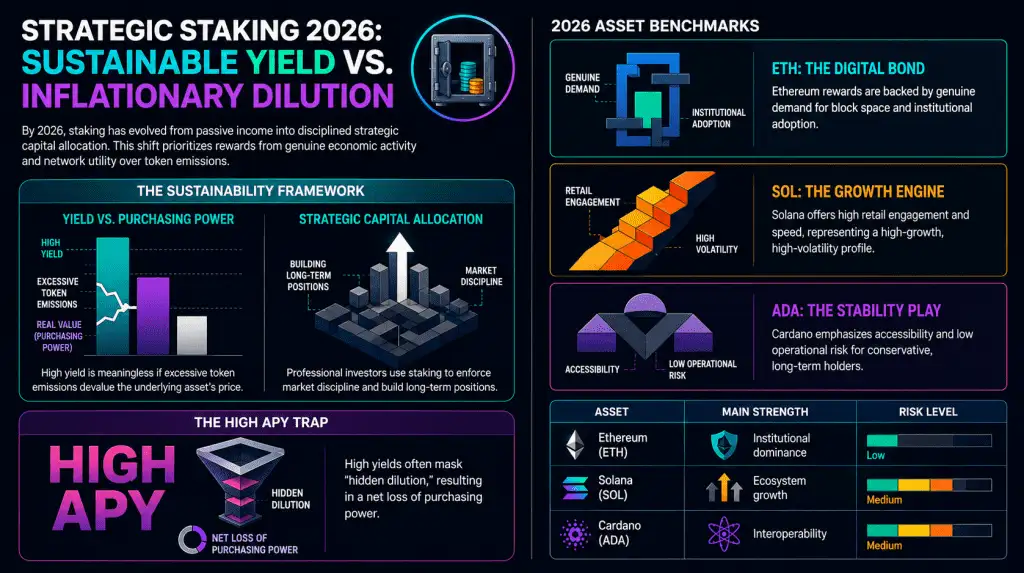
The top staking coins in 2026 are not simply those that provide the highest annual percentage yield. They are networks that effectively balance security, user adoption, token utility, and reward models that are sustainable. These networks reward participation without unintentionally devaluing their tokens through excessive emissions. This article will outline the strongest staking opportunities in 2026 and discuss why professional investors are increasingly viewing staking not as a means of passive income but as a form of strategic capital allocation.
What Makes a Staking Coin Worth Holding in 2026
Staking has evolved beyond being just a technical process. It is now an integral part of how blockchain economies operate. In proof-of-stake networks, validators are responsible for securing the blockchain and processing transactions. Participants who stake their assets earn rewards in return, which may be derived from transaction fees, token emissions, or protocol incentives. However, high yield by itself does not carry significant meaning.
Professional investors assess staking opportunities through five key criteria: network adoption and usage, the relationship between token inflation and real demand, the level of validator decentralization, the flexibility of liquidity, and the potential for long-term ecosystem growth. A staking reward is only appealing if the underlying asset maintains its value over time. The best staking coins in 2026 combine yield with durability.
Ethereum (ETH)
Ethereum continues to be the benchmark staking asset in the cryptocurrency market. Its dominance is based on a straightforward reality: Ethereum is not merely a blockchain. It serves as the foundational layer for much of decentralized finance, tokenized assets, and smart contract activities.
By 2026, staking ETH has transformed into something akin to digital bond exposure within the cryptocurrency markets. Validators secure the network and earn rewards that are generated from transaction fees and protocol issuance. Given that Ethereum supports a vast ecosystem, its staking rewards are backed by genuine network usage rather than just inflation. This distinction is significant. Many staking coins produce yield by creating additional tokens. In contrast, Ethereum derives a substantial part of its rewards from actual demand for block space.
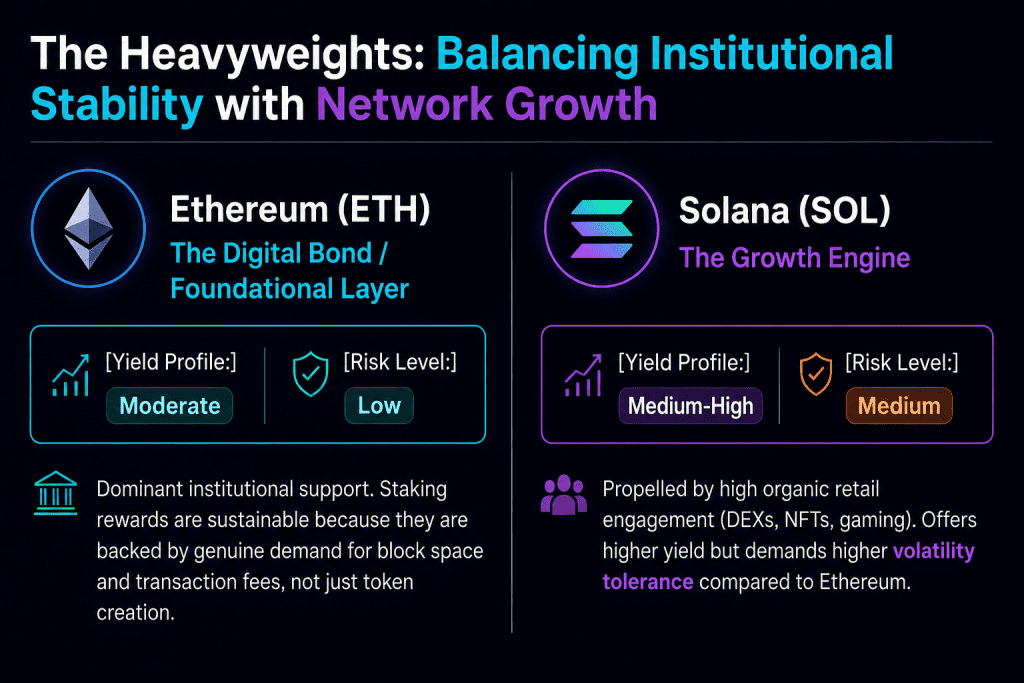
For long-term investors, ETH staking provides a combination that is not commonly found in the cryptocurrency landscape: relative stability, institutional adoption, yield generation, and strong liquidity. Liquid staking platforms have also increased flexibility, allowing investors to stake ETH while retaining access to liquidity through derivative tokens. Although Ethereum may not present the highest APY in the market, it remains a robust example of sustainable staking economics.
Solana (SOL)
Solana has emerged as one of the most actively utilized proof-of-stake ecosystems in the cryptocurrency space. Its appeal lies in its speed, low transaction costs, and strong engagement from retail investors. By 2026, Solana supports a growing ecosystem that includes decentralized exchanges, NFT platforms, gaming applications, and payment infrastructures. This ongoing activity bolsters validator demand and enhances staking participation.
SOL staking rewards continue to be attractive due to the expanding network usage. Unlike smaller chains that depend heavily on inflationary incentives, Solana increasingly benefits from organic activity.
For investors, SOL staking offers the potential for higher yields compared to Ethereum, albeit with greater volatility. This tradeoff defines Solana’s role within investment portfolios. Ethereum symbolizes stability, while Solana embodies growth. Professional investors often find value in combining both assets.
Cosmos (ATOM)
Cosmos has long been acknowledged for its staking ecosystem. Its central vision focuses on interoperability, allowing different blockchains to communicate and transfer assets seamlessly. In 2026, this narrative remains relevant as fragmented ecosystems compete for liquidity. ATOM staking rewards are generally higher than those of Ethereum, in part due to Cosmos’ emphasis on incentivizing network participation.
The structure of the Cosmos ecosystem is particularly appealing. Many projects within the Cosmos network also provide staking opportunities, creating layered participation across interconnected chains.
For long-term stakers, Cosmos offers exposure to the foundational layer of blockchain interoperability. However, investors need to monitor token inflation and governance developments closely, as these factors significantly impact long-term value retention.
Avalanche (AVAX)
Avalanche has established itself as one of the most robust enterprise-friendly proof-of-stake networks. Its subnet architecture allows developers and institutions to create tailored blockchain environments for specific applications. This flexibility has drawn increasing institutional interest by 2026. AVAX staking rewards benefit from the growing activity within the ecosystem while maintaining relatively accessible requirements for validator participation. The network effectively balances speed, scalability, and decentralization better than many competing chains.
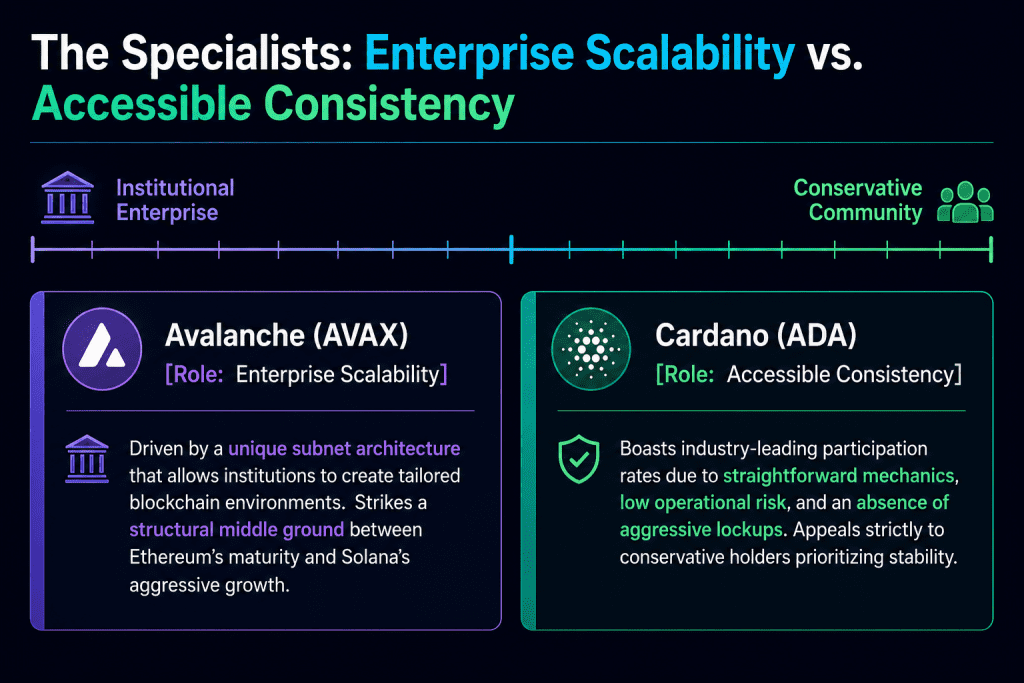
For investors, Avalanche offers a middle ground between the maturity of Ethereum and the aggressive growth profile of Solana. Its staking attractiveness lies not only in the rewards but also in the broader adoption potential of its infrastructure.
Cardano (ADA)
Cardano remains one of the most debated staking ecosystems in the cryptocurrency space. Supporters regard it as one of the most academically rigorous blockchain projects, while critics claim its growth has lagged behind competitors. Nevertheless, in 2026, Cardano still boasts one of the highest staking participation rates in the industry. One factor contributing to this is accessibility. ADA staking is straightforward, presents low operational risk, and does not aggressively lock assets compared to certain networks.
This simplicity attracts long-term holders who favor stability and passive participation over aggressive yield chasing. The expansion of Cardano’s ecosystem has been gradual rather than explosive. However, its strong community and staking culture continue to support network participation. For conservative crypto investors, ADA remains relevant.
Polkadot (DOT)
Polkadot centers on multi-chain infrastructure and interoperability. Its ecosystem design allows multiple specialized blockchains to operate within a unified security framework. This setup creates ongoing demand for staking participation, as validators are essential for maintaining network security and governance. DOT staking rewards remain relatively competitive in 2026, particularly for investors willing to engage directly in validator nomination systems.
The long-term attraction of Polkadot heavily relies on whether interoperability becomes increasingly critical as blockchain ecosystems expand. For investors who believe the future of crypto involves many interconnected chains rather than a single dominant network, DOT remains an important staking asset.
Why High APY Can Be Dangerous
One of the most significant mistakes made in staking is equating high yield with high quality. Many smaller projects promote very appealing APYs, but these rewards are frequently financed through aggressive token inflation instead of genuine economic activity. This leads to hidden dilution. An investor might technically earn a greater number of tokens while simultaneously experiencing a loss in purchasing power due to the rapid expansion of token supply.
Professional investors recognize this. They concentrate less on raw APY and more on real network demand, token utility, long-term sustainability, and liquidity depth. Sustainable yield is more important than temporary excitement.
The Hidden Advantage of Staking During Market Cycles
Staking generates more than just rewards. It influences investor behavior. Staked assets are psychologically more difficult to sell in a panic. This encourages a long-term perspective and reduces impulsive decision-making during times of volatility. Many professional investors utilize staking as a means to stay engaged with long-term positions while generating additional returns during slower market phases. In this way, staking serves not only as an income strategy but also as a mechanism for discipline.
Comparison: Best Staking Coins in 2026
| Coin | Main Strength | Average Yield Profile | Risk Level |
| Ethereum (ETH) | Institutional adoption and ecosystem dominance | Moderate | Low |
| Solana (SOL) | High activity and ecosystem growth | Medium-High | Medium |
| Cosmos (ATOM) | Interoperability infrastructure | High | Medium |
| Avalanche (AVAX) | Enterprise scalability | Medium | Medium |
| Cardano (ADA) | Accessible staking system | Moderate | Low-Medium |
| Polkadot (DOT) | Multi-chain architecture | Medium-High | Medium |
The best staking coins in 2026 are not necessarily those that promise the highest returns. They are the ones that balance yield, adoption, liquidity, and long-term survivability. Ethereum provides structural strength. Solana offers growth. Cosmos and Polkadot provide exposure to interoperability. Avalanche presents scalability potential. Cardano offers simplicity and consistency. Each of these reflects a different philosophy concerning blockchain participation. In the cryptocurrency space, passive income is never truly passive. The most substantial returns belong to investors who comprehend what they hold and why it is significant.
Where Investors Learn to Stake Strategically
Most investors approach staking based on emotions. They chase after APY. In contrast, professional investors take a structural approach. Inside ParadiseFamilyVIP, staking is regarded as a component of a larger portfolio strategy that involves risk management, market cycles, and capital preservation. The objective is not merely to earn more tokens but to build positions that will still hold value years later.
Crypto Staking FAQ
What makes a staking coin worth holding in 2026?
Professional investors weigh five criteria: network adoption and usage, the balance between token inflation and real demand, validator decentralization, liquidity flexibility, and long-term ecosystem growth. A reward is only appealing if the underlying asset holds its value over time.
Which staking coin is considered the safest?
Ethereum is widely viewed as the safest staking asset because of its broad adoption, deep liquidity, and institutional support. Its rewards come largely from genuine demand for block space rather than newly issued tokens.
Why can a high APY be dangerous?
Many smaller projects fund attractive APYs through aggressive token inflation rather than real economic activity. This causes hidden dilution, where you earn more tokens but lose purchasing power as supply expands rapidly.
How does staking affect investor behavior during market cycles?
Staked assets are psychologically harder to sell in a panic, which encourages a long-term perspective and reduces impulsive decisions during volatility. Many investors use staking as a discipline mechanism, not only an income source.
Crypto trading involves substantial risk of loss. This article is educational and is not financial advice. Past performance does not guarantee future results. Always do your own research.
What is different here
Most guides stop at the theory. The MyCryptoParadise team shares the live trades, and the reasoning behind each one, inside ParadiseFamilyVIP. Everything here is education, not financial advice.
Crypto trading involves substantial risk and is not suitable for everyone. Nothing here is financial advice; it is education only. Never risk more than you can afford to lose.





Join the discussion
No comments yet. Members, share how you are reading this.