

Crypto Signals Quality
In short
High-quality crypto signals come from a structured, repeatable process: defined risk management, a clear stop loss, transparent wins and losses, and reasoning behind every entry. Low-quality ones rely on hype, hidden losses, reckless leverage, low-liquidity coins, and FOMO marketing. Judge a provider by consistency across a full market cycle, not isolated wins in a bull run.
Every day, crypto traders are flooded with crypto signals across Telegram, Discord, and private communities. Some promise fast profits. Others showcase their impressive 100% win rate. On the surface, everything appears convincing.
But here’s the reality most crypto traders discover too late:
Access to crypto signals is easy. Knowing which ones deserve your capital is not.
In the crypto market, the difference between a disciplined signal and a reckless one is often invisible to the untrained eye. Both may look similar at first glance, with the same charts, entry levels, and confident tone. But over time, their outcomes couldn’t be more different.
This is where most traders struggle. They don’t lose because the signals don’t work. They lose because they follow signals built on weak foundations:
- No real risk management strategy,
- No structured crypto trading strategy,
- Lack of consistency across market conditions.
The survival of fake social media influencers is threatened when market volatility increases or trend changes. Skilled crypto traders use crypto signals differently:
- Experienced traders don’t chase hype,
- They don’t rely on isolated wins,
- They treat the market as a business, develop a winning strategy, and continuously improve.
In crypto trading, one truth always holds that the quality of a crypto signal is defined long before the trade plays out. This guide is built to help you see that difference clearly.
You’ll learn how to:
- Identify the traits of structured and high-quality signal providers
- Recognize warning signs before they wipe out your capital
- Evaluate whether a signal fits into a sustainable trading approach
More importantly, you’ll start thinking like a trader who filters opportunities, not one who blindly follows them. Because in the long run, success in crypto isn’t about finding more signals. It’s about trusting the right ones and ignoring the rest.
Why Many Crypto Signal Providers Fail to Deliver?
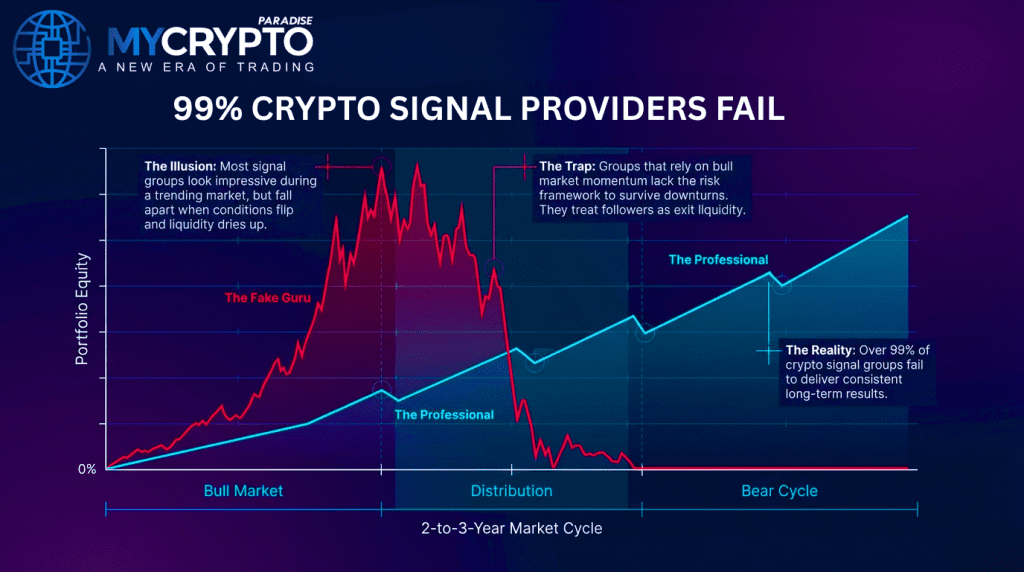
At first glance, many crypto signal providers appear highly skilled. During strong market conditions, especially in bullish phases, it is easy for almost any group to look profitable. Trades hit targets, charts look clean, and confidence spreads quickly across the community. For new traders, this creates the illusion that they have found a reliable edge.
But the market does not stay bullish forever. As soon as conditions shift, volatility increases, liquidity changes, or trends begin to weaken, the gap between genuine crypto signal providers and those with weak offerings becomes apparent.
- This is where most signal groups begin to fail.
- The core issue is not bad luck. It is the absence of a trading strategy.
Many providers operate without a clear system. Their decisions are often influenced by short term market noise, social sentiment, or emotional reactions rather than a defined trading strategy. While this approach may produce occasional wins, it cannot survive changing market trends.
Over time, several patterns start to appear. Some providers become inconsistent, shifting from one strategy to another without direction. Others continue forcing trades even when the market offers no clear opportunity. Many begin to hide losses, highlight only winning trades, or quietly stop sharing results altogether.
These behaviors are not random. They are symptoms of a deeper problem. There is no repeatable edge behind the signals.
Consistent trading is built on probability, discipline, and proper risk management. It requires the ability to adapt while still following a structured framework. Without that foundation, performance becomes unstable and eventually breaks down.
Time exposes this reality. A signal provider may look impressive over a few weeks or even months, but across a full market cycle, weaknesses always surface. This is why short term results can be misleading, while long term consistency tells the real story. The difference between strong and weak providers becomes clear when you observe how they behave under pressure.
- Unstructured providers react to the market. Professional traders prepare for it.
- Unstructured providers focus on outcomes. Professional traders focus on execution.
- Unstructured providers rely on momentum. Professional traders rely on a system.
Understanding this distinction is critical. Because before you can identify high quality signals, you need to recognize why most signals fail in the first place.
Red Flags: Warning Signs of Low-Quality or Scam Signals
Not all bad signal providers look dangerous at first. In fact, many of them appear skilled on the surface. Clean charts, confident language, active communities, and frequent crypto signals can easily create the impression of expertise. For inexperienced traders, this is often enough to build trust.
But in reality, weak providers leave behind patterns. These patterns are not always obvious in a single trade. They reveal themselves through behavior, consistency, and how decisions are made over time. Once you understand what to look for, it becomes much easier to filter out unreliable groups before they impact your capital.
Below are the most important warning signs that separate structured trading from noise.
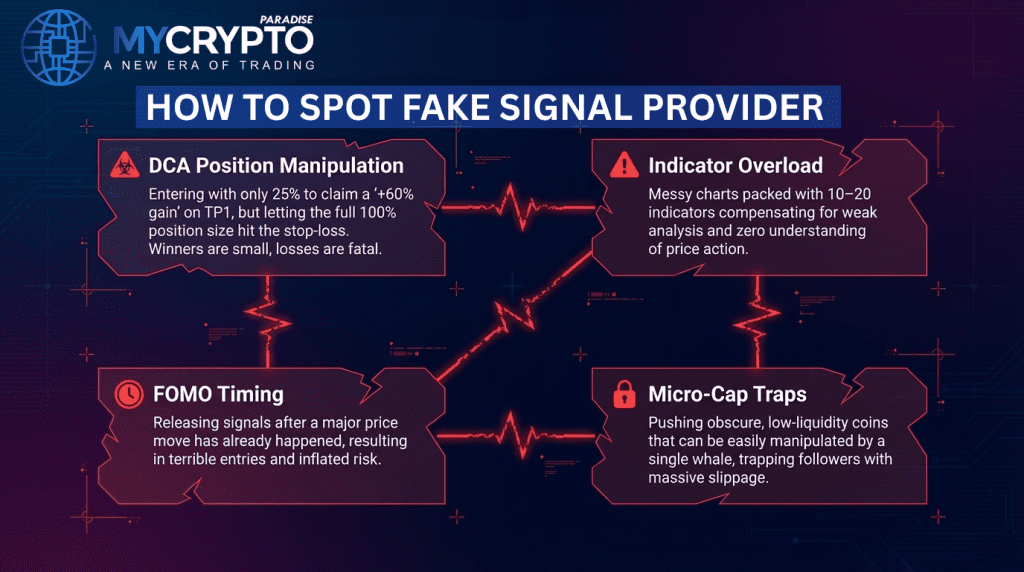
1. Unrealistic Expectations Presented as Reality
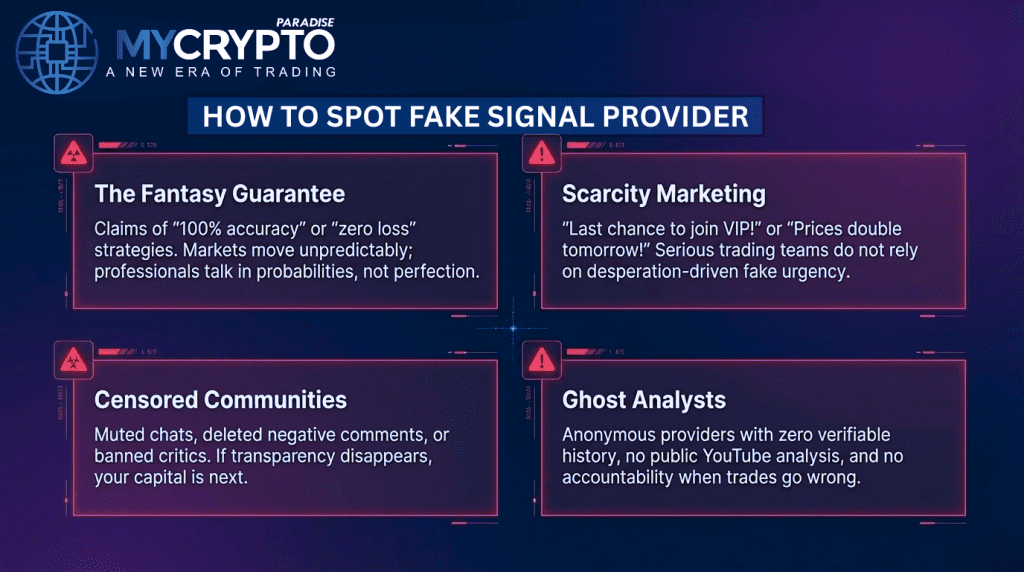
Any provider claiming 100% accuracy or consistent high returns without meaningful drawdowns is not operating in real market conditions.
Losses are a natural part of crypto trading. Even the most experienced traders go through periods of underperformance. When a group avoids discussing losses or frames trading as a guaranteed outcome, they are selling an illusion rather than a process. A serious provider speaks in terms of probability, not certainty.
2. Lack of Proper Risk Management
One of the fastest ways to identify a bad signal provider is by looking at how they handle risk.
If stop loss levels are missing, constantly adjusted without logic, or treated as optional, the entire strategy becomes unstable. Risk should always be defined before the trade begins, not after the market moves against it. Groups that avoid strict risk management often rely on hope rather than discipline.
3. Selective Transparency
Performance that looks flawless is rarely real. Many providers highlight winning trades while quietly ignoring losses. A bad signal provider often deletes unsuccessful crypto signals or presents edited results that do not reflect actual execution. Over time, this creates a distorted picture of consistency.
A trustworthy provider is transparent across all outcomes. Wins and losses are both part of the record.
4. Recommending Low Liquidity Coins
According to recent data from CryptoQuant, 40% of total altcoins in the crypto market are near or at all time low. Bad crypto signal providers often push these low-cap coins with low liquidity because they’re easy to manipulate. These trades look explosive on paper, but can trap traders with massive slippage or zero exit liquidity.
Reliable signal providers avoid assets that a single whale or a group can manipulate and change their direction. Usually, when a signal provider trades unknown coins, it’s usually because someone is benefitting behind the scenes.
5. Late Entries Disguised as Opportunities
Timing is a defining factor in crypto trading. When signals are consistently shared after a strong price move, the risk increases while the reward decreases. So, these are the times when signal providers react to market fluctuations rather than anticipating them.
By the time most traders enter, the move is already exhausted. They get trapped and become exit liquidity for the whales.
6. Aggressive Marketing Using Scarcity FOMO
“Last chance to join VIP!”
“Only 3 spots left!”
“Prices double tomorrow!”
The marketing tactics listed above have nothing to do with crypto trading and everything to do with pressuring crypto traders to pay quickly. The best crypto signal providers don’t rely on FOMO and other marketing gimmicks. If your provider pushes to sell subscriptions using these marketing tactics, not to teach or deliver value, that’s your cue to walk away.
7. Overuse of High Leverage Without Proper Explanation
Recommending 20x, 50x, or even 100x leverage without context is extremely dangerous, especially for beginners.
Experienced crypto signal providers use leverage responsibly, not recklessly. Bad providers use high leverage to create flashy percentage returns they can screenshot and brag about. When leverage becomes a marketing tool instead of a calculated move, then your capital is at risk.
8 Lack of Clear Reasoning
Crypto signals without explanation are difficult to evaluate. When providers consistently share entries without context, traders are left blindly following numbers without understanding the logic behind them. This creates dependency instead of growth.
Skilled crypto signal providers always share proper reasoning for their trade alerts, even if it is simple. The lack of proper context will make you dependent on the crypto signal providers and limit your growth.
9. Limited Interaction or Controlled Communities
The behavior of the community reflects the integrity of the crypto signal provider.
If your provider restricts discussions, ignores questions, or removes your criticism, then transparency becomes limited. This type of environment discourages accountability and prevents traders from evaluating performance openly. Healthy communities allow for discussion, feedback, and learning.
10. Anonymous Providers With Zero Accountability
Crypto traders don’t need to reveal their identity, but they should at least have a verifiable presence, history, or reputation.
When a crypto signal provider hides behind new accounts, fake names, or no track record at all, it’s a major warning sign. If no one is accountable, no one is responsible when things go wrong.
11. Contradictory Signals or Constant Strategy Shifts
If crypto signal providers are bullish and with a small move, they become bearish. One day they’re scalpers, the next they’re swing traders.
Such inconsistency means the provider isn’t following a real system. They’re reacting to noise and not a structure. Over time, this lack of direction destroys both trust and portfolios.
12. Lack of Education and Explanation
A genuine crypto signal provider wants members to grow, not stay dependent.
When signals come with zero explanation, zero context, and zero learning value, it’s usually because the provider has no logic behind the trade.
“Blind calls = blind risks”
A provider who can’t teach likely doesn’t understand the market.
13. Delayed Signal Delivery or Slow Reaction Time
Timing is everything in trading. If a provider sends entries late or reacts slowly to changing conditions, the setup often becomes invalid before you can execute it.
Many bad providers simply post trades after the move has already begun, leaving you with terrible entries and inflated risk. Reliable traders stay ahead of the move, not behind it.
14. Emotional Decision Making
The tone of the analyst often reveals their mindset. If a provider panics during market correction, celebrates wins excessively, or expresses frustration toward the market, decisions are likely driven by emotion rather than structure.
Emotion driven trading leads to inconsistent and high risk outcomes. A serious provider remains calm, objective, and disciplined regardless of market conditions.
15. Overtrading and Short Term Gambling Behavior
The signal frequency in the groups does not mean quality. Providers that focus on rapid, frequent trades often ignore key factors such as liquidity, spreads, and volatility.
These setups are difficult to execute consistently and usually resemble gambling rather than structured trading. Professional traders are selective. They wait for clear opportunities instead of forcing trades.
16. No Structured Planning or Review Process
The best crypto signals require both preparation and reflection. If a signal provider never explains why a trade was taken, what invalidates it, or what could be improved after the outcome, there is no real structure in place. Without review, there is no improvement and without planning, there is no edge.
17. No Alignment With Their Own Crypto Signals
One of the biggest red flags: “The crypto signal provider doesn’t actually trade their own signals.”
If they refuse to show proof of participation, avoid discussing execution, and can’t explain slippage or risk sizing, it means they’re not confident in their own calls. A trustworthy provider stands behind their crypto signals with real positions, not just content.
How to Evaluate a Signal Provider Before You Commit?
Most crypto traders evaluate signal providers in the wrong way. Mostly, they check win rates, trade frequency, and how active a signal provider appears. But these surface level factors rarely reflect the true quality of a trading system. Disciplined trading is not built on short term activity or a few results. It is built on structure, discipline, and a clearly defined approach to risk and execution.
To properly evaluate any signal provider, you need to understand the principles that drive a consistent operation. The following principles reflect how professional signal providers should operate.
1. Capital Preservation is Always a Priority
Most inexperienced crypto traders enter the market focused on maximizing profits. Professional traders think differently. Their first objective is survival. In crypto trading, opportunities never disappear. New setups form every week, new trends emerge every cycle, and volatility constantly creates fresh entries. Capital, however, is limited. Once it is heavily damaged, recovering becomes exponentially harder.
This is why experienced traders build their entire decision-making process around capital preservation. The goal is not to win every trade. The goal is to remain financially and psychologically stable long enough to capitalize on high-probability opportunities over time. This mindset changes how trades are approached. Instead of chasing excitement, disciplined traders focus on sustainability. They understand that avoiding catastrophic losses matters more than forcing aggressive gains during short-term market moves.
The difference becomes most visible during unstable market conditions. Emotional traders become reactive, increase exposure, and try to recover losses quickly. Structured traders reduce risk, protect liquidity, and wait for conditions where probability returns in their favor. Over the long run, consistency is not built by traders who make the most during euphoric phases. It is built by traders who protect their capital well enough to survive every phase of the market cycle.
2. Education Is Integrated with Crypto Signals
Crypto signals alone do not create skilled crypto traders. Without understanding the logic behind a trade, most traders remain dependent and unable to adapt when market conditions change. Each setup should be supported by context, explanation, and structured analysis. Traders should know the market context for the trade and where they should enter or exit it.
Over time, these crypto traders can build pattern recognition, decision-making ability, and independence. A serious provider does not aim to create followers. Crypto traders can trade the market and develop a structured trading strategy using these insights.
3. The Human Factor Remains Central
Indicators alone cannot dictate trading in the crypto market. They are driven by behavior, emotion, and decision making under pressure. While automation and tools can assist, trading remains a human process at its core.
Professional traders consider market sentiment, emotional extremes, and behavioral patterns with technical structure. This allows traders to better interpret why prices move the way they do, not just where they might go. A provider that ignores the human side of the market often misses the bigger picture.
4. Structured Trading Strategy
Consistency does not come from guessing a few crypto market moves. It comes from following a structured trading system. A structured trading system always includes market structure, liquidity behavior, and multi-timeframe alignment in each trade. Such a system removes randomness and replaces it with calculated decision making.
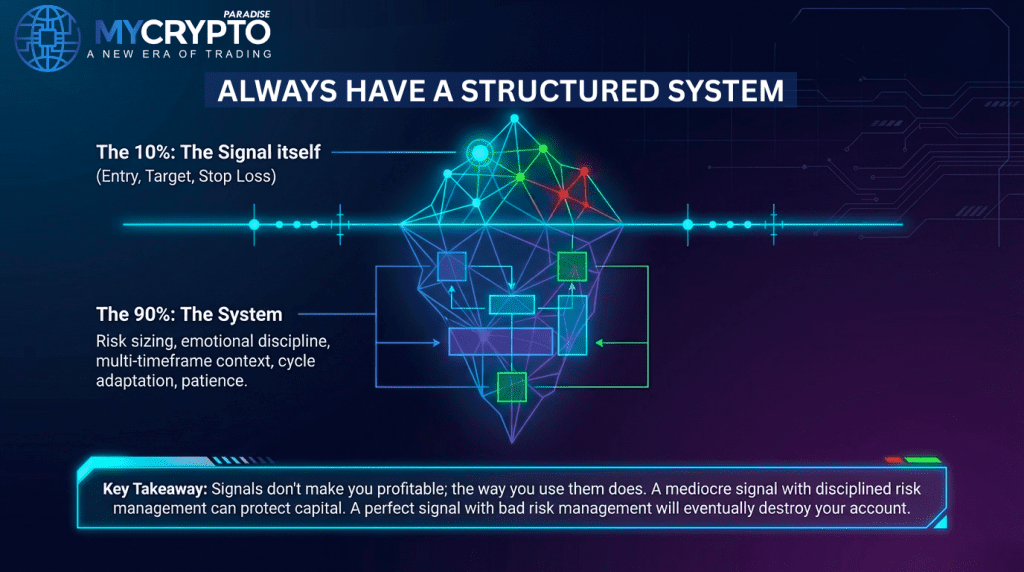
You cannot predict every market move, so you should develop a system that performs in the long term. If there’s no proper structure, long-term survival is very hard.
5. Execution Matters More Than the Idea
A good trading setup can still fail with poor execution. This is where many crypto traders struggle. Mostly, the best crypto signals become irrelevant without timely execution in the market.
This is why serious signal providers focus on signal execution. They share entry zones, invalidation levels, targets for a trade, and also teach how to manage positions as market conditions change. Signal execution shows that crypto signals are not theoretical trading alerts, but rather actionable.
6. The Strategy Evolves, the System Stays Consistent
The crypto market is always changing. Trends shift, volatility expands, and liquidity moves due to volatility in the crypto market.
Best crypto traders adapt to market changes without abandoning their core framework. The strategy evolves with the environment, but the underlying system remains consistent. This allows their performance across different market cycles.
7. They Should Trade Their Own Signals (Skin in the Game)
One of the strongest signs of a trustworthy provider is that they actively trade the same signals they share.
If the provider dodges questions, avoids sharing execution, or admits they don’t trade their own setups, that’s a major red flag. A real analyst stands behind their trades and feels the same wins and losses their members experience. Want to know more about crypto signal providers? Click Here
How to Use Crypto Signals without Becoming Exit Liquidity?
Most traders misunderstand how traders should use crypto signals. They often treat them as instructions to follow rather than tools to interpret the market move. Entry is copied, targets are set, and the outcome is left to the market. This strategy can produce a few wins in the short term, but survival in the long term is hard.
You need to use crypto signals like serious traders in order to get better results. Crypto signals are not shortcuts, but structured inputs within a larger system.
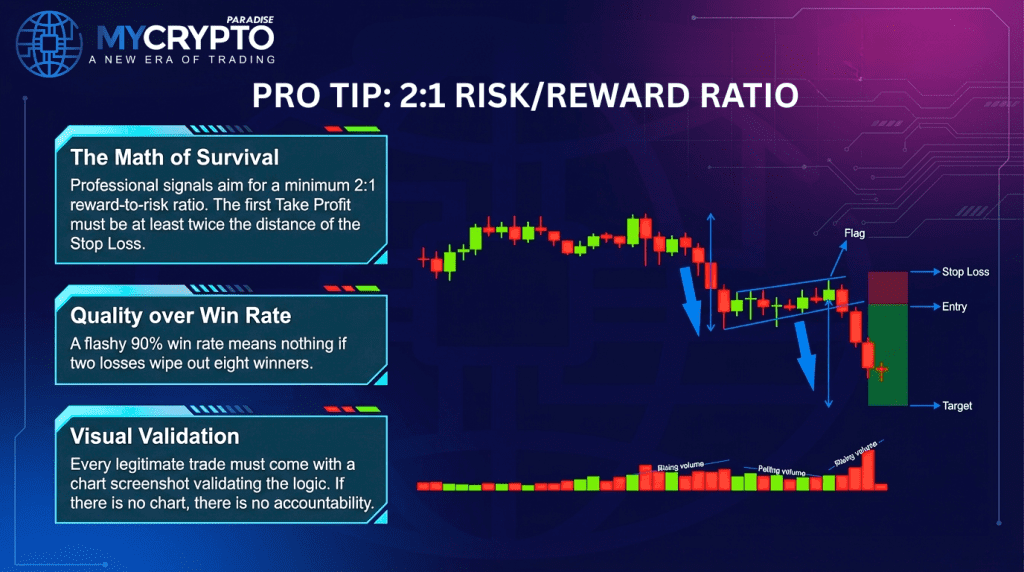
1. Risk Management Defines the Outcome, Not the Signal
A profitable trade idea means very little without proper execution. In professional trading, risk management is what transforms a setup from speculation into a structured position.
Two traders can take the exact same crypto signal and produce completely different results. The difference usually comes down to exposure control. Position sizing, stop-loss placement, leverage usage, and trade management determine whether a trader stays consistent or becomes vulnerable to a single large loss.
This is why experienced traders define risk before entering the market. They know exactly how much capital is exposed, where the trade becomes invalid, and how the position will be managed if volatility increases. Without this structure, even high-quality signals become dangerous.
For example, many traders misuse leverage during strong market momentum. A setup that was originally designed for controlled exposure becomes excessively risky when position size is increased emotionally. Instead of following a calculated plan, the trader becomes dependent on the market moving immediately in their favor.
2. Signal Should Be Understood Before Execution
Blind execution creates huge risk. Disciplined crypto traders do not enter positions simply because a level is provided. They evaluate the context behind the setup. Trend direction, market structure, liquidity zones, and volatility all influence whether a trade is worth taking.
This is where structured providers add value. When reasoning is provided alongside the signal, crypto traders can assess whether the setup aligns with current market conditions or not.
3. Position Sizing Must Reflect Your Own Risk Profile
One of the fastest ways traders destroy their accounts is by using position sizes that do not match their experience, capital, or emotional tolerance.
A setup may look strong, but excessive exposure turns normal market fluctuations into unnecessary losses. Small pullbacks begin triggering panic, emotional decision-making increases, and traders often exit early or revenge trade after a loss. This problem becomes even worse in leveraged trading. Many beginners copy high-risk positions without understanding liquidation levels, volatility ranges, or the rapid fluctuations in market conditions.
Experienced traders approach exposure differently. They risk only a controlled percentage of their portfolio on each trade and adjust size based on volatility and market conditions. This prevents a single losing position from damaging the entire account. Over time, proper position sizing protects traders from emotional spirals, forced liquidations, and the kind of large drawdowns that become difficult to recover from.
4. Timing Matters More Than Most Traders Realize
Crypto signal is only valid within a specific window. Entering late changes the entire risk-to-reward profile of the trade. What was once a high probability setup can quickly turn into an unfavorable position.
This is one of the most common mistakes.
Crypto traders chase entries after the price has already moved, driven by the fear of missing out. In doing so, they can lose the original setup edge. Missing a single trade is part of trading, but forcing one can wipe your account.
5. Actively Manage the Trade as Market Conditions Change
Signal execution is not a single action because the market can evolve, conditions can change, support/resistance can break, and Liquidity can shift in the market.
Skilled traders manage positions actively. They adjust stop losses, secure partial profits, and exit early when the market structure no longer supports the trade. Crypto signals should guide this trading process, not replace it. A static approach in a dynamic market leads to avoidable losses.
6. Track Your Own Performance
90% success claims from your signal provider can create a sense of confidence in crypto traders. What matters is how signals perform within your own execution. Entry timing, position sizing, and decision making all influence the outcome of the trade.
This is why tracking performance is essential. To improve your trading strategy, you need to record trades, review results, and identify patterns. You cannot improve your trading strategy without your trading data.
7. Signals Should Accelerate Your Learning
Your long term goal should be independence from the crypto signal provider. Signals can help shorten the learning curve, but only if they are used correctly. When traders focus on understanding structure, recognizing patterns, and analyzing context, signals become a tool for development.
When you use signals passively, they create dependency. Best trading environments encourage growth. Over time, traders should rely less on signals and more on their own decision making process.
8. Combine Signals With a Bigger Market Narrative
A single signal is just one trade. A market narrative is the map that guides everything. Consistent crypto traders always ask:
- Are we trending or range-bound?
- Are whales accumulating or distributing?
- Are altcoins lagging or leading?
- Is volatility increasing or contracting?
Disciplined trader teaches crypto traders to read the environment because the same signal can perform very differently depending on the market phase. A trader without a market context cannot become independent in the long term. Want to know more about crypto signal providers? Click Here
Why Understanding Market Context Is More Important Than Any Signal?
Most beginners think signals are the key to profitability, but the traders who survive multiple market cycles know the truth:
Market context decides whether a signal has an edge or becomes a trap.
- A buy signal in an uptrend is very different from a buy signal during distribution.
- A short signal in a clean downtrend is nothing like shorting a low-liquidity chop zone.
Here’s how understanding market context protects your capital more than a crypto trading alert ever could.
1. Trend Direction Determines the Strength of Any Signal
Mostly, trades do not fail due to the result of a bad signal, but due to trading against the market direction. Skilled traders always assess market structure across multiple timeframes. The larger trend provides context, the intermediate structure defines positioning, and the lower timeframe refines execution.
When these layers align, the probability increases. When they conflict, even technically valid setups become unreliable. A signal is never evaluated in isolation. It is evaluated in relation to the environment it exists in.
2. Volatility Changes the Rules of Execution
Volatility spikes can destroy even the best crypto signals in the market. Price action can liquidate your positions during news events, unexpected activity, and sudden whale activity. In such phases, reliable signal providers teach crypto traders to reduce position size, tighten exposure, and wait for stabilization. A provider who doesn’t adjust for volatility isn’t trading professionally because they’re gambling with your account.
3. Liquidity Zones Reveal Where Smart Money Is Targeting
If you don’t understand liquidity, you’re trading blind. Markets often “seek liquidity” before making their real move, which means:
- Sweeping stops
- Trapping retail traders
- Faking breakouts
- Reversing after manipulation
Serious signal providers identify liquidity pockets so traders can avoid becoming part of the hunt. Signals without liquidity logic are signals designed for noobs.
4. Market Cycles Dictate Which Setups Actually Work
Every cycle, bull phases, distribution, bear markets, and accumulation have a different personality. The setups that worked last month may completely break down in the new environment. Professionals adapt. Amateurs repeat the same strategy until they wipe out.
For the best crypto signals, serious providers routinely explain cycle transitions and teach members how to:
- Shift strategies
- Adjust risk
- Modify targets
- Avoid high-risk zones during cycle tops.
Understanding the cycle is often more valuable than the signal itself.
5. Correlation Between Major Assets Impacts Every Trade
Most beginners analyze their coin in isolation. Professionals don’t.
They track:
- BTC dominance
- ETH trend strength
- DXY direction
- NASDAQ correlation
- TOTAL 1, 2, and 3 market cap flows
When BTC is breaking structure or dominance is spiking, altcoin signals, even well-designed ones, become far less reliable. This broader perspective is one reason why the best crypto signals maintain consistency across multiple market phases.
6. Sentiment and Narrative Shifts Can Void Signals Instantly
Sudden mood shifts in the market can override any technical setup. Narratives like:
- ETF approval
- Regulatory fear
- Major exchange issues
- Whale accumulation cycles
- Hype-driven altcoin rotations
These things push markets faster than charts can react. On-chain flows, smart-money behavior, social sentiment, and whale movements are necessary for traders. Signals supported by sentiment are far more reliable than those based only on chart patterns.
7. Supply and Demand Imbalances Shape Every Setup
Experienced traders avoid low-volume zones, thin liquidity, and unproven levels. Beginners, on the other hand, often trade directly into these danger areas.
- When supply outweighs demand, even bullish signals fail.
- When demand outweighs supply, even minor setups can explode upward.
They help traders understand where these imbalances lie, a skill that transforms how you evaluate every entry and exit.
8. Context Helps You Know When Not to Trade
The most profitable traders don’t win because they trade more. They win because they avoid low-probability environments. Flat ranges, chop zones, fake breakouts, and overextended pumps context helps you identify when the market has no clear edge. Want to know more about crypto signal providers? Click Here
Why MyCryptoParadise Created This Crypto Signals Guide?
The crypto trading landscape has changed dramatically over the last few years, but one problem has stayed exactly the same:
Most crypto signal groups simply aren’t built to survive real market conditions.
After being in the market since 2016 and observing countless competitors across multiple market cycles, we noticed a dangerous pattern repeating in the crypto market:
Groups that thrive during major bullish trends collapse when volatility hits. Crypto signal provider often:
- disappear when their win rate drops
- delete their losing trades
- post crypto signals without charts, logic, or context
- Treat their subscribers as exit liquidity.
This guide was created to protect traders from that very environment. MyCryptoParadise has spent years helping traders break out of the cycle of hype-driven, emotionally reactive trading. We want to ensure that everyday traders understand what real trading looks like, not the fantasy version sold in anonymous channels.
The Real Problem With Most Signal Groups
After deep research and countless case studies, the ParadiseTeam identified why over 99% of signal providers fail long-term:
- They rely on bull market momentum, not strategy
- They have no risk framework to survive downturns
- They cherry-pick screenshots and hide the real P&L
- They trade without a multi-timeframe context
- They chase pumps instead of following smart money
- They manipulate numbers to look more profitable than they are
Worst of all, many of these groups treat subscribers as liquidity, pushing risky altcoins and low-market-cap meme plays where the provider exits early while followers absorb the losses.
It’s not just unprofessional. It’s predatory.
The Supercycle Trap: How Bad Signal Groups Collapse
Bad crypto signal providers appear successful only because the market is trending. During euphoric phases, even poor-quality setups can reach their targets.
But when the cycle shifts, liquidity dries, volatility expands, and accumulation begins, these groups fall apart:
- They overtrade
- They force trades where no edge exists.
- They don’t adapt to new structures.
- They rely on emotional reactions instead of probability.
- They lose consistently until the group goes silent.
We call this pattern the Supercycle Trap. It’s the single biggest reason crypto traders lose their precious capital following the wrong people.
This guide was built to help traders avoid falling into that trap ever again.
What Separates Traders Who Survive From Those Who Don’t?
Most traders spend months searching for the perfect signal. They test groups, follow alerts, react to every chart, and slowly realize that signals alone never made anyone consistently profitable.
The traders who survive multiple market cycles figured out something different. They stopped looking for more signals and started building a system: risk management, market context, emotional discipline, and structured execution across a series of trades.
That shift changes everything. And it does not require a paid membership to begin.
Start with what is already available for free: MyCryptoParadise provides structured educational content, market analysis, and trading insights across multiple platforms, at no cost.
- MCP University FREE: Learn market structure, risk management, and trading psychology
- MyCryptoParadise FREE Telegram: Daily Bitcoin analysis and market updates
- YouTube Channel: In-depth video analysis and educational breakdowns
These resources are designed to help you think like a professional trader before you ever consider following a signal.
For traders ready to go further: ParadiseFamilyVIP🎖️ is where the ParadiseTeam shares structured trade setups, real-time market positioning, and strategic guidance built for serious capital.
Membership capacity is controlled for a specific reason. When too many traders enter the same position simultaneously, slippage increases, market visibility rises, and execution quality deteriorates for everyone. Fewer members means each setup retains its original edge.
This is not about creating artificial demand. It is about protecting the quality of execution for every trader inside the room.
ParadiseFamilyVIP is built for traders who already understand that risk management matters more than win rate, that patience outperforms activity, and that capital protection is the foundation of long-term growth.
If that sounds like how you already think about trading, the next step is simple: explore the memberships and decide whether it fits your approach.
Crypto Signals FAQ
What makes a crypto signal high-quality?
A high-quality signal comes from a defined, repeatable trading strategy with clear risk management and a stop loss set before the trade. It explains the reasoning behind the entry and is recorded transparently, including losses. Consistency across different market conditions matters more than a streak of wins.
What are the warning signs of a bad or scam signal provider?
Red flags include claims of 100% accuracy, missing or constantly shifting stop losses, deleting losing trades, pushing low-liquidity coins, late entries after a big move, FOMO marketing like "only 3 spots left," and reckless high leverage. These point to noise rather than a structured process.
Why do many signal providers look good but still fail?
In strong bull markets almost any group can appear profitable because most trades hit targets. The weakness shows when volatility rises or trends reverse, exposing the absence of a real system. Short-term results can mislead, while a full market cycle reveals whether there is a genuine edge.
Is high leverage a red flag in crypto signals?
Recommending 20x, 50x, or 100x leverage without context is a warning sign, especially for beginners. Experienced providers use leverage responsibly and explain the reasoning. When high leverage exists mainly to produce flashy screenshot-worthy percentages, your capital is exposed to outsized risk.
Crypto trading involves substantial risk of loss. This article is educational and is not financial advice. Past performance does not guarantee future results. Always do your own research.
What is different here
Most guides stop at the theory. The MyCryptoParadise team shares the live trades, and the reasoning behind each one, inside ParadiseFamilyVIP. Everything here is education, not financial advice.
Related: Crypto signals on Telegram · How to choose a crypto signals Telegram channel
Crypto trading involves substantial risk and is not suitable for everyone. Nothing here is financial advice; it is education only. Never risk more than you can afford to lose.




Join the discussion
No comments yet. Members, share how you are reading this.