


Listen: the breakdown
Market briefing: Aave froze its V3 and V4 markets after a wallet tied to the Binance exploiter parked about 60 million USDT and borrowed 19,762 WETH. BTC was trading near $78,532 as this hit.
- A Binance exploiter wallet deposited roughly 60M USDT into Aave V3 Ethereum Core
- The same wallet borrowed 19,762 WETH, prompting Aave to freeze V3 and V4 markets
- ETH sat near $2,250 and BNB near $715, both down on the day as the news landed
Aave just froze two entire markets. The trigger was not a bug but a borrower: the Binance exploiter deposited 60M stolen USDT and took out 19,762 WETH. How fast can DeFi really react?
Aave froze its V3 and V4 markets. The trigger was not a bug or a broken oracle. It was a depositor.
A wallet linked to the Binance exploiter moved roughly 60 million USDT into Aave V3 Ethereum Core. Then it borrowed 19,762 WETH against that collateral. In plain terms, stolen money walked into the largest lending protocol in DeFi and took out a loan. Aave's risk service provider flagged the wallet, and the protocol pulled the freeze lever on two markets to cap the exposure.
This is the part most retail never sees. Hacked funds do not vanish. They go looking for the deepest pool to hide inside.
The borrow matters more than the deposit. By turning 60 million USDT into a large WETH position, the exploiter swapped a traceable stablecoin for a liquid asset it can later sell. That pushes bad-debt and contagion risk onto Aave's pools. It is exactly why the team moved.
Freezing a market is a defensive act, not a dramatic one. It halts new borrows and limits how far the exposure can grow while the damage is assessed. Think of it as sealing a door before the smoke spreads.
This also extends a thread we have tracked all day. Arbitrum's Security Council already froze exploit funds on its chain, and the hacker was last seen rotating stolen tokens into ETH. What is new here is the method: not a dump, but a loan dressed in protocol plumbing.
When tainted collateral walks into a lending giant
This is a protocol-risk event, not a macro liquidity story. No central bank moved. No data print landed. A single wallet simply used the rails of open finance against the people who built them.
The transmission runs through trust, not rates. Aave's pools rely on the assumption that collateral is clean and borrowers behave. When exploit-tainted USDT becomes collateral for a near-20,000 WETH loan, that assumption cracks. The protocol now carries the risk that the borrower walks away, leaving the pool to absorb the gap.
Freezing V3 and V4 contains that risk, but it also sends a message. The deepest lending market in DeFi can be forced to slam the brakes by one determined actor with stolen funds. That is a sobering reminder of how composability cuts both ways.
The second-order fear is contagion. Lending protocols connect to each other through shared assets, liquidations, and wrapped tokens. A solvency scare at one hub makes counterparties nervous everywhere, which thins liquidity precisely when it is needed most.
ETH sits at the center of this. It is the asset borrowed and the asset backing most of the system around it. So any doubt about Aave's exposure feeds straight into how the market prices ETH risk.
BNB carries a separate weight. It is the token of the exchange the funds were stolen from, which is why it has been the heavier faller through this whole episode.
Contagion worry seeps into ETH and BNB
The price reaction has been orderly, not violent. ETH was trading near $2,250, down about 2.6 percent on the day, while BNB sat near $715, down close to 5 percent. On the hour, both barely moved.
We read the direction as fitting the news, but we are careful about cause. There is no on-chain evidence yet that the borrowed WETH has been dumped. No cascade of liquidations is visible. So treat today's weakness as coincident with this event, not proven to be caused by it.
Start with BTC as the risk anchor. Bitcoin was near $78,532 as this landed, already soft on the day. A DeFi solvency scare rarely lifts BTC. It nudges traders to trim risk at the margin, and that drag flows downhill.
ETH feels it most directly. It is the collateral-adjacent asset in the Aave loan, so headline risk attaches to it first. If the exploiter sells that WETH, the supply hits an already nervous order book.
Alts and DeFi tokens sit at the end of the chain. Lending, yield, and governance names tend to wobble together when counterparty fear rises. The weakest hands get shaken first, and liquidity on smaller books is thin.
BNB is the odd one out, pressured by its tie to the hacked exchange rather than to Aave itself. Two separate overhangs, one ugly headline.
Whether that borrowed WETH starts to move
The single most important thing is the WETH. If that borrowed position gets sold into the market, the contagion fear stops being abstract and becomes measurable supply. Watch for large WETH transfers out of the exploiter wallet toward exchanges.
Confirmation of the bearish read looks like this: the freeze stays in place, the borrowed WETH moves, and other lending protocols tighten parameters in response. That would signal the stress is spreading rather than contained.
Invalidation looks calmer. Aave reopens the markets in an orderly way, the exposure is quantified and covered, and the wallet stays still. If the loan simply sits there as frozen risk, the market exhales and ETH stabilizes.
Watch the other hubs too. Coordinated freezes or whitelists across protocols would tell you the industry is treating this as a systemic moment, not a one-off.
Keep an eye on ETH's hourly behavior. It printed a small positive hour even as the daily stayed red. That split often means the sellers are patient, not panicked, which keeps the outcome open.
Finally, note the bad-debt question. If Aave confirms the pool is fully backed and no shortfall exists, the headline loses its teeth. The scary word here is solvency, and so far it remains a risk, not a realized loss.
Until the WETH moves or the freeze lifts, this stays a developing containment story wearing confirmed facts.
What the Aave freeze means for DeFi liquidity
The ParadiseTeam frames this as a counterparty-risk event, not a macro turn. It adds a fresh reason for caution on ETH and DeFi names, but it does not rewrite the broader map we have been trading.
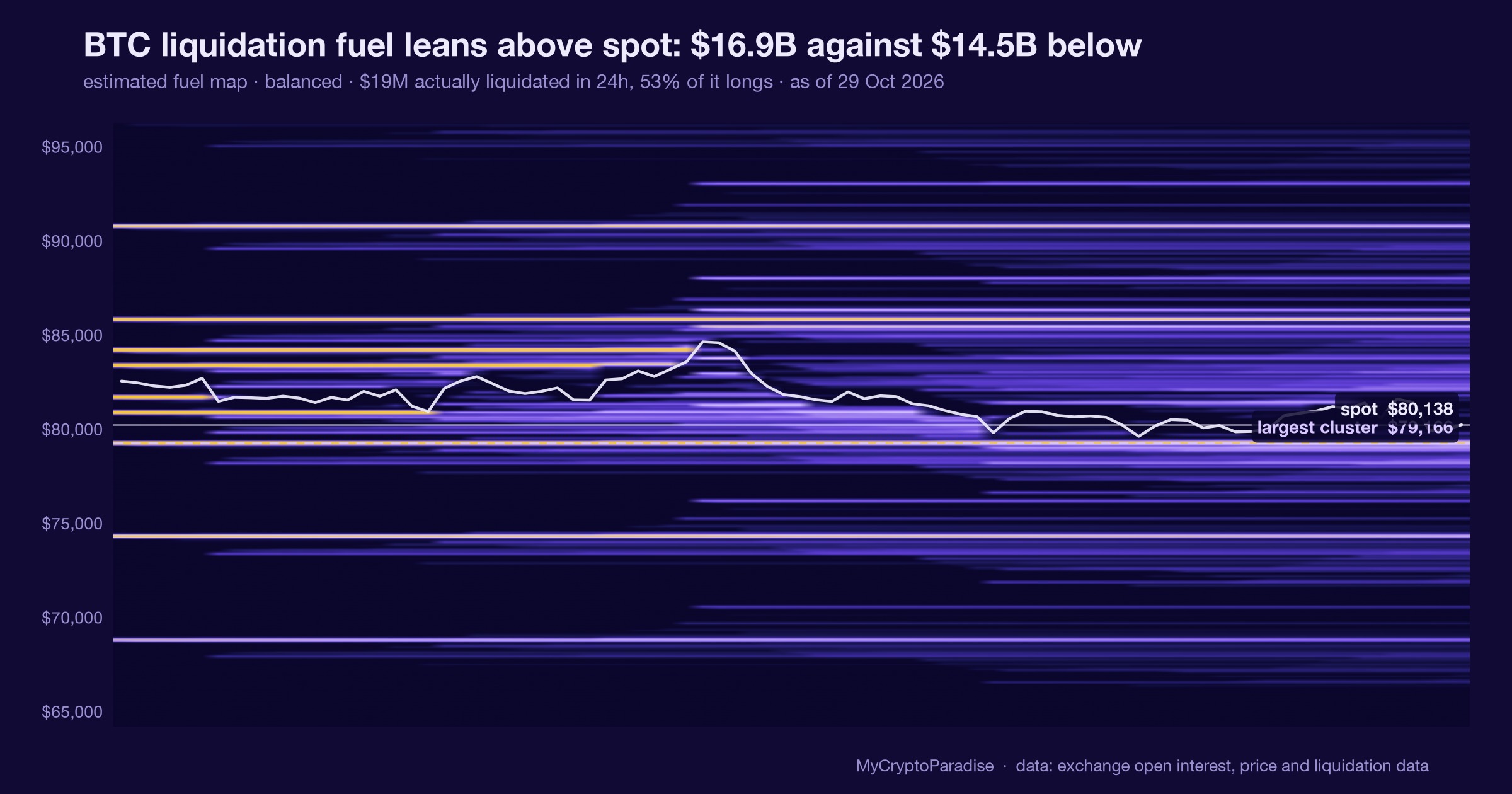
BTC was near $78,532 as of 07:04 UTC, sitting right against the $79,000 liquidation cluster we have flagged. Below that lies the 0.786 support. A DeFi scare like this is the kind of headline that can nudge price into that cluster, so we respect it as a trigger, not the main plot.
Our standing structure still matters more than one loan. Smart money has been absorbing supply at support with large buy walls, having already reaccumulated near $71,000 and $61,000 and taken profit on the $79,000 bounce. It is patient and lightly positioned, waiting for lower prices.
The leverage picture adds nuance. Far more liquidity sits above price than below, which keeps a short-squeeze path toward $90,000 alive even on bad news. That is why we do not assume a clean breakdown just because a headline is ugly.
For ETH specifically, this event raises the bar. Strength here can meet selling if the borrowed WETH threatens to hit the market, so we treat ETH rallies with extra suspicion until that risk clears.
Net read: a contained, defensive move that fits a cautious DeFi stance, while the bigger BTC reaccumulation thesis stays firmly intact.
The read behind this: we framed this story through our own market analysis, Is Bitcoin Ready for a Bigger Rally?
Track it live: our crypto liquidation heatmap and the Crypto Fear and Greed Index both update in real time, so you can watch this shift for yourself.
Related coverage
For exact entries, targets, and stop losses with full risk management, that is what ParadiseFamilyVIP is for. New to reading these moves? Start with our crypto trading strategies guide.
ParadiseTeam is monitoring the market situation closely, and we are taking these developments into consideration while building our trading tactics inside ParadiseFamilyVIP.
Crypto trading involves substantial risk. Prices are volatile and you can lose money. This article is educational and is not financial advice. Past performance does not guarantee future results.
What does the Binance exploiter do with the 19,762 WETH next?
How 1 Paradiser is calling it
The first call is still open
Free account, no password. Members just sign in.










Join the discussion
No comments yet. Members, share how you are reading this.