- The Ascending Channel Pattern is a bullish market structure that forms when the price moves between two parallel upward sloping trendlines. Specifically, it reflects a controlled uptrend with higher highs and higher lows.
- You need to wait for the price to react clearly from channel support or confirm a breakout before entering. A rushed entry in the middle of the structure often leads to poor risk-to-reward and emotional trading decisions.
- Stop-loss placement is subjective. In most cases, it can be placed below channel support or below the latest swing low. Conversely, the target is often set near the upper boundary of the channel.
The ascending channel is a clean and practical trend structure, yet many crypto traders misread it or force trades within it. This usually happens because they focus on drawing the lines, not on how the price behaves inside the channel. As a result, they treat every pullback as a buy, even near resistance or weak momentum.
At MCP University FREE, this guide is part of our strategic trading series developed for disciplined and professional crypto traders. After reading the full article, you will be able to identify, confirm, and trade the ascending channel pattern with expert accuracy and confidence.
Introducing the Ascending Channel Pattern
The Ascending Channel Pattern is a bullish price structure that helps crypto traders identify orderly upward trends. In simple terms, it shows that buyers are still in control, but the market is not moving vertically. Instead, price advances in waves, making higher highs and higher lows while staying inside two rising parallel lines.
Specifically, the pattern forms when price repeatedly bounces between an upward-sloping support line and an upward-sloping resistance line. As a result, the market creates a visible “channel” where buyers tend to step in near support and sellers or profit-takers appear near resistance.
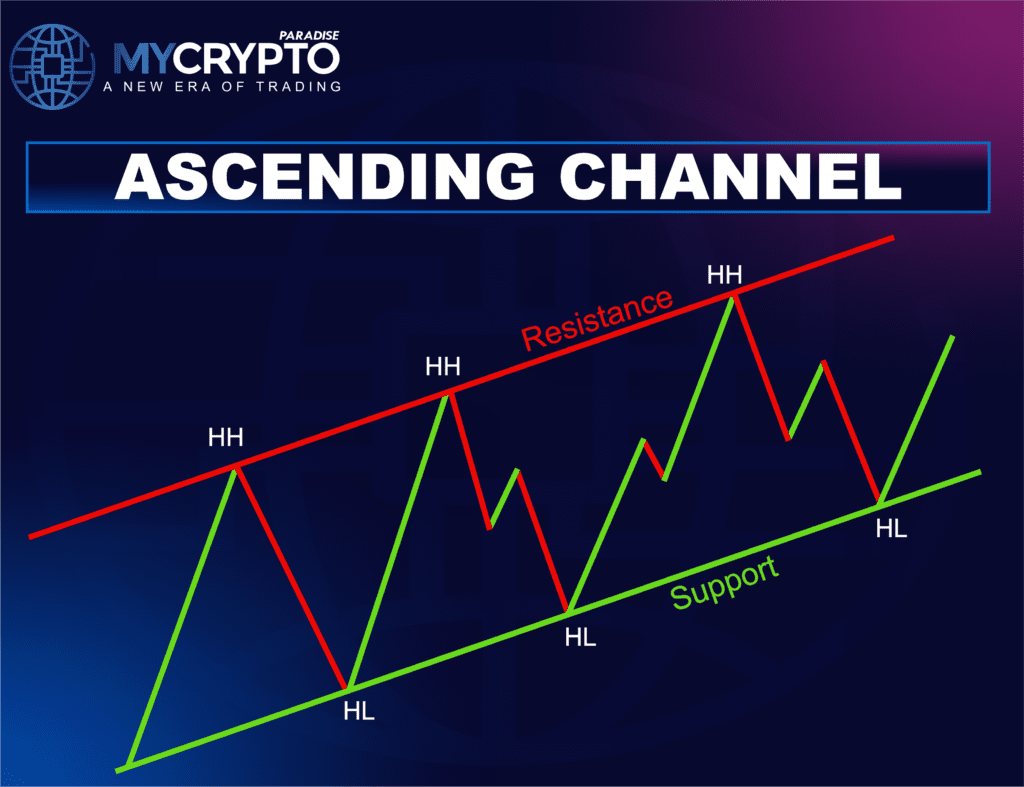
Finally, the pattern remains valid as long as the price respects both boundaries. At this point, crypto traders can either trade the swings inside the channel or wait for a confirmed breakout above resistance to continue with the larger trend.
Key characteristics of an ascending channel include:
- Clear bullish trend beforehand: The market should already be moving upward with higher highs and higher lows.
- Two parallel upward-sloping trendlines: One line connects the swing lows and acts as support, while the other connects the swing highs and acts as resistance.
- Multiple touches: Price should react to both boundaries several times to validate the channel.
- Orderly pullbacks: Corrections inside the channel tend to stay controlled rather than collapsing sharply.
- Potential continuation or breakdown: The pattern usually supports the bullish trend, but a loss of channel support can also signal weakness or a reversal.
This pattern is crucial because it reflects balance within bullish control. Buyers are still winning, but they are not chasing irrationally. Large participants often prefer these structured trends because they can build or defend positions during repeated pullbacks.
How to Identify the Ascending Channel Pattern?
Spotting a reliable ascending channel requires patience and careful observation. These are the steps you should follow:
Confirm the prior trend
Without an existing bullish trend, an ascending channel lacks context. The structure should show higher highs and higher lows before the channel becomes obvious.
Draw the lower trendline first
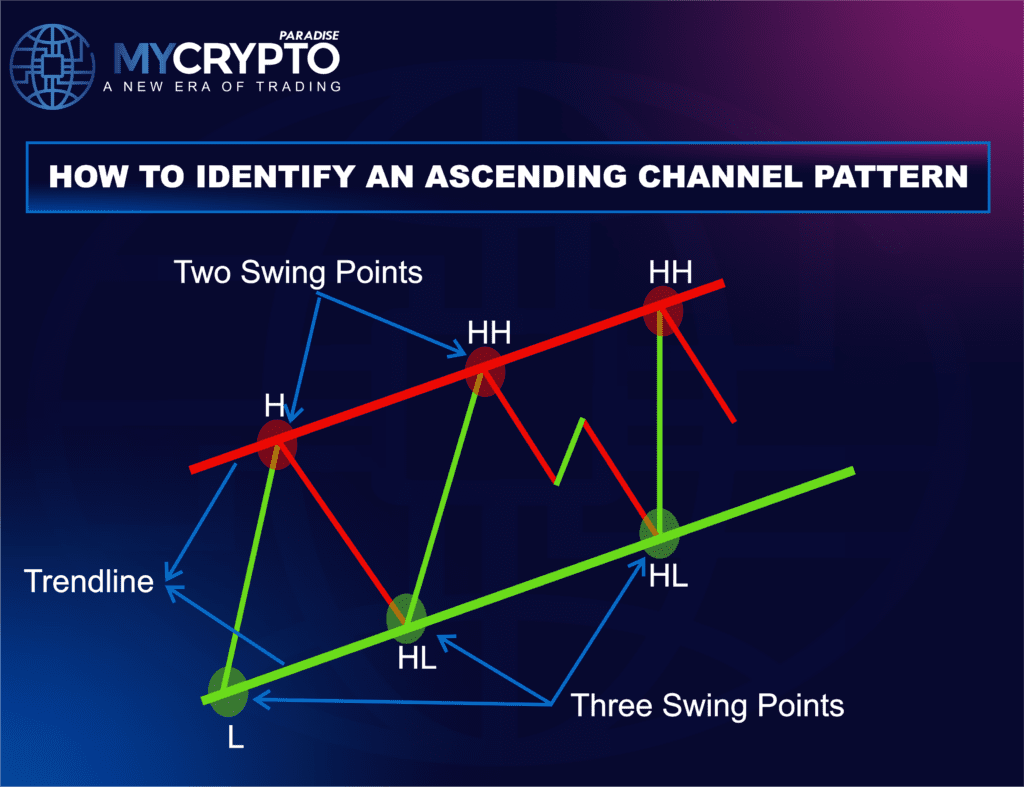
Start by connecting at least two major swing lows. This line should slope upward and act as a dynamic support area.
Draw the upper trendline next
Then, align the line with the corresponding swing highs. Ideally, it should run parallel to the lower trendline, creating a clean price corridor.
Validate multiple reactions
Price should touch or come close to both boundaries several times. The more consistent the reactions, the stronger the channel structure becomes.
Observe behavior inside the channel
Healthy channels usually show controlled pullbacks, reasonable candle structure, and no random deep breakdowns through support.
Wait for the trade location
Once the structure is identified, the key is not just seeing the pattern but knowing where the price is inside it. Buying near support and taking profits near resistance is generally safer than entering in the middle.
Market Anatomy of Ascending Channel
The anatomy of an ascending channel is defined by a clear bullish structure where price forms a sequence of higher highs and higher lows. This structure is contained within two upward-sloping parallel trendlines that act as dynamic resistance and support.
As price moves upward, each pullback respects the lower boundary, creating higher lows and maintaining trend integrity. At the same time, upward pushes reach the upper boundary, forming higher highs and completing the channel structure.
This repeated movement between support and resistance creates a well-organized price flow, showing controlled expansion rather than impulsive movement. The spacing between highs and lows remains relatively consistent, reinforcing the trend strength.
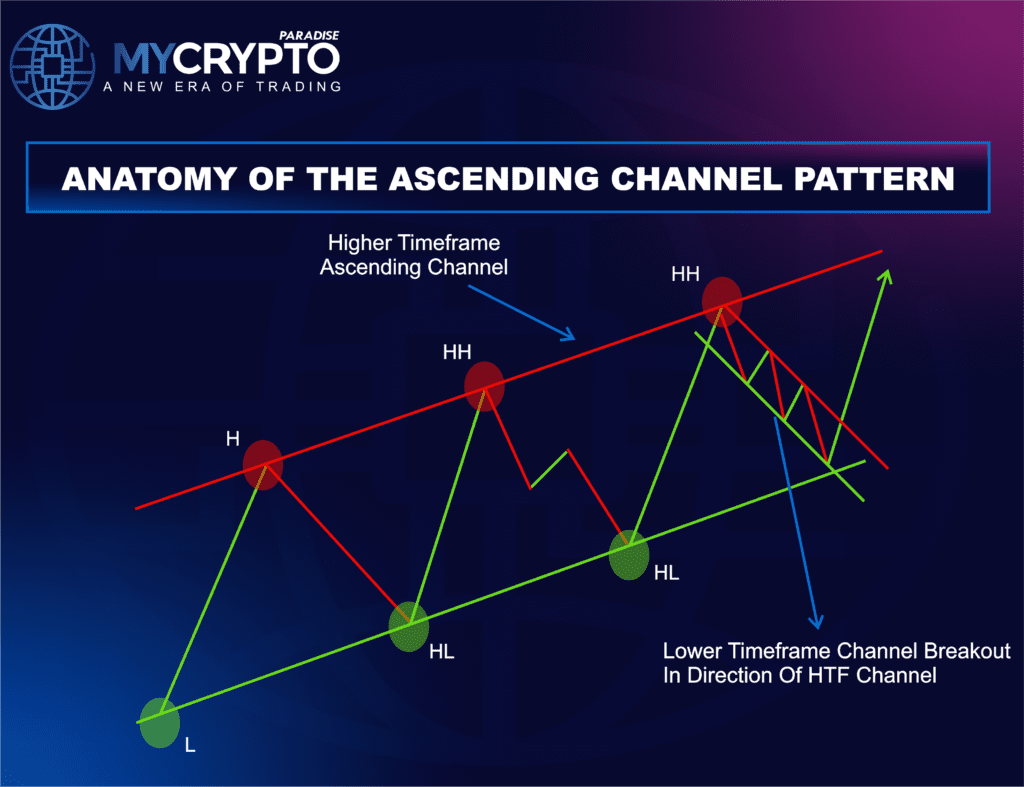
Over time, this structure becomes more reliable as multiple touches validate both boundaries. The channel remains intact as long as the price continues respecting these levels and maintaining the sequence of higher highs and higher lows.
The structure is considered valid until a clear break occurs. A breakout above resistance suggests trend continuation with increased momentum, while a breakdown below support signals a potential shift in structure and possible trend reversal.
How to Trade the Ascending Channel Pattern?
Trading an ascending channel requires patience, timing, and clear risk control. First, you should decide whether you want to trade the pattern as a range within an uptrend or wait for a breakout above resistance. Both approaches can work, but they require different levels of confirmation and different expectations.
Buy near support
The most common way to trade an ascending channel is to enter near the lower trendline after the price shows a clear reaction. For example, a rejection wick, bullish engulfing candle, or strong recovery candle can provide evidence that buyers are stepping in again. This approach usually offers a better risk-to-reward profile because the stop-loss can remain relatively tight.
Take profit near the resistance
Since the upper boundary often acts as a reaction zone, many crypto traders choose to lock in profits before the price reaches the exact resistance line. This reduces the risk of holding through a reversal near the top of the channel.
Breakout entry
Some crypto traders prefer to wait for the market to break and close above the upper boundary. In that case, the breakout should be decisive and ideally supported by stronger volume. A breakout without follow-through often turns into a trap, especially in crypto.
Retest entry
A more conservative method is to wait for the breakout first and then look for a retest of the former resistance as new support. This approach can reduce false entries, although it may sometimes miss fast continuation moves.
Stop-loss placement
Stop-loss placement can be handled in different ways depending on the pattern and the volatility of the asset. Ideally, the stop-loss should be placed below the lower channel boundary or below the most recent swing low.
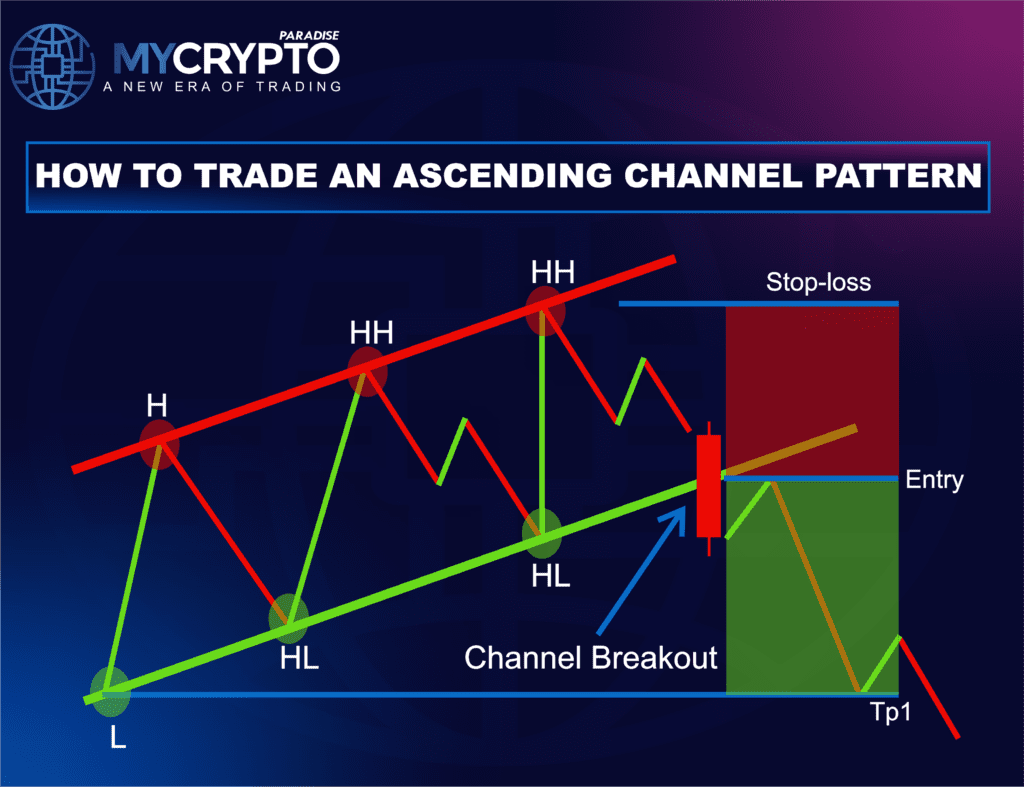
However, there are situations where the channel is wide, and using a stop-loss under the full structure can reduce position size too much; therefore, in such cases, crypto traders may place the stop-loss below the confirmation candle or the latest local low.
Profit target
If you are trading inside the channel, the upper boundary becomes the most logical target. On the other hand, if you are trading a breakout, you can use previous resistance levels, extension targets, or simply trail the position while the market continues to trend.
How to Confirm Ascending Channel Using Volume & Other Tools?
Understanding the ascending channel pattern is crucial for crypto traders who want to follow trends without overpaying for entries. Moreover, confirmation from volume and additional technical tools makes the pattern more reliable. Therefore, when these signals align, traders can make more confident trading decisions.
Volume Patterns to Watch in an Ascending Channel Pattern
- Volume on pullbacks: In a healthy ascending channel, pullbacks toward support typically occur on lower volume. This suggests that selling pressure is limited and not driven by strong conviction.
- Volume near support: When price reaches the lower boundary, a modest increase in volume can signal that buyers are stepping back in. This often strengthens the case for a bounce.
- Volume during rallies: Stronger volume on the move from support to resistance is generally a positive sign. This suggests that buyers remain willing to push the trend higher.
- Breakout confirmation: A breakout above channel resistance should ideally be accompanied by a visible expansion in volume. Weak breakout volume often increases the chance of a fake move.
Additional Confirmation Signals in an Ascending Channel Pattern
- RSI behavior: RSI can help you judge whether the price is overextended near the upper boundary or recovering from oversold conditions near support. It is not enough on its own, but it can improve timing.
- Moving averages: The 20 EMA or 50 EMA often aligns with channel support in trending markets. When these tools support the same area, the setup becomes more meaningful.
- Horizontal structure: If channel support also matches a previous breakout level or horizontal demand zone, the probability of a stronger reaction improves.
- Market context: Ascending channels tend to perform better in healthy bullish environments. If the overall market is weak or Bitcoin is losing major support, channel setups on altcoins can fail more easily.
- Other tools: Fibonacci retracements, trend-based volume, and higher timeframe resistance zones can all add useful confirmation, especially when price approaches important decision points.
Ascending Channel Pattern vs. Other Patterns
Ascending Channel vs. Rising Wedge
A Rising Wedge also slopes upward; however, its two trendlines converge, unlike the parallel lines of an ascending channel. In contrast, an Ascending Channel maintains more consistent spacing between support and resistance.
Therefore, the channel usually reflects a healthier and more sustainable bullish structure, while the rising wedge often carries a bearish reversal bias. Want to learn more about Rising Wedge? Click Here
Ascending Channel vs Bull Flag
A Bull Flag is generally a shorter-term continuation pattern that appears after a sharp impulsive move, followed by a brief downward or sideways correction. In contrast, an Ascending Channel tends to develop over a longer period with repeated upward oscillations.
Therefore, the bull flag often resolves faster, while the ascending channel offers multiple swing opportunities. Want to learn more about Bull flag? Click Here
Ascending Channel vs Rising Range
A simple rising range may show price moving upward, but it often lacks the clean parallel structure and repeated rhythm of a proper channel. Consequently, the ascending channel usually provides clearer boundaries for entries, stops, and targets.
Common Mistakes When Trading the Ascending Channel Pattern
Buying in the middle of the channel:
One of the most common mistakes beginners make when trading the Ascending Channel Pattern in crypto is entering too late, usually in the middle of the structure. The pattern may still be valid, but the location is poor. As a result, the trader ends up with limited upside, wide downside risk, and increased emotional pressure during the next pullback.
Ignoring the upper boundary:
Furthermore, many traders assume that because the trend is bullish, the price will eventually push through resistance every single time. Specifically, they keep holding longs directly into the upper channel line without respecting it as a profit-taking zone. However, repeated rejection near resistance is part of how the pattern works.
Confusing it with a rising wedge:
Not every upward-sloping structure is an ascending channel. If the boundaries are narrowing, the pattern may actually be a rising wedge. Therefore, misidentifying the structure can lead to buying a setup that is already losing strength.
Trading without confirmation:
Some crypto traders buy every touch of support automatically. In reality, price action still matters. A support area is not enough if candles show heavy selling pressure or if the market context is clearly weakening.
Ignoring volume during breakout:
A breakout above resistance should show intent. If the breakout occurs on weak participation, it may fail quickly. Consequently, crypto traders who chase it without confirmation often get trapped in fake continuation moves.
Trading without proper risk management:
Many beginners take channel setups without a stop-loss because the trend “looks strong.” A well-defined stop-loss below support or below the latest swing low establishes invalidation and preserves capital. Therefore, trading without a structured risk plan remains unacceptable in professional crypto trading.
When Ascending Channel Pattern Fails?
No pattern works every time, and the ascending channel is no exception. In fact, some of the worst losses happen when traders assume a bullish structure is guaranteed to continue.
A failed ascending channel usually begins with weakening reactions from support. The bounce becomes smaller, momentum fades, and price starts spending more time near the lower boundary. This often shows that buyers are no longer stepping in with the same confidence.
Once price breaks below channel support with conviction, the pattern loses its bullish structure. At that point, the market may enter a deeper correction, form a new range, or even reverse into a bearish trend.
For that reason, channel support should never be treated as a magical line. It is simply a key decision area. If the market defends it, the pattern remains valid. If it loses it decisively, the trader must adapt.
Conclusion
The Ascending Channel Pattern can give you a clear edge, but only if you trade it with patience, structure, and realistic expectations. Most crypto traders struggle with it, not because the pattern is difficult, but because they enter at the wrong time. If you are serious about improving your results, stop treating every bullish chart as a breakout opportunity. Instead, learn to read the rhythm of the trend, understand where support and resistance truly matter, and respect the market when it tells you the structure is changing.
At ParadiseFamilyVIP🎖️, you get to see our personal trading setup and learn to treat crypto trading as a business.
👉 Join ParadiseFamilyVIP🎖️ to trade with confidence, structure, and precision. Limited slots are available, so secure your place or join the waiting list to stay ahead of high-momentum market moves.
FAQs
What is an ascending channel pattern in crypto trading?
It is a bullish chart pattern where the price moves between two upward-sloping parallel lines. As long as the market continues making higher highs and higher lows within the channel, the trend remains structurally bullish.
Is the ascending channel always bullish?
No, absolutely not. Generally, it reflects a bullish structure, but it can still fail. If price breaks below the lower boundary with confirmation, the pattern is no longer valid and may lead to a correction or reversal.
Which timeframes work best for ascending channels?
Higher timeframes usually provide stronger and more reliable structures, especially for swing trading. However, lower timeframes can still offer useful opportunities if the broader trend supports the setup.
Where should I set my stop-loss?
Stop-loss placement is subjective and depends on volatility, entry style, and market context. Ideally, it should be placed below channel support or below the most recent swing low to define invalidation clearly.
Should I buy every touch of support?
No. Although channel support is an important area, you should still wait for some form of confirmation, such as rejection candles, a recovery in momentum, or improving volume behavior.
Is an ascending channel better than a bull flag?
Not necessarily. Both are useful patterns, but they serve different purposes. A bull flag is usually faster and more explosive, while an ascending channel often provides more structured pullback opportunities over time.