

Developing story update (July 17, 2026, 15:45 UTC):
Wu Blockchain (@WuBlockchain): WuBlockchain Weekly: Tether Freezes $131M in USDT Linked to Iran’s IRGC, U.S. and U.K. Move to Align Stablecoin Rules, Morgan Stanley’s E*TRADE Launches Crypto Spot Trading, DTCC Begins a Tokenized RWA Pilot, and Crypto Media Faces Widespread Cuts.. Twitter
Listen: the breakdown
Market briefing: Tether has frozen four TRON addresses holding roughly $131 million in USDT linked to the IRGC. Bitcoin sits near $64,733, up 3.7 percent, unmoved by the freeze itself.
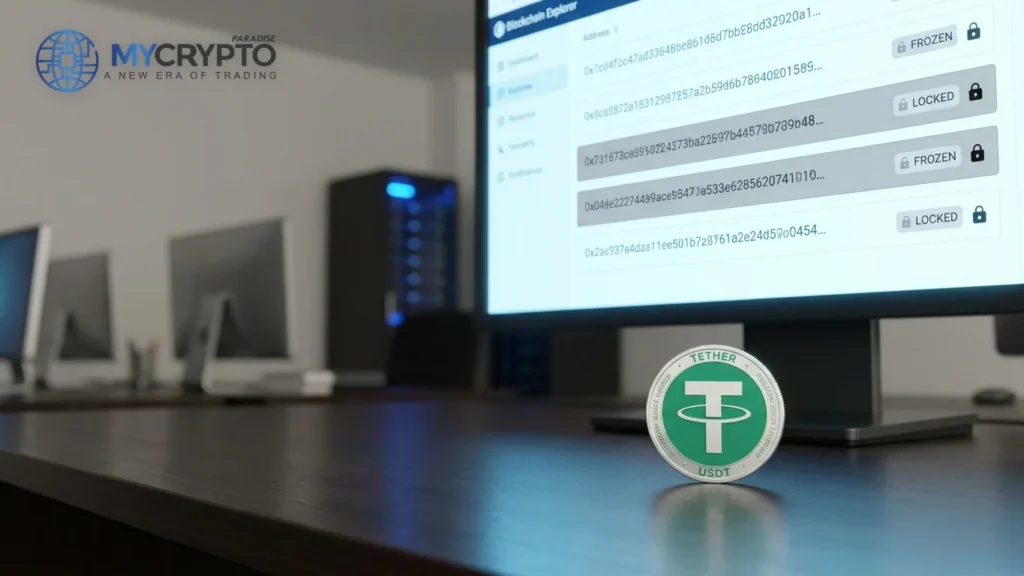
- Tether froze 4 TRON addresses holding about $131M in USDT tied to the IRGC.
- The action targets sanctioned illicit finance, not the broader USDT float or market liquidity.
- BTC near $64,733 and ETH near $1,875 are moving on structure, not on this freeze.
Source: TRONSCAN
Tether just froze $131M in USDT across four TRON addresses linked to the IRGC. A big compliance headline, but does it actually change where Bitcoin goes next?
Tether froze four TRON network addresses holding roughly $131 million in USDT. On-chain, those wallets are linked to the IRGC.
This is a targeted sanctions-compliance action, not a market event. Tether can freeze specific addresses at the contract level, and here it used that power against funds tied to a sanctioned entity.
Most of the balance had been moved through the addresses before the freeze, which is the usual pattern once scrutiny arrives. The theatre of moving money to look clean rarely survives an issuer with a blacklist function.
This extends a thread we covered earlier today around Tether investing in compliance infrastructure. That story was about intent. This one is the enforcement in practice, which is the more useful signal.
What changed structurally is small but real. The freeze removes $131 million from circulation for those holders. It does not touch the wider USDT supply, the redemption mechanism, or exchange liquidity.
Meanwhile Bitcoin trades near $64,733, up about 3.7 percent on the day, and Ethereum near $1,875, up over 5 percent. Neither reacted to the freeze, because neither had reason to.
So the honest framing matters here. This is a headline about control and compliance, not a catalyst for price. Traders who conflate the two tend to trade the news instead of the market.
Why a targeted freeze rattles issuer trust
The mechanism here is trust, not liquidity. A centralized issuer freezing $131 million shows that USDT is programmable and enforceable at the contract level.
For regulators, that is a feature. It demonstrates that a dominant stablecoin can and will act against sanctioned flows, which strengthens the case for stablecoins inside a compliant financial system.
For holders, it is a quiet reminder. The dollar in your USDT wallet is a claim on an issuer that can freeze it, and that counterparty risk sits underneath the whole crypto market.
That is the real transmission line. Stablecoins are the plumbing that moves capital between exchanges, chains, and desks, so anything that touches confidence in the largest one touches everyone indirectly.
In this case the effect is contained. The freeze is surgical, aimed at four flagged addresses, and it does not question USDT's backing or its ability to redeem for the millions of legitimate holders.
So the macro read is measured. This reinforces the direction of travel toward tighter oversight of stablecoins and illicit finance, which over time supports institutional adoption rather than threatening it.
The risk only becomes systemic if freezes ever look arbitrary or backing looks thin. Neither is the case today, which is why the market treated it as news rather than a threat.
Why BTC and ETH shrugged off the freeze
Start with the tape. Bitcoin is near $64,733 and up about 3.7 percent, while the freeze made no visible dent in either price or on-chain USDT liquidity.
That is the tell. When a $131 million action passes through the market with no reaction, the market is telling you it did not view this as a liquidity event.
The reason is scale and containment. $131 million is a rounding error against USDT's total float and against daily crypto volumes, and it was frozen at specific wallets rather than pulled from exchange reserves.
So the usual cascade does not fire. There is no sudden USDT shortage, no forced unwinding, no stablecoin depeg pressure to transmit into BTC, then ETH, then alts.
Instead, BTC and ETH are trading on their own structure. Bitcoin's push higher and Ethereum's stronger 5 percent day reflect technicals and broader sentiment, not this headline.
The practical impact is reputational and regulatory, and it lands on the issuer, not on price. It nudges the long-term narrative around stablecoin compliance without moving a single candle today.
For traders, the lesson is separation. An important compliance story and an important price story are not the same thing, and treating one as the other is how isolated news gets overtraded.
What confirms this stays a contained event
The first thing to watch is scope. If the freeze stays limited to these four IRGC-linked addresses, it confirms a surgical enforcement action with no market consequence.
The signal flips only if the pattern widens. A sudden wave of freezes across many unrelated addresses, or any hint of pressure on USDT's backing, would change the story from compliance to counterparty risk.
Watch the peg and the redemptions. As long as USDT holds its dollar peg and redemptions stay smooth, confidence is intact and this remains background noise for price.
A depeg, even a brief one, is the real invalidation. That is when a stablecoin story becomes a liquidity story, and the effect would show up fast across BTC and ETH.
On the macro side, watch how regulators frame it. Tighter, clearer stablecoin rules that reward compliant issuers support the adoption narrative over time.
Heavy-handed or arbitrary intervention would do the opposite, but nothing in this action points that way yet.
For now the confirmation is simple. Price ignoring the freeze, the peg holding, and no spread to other addresses all say the same thing, which is that this is a controlled event, not a turning point.
Reading the freeze against the current push
The ParadiseTeam view is to keep this story in its own lane. This is a compliance freeze, not a market driver, so it does not change the levels that actually matter here.
The read is that Bitcoin, near $64,733 as of this writing, is being driven by structure and flow, not by an isolated $131 million action against sanctioned wallets.
Inside the broader corrective picture, the tactical bias remains toward the upside push, with smart money working price higher toward the $79,000 region rather than reacting to news like this.
That is the retail trap the ParadiseTeam watches for. Retail tends to grab an emotive headline and trade it, then get caught leaning the wrong way against the dominant flow.
The smart-money mechanism is patience. Freezes like this scare newcomers about USDT while professionals simply note it, keep their thesis, and let the compliance narrative mature in the background.
So the ParadiseTeam frames current strength as a move within a larger structure, not a reason to over-extend. Upside toward $79,000 stays the working idea, with real risk of a deeper corrective leg toward the $44,000 zone still on the table.
The discipline is separation. Trade the levels and the flow, treat this freeze as context for issuer trust, and do not let an isolated headline dictate position size.
Track it live: our live crypto funding rates and the Crypto Fear and Greed Index both update in real time, so you can watch this shift for yourself.
Related coverage
For exact entries, targets, and stop losses with full risk management, that is what ParadiseFamilyVIP is for. New to reading these moves? Start with our crypto trading strategies guide.
ParadiseTeam is monitoring the market situation closely, and we are taking these developments into consideration while building our trading tactics inside ParadiseFamilyVIP.
Crypto trading involves substantial risk. Prices are volatile and you can lose money. This article is educational and is not financial advice. Past performance does not guarantee future results.
Do Tether freezes like this help or hurt long-term trust in USDT?
Follow this topic: Stablecoin news





Join the discussion
No comments yet. Members, share how you are reading this.