

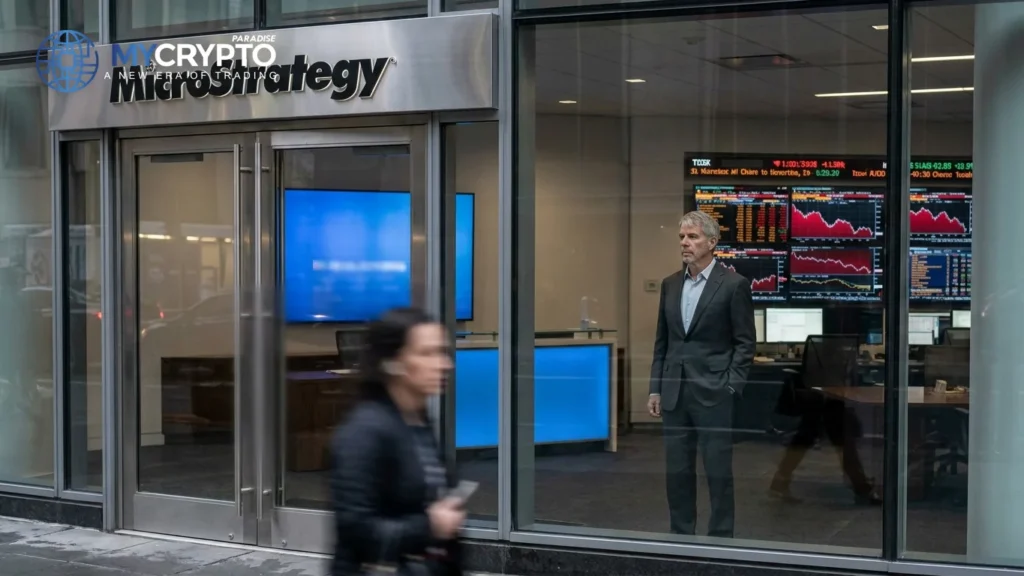
Developing story update (July 01, 2026, 18:17 UTC):
Update: further details on Strategy’s framework have been confirmed. The move ends four years of an absolute never-sell stance, marking a clear shift to active treasury management rather than a one-off decision.
Alongside the Bitcoin sale authorization, Strategy approved up to $1 billion of common-stock buybacks and up to $1 billion of preferred-security repurchases, and raised the annual dividend rate on its Variable Rate Series A perpetual preferred. For traders, this widens the funding options Strategy can use for shareholder returns, which probably lowers the odds it is ever forced to sell Bitcoin into weakness.
What to watch now: Whether Strategy actually executes any Bitcoin sales or resumes buying, and the size of any buybacks reported next.
Developing story update (July 01, 2026, 16:54 UTC):
Update: Strategy paused its Bitcoin buying during the week of the announcement, a shift for a company known for steady accumulation. For traders, that removes a familiar bid from the market for now, though it does not signal selling.
The company has also clarified that the program authorizes Bitcoin sales under defined conditions but does not require it to reduce its holdings. This reinforces the read that the move is precautionary treasury management, not a committed sell program, which keeps the forced-liquidation overhang low.
What to watch now: Whether Strategy resumes Bitcoin buying or begins using the discretionary sale authority.
Developing story update (July 01, 2026, 16:12 UTC):
Update: Strategy paused its Bitcoin buying during the week of the announcement, the first clear break in its steady accumulation pattern. For traders this matters more than the sale authorization itself, because it signals the company is prioritizing capital management over adding supply right now.
The authorization to sell up to $1.25 billion in Bitcoin is now framed under a formal Digital Credit Capital Framework covering its dollar reserve, dividends, and share repurchases. A structured mechanism like this points to orderly, pre-planned activity rather than reactive forced selling, which probably reduces the odds of a disorderly supply shock from a major holder.
What to watch now: Whether Strategy resumes buying next week or the pause extends into a longer accumulation halt.
Developing story update (July 01, 2026, 15:29 UTC):
Update: the authorized sale capacity has now been quantified. The up to $1.25 billion in Bitcoin translates to roughly 21,082 BTC, or about 2.5% of Strategy’s stated holdings, framed as a discretionary monetization authority sitting alongside the committed $2.55 billion dollar reserve.
For traders, the scale matters: capping potential sales near 2.5% of the position keeps this firmly in the balance-sheet-flexibility category rather than a wind-down, which likely limits the odds of a large forced-supply overhang.
What to watch now: Whether any of the 2.5% capacity is actually monetized, or if it stays an unused backstop.
Developing story update (July 01, 2026, 15:07 UTC):
A follow-on detail has been confirmed since we first covered this. Strategy has increased the annual dividend rate on its Variable Rate Series A Perpetual Securities, and the wider plan is now formalized under a named Digital Credit Capital Framework aimed at strengthening its risk-to-reward profile.
For traders the read is unchanged: this is treasury housekeeping, not forced selling. A higher preferred dividend rate is a cost the company is choosing to carry to keep its dollar reserve committed, which lowers the probability of a disorderly Bitcoin sale from a large holder rather than raising it.
What to watch now: Watch whether Strategy actually taps the $1.25 billion sale authorization or leaves it unused as a backstop.
Developing story update (July 01, 2026, 14:06 UTC):
Update: Strategy has now raised the annual dividend rate on its Variable Rate Series A Perpetual Securities, adding a fresh cash obligation to the picture. The $1.25 billion Bitcoin sale authorization is being framed as discretionary monetization authority, meaning it is a tool the company can use rather than a scheduled sale.
For traders the read is unchanged in direction. A higher dividend rate raises the case for keeping optional access to liquidity, which is likely why the framework pairs the buyback capacity with the discretionary sale option. This keeps forced-selling risk lower while giving the company more control over its cash needs. Price action has stayed roughly flat, suggesting the market is treating this as balance-sheet housekeeping rather than a supply threat.
What to watch now: Whether Strategy actually taps any of the $1.25B monetization authority or leaves it unused while it funds the higher dividend.
Developing story update (July 01, 2026, 13:45 UTC):
Update: Strategy also paused its Bitcoin buying during the week of the authorization. The company stepped back from adding to its position while it reset its capital plan, rather than continuing to accumulate.
For traders, a paused corporate buyer removes one source of steady spot demand in the near term. It does not signal selling, but it does mean less predictable bid support from this holder until buying resumes.
What to watch now: Whether Strategy resumes Bitcoin buying or begins using the sale authorization, and any pause-to-active shift in its treasury activity.
Developing story update (July 01, 2026, 12:43 UTC):
Update: Strategy has also raised the annual dividend rate on its Variable Rate Series A Perpetual Securities. The move fits the same treasury-management shift behind the Bitcoin sale authorization, giving the company more scheduled cash obligations to service from its dollar reserve rather than from forced coin sales.
For traders, this reinforces the earlier read: the framework is built to fund dividends, buybacks and reserves through defined channels, which likely keeps a large holder from becoming a source of surprise supply during weak tape.
What to watch now: Whether the higher preferred dividend rate pressures Strategy to actually exercise any of the $1.25 billion Bitcoin sale authorization.
Developing story update (July 01, 2026, 12:23 UTC):
Update: Strategy paused its Bitcoin buying during the week of the announcement, a detail that fits the more active treasury posture behind the sale authorization. The move is now confirmed as part of a formal framework covering the USD reserve, dividend and interest payments, and share repurchases.
For traders the read is unchanged. The authorization still creates a controlled route to fund obligations rather than forcing spot selling, so it likely reduces the probability of surprise supply from a major holder even with buying on hold for now.
What to watch now: Whether the buying pause is temporary or signals a longer accumulation break by a major holder.
Developing story update (July 01, 2026, 11:41 UTC):
Strategy has paused its Bitcoin buying during the week of this announcement, according to the latest confirmed details. For traders, this points to a treasury team focused on active management rather than continued accumulation for now.
The pause does not change the core framework: the sale authorization is positioned to reduce forced-selling risk while supporting the dollar reserve, dividends, and buybacks. Read it as a possible structural de-risking step rather than a directional call on price.
What to watch now: Whether Strategy resumes Bitcoin buying or keeps the pause in place in the coming weeks.
Developing story update (July 01, 2026, 10:17 UTC):
Update: the plan is no longer just an authorization. Strategy has now formalized it in an official regulatory filing dated June 29, adopting a board-approved treasury framework that governs when and why it can sell Bitcoin.
The filing also sets a minimum cash reserve floor of $2.55 billion. For traders, that matters more than the sale figure itself: a defined cash buffer means any Bitcoin sales would likely be measured and rules-based rather than forced, which continues to reduce the risk of a large distressed supply hitting the market.
What to watch now: Whether Strategy actually executes any BTC sales under the new framework or leaves the authorization unused.
Developing story update (July 01, 2026, 09:13 UTC):
Update: The company has raised the annual dividend rate on its Variable Rate Series A Perpetual securities, reinforcing that proceeds from the authorized Bitcoin sale are earmarked for dividend and capital obligations rather than open-market dumping.
The approved sale capacity now works out to roughly 21,082 BTC at current prices. The buying pause and the up to 1.25 billion dollar ceiling are unchanged, so for traders this remains a framework for controlled, as-needed sales rather than confirmation of any actual selling.
What to watch now: Watch for any filing confirming BTC actually sold versus the authorization remaining unused.
Developing story update (July 01, 2026, 08:52 UTC):
Update: Strategy has paused its Bitcoin purchases during the week of the announcement, so the treasury is neither adding nor being forced to sell while the new authorization sits in place.
The sale authorization is now framed as part of a new Digital Credit Capital Framework, pointing to a more structured, active approach to managing the balance sheet rather than a one-off decision.
What to watch now: Watch whether the buying pause ends or extends, as a resumption would signal renewed spot demand.
Developing story update (July 01, 2026, 08:11 UTC):
A follow-on detail has been confirmed: Strategy paused its Bitcoin buying during the week of the sale authorization. This lines up with the read that the firm is prioritizing balance-sheet flexibility over fresh accumulation for now.
For traders, a paused buyer is not the same as a seller. The program still carries no obligation to sell any Bitcoin, and the committed dollar reserve remains in place. It removes a source of steady demand at the margin without adding forced supply, so the practical near-term impact on spot is likely small.
What to watch now: Whether the buying pause extends into following weeks or accumulation resumes.
Developing story update (July 01, 2026, 07:50 UTC):
Update: Strategy has attached hard capital-return numbers to the program. It has authorized up to $1 billion of common-stock buybacks and a further $1 billion of preferred-security repurchases, and has raised the annual dividend rate on its Variable Rate Series A perpetual stock.
For traders the read is unchanged but firmer: this looks like structured treasury management, not forced liquidation. The added buyback and dividend capacity is designed to cut forced-dilution risk, which lowers the odds of pressured BTC selling rather than raising it. BTC is holding near $58,665 with support in focus around $57,500.
What to watch now: Whether any actual BTC is sold under the authorization, or whether buybacks and the reserve cover the dividend and repurchase costs instead.
Developing story update (July 01, 2026, 06:03 UTC):
Update: More detail has emerged on how Strategy plans to use the proceeds. Alongside the previously reported authorization to sell up to $1.25 billion in Bitcoin, the company has now cleared up to $1 billion of common-stock buybacks and a further $1 billion of preferred-security repurchases, and it has raised the annual dividend rate on its Variable Rate Series A perpetual preferred.
The company is also reported to be holding a committed $2.55 billion cash reserve and paused its Bitcoin purchases during the week of the announcement. For traders, this reinforces the read that the move is about balance-sheet flexibility rather than a forced sell, though a pause in buying removes one steady source of demand for now.
What to watch now: Watch whether Strategy resumes Bitcoin buying or actually taps the $1.25 billion sale authorization in the weeks ahead.
Developing story update (July 01, 2026, 05:19 UTC):
Update: Strategy has paused its Bitcoin buying during the week of the announcement, and the newly authorized program does not obligate the company to sell any BTC. It is standing capacity, not a committed sale.
The company is also holding a committed dollar reserve of about $2.55 billion, which reinforces the read that this is treasury flexibility rather than forced distribution. For traders, the takeaway is unchanged: the overhang of unplanned selling is reduced, not that supply is about to hit the market.
What to watch now: Watch whether Strategy resumes BTC buying or actually taps the sale authorization in the coming weeks.
Developing story update (July 01, 2026, 04:57 UTC):
Update: fresh detail puts the authorized Bitcoin sale ceiling at roughly 21,082 BTC, which frames the $1.25 billion figure in coin terms and confirms the cap is a small share of Strategy’s total holdings rather than a full unwind.
The wider framework also adds up to $1 billion of preferred-security repurchases alongside the previously noted $1 billion common-stock buyback capacity, and lifts the annual dividend rate on its Variable Rate Series A Perpetual preferred. Read together, this looks like balance-sheet flexibility and capital-return management, not a signal that forced Bitcoin selling is coming.
What to watch now: Whether Strategy actually taps any of the 21,082 BTC ceiling or leaves it unused as a liquidity backstop.
Developing story update (July 01, 2026, 03:32 UTC):
Two further details have since been confirmed. Strategy paused its Bitcoin buying during the week of the announcement, so the treasury shift is being managed rather than layered on top of fresh accumulation.
The authorization also sits inside a formal new Digital Credit Capital Framework covering dividends and share repurchases, which points to more active, structured treasury management. For traders this reinforces the read that the sale authorization is a risk-reduction step, not a rush to offload coins, and probably keeps a large forced-seller overhang off the table.
What to watch now: Whether Strategy resumes Bitcoin buying or actually taps the sale authorization in the coming weeks.
Developing story update (July 01, 2026, 03:10 UTC):
Update: Strategy has also raised the annual dividend rate on its Variable Rate Series A Perpetual Securities, alongside the previously reported Bitcoin sale authorization, the committed dollar reserve, and the buyback plans.
For traders, this points to a treasury that is being actively managed for cash flow and balance-sheet strength rather than forced liquidation. It reinforces the read that the sale authorization is a risk-management tool, not a signal of distressed selling.
What to watch now: Whether Strategy actually taps the sale authorization or leaves it as a standby buffer while funding dividends and buybacks.
Developing story update (July 01, 2026, 02:48 UTC):
Update: Strategy’s stock first slid after a broker cut its price target on the back of recent Bitcoin weakness, then recovered as the company tied any future share issuance to valuation discipline near 1x its Bitcoin net asset value. This reinforces the shift toward more measured treasury management rather than aggressive expansion.
The company has also clarified how proceeds may be deployed: up to $1 billion in common-stock buybacks and up to a further $1 billion in preferred-security repurchases, in addition to funding dividends. For traders, this points to reduced forced-selling pressure and less dilution risk, though it does not remove broader market downside risk.
What to watch now: Whether MSTR issuance stays disciplined near 1x mNAV and whether the Bitcoin buying pause continues.
Listen: the breakdown
Market briefing: Strategy has authorized selling up to 1.25 billion dollars in Bitcoin to manage its treasury, quietly retiring the biggest forced-seller fear on the board while BTC trades at 58,367, down 2.6 percent on the day.
- Strategy approved selling up to $1.25 billion in Bitcoin under a new Digital Credit Capital Framework.
- The plan funds a dollar reserve, dividends and buybacks, and is built to prevent forced Bitcoin selling.
- BTC trades at $58,367, down 2.6 percent, as the removal of a large potential seller reshapes market structure.
Strategy just authorized a $1.25 billion Bitcoin sale, and the market read it as relief rather than fear. So who is really selling while retail panics?
The company that built its identity on never selling Bitcoin just gave itself permission to sell some. Strategy authorized the disposal of up to 1.25 billion dollars in Bitcoin as part of a new Digital Credit Capital Framework. The proceeds are earmarked for a dollar reserve, dividend payments and share repurchases. The framework is designed to do one specific thing: reduce the risk that the company is ever forced to dump Bitcoin at the worst possible moment. Alongside it, Strategy authorized up to 1 billion dollars in common-stock buybacks and up to 1 billion in preferred-security repurchases, raised the dividend rate on its Variable Rate Series A Perpetual S, and paused Bitcoin buying for the week. It also committed to a 2.55 billion dollar USD reserve. The headline sounds bearish. A famous holder can now sell. Yet the market structure it creates is the opposite of what the surface suggests. For years the tail risk hanging over Bitcoin was a leveraged treasury being squeezed into a fire sale. That scenario just got a release valve. Any Bitcoin sold here would crystallize a realized loss, which tells you the company is choosing prudence over price. It is a shift from ideology to treasury management. BTC still trades lower on the day at 58,367, so the paper is not celebrating. The question is who benefits when a forced seller quietly becomes an optional one.
Why removing a forced seller matters
The transmission mechanism here runs through fear, not fundamentals. Bitcoin does not have earnings, so its price is a function of who is willing to hold and who might be compelled to sell. For a long time, the single largest overhang was the possibility that a highly leveraged corporate treasury could be forced to liquidate Bitcoin to meet obligations. That is the kind of forced selling that turns an ordinary dip into a cascade, because it arrives at exactly the moment nobody wants to buy. Strategy's new framework is built to defuse that scenario. By pre-funding a dollar reserve and giving itself an orderly path to raise cash, the company removes the gun from its own head. A large potential seller becomes a discretionary one, and discretionary sellers rarely sell into panic. This matters for the whole market because structure sets the floor. When the biggest visible tail risk is retired, the distribution of possible outcomes narrows on the downside. Traders who were pricing in a forced-liquidation shadow can stop discounting it. That does not make Bitcoin go up by decree. It simply removes a reason to be short. The company accepting a realized loss to do this is the tell: this is risk management, not a bullish victory lap. In markets, the seller who plans his exit calmly is far less dangerous than the one who has no choice. That distinction is the entire point of the announcement.
How the de-risking flows to BTC and alts
Follow the liquidity. On paper this is a de-risking event, yet BTC still trades down 2.6 percent at 58,367. That gap between the news and the tape is where the real story sits. The immediate effect on Bitcoin is structural rather than directional: a source of concentrated downside pressure has been softened, so the order book carries less latent supply near the lows. Bitcoin sets the tone first, as always. If BTC stops leaking here and starts to build a base, the removal of the forced-seller narrative gives it room to reclaim lost ground without a specific new buyer needing to appear. Ethereum tends to follow Bitcoin's lead with a lag and more amplitude, so a Bitcoin stabilization typically pulls ETH off its own lows a beat later. Alts sit at the end of the chain and react last, magnifying whatever Bitcoin does in both directions. For now the price weakness looks disconnected from the actual news, which is usually the market's way of shaking out weak hands before it moves. Nobody rings a bell when a tail risk quietly disappears. The chart still shows red, and that red is the point of maximum discomfort. Structure has improved while sentiment has not caught up. That divergence between an improving backdrop and a nervous tape is the condition in which reversals are built, not the condition in which trends end.
What confirms the reversal from here
The confirmation signals are specific, and they live on the daily candle. The first thing that matters is whether Bitcoin defends the zone it is sitting in rather than losing 54,000, the next important support below. Holding here keeps the de-risking narrative intact. Above, the level that turns this from hope into evidence is a daily close back above 60,000. A green daily candle that closes above that line would mark a bullish engulfing and tell you the buyers have taken control of the timeframe that counts. The next checkpoint is a close above 60,300, the Fibonacci 1.272 level, which would confirm momentum rather than a bounce. Volume is the honesty check. A reclaim on thin volume is a trap; a reclaim on volume above the moving-average trend is real participation. Watch the daily MACD lines reclaim and turn up, and a Stochastic RSI bullish cross, both of which would align with the exhaustion already visible in momentum. Invalidation is equally clear. A decisive daily close below support that opens the path toward 54,000 would say the shakeout has become genuine distribution and the structure has failed. The tell to trust over the noise is simple: improving structure plus a bullish divergence usually resolves up, while a loss of support on real volume resolves down. Let the daily close decide, not the intraday flicker.
What this print signals for liquidity
The ParadiseTeam reads this through liquidity, not sentiment. With BTC at 58,367 and down on the day, the tape looks bearish while the backdrop just improved. That mismatch is the signal. Removing a potential forced seller thins the downside supply exactly as price defends the 58,000 area where bulls have been holding the bottom. Note who is positioned where. An inexperienced whale is heavily short, with liquidation risk toward 65,836, which is also the level that has been acting as resistance. When the crowd is short into improving structure, their stops become fuel. Previous lows looked like long squeezes rather than real spot selling, which fits a shakeout more than a breakdown. The bullish divergences in volume and RSI say bearish momentum is fading, not building. For the ParadiseTeam the near-to-medium read is bullish, but it is conditional on the daily close. The line that matters is 60,000; a green daily close above it, ideally through 60,300 on genuine volume, would confirm smart money has taken the other side of that short. Lose 54,000 on a daily close and the read is wrong. The realized loss Strategy is willing to book to de-risk is the quiet tell that patient hands are managing exposure while impatient ones are trapped short. Probabilities, not promises: the structure favors accumulation, but the daily candle gets the final word.
For exact entries, targets, and stop losses with full risk management, that is what ParadiseFamilyVIP is for. New to reading these moves? Start with our crypto trading strategies guide.
ParadiseTeam is monitoring the market situation closely, and we are taking these developments into consideration while building our trading tactics inside ParadiseFamilyVIP.
Crypto trading involves substantial risk. Prices are volatile and you can lose money. This article is educational and is not financial advice. Past performance does not guarantee future results.











Join the discussion
No comments yet. Members, share how you are reading this.