


Listen: the breakdown
Unconfirmed: This is an early, unverified report that has not been confirmed and may not be accurate. We are tracking it and will update or correct it as facts emerge.
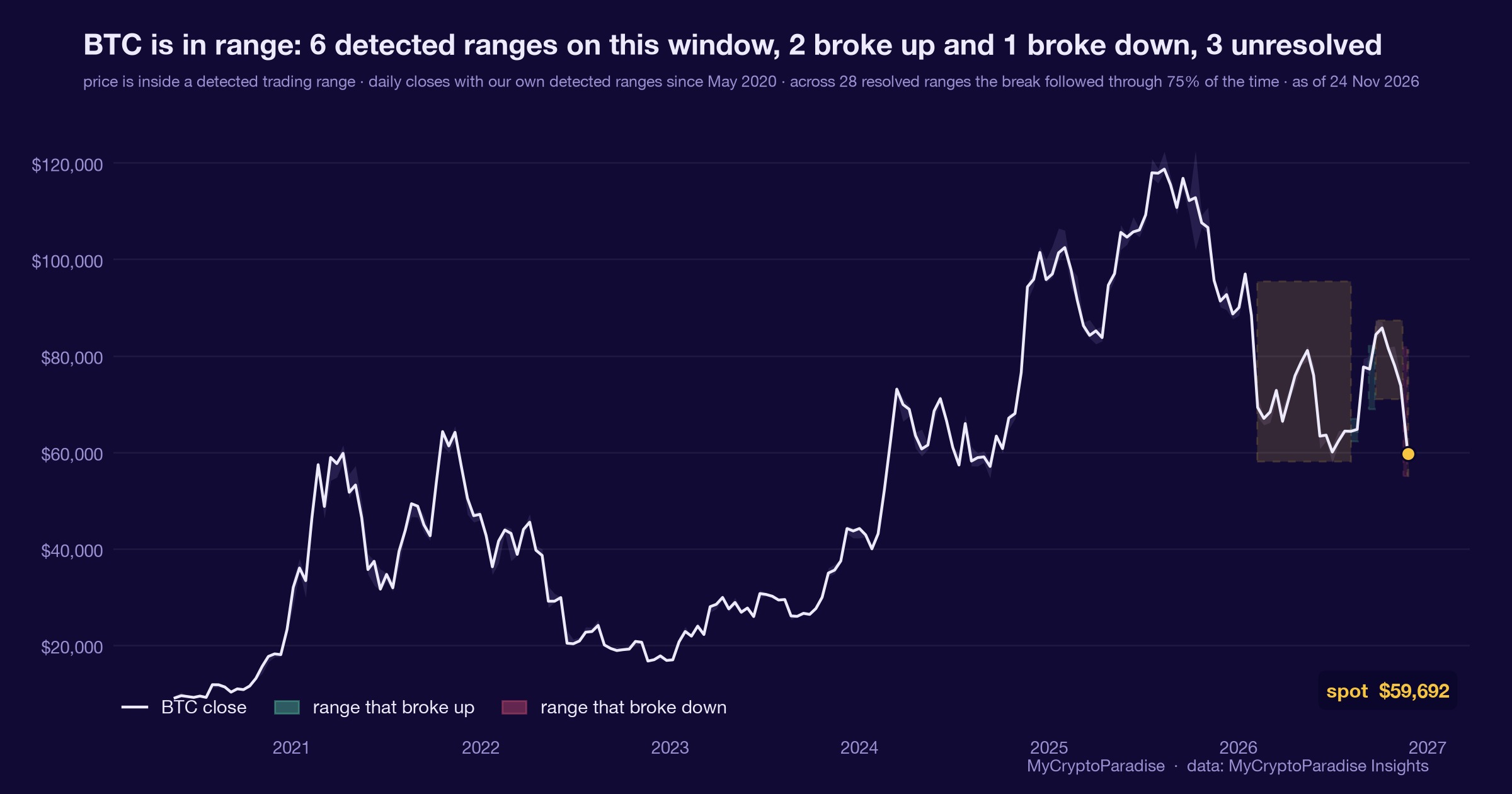
Market briefing: A claim is circulating that over a thousand Bitcoin mining sites were hit by a cyberattack that redirected their computing power, and the attack is said to be ongoing. BTC was trading near $60,911, up on the day, as of 05:02 UTC.
- A claim says over 1,000 Bitcoin mining sites were hit by a cyberattack that redirected their computing power
- The claim describes the attack as still ongoing, with more sites potentially exposed
- BTC showed no visible flinch, trading near $60,911 and green on the day as of 05:02 UTC
A claim is spreading that a Bitcoin mining cyberattack hijacked computing power across more than 1,000 sites, and it is still live. So why is BTC green?
A claim is moving fast this morning. More than 1,000 Bitcoin mining sites were allegedly hit by a cyberattack that redirected their computing power. The claim says the attack is still ongoing, and that more sites could follow. That is the headline. Here is the part that matters for traders: the tape disagrees with it.
BTC was trading near $60,911 as of 05:02 UTC, up on the day and roughly flat over the last hour. A story about hijacked mining infrastructure should, on its face, read as a direct hit to the network that secures the asset. Fear should show up in price. So far, it has not.
We want to be precise about what we actually know. We can confirm the claim is circulating and that it describes a mass, still-active intrusion. We cannot independently confirm the scale, the operators affected, or any measurable impact on the network. Treat this as an unverified report, not a settled event.
That gap between the claim and the chart is the whole story right now. Either the market has not credited the severity, any disrupted hashrate is being absorbed without friction, or the claim simply has not reached enough traders to move anything.
Mining stories tend to arrive loud and resolve quietly. The loud part is here. The data that would make it real, hashrate drops or miners dumping coins, has not shown up on our screens yet.
Why a mining attack threatens network trust
Mining is the engine room of Bitcoin. Computing power, the hashrate, is what secures every block and keeps the network honest. So a credible claim that someone redirected that power across a thousand sites strikes at the asset's core promise, not at a single company's balance sheet.
That is why this type of story carries weight even before anyone proves it. Bitcoin's entire pitch rests on the idea that no one can quietly seize its infrastructure. A mass mining cyberattack, if real, pokes directly at that confidence.
The transmission runs in two steps. First, disrupted or hijacked miners can be forced to sell coins to cover operations or cut losses, which adds supply. Second, and larger, is the trust channel: holders who fear the network itself has been compromised sell for reasons that have nothing to do with miner cash flow.
Here is the honest caveat. We have no confirmed same-day data showing either channel firing. No visible hashrate collapse, no miner-driven selling wave. The fear mechanism exists in theory; the evidence of it working is not on the chart.
The macro backdrop matters too. The broader tape has been quiet, thin on conviction rather than gripped by panic. A security scare landing into a calm market behaves differently than one landing into an already stretched, jumpy one. For now, the market is treating a dramatic claim with a shrug, which is itself a data point.
How the threat could move BTC then alts
Read on its own facts, this story leans bearish. A claim that attackers hijacked mining power across more than 1,000 sites is a network-integrity threat, and threats to the thing that secures Bitcoin belong in the risk column until proven otherwise.
But the liquidity cascade has not started. BTC near $60,911 is up on the day, not down. If real forced selling from compromised miners were hitting the market, we would expect pressure first in BTC, then a sharper bleed through ETH, then a harder fall across lower-liquidity alts. None of that sequence is visible yet.
That absence is the tell. When genuinely bad news lands and price refuses to fall, one of three things is true. The market does not believe the claim, the affected operators are too small to matter, or the selling is being absorbed cleanly by buyers who were already waiting.
Alts, for their part, are giving no distinct signal. They are tracking BTC, which means there is no independent panic bid or panic sell happening below the majors. The whole complex is simply waiting.
So the bearish case here is conditional, not confirmed. The downside risk is real on the facts of the claim. The downside action is not. If hashrate data turns or miners start moving coins to exchanges, this flips from a headline into a catalyst, and that is when the cascade would actually begin.
What confirms the attack versus what fades it
Watch the data, not the drama. The claim will either earn confirmation or quietly dissolve, and two measurable things settle it. The first is network hashrate. A sustained, visible drop would support the idea that real mining capacity went offline or was redirected.
The second is miner behaviour on exchanges. Forced selling leaves fingerprints: coins moving from mining-linked wallets into exchange order books, followed by supply pressure. If that shows up, the story stops being a rumour and starts being a flow.
Until then, the invalidation is simply price and silence. BTC holding green with no hashrate dent and no miner outflows tells us the market has judged this claim and moved on. A dramatic headline that produces no data tends to fade within a session or two.
We would also track whether the claim broadens with specifics. Named operators, confirmed downtime, and technical detail would push it from unverified toward developing. Vague escalation with no evidence usually signals the opposite.
One caution worth stating plainly. The danger window is not now; it is the moment confirmation arrives into a market that spent the morning ignoring the risk. That is when traders who shrugged get caught repricing fast.
So the confirmation to respect is a hashrate turn plus exchange inflows from miners. The invalidation is the boring outcome: no data, no follow-through, price unbothered. On current evidence, the boring outcome is winning.
Why the market shrug is the real signal
The ParadiseTeam view is to respect the risk and distrust the headline in equal measure. A mining cyberattack claim is a reason to raise your guard, not a reason to sell into a market that is refusing to flinch.
Context sets the frame. Our standing read has been cautious on this bounce, treating recent strength as leverage rather than real accumulation, with $64,000 now acting as resistance after flipping from support. BTC near $60,911 sits below that line, so this scare lands in a tape we already saw as fragile underneath.
That is why the ParadiseTeam is slow to add fresh bearish risk purely on this story. The move we care about is a push toward the $44,000 region, and that comes from genuine capitulation and forced selling, not from a rumour the chart has ignored.
Here is where the two threads meet. If this attack is confirmed and triggers real miner-driven selling, it becomes exactly the kind of forced-seller event that could accelerate a flush, which fits our longer-term map lower.
Until that evidence prints, we treat the claim as unconfirmed and unpriced. The ParadiseTeam is watching hashrate and miner flows, not the headline. Smart money tends to wait for forced sellers; retail tends to react to the first scary sentence. The gap between those two behaviours is usually where the edge lives, and right now it favours patience.
The read behind this: we framed this story through our own market analysis, Bitcoin Bounce Was Leverage, Not Smart Money.
Track it live: our Crypto Fear and Greed Index and the live crypto funding rates both update in real time, so you can watch this shift for yourself.
Related coverage
For exact entries, targets, and stop losses with full risk management, that is what ParadiseFamilyVIP is for. New to reading these moves? Start with our crypto trading strategies guide.
ParadiseTeam is monitoring the market situation closely, and we are taking these developments into consideration while building our trading tactics inside ParadiseFamilyVIP.
Crypto trading involves substantial risk. Prices are volatile and you can lose money. This article is educational and is not financial advice. Past performance does not guarantee future results.
Does this mining attack claim get confirmed and move BTC this week?
How 1 Paradiser is calling it
The first call is still open
Free account, no password. Members just sign in.











Join the discussion
No comments yet. Members, share how you are reading this.