

Listen: the breakdown
Market briefing: South Korea just lost ₩1,118 trillion, roughly $745 billion, as the Kospi crashed 22 percent in two weeks. Bitcoin was trading near $81,906, down less than one percent, barely acknowledging the carnage next door.
- Over ₩1,118 trillion, about $745 billion, erased from Korean stocks as the Kospi falls 22% in two weeks
- Samsung and SK Hynix, half the index between them, have crashed 25% and 34%
- BTC sat near $81,906, down under 1%, while the Kospi shed another 4% today
A Korean stock market crash just vaporised ₩1,118 trillion, yet Bitcoin barely flinched near $81,906. So is crypto truly decoupled, or is the risk-off wave still on its way?
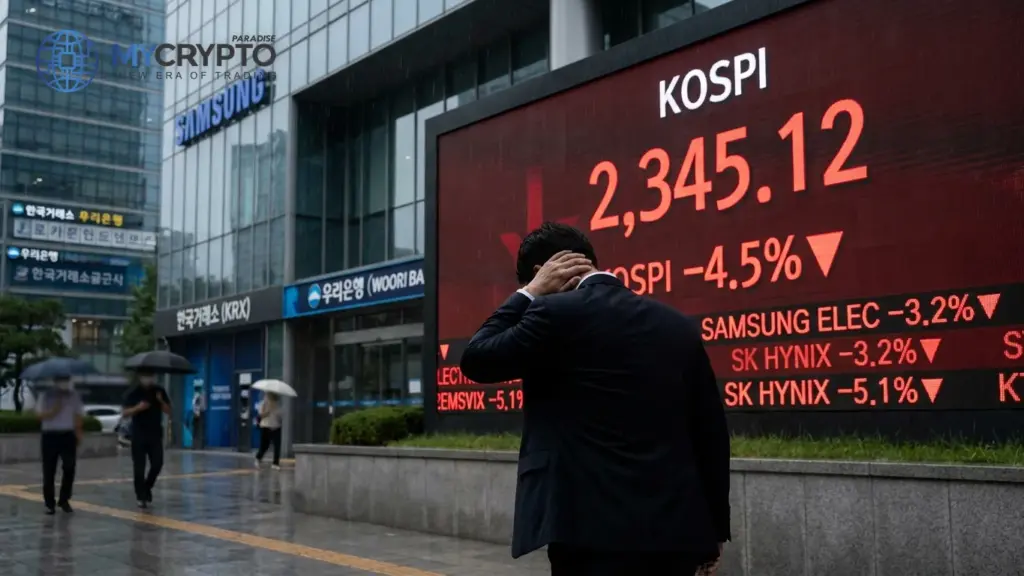
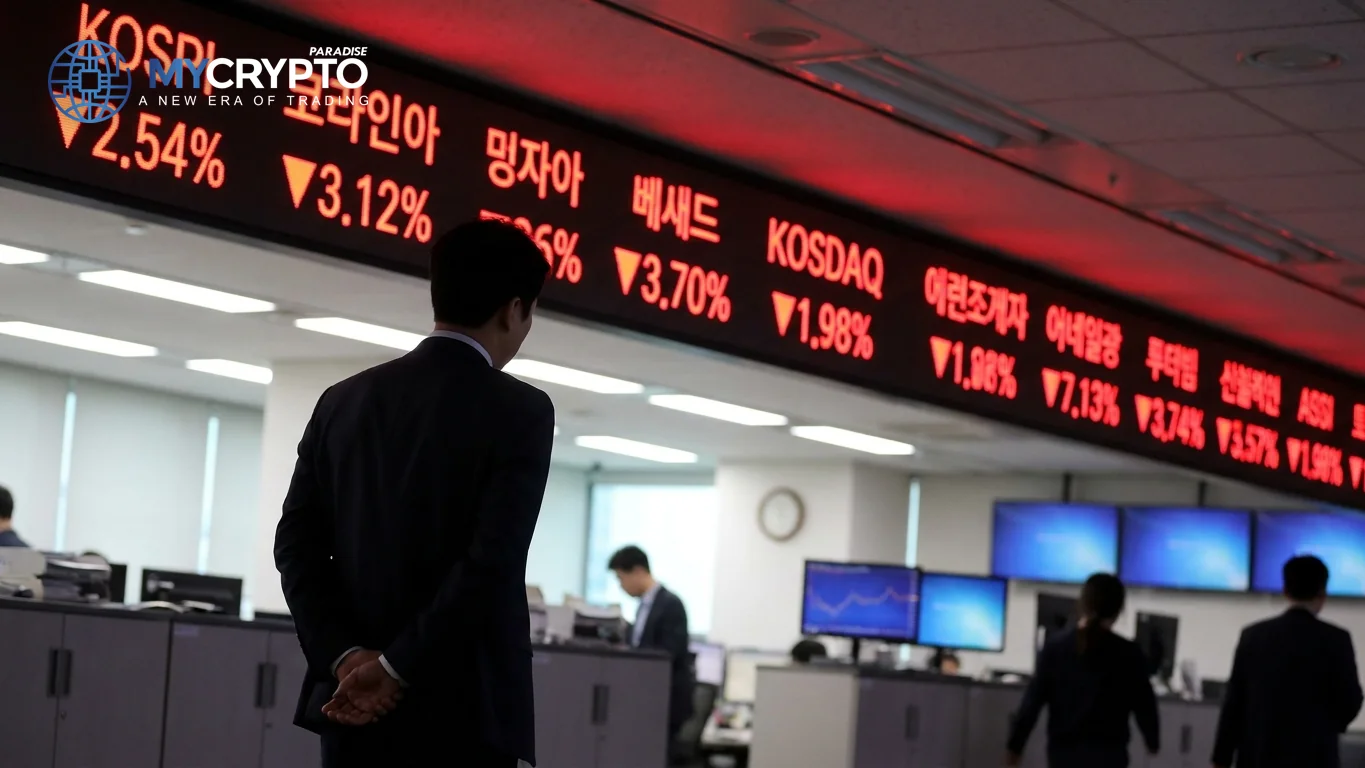
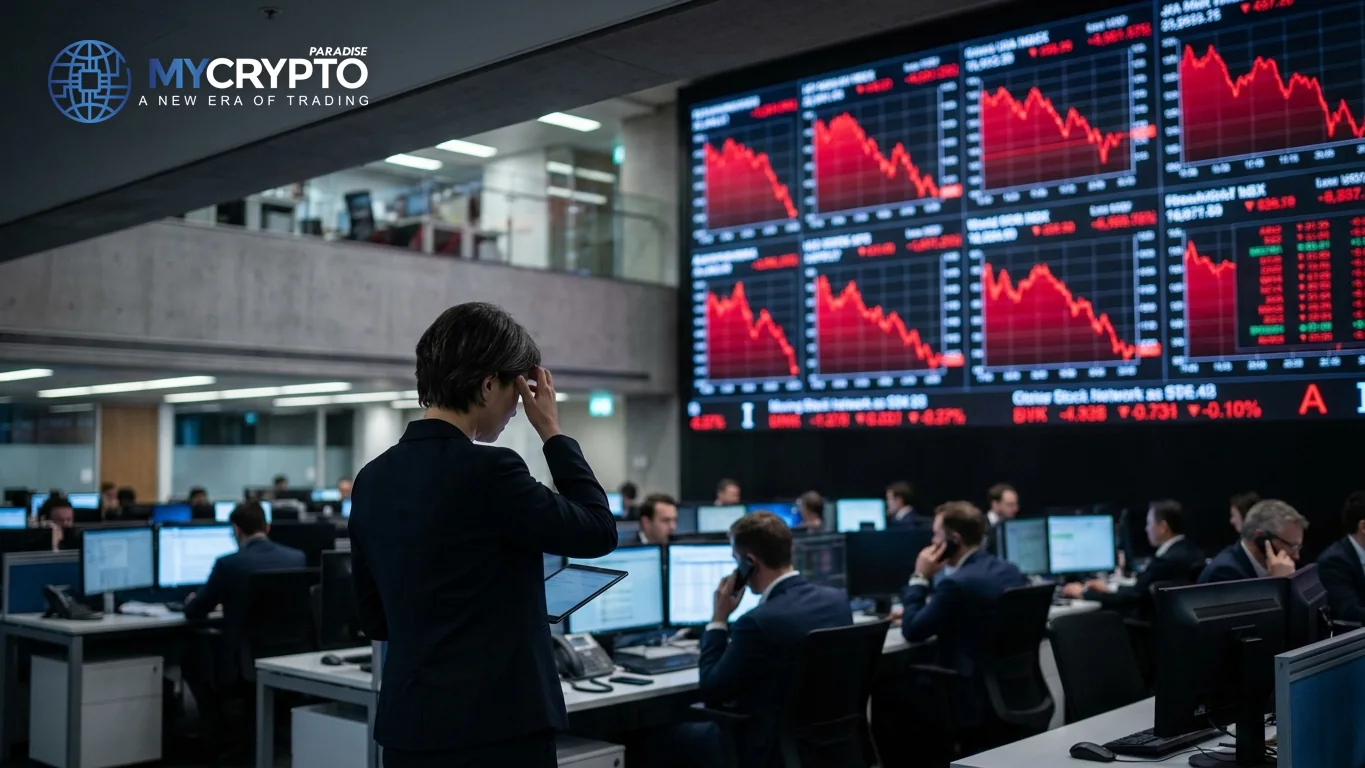
South Korea's stock market has just suffered one of its sharpest two-week drops in years. Over ₩1,118 trillion, roughly $745 billion, has been erased from the Kospi index. The index itself is down 22 percent in a fortnight. Today it fell another 4 percent, wiping out almost all of yesterday's rebound.
The damage is concentrated where it hurts most. Samsung and SK Hynix together make up half the entire index. Samsung shares have crashed 25 percent. SK Hynix has fallen 34 percent. When half an index moves like that, the index has nowhere to hide.
This extends a story we flagged earlier today, when the Kospi shed ₩170 trillion in a single session. What is new is the scale of the full two-week picture, and the fact that the bounce traders hoped for lasted barely a day.
For crypto readers, the striking part is what did not happen. Bitcoin was trading near $81,906 as of this snapshot, down under 1 percent on the day. Ethereum sat near $2,403, down about 1 percent. A $745 billion hole opened in a major Asian economy, and crypto largely looked the other way.
That gap between a regional equity collapse and a near-flat Bitcoin is the real question here. We should be honest upfront: there is no single confirmed catalyst tying the two together today. So the rest is our read, not a proven chain.
A $745 billion hole in Asian risk appetite
The transmission that worries us runs through risk appetite, not a direct crypto wire. A 22 percent crash in a G20 equity market is a large, visible deleveraging event. When ₩1,118 trillion evaporates, investors across the region sell what they can, raise cash, and cut exposure to anything that moves fast. Crypto is the fastest-moving thing most portfolios own.
The concentration makes it worse. Samsung and SK Hynix are not minor names. They are the memory-chip backbone of the global technology trade. A 25 and 34 percent drop in those two tells you something about how the market is now pricing the entire artificial-intelligence hardware cycle.
That matters for us because crypto and the AI-chip trade have shared the same tide for two years. Both run on cheap money, forward optimism, and the belief that this cycle keeps compounding. When one of those pillars cracks in Seoul, the question is whether the same doubt crosses into digital assets.
So far, it has not. BTC near $81,906 is not behaving like an asset in a risk-off panic. Either global crypto money genuinely sees this as a local Korean problem, or the contagion is simply slow.
We lean toward caution. A shock this size rarely stays politely inside one border. History suggests the correlation that looks absent on day one often shows up on day five, once the margin calls finish working through the system.
Why crypto's calm may be borrowed time
On its own facts, this story leans bearish for crypto, and the mechanism is risk appetite. A $745 billion equity crash shrinks the pool of money willing to hold speculative assets. Bitcoin sits at the speculative end of almost every allocation. That is the headwind, even if the chart has not shown it yet.
The cascade, if it comes, follows a familiar order. BTC moves first, because it is the most liquid and the easiest to sell at 3am when a Korean margin desk is forcing exits. Right now BTC near $81,906 is holding, which tells us the selling pressure has not arrived in force.
Ethereum comes next, and ETH near $2,403 is tracking Bitcoin closely rather than leading. That is normal. In a genuine risk-off wave, ETH tends to fall harder than BTC once the move accelerates.
Alts would be the real casualty. Thin order books and heavy retail positioning mean they amplify any BTC weakness. If contagion fears spread from Seoul, smaller tokens would feel it long before Bitcoin breaks a key level.
For now, the honest read is decoupling, not immunity. Crypto is uncorrelated to this event today. But uncorrelated and safe are not the same word. The absence of a reaction can mean the market has judged the risk, or simply that it has not finished reacting. We would not confuse one for the other.
The signals that turn Seoul into a crypto problem
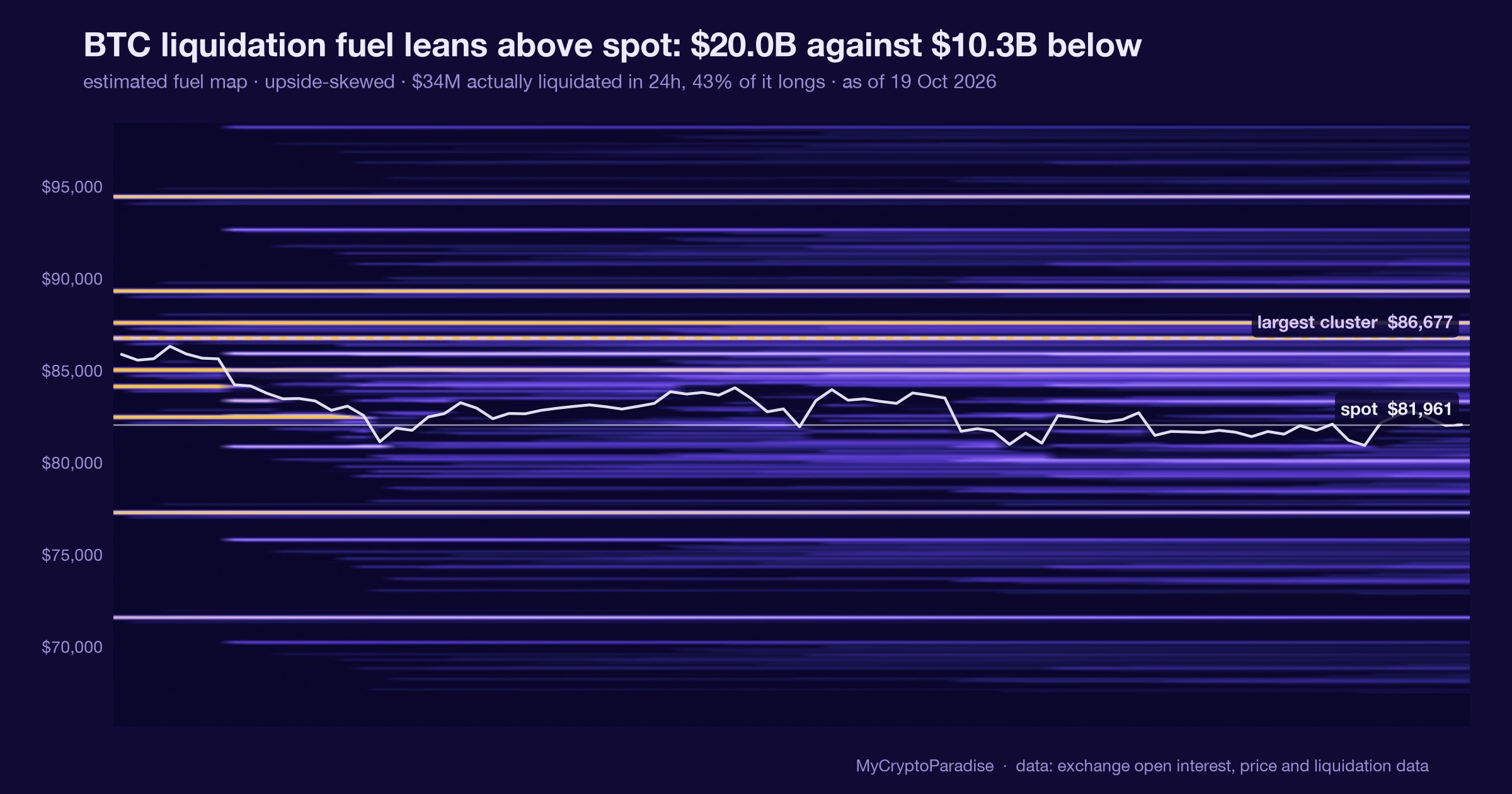
The cleanest confirmation that this is spreading would be Bitcoin losing its footing on heavy volume while Asian markets are open. If BTC breaks below $79,000 on a Seoul session, with liquidations clustering there, that is contagion arriving, not local noise. That $79,000 level is where overleveraged longs are most exposed.
A second tell is correlation itself. Watch whether BTC starts moving tick-for-tick with Kospi futures. Today they are disconnected. If that changes, the decoupling story is over, and crypto becomes a risk-off sell like everything else.
Invalidation of the bearish case is simpler than it sounds. If the Kospi stabilises and Samsung and SK Hynix find a floor, the whole contagion thesis loses its fuel. Equity crashes that find a bottom stop exporting fear within days.
We would also watch the dollar and regional currency moves. A sharp risk-off event often pushes money into the dollar, and a stronger dollar is a quiet, persistent drag on Bitcoin. That pressure builds slowly and shows up on the chart last.
Finally, respect the possibility that nothing happens. The most likely single outcome is that this stays a Korean equity story and crypto keeps trading its own structure. The point is not to predict contagion. It is to know, in advance, exactly which prints would tell you it has begun, so you are not improvising when they appear.
What a risk-off wave means at the $79k support
The ParadiseTeam reads this as a macro headwind meeting a market that is, for now, trading its own internal structure. Our standing lens is still constructive on lower timeframes while the $78,000 to $79,800 support zone holds. This Korean crash does not break that structure. It raises the cost of being wrong on it.
Here is the tension. On spot, cumulative volume delta, which tracks net buying against selling, keeps printing higher highs and higher lows. That points to larger players absorbing supply near support, not fleeing it. A genuine risk-off panic from Seoul would be the thing that overrides that quiet accumulation.
So the level that matters is $79,000. With BTC near $81,906, a hold above that zone keeps the path toward $85,000 and the $88,400 to $90,000 short-liquidation pocket alive. Overleveraged longs sit right at $79,000, and a Korean-driven flush is exactly how they get liquidated before any move up.
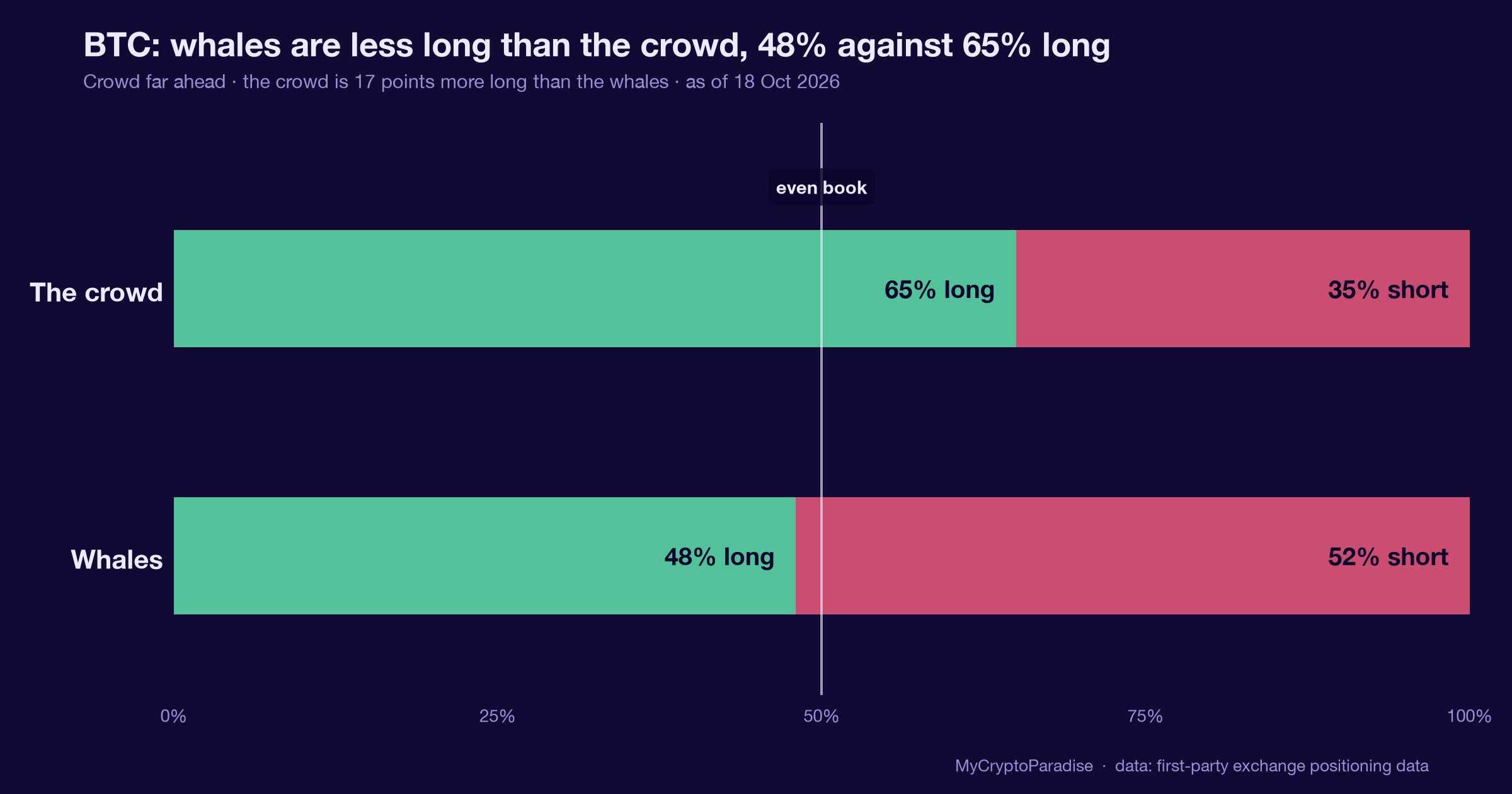
The smart-money versus retail read here is unusual, because the fear is next door, not in crypto. Retail is not panicking about Bitcoin today. That means there is less capitulation for larger players to feed on, and less of an edge in chasing.
Our stance is patience, not conviction. We respect the bearish macro signal from Korea without abandoning the bullish lower-timeframe structure, as long as $78,000 holds. Below it, this stops being a Korean story and becomes a crypto one.
The read behind this: we framed this story through our own market analysis, Can Bitcoin Rally Back to $90K?
Track it live: our Crypto Fear and Greed Index and the live crypto funding rates both update in real time, so you can watch this shift for yourself.
Related coverage
For exact entries, targets, and stop losses with full risk management, that is what ParadiseFamilyVIP is for. New to reading these moves? Start with our crypto trading strategies guide.
ParadiseTeam is monitoring the market situation closely, and we are taking these developments into consideration while building our trading tactics inside ParadiseFamilyVIP.
Crypto trading involves substantial risk. Prices are volatile and you can lose money. This article is educational and is not financial advice. Past performance does not guarantee future results.
Does the Korean crash spill into crypto within the week?
This is how 1 Paradiser is calling it. Tap your call.
No calls on this one yet. Tap yours to be the first.
Free account, no password. Members just sign in.






Join the discussion
No comments yet. Members, share how you are reading this.