

Listen: the breakdown
Market briefing: Initia confirmed a second exploit in under three weeks, with $3.27 million drained via a leaked cloud key and the L1 now halted. BTC sits near $73,856, down 1.1 percent, soft into a project-specific hit that stays local.
- Attacker forged IBC withdrawals using a leaked cloud credential, draining $3.27M from Initia's L1 custody account.
- This is Initia's second security incident in under three weeks, forcing a full halt of its L1 blockchain.
- Roughly $2.16M of the stolen funds sits frozen on the paused chain, while no INIT token holdings were touched.
An Initia exploit drained $3.27M through a single leaked cloud key, and the chain is halted. But the dollar figure is not the real story here. What breaks when a security model fails twice in three weeks?
Initia confirmed on 9 November that an attacker drained $3.27 million from its L1 custody account. The method was almost mundane. A compromised cloud access credential, a leaked GCP key, let the attacker forge IBC (inter-blockchain communication) withdrawals across five of its rollups.
The team has paused the L1 blockchain in response. Roughly $2.16 million of the stolen funds remains frozen on that halted network and cannot currently move. The attacker pulled specific assets, 13,400 TIA, 8,000 USDC.inj and 597,000 Noble USDC, and left INIT token holdings untouched.
Here is the part that matters. This is Initia's second security incident in under three weeks.
A single exploit is misfortune. A second, under broadly similar conditions, starts to look like a pattern in how the infrastructure is secured. The headline number is $3.27 million, but the number is not the wound. The repeat is. A forged withdrawal path that works twice is an operational problem, not bad luck.
That distinction reframes the whole event. One hack invites a patch and a post-mortem. Two hacks in three weeks invite a harder question about whether the custody design and key management were ever sound. Promised reserve compensation reads well in a statement, but statements do not move frozen funds.
For traders, this is an idiosyncratic ecosystem-confidence event, not a macro catalyst. BTC and ETH trade on their own soft tape. Initia and the tokens leaning on its rollups carry the cost of trust that now has to be rebuilt from a lower base.
A security model that failed twice
The transmission here runs through trust, not price feeds. Initia's value proposition rests on rollups settling safely to its L1. When the custody layer securing those settlements gets drained via a forged withdrawal, the product's core promise is what takes the hit.
TVL (total value locked) and rollup confidence are the real collateral. Capital parks in an ecosystem because it believes the plumbing holds. A leaked cloud key that forged IBC withdrawals across five rollups attacks exactly that belief, and belief, once broken twice, does not reset on a press release.
The repeat is the mechanism. A first exploit can be waved off as a novel attack. A second, under similar conditions, tells the market the fix did not fix the class of problem. That is why the dollar figure understates the damage. Three million can be reimbursed. A reputation for secure infrastructure, lost twice in three weeks, is far more expensive to buy back.
The promised full reserve compensation sits in an awkward place for now. It is a commitment, not a settled fact, and the frozen $2.16 million is stuck on a paused chain. Until funds actually move to affected users, treating that promise as done is optimistic.
This is contained by design. A small-cap L1 hack has limited reach into broader liquidity. But within its own orbit, Initia and anything leaning on its rollups now trade with a credibility discount the market has only started to apply.
Trust leaking out of rollup liquidity
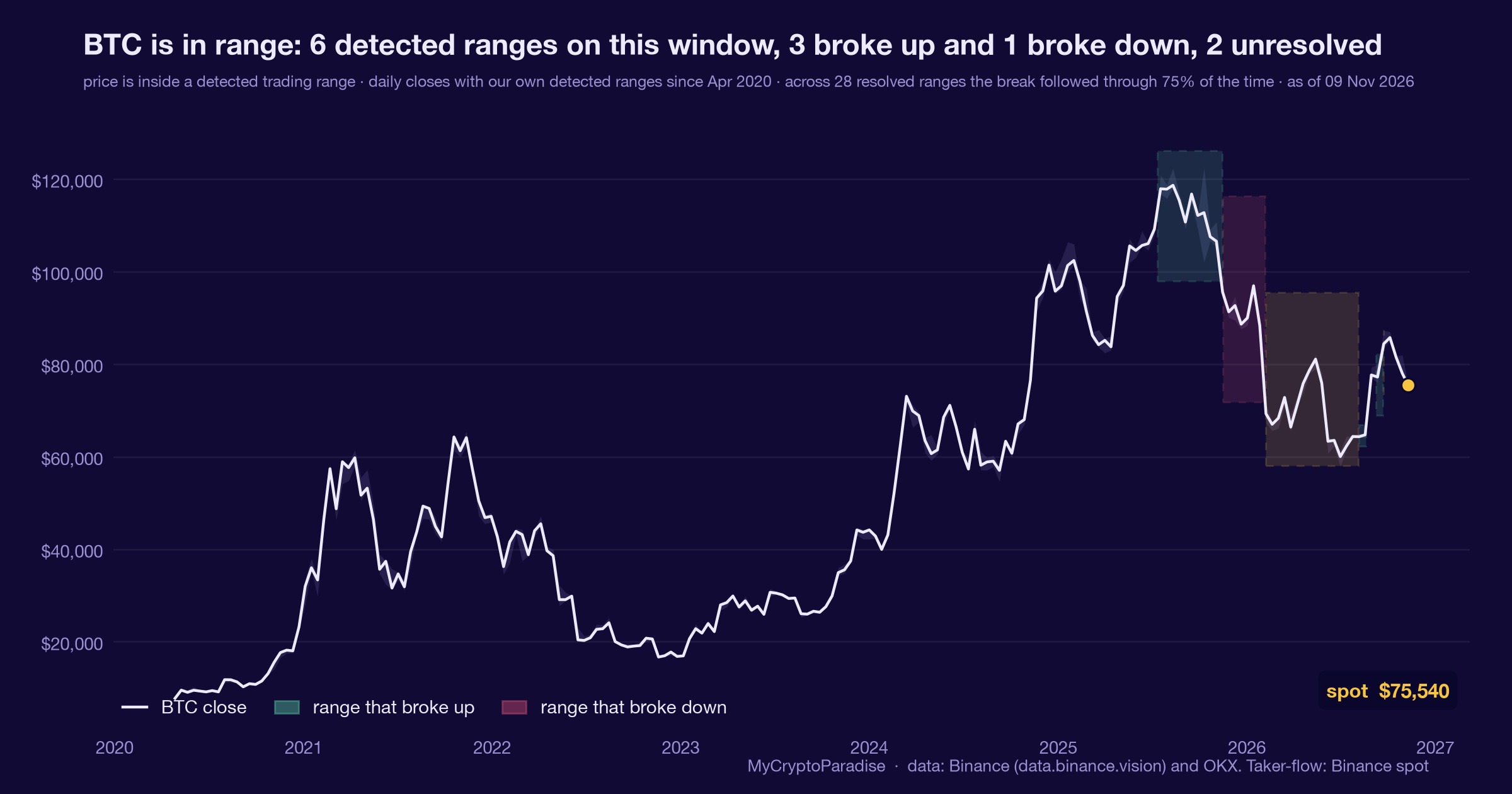
Start with where the pain actually lands. The damage is concentrated in Initia and the rollup tokens that depend on it, not in the majors. BTC was trading near $73,856, down 1.1 percent on the day, and ETH near $2,068, down 2.5 percent. Both softened on their own macro tape, not on this.
That separation matters. A halted L1 and a forged-withdrawal exploit have no mechanical path into BTC or ETH liquidity. The majors moved first, independently, and this hack rides alongside a mildly risk-off backdrop rather than causing it.
So the cascade is narrow. Confidence drains from Initia-linked liquidity, rollup trust takes the direct blow, and the broader alt market feels, at most, a faint second-order chill. The market is not cheering alt-L1 infrastructure news today, which gives a story like this less room to find a bid.
The only confirmed directional activity is the attacker's own. Draining the custody account and liquidating stolen TIA and USDC is distribution by a bad actor, nothing more. There is no accumulation footprint around this event, no sign of smart money stepping into weakness. That absence is itself informative.
Retail sentiment reads mixed rather than panicked. That usually means the repeat-incident risk is not yet fully priced. A market that has not panicked has not finished re-rating either, which leaves Initia-linked tokens exposed to a slower, grinding confidence discount as the facts settle.
Frozen funds, and whether the audit lands
The cleanest confirmation signal is boring and physical: do the frozen funds and the promised compensation actually move. Roughly $2.16 million sits locked on the paused L1. A credible recovery starts when users are made whole and that capital leaves the attacker's reach. Words do not settle this. Transfers do.
Watch the chain restart conditions next. An L1 that resumes without an independent audit of the infrastructure rebuild tells you the pressure to reopen beat the discipline to secure. That would be an invalidation of any recovery thesis, not a confirmation of one.
The key question is the class of bug. The first and second incidents happened under broadly similar conditions. If the post-mortem shows the same credential and withdrawal weakness, the market should assume a third is possible until proven otherwise. A published, independent audit changes that calculus. Its absence keeps the discount intact.
There is a wider thread worth noting. This lands on a day that already carried an Across DNS hijack and an Arcus accounting-bug exploit, so the operational-risk theme across infrastructure is live, not isolated to one project.
What would genuinely turn the story is a restart paired with an external audit and funds visibly returned. Short of that, treat statements of reserve coverage as unproven. The honest base case is caution on Initia-linked rollup tokens until the plumbing is independently signed off, not before.
What repeat breaches cost ecosystem liquidity
The ParadiseTeam frames this as an idiosyncratic confidence event, not a macro turn. Nothing in these facts moves BTC or ETH. With BTC trading near $73,856 and soft on the day, the majors are running their own tape, and this hack sits beside that weakness rather than driving it.
So the read stays local. The operational-risk signal here is specific to Initia and the tokens leaning on its rollups. A security model that failed twice in three weeks carries a credibility discount that is only partly priced, which argues for patience, not for catching the falling knife on a halted chain.
The only confirmed flow is the attacker liquidating stolen TIA and USDC. That is distribution, plain and simple, with no accumulation footprint to lean on. When the single piece of directional activity is a bad actor selling, there is no smart-money bid to front-run.
Our standing caution applies cleanly. In a mildly risk-off tape, infrastructure trust stories get sold first and bought back slowly, and relief rallies on unproven compensation promises tend to meet supply. Treat any bounce in Initia-linked tokens as suspect until funds actually move.
The discipline is simple. Until an independent audit of the rebuild is published and users are made whole, we stay wary of the ecosystem and let the proof lead the position. Risk first means waiting for the plumbing to be signed off, not for the statement to sound reassuring.
Track it live: our Crypto Fear and Greed Index and the live crypto funding rates both update in real time, so you can watch this shift for yourself.
Related coverage
For exact entries, targets, and stop losses with full risk management, that is what ParadiseFamilyVIP is for. New to reading these moves? Start with our crypto trading strategies guide.
ParadiseTeam is monitoring the market situation closely, and we are taking these developments into consideration while building our trading tactics inside ParadiseFamilyVIP.
Crypto trading involves substantial risk. Prices are volatile and you can lose money. This article is educational and is not financial advice. Past performance does not guarantee future results.
Can Initia rebuild trust after a second exploit in three weeks?
How 1 Paradiser is calling it
The first call is still open
Free account, no password. Members just sign in.











Join the discussion
No comments yet. Members, share how you are reading this.