


Listen: the breakdown
Market briefing: Bitcoin was trading near $62,584 on Monday, down about 2.2% on the day, as a broad risk-off wave and profit-taking pulled crypto lower alongside falling global stocks.
- Bitcoin slid roughly 2.2% to around $62,584 as a broad Monday selloff spread across risk assets.
- Renewed geopolitical tension and simple profit-taking, not one clean catalyst, drove the reversal of weekend gains.
- About $253 million in leveraged positions were liquidated as a leading Asian equity index dropped more than 9%.
Bitcoin fell to $62,584 on Monday as a risk-off selloff and profit-taking hit crypto together. So is this fear at support, or the start of something worse?
Crypto handed back its weekend gains on Monday. Bitcoin slipped about 2.2% to around $62,584, and Ethereum eased near $1,771 as sellers took control across the board.
There was no single clean trigger. Instead, two familiar forces arrived at once: renewed Middle East tension and ordinary profit-taking after a strong weekend.
The move did not stay inside crypto. A leading Asian equity index dropped more than 9%, a reminder that when fear spreads, correlations tend to snap back to one.
Leverage did the rest. Roughly $253 million in leveraged positions were liquidated, the mechanical part of every fast reversal, where forced sellers accelerate a move that was already underway.
We covered the geopolitics angle earlier as strikes lifted oil and pressured Bitcoin under $63,000. What is new here is the breadth. This was not a single-story dip. It was a coordinated risk-off session where equities, oil headlines, and crypto moved as one nervous block.
Structurally, that matters more than the percentage. A selloff driven by external shock rather than crypto-specific damage tends to land on whoever is holding the most leverage, not on the asset itself. The chart bent. The thesis did not.
And Bitcoin did all of this while sitting on a level our lens has watched closely for weeks.
Why a global fear wave reached crypto
The transmission runs through risk appetite, not through Bitcoin's own fundamentals.
Geopolitical tension raises uncertainty. Uncertainty pushes large allocators to trim exposure to anything volatile. Crypto sits at the far end of that volatility spectrum, so it feels the trimming first and hardest.
That is the chain in plain terms: tension raises fear, fear tightens liquidity, tighter liquidity pulls capital out of risk assets, and Bitcoin, Ethereum, and alts all reprice lower together.
Profit-taking amplifies it. After a strong weekend, traders sitting on gains have a reason to sell into any headline, and a fresh geopolitical story gives them the excuse.
The cross-market drop confirms the mechanism. When a major stock index falls more than 9% on the same day crypto sells off, the driver is shared risk aversion, not a problem unique to blockchains.
This is where honesty matters. There is no confirmed same-day catalyst that fully explains the size of the move. The cleaner read is that leverage and positioning were stretched, and a nervous headline was enough to flush them.
That distinction changes everything for what comes next. A dip built on fear and forced selling behaves very differently from a dip built on broken fundamentals. One tends to recover once the panic clears. The other does not.
How the selloff moved through BTC, ETH and alts
The liquidity drain followed the usual order.
Bitcoin moved first, sliding about 2.2% as the deepest and most liquid crypto asset absorbed the initial selling. It is where large players adjust risk fastest.
Ethereum tracked close behind near $1,771, down about 2%. That tight correlation tells you this was a market-wide repricing, not a rotation between assets.
Alts, as always, sat downstream. When Bitcoin and Ethereum fall together on external fear, thinner altcoin order books get hit harder per dollar of selling, because there are fewer buyers to catch the drop.
The $253 million in liquidations is the tell. Forced selling is not conviction selling. It is margin desks closing positions that ran out of collateral, which pushes price faster than genuine sellers ever could.
That is the part retail consistently misreads. A liquidation cascade looks like everyone selling, when it is really a small pool of over-leveraged accounts being flushed at speed.
Once that fuel burns off, the selling pressure often thins out quickly. The chart looks dramatic in the moment and far more ordinary a day later.
So the impact is real but shallow in nature. Prices fell across the board, yet the damage concentrated in leverage rather than in the underlying demand for Bitcoin itself. That is a very different picture from a fundamental breakdown.
What confirms strength versus a deeper break
The next few sessions turn on one question: does the reclaimed support hold?
Our lens marks the $63,000 to $64,000 zone as former resistance that flipped to support. Bitcoin is now testing the lower edge of it near $62,584, which makes this level the line that matters.
Confirmation looks like a reclaim. If price recovers back above $63,000 and holds, the Monday dip reads as a leverage flush inside an intact structure, and the path back toward the $65,000 to $67,000 resistance stays open.
Invalidation looks like acceptance below. If Bitcoin loses this zone and starts building sessions under it, the near-term bullish push weakens, and the larger corrective structure our lens tracks moves into focus.
Watch the geopolitical headlines too, but for reaction rather than direction. If fresh tension hits and Bitcoin refuses to make new lows, that non-reaction is often more bullish than any positive news.
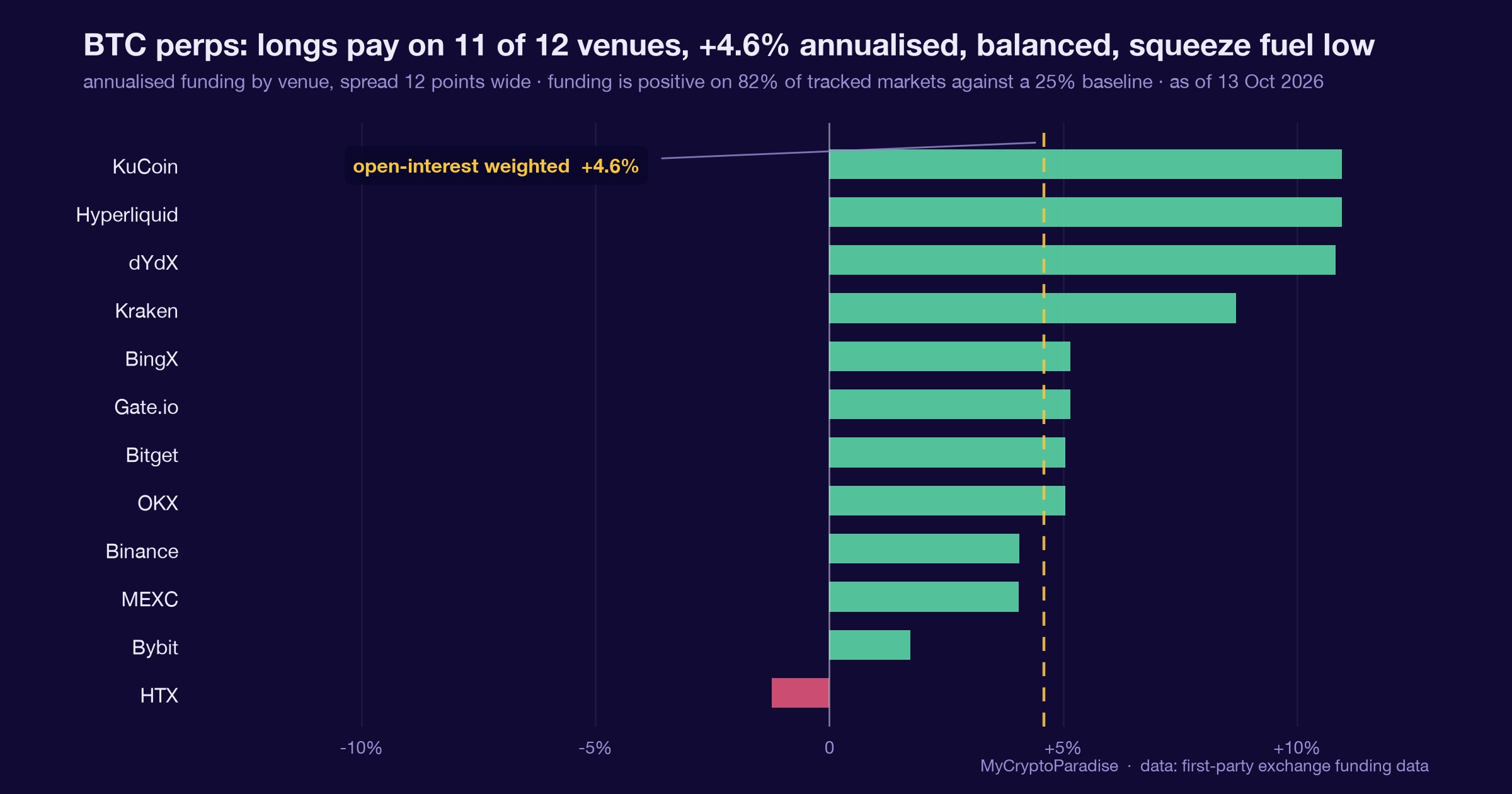
Leverage is the other gauge. If funding resets and open interest cools after this flush, the market becomes healthier, not weaker, because the fragile positions are gone.
The trap to avoid is treating a fear-driven dip as a trend change on its own. Volatility around a support test is normal. What counts is where price closes, not where it briefly wicks. Patience over the next daily closes will tell you far more than the intraday panic did.
What this dip signals about liquidity at support
The ParadiseTeam reads this as fear arriving precisely where it is least useful for retail and most useful for professionals.
Bitcoin near $62,584 is testing the $63,000 to $64,000 zone our lens flags as reclaimed support. Bearish, external-shock news landing on that level, with retail already nervous, is the textbook setup for smart money to accumulate from panicking sellers.
The mechanism sits in the stops. After a weekend rally, late longs cluster their protective stops just under this support. A geopolitical headline and a $253 million liquidation cascade are exactly what runs those stops, handing cheaper coins to disciplined buyers.
That is why our near-term bias stays constructive. The lens looks for an immediate push toward the $65,000 to $67,000 resistance and, if momentum holds, higher, provided this support survives.
The honesty is in the frame. This near-term strength lives inside a larger corrective structure. Professionals treat any push up as a move to manage, not a reason to abandon discipline, because the higher-timeframe picture still points to real risk later.
So the edge here is patience, not prediction. Retail tends to sell this dip in fear or chase the bounce in relief. The steadier approach watches whether $63,000 reclaims, treats the liquidation flush as noise, and stays flexible. Probabilities favor the buyers at support for now, but only while that support holds.
Track it live: our crypto liquidation heatmap and the Crypto Fear and Greed Index both update in real time, so you can watch this shift for yourself.
Related coverage
For exact entries, targets, and stop losses with full risk management, that is what ParadiseFamilyVIP is for. New to reading these moves? Start with our crypto trading strategies guide.
ParadiseTeam is monitoring the market situation closely, and we are taking these developments into consideration while building our trading tactics inside ParadiseFamilyVIP.
Crypto trading involves substantial risk. Prices are volatile and you can lose money. This article is educational and is not financial advice. Past performance does not guarantee future results.
Does Bitcoin reclaim $63K and hold, or lose the level from here?
This is how the Paradisers are calling it. Tap your call.
No calls on this one yet. Tap yours to be the first.
Free account, no password. Members just sign in.










Join the discussion
No comments yet. Members, share how you are reading this.