


Listen: the 2-minute breakdown
Developing story: This story is still unfolding. We are tracking it and will update this article as more details are confirmed.
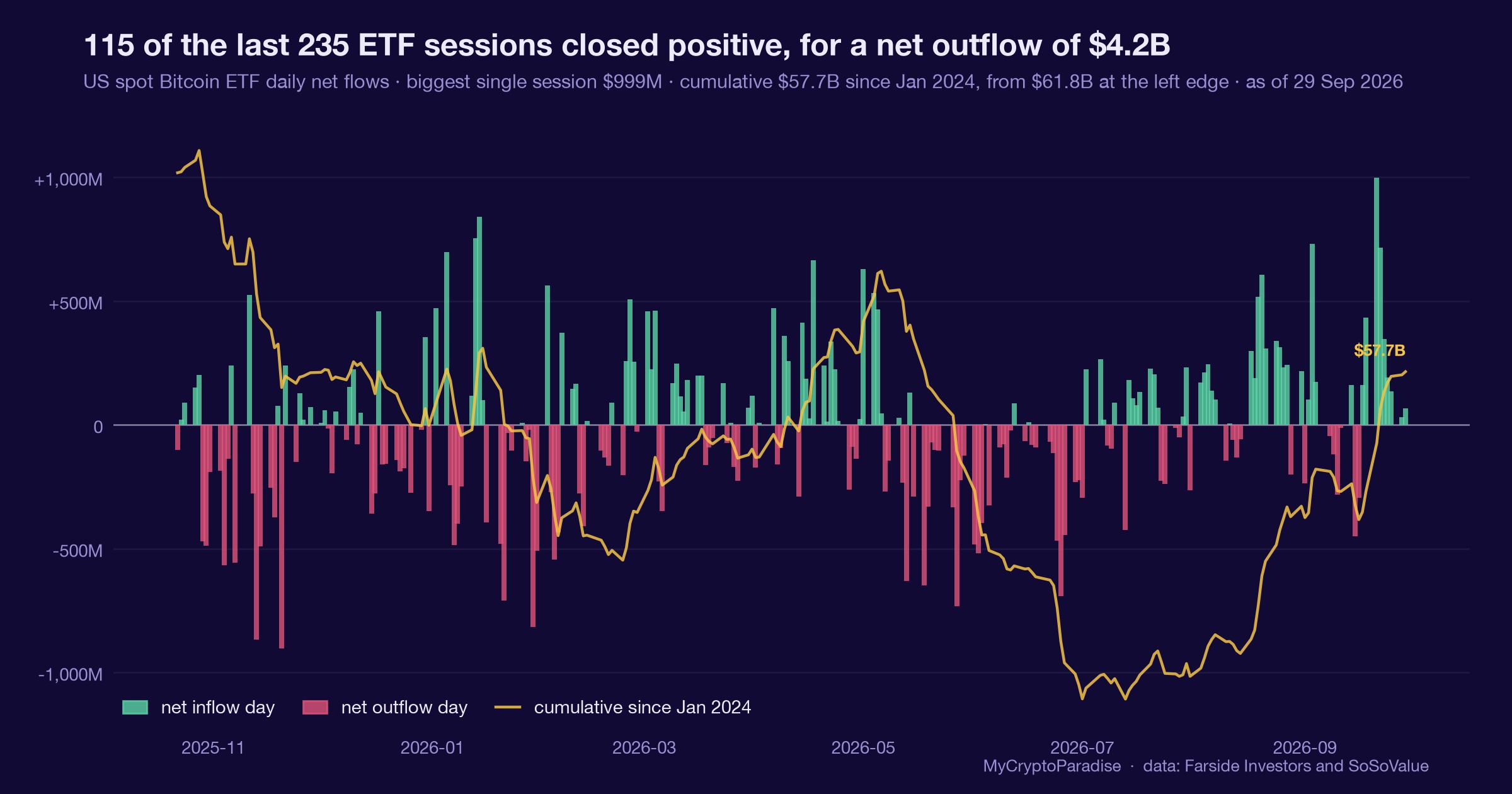
Market briefing: Bitcoin ETFs are on track for their worst month on record, with around four billion dollars in outflows. BTC trades near 59,779, down about one percent on the day. We read the panic as smart money quietly buying what scared hands are selling.
- Bitcoin ETFs face their worst month on record, near $4 billion in outflows.
- BTC trades at $59,779, down 0.96% on the day and slipping under $60,000.
- We read the exodus as capitulation that hands smart money cheaper coins.
Bitcoin ETF outflows are now set for their worst month ever, near $4 billion. Retail sees the exits and braces for worse. But who is buying what they sell?
We have already covered the weekly ETF bleed and the break below $60,000. Here is what is new. The damage has now stretched to a full calendar month. Bitcoin exchange-traded funds are set for their worst month on record, with roughly $4 billion in outflows. That is the headline number, and it is a real one. Bitcoin trades at $59,779, down 0.96% over 24 hours and down 0.32% in the last hour. The story has graduated from a bad week to a bad month, and the financial press is treating it accordingly. Outflows from a regulated fund are not a mood. They are settled instructions. Money that arrived through these vehicles is now leaving through the same door. That removes a steady bid that supported price through much of the rally. Headlines call it a confidence problem. We see it more plainly as a liquidity problem with a confidence soundtrack. The interesting part is the timing. The selling is loudest exactly where the chart gets interesting, near support, with retail already nervous. Every cycle produces a moment when the official narrative and the price action quietly disagree. This looks like one of them. The question is not whether the outflows are real. They are. The question is who is standing on the other side of every redemption, calmly taking the coins that fearful money is letting go.
Why ETF redemptions drain market liquidity
An ETF is a pipe between traditional finance and Bitcoin. When money flows in, the issuer buys spot BTC, and that demand lifts price. When money flows out, the pipe runs in reverse. Redemptions force selling to meet investors leaving the fund. A record month of outflows means that pipe has been pushing supply onto the market, not pulling it off. That is the transmission mechanism. The driver is capital leaving regulated funds. The macro effect is a tilt toward risk-off positioning inside traditional finance, where some allocators take profit or reduce exposure. The liquidity effect is a thinner institutional bid for spot Bitcoin. With less passive buying underneath price, normal selling carries more weight, and moves become sharper. This is why a $4 billion figure matters beyond the shock value. It is not retail clicking sell on an app. It is structured money rotating out, and that rotation reaches every corner of the market that priced in steady ETF demand. The honest caveat is that an outflow tells you money left. It does not tell you who picked it up, or at what price, or with what intention. Flows describe the plumbing. They do not, on their own, decide the direction. That distinction is where our read begins.
How the outflow pressure reaches ETH and alts
Bitcoin absorbs the shock first. Spot selling from redemptions pressures BTC directly, which is why price now sits at $59,779, just under the round $60,000 level so many watch. When Bitcoin softens, the rest of the market usually follows with a lag and a multiplier. Ethereum tends to move in BTC's direction but with a wider swing, because its liquidity is thinner and its holders more reactive. Altcoins sit at the far end of that chain. They feel the least passive support and the most fear, so they tend to fall hardest when the leader wobbles and bounce hardest when it steadies. That is the standard cascade, and the outflow headline feeds straight into it. But cascades cut both ways. The same thin liquidity that exaggerates a flush also exaggerates a recovery. A market that overshoots to the downside on fear can snap back quickly when the selling pressure simply runs out of sellers. The brief notes signs of bearish exhaustion and bullish divergence underneath this move. If that holds, the cascade reverses, and the assets that fell furthest tend to lead the rebound. For now, BTC remains the tell. Where Bitcoin closes decides whether this is a deeper drain or a base being built while everyone watches the exits.
What confirms a base versus more downside
Watch where Bitcoin closes, not where it ticks. A daily candle that reclaims and holds above $60,000 would suggest the outflow fear is being absorbed rather than obeyed. A push and close above the $60,300 Fibonacci 1.272 level would strengthen that case. Confirmation also lives in the supporting signals. Rising volume on a green daily candle, MACD lines turning up, and a bullish cross on the Stochastic RSI would all point to selling losing its grip. The bullish divergence already noted, lower price against a higher low in momentum, is the early tell that bears are tiring. Invalidation is just as clear. If $58,000, the level bulls are defending, breaks and holds below on a daily basis, the read weakens. A decisive loss of that zone opens the path toward the next important support near $54,000. That would tell us the outflows are doing more than scaring people. They would be setting price. Also watch whether ETF flows themselves stabilise or keep accelerating. A record can always get worse before it gets better. The market often rewards patience here. The trader who waits for the close usually learns more than the one who reacts to the headline that arrives mid-candle.
What the record outflows mean at support
The ParadiseTeam reads this print through one lens: who is on each side of the redemption. With BTC at $59,779, the worst month of outflows on record is landing near support, not into strength. That matters. The crowd sees $4 billion leaving and braces for lower prices, which is precisely the fear that creates liquidity for patient buyers. We note an inexperienced whale heavily short, with liquidation risk up at $65,836. If price grinds higher, that position becomes fuel. Forced short covering can turn a quiet recovery into a sharp one. So we treat the outflow story as a possible shakeout rather than a verdict. The structure supports caution turning to interest, not conviction. Bulls are defending $58,000. A daily close back above $60,000, and better still above the $60,300 Fibonacci level, would tell us accumulation is winning over capitulation. The bullish divergence in momentum and signs of bearish exhaustion fit that picture. None of this is a promise. If $58,000 fails and $54,000 comes into play, the read resets and we respect it. Our bias here is upward, probabilities not certainty, because the heaviest selling is appearing where smart money tends to buy and where the most over-leveraged trader is positioned to be wrong. Watch the close, watch the whale, and let the market confirm before the headlines do.
For exact entries, targets, and stop losses with full risk management, that is what ParadiseFamilyVIP is for. New to reading these moves? Start with our crypto trading strategies guide.
ParadiseTeam is monitoring the market situation closely, and we are taking these developments into consideration while building our trading tactics inside ParadiseFamilyVIP.
Crypto trading involves substantial risk. Prices are volatile and you can lose money. This article is educational and is not financial advice. Past performance does not guarantee future results.
After record ETF outflows, where does BTC close the week?
Follow this topic: Bitcoin ETF news











Join the discussion
No comments yet. Members, share how you are reading this.