


Developing story update (July 01, 2026, 06:24 UTC):
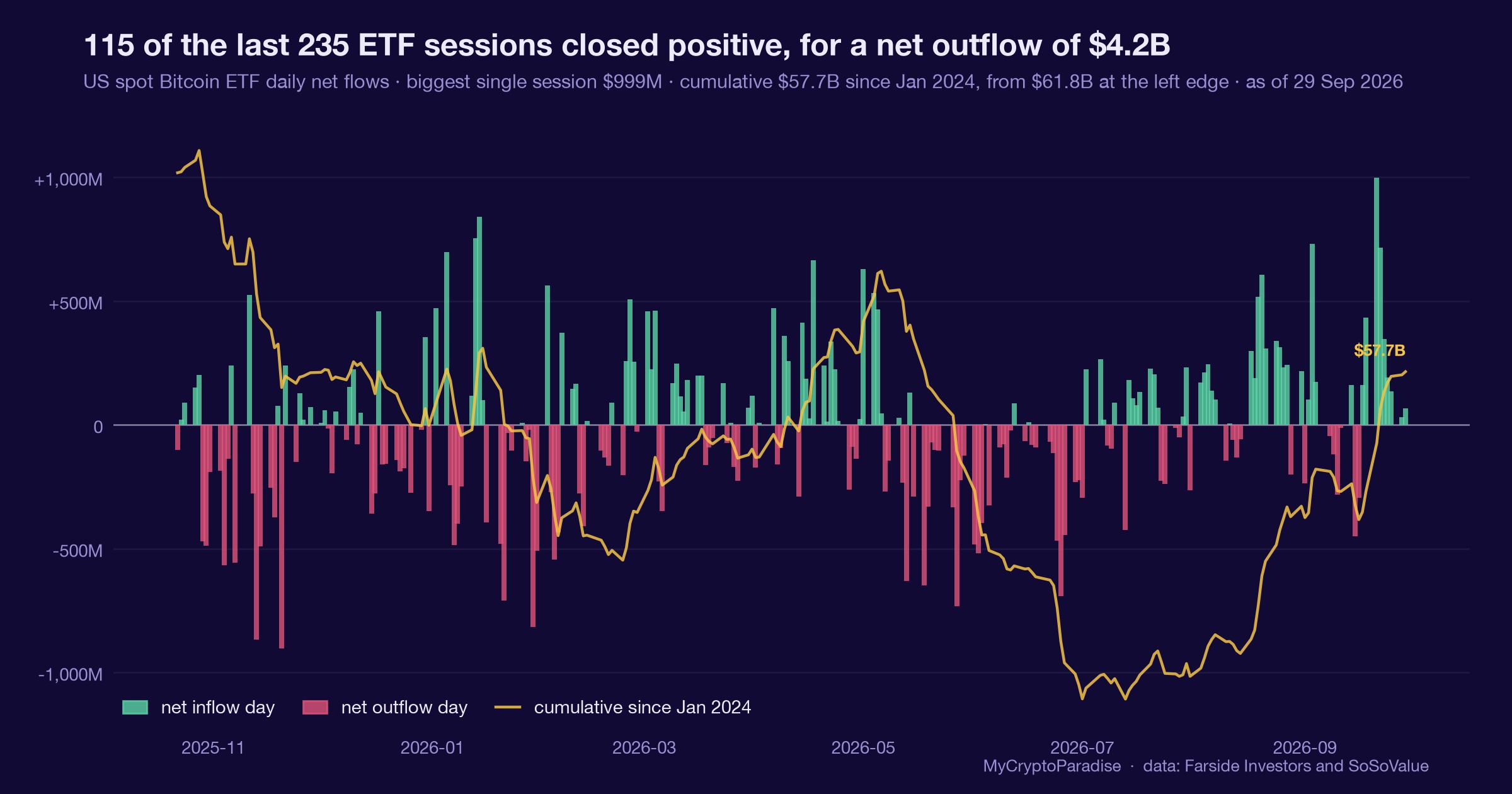
Update: fresh figures put the bulk of June’s damage on the largest fund. BlackRock’s IBIT accounted for roughly $3.3 billion of the month’s withdrawals, meaning one product drove most of the record outflow rather than broad-based selling across issuers.
The redemption run has now stretched to nine consecutive trading days. Concentrated, single-fund selling into a persistent streak often signals a rotation working itself out rather than fresh panic, which keeps our base case intact: this reads as forced and futures-driven pressure that smart money can absorb on spot, with a lower probability of sustained continuation.
What to watch now: Watch whether the ETF outflow streak breaks or a green inflow day appears, a likely early tell that the rotation is exhausting.
Listen: the breakdown
Market briefing: Bitcoin ETFs just closed their worst month on record, with roughly $4.5 billion in June net outflows. Yet BTC sits at $59,252, barely down on the day, and that quiet resilience is the story.
- U.S. spot Bitcoin ETFs shed a record $4.5 billion in June, about 29% past the prior worst month.
- BlackRock's IBIT drove roughly $3.3 billion of it, with $300.4 million leaving on June 29 alone.
- The funds ran an eight-day outflow streak, yet BTC holds near $59,252 rather than breaking down.
Bitcoin ETF outflows just posted the worst month on record, around $4.5 billion gone in June. So if the exit was this violent, why is price barely moving?
U.S. spot Bitcoin ETFs have just recorded their worst month on record. Roughly $4.5 billion in net outflows left the funds in June, surpassing the previous monthly record of $3.56 billion, set in February 2025, by about 29 percent. We flagged the record earlier today. What has sharpened since is the shape of it. BlackRock's IBIT, the largest and usually the calmest of the group, accounted for the majority of the bleed, near $3.3 billion. On June 29 alone, IBIT gave up $300.4 million while the funds together shed $231 million, an eighth straight day of withdrawals. That is not a single bad print. It is a slow, disciplined exit. The convenient narrative blames macro: higher rates, geopolitical noise, and a record-breaking SpaceX IPO pulling institutional money toward shinier stories. All plausible, none confirmed as a single same-day catalyst, so we treat the cause as our read rather than a fact. Here is the part the headline skips. Despite eight days of outflows and a record month, Bitcoin trades at $59,252, down only 0.1 percent on the day. A market being genuinely abandoned does not sit this still. Flows measure who is leaving a wrapper. Price measures who is willing to own the asset underneath. When those two disagree this loudly, the disagreement is the signal. Someone is absorbing what the ETFs are handing over, and doing it without panic. The record outflow is real. The collapse it implies has not arrived.
Why record ETF outflows misread the tape
The macro transmission here is straightforward, which is exactly why it is worth questioning. Institutional capital rotates on relative return. Higher interest rates make cash and short bonds a real competitor again. Geopolitical uncertainty pushes allocators toward safety. A marquee IPO offers a fresh, story-rich place to park risk. Each of those pulls money out of a Bitcoin ETF wrapper. Add them up and you get a record month of Bitcoin ETF outflows. That is the tidy version. The problem is that outflows and selling are not the same thing. An ETF redemption removes exposure from one vehicle. It says nothing about whether the coin itself finds a buyer. If BTC were being dumped alongside these flows, price would be well under support by now. Instead it holds near $59,252 after eight straight days of withdrawals. That gap matters because it tells you where conviction actually sits. Retail and less seasoned institutions tend to chase the wrapper. They buy the ETF when it is easy and green, and they leave when the monthly statement turns red. Record outflows are, more often than not, a record of who got uncomfortable, not a record of the asset losing its floor. The macro story explains the exit. It does not explain the resilience. When the crowd leaves through the front door and price refuses to fall, the more experienced money is usually letting itself in through the back.
How the exit ripples from BTC to alts
Follow the liquidity, not the press release. Record Bitcoin ETF outflows thin the most visible layer of demand, so the reflexive expectation is a cascade: BTC leads down, ETH follows, alts get hit hardest as risk appetite drains. That is the mechanical path, and in a genuine breakdown it plays out fast. It is not playing out. BTC sits at $59,252 while the funds bleed, which changes the read for everything below it. Bitcoin is the liquidity anchor. When it holds through a record outflow month, the pressure that should be flushing ETH and alts loses its source. The eight-day streak has already delivered its blow, and the blow was absorbed. For ETH, that means the feared correlated slide has not been triggered. For alts, the usual pattern is a lag: they wait for BTC to confirm a direction before moving with conviction. Right now BTC is confirming stubbornness, not surrender. The more interesting liquidity detail is where the redeemed capital goes. If it rotates into equities and the SpaceX IPO, it leaves crypto structurally lighter but also less crowded, and thinner books can turn violently once demand returns. The market is not showing a broad-based sell cascade. It is showing a single wrapper draining while the underlying asset refuses to follow. That divergence is the impact that actually matters, and it points up more than down.
What confirms a squeeze versus a breakdown
This is where honesty beats bravado. The bullish case rests on divergence holding, and divergences can resolve either way. Watch the flows first. If outflows slow and the eight-day streak breaks into even a single green day, that is early evidence the capitulation is spending itself. A fresh acceleration of redemptions, on the other hand, would warn that the exit is not done and that price patience may run out. Then watch price against the levels that define the fight. The bulls are defending the $58,000 area, and BTC at $59,252 sits just above it. A daily close back above $60,000 would flip the near-term structure toward strength and print the kind of candle that traps late sellers. A reclaim of the $60,300 region above it would add conviction. The invalidation is equally clean. A daily close that loses $58,000 and opens the door toward the $54,000 support zone would tell us the outflows finally dragged the asset with them, and that the accumulation read was early. Above, $65,836 is the ceiling that matters, the level where an overextended short is most exposed. Between $58,000 and $60,300 the story is undecided. Below $54,000 the bearish case earns respect. The point is not to predict the exact bar. It is to let price, not the record outflow headline, tell you which side blinked first. Confirmation and invalidation are both close, so position sizing matters more than certainty here.
What the outflow reveals about who is buying
The ParadiseTeam reads this record outflow through where price is sitting, not where the headline points. BTC at $59,252 is holding just above the $58,000 zone the bulls are defending, after a month that should, on paper, have broken it. That resilience is the tell. Record Bitcoin ETF outflows with retail leaving the wrapper, at support, on a medium timeframe, is the textbook shape of capitulation feeding accumulation. The flow numbers say fear. The chart says absorption. Two things sharpen the read. First, the divergences: price is carving lower lows while volume and momentum carve higher lows, the classic sign of sellers running out of ammunition rather than gaining strength. Second, positioning: an inexperienced whale sits heavily short into this, exposed toward $65,836, which means the crowd is likely leaning the wrong way just as the wrapper empties. That combination, exhausted bears plus a trapped short plus demand that refuses to crack, is what turns a record outflow into fuel. The line in the sand is simple. A daily close back above $60,000, ideally reclaiming $60,300 on real volume, confirms the reversal thesis and puts the short under pressure. A daily close below $58,000 that heads for $54,000 invalidates it and says the outflows finally won. Until one of those prints, the ParadiseTeam treats the record exit as the sound of weak hands leaving, not of the asset dying. Probabilities, not promises.
For exact entries, targets, and stop losses with full risk management, that is what ParadiseFamilyVIP is for. New to reading these moves? Start with our crypto trading strategies guide.
ParadiseTeam is monitoring the market situation closely, and we are taking these developments into consideration while building our trading tactics inside ParadiseFamilyVIP.
Crypto trading involves substantial risk. Prices are volatile and you can lose money. This article is educational and is not financial advice. Past performance does not guarantee future results.
How will Bitcoin's price perform in July following record ETF outflows?
Follow this topic: Bitcoin ETF news










Join the discussion
No comments yet. Members, share how you are reading this.