

DeFi Yield Platforms
In short
The five DeFi yield platforms most frequently cited for signal-backed strategies in 2025 are PancakeSwap, SushiSwap, Curve, Aave, and Lido. These platforms are evaluated based on criteria such as deep liquidity, reliable execution, audited security, stable yield structures, and ease of automation for bots and smart contracts.
Pick your pen up and note the list of the best 5 DeFi yield platforms that each crypto trader must know:
- PanCakeSwap
- Sushi
- Curve
- Aave
- Lido
The latest crypto crash has devastated the crypto industry, as crypto traders seek alternative income streams. For gamblers, McDonald’s might be a perfect place. However, for serious crypto traders, DeFi yield platforms prove particularly useful. We have already discussed the best crypto trading strategies that you can read here.
This guide will discuss the best 5 DeFi yield platforms that professional traders can use in 2025. We will discuss each platform in the above list and find out which one is best for you.
Let’s break it down:
What Makes a DeFi Yield Platform Suitable for Signal-Backed Strategies?
Before choosing where to deploy capital, crypto traders need to understand what separates an average DeFi yield platform from one that can support serious and signal-driven execution. Signal-backed strategies rely on precise timing, reliable liquidity, and predictable behavior. If the platform cannot keep up, the crypto trading strategy fails before it even starts.
Here’s the list on how to choose the right platform:
Liquidity
Signal-backed strategies depend on timely entries and exits. Deep liquidity ensures crypto traders can move capital without suffering from heavy slippage. When signals fire repeatedly, poor liquidity becomes a silent performance killer.
Reliability
A platform must operate smoothly even during market stress. Technical issues, stalled transactions, or unstable pools can break a well-designed model. Traders need environments where execution remains consistent at all times.
Security
Any strategy that runs automatically requires a secure foundation. Weak audits or past exploits introduce unnecessary risk. Traders should be confident that their capital is protected while their strategies operate in the background.
Yield Stability
Some platforms offer returns that swing wildly throughout the day. Others maintain predictable, steady yields. Stable reward structures make it easier for traders to plan, model, and benchmark their signal-driven strategies.
Automation Support
Signal-backed trading thrives on automation. Platforms that integrate easily with bots, smart contracts, and third-party tools allow traders to execute signals cleanly and precisely. The smoother the automation, the stronger the overall strategy.
Best 5 DeFi Yield Platforms in 2025
Let’s discuss the best 5 DeFi Yield platforms one by one:
PanCakeSwap:
PancakeSwap is the leading AMM (automated market maker) on the BNB Chain, providing swapping, yield farming, and staking opportunities. Let’s discuss the details:
Overview & Key Metrics
- What it is: PancakeSwap is the flagship decentralized exchange (DEX) on the BNB Chain, operating a classic AMM (automated market maker) model.
- Multichain Expansion: Beyond BNB Chain, PancakeSwap has expanded to several chains, including Base, Arbitrum, Solana, and others via its “Infinity” upgrade.
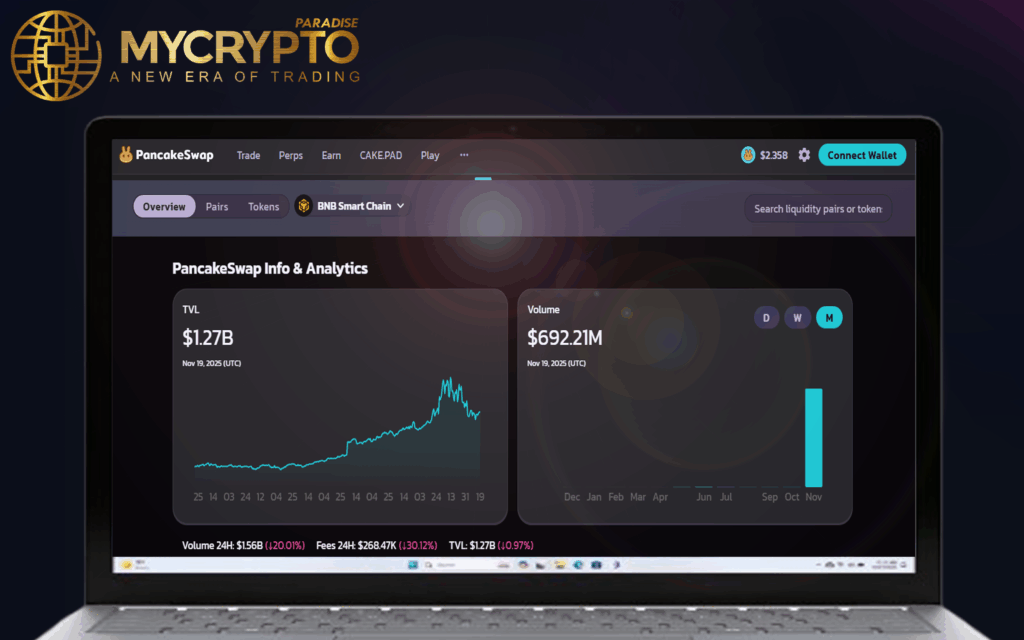
- Total Value Locked (TVL): As of the most recent data, PancakeSwap’s combined TVL is approximately $2.424 billion.
- Revenue & Fees: The protocol generates substantial fee revenue. According to DeFiLlama, annualized revenue is around $120 million, with $359 million in fees.
- Trading Volume: According to recent data, PancakeSwap recorded a monthly trading volume of $80 billion and active users in the millions.
Yield Opportunities on PancakeSwap
The yield opportunities on the PankCakeSwap are given as:
- Farms (Liquidity Provision): Users can provide liquidity in LP (liquidity provider) pools, for example, CAKE/BNB, to earn $CAKE rewards + a share of trading fees. Farming is “legacy” but still widely used; when you stake LP tokens, you accrue $CAKE, which you can “harvest.”
- Syrup Pools (Single-Token Staking): You can stake only $CAKE (or other tokens, depending on the pool) in Syrup Pools to earn $CAKE or other reward tokens. There are Auto-CAKE pools that auto-compound your earned CAKE, and Manual CAKE pools where you harvest manually. There is an unstaking fee: for Auto-CAKE, if you unstake within 72 hours, there’s a 0.1% fee.
- Cross-Chain and New Features: With PancakeSwap Infinity, the platform has expanded DEX and liquidity capabilities to Base (an L2), increasing reach and potential yield. Through Infinity and cross-chain infrastructure, PancakeSwap supports multi-chain liquidity, which can benefit strategies that monitor on-chain signals across chains.
Security & Reliability
- Audit: PancakeSwap’s cross-chain contracts were reviewed by Burra Security in May 2025. The audit covered core components like cross-chain sender, dispatcher, and adapter contracts.
- Findings: According to the Burra audit, no “critical” severity vulnerabilities were reported in their scope.
- Historical audits: Earlier audits (e.g., by SlowMist) have also been conducted, though older.
- Smart-contract risk: While audited, cross-chain systems always carry added risk (bridging, adapter logic). Any signal-backed system should monitor on-chain bridge risk carefully.
Pros for Signal-Backed Strategies
- Deep Liquidity on BNB Chain: Because PancakeSwap has significant TVL, its LP pools are relatively deep. That allows signal-based strategies to deploy or exit with lower slippage.
- High Activity & Fee Potential: With strong trading volume and fee generation, signal strategies can capitalize not just on farming but also on fee capture or arbitrage.
- Composable across Chains: Thanks to PancakeSwap Infinity, strategies can be multi-chain: signals can pick up inefficiencies across BNB Chain and L2s (like Base), enabling cross-chain rotation.
- Compounding via Syrup Pools: Auto-CAKE pools allow automatically compounding CAKE returns, which is ideal for long-horizon or trend-following signal strategies.
- Governance & Token Leverage: CAKE token can be staked, and the tokenomics (e.g., incentives) provide additional levers. A signal strategy could decide when to stake CAKE based on token momentum or on-chain governance activity.
Risks & Limitations
- Impermanent Loss: When providing liquidity, especially in volatile token pairs (e.g., CAKE-BNB), LPs risk impermanent loss. For signal strategies, this must be modeled carefully.
- Cross-Chain Complexity: Using PancakeSwap across chains involves bridging risk. Cross-chain contracts were audited; however, bridging always introduces additional risk layers.
- Token Emission Risk: CAKE emissions, reward schedules, and incentives (e.g., future syrup pool rewards) can change. Signal strategies should factor in possible tokenomics shifts.
- Slippage Risk on Low-Volume Pools: While core pools are deep, some LP pairs might have limited liquidity, making heavy strategy deployments risky.
Sushi (SushiSwap):
Sushi is a multi-chain decentralized exchange and AMM with a modular product stack that includes BentoBox, Trident, Kashi, an aggregator, and xSUSHI staking. It positions itself as a liquidity and fee-capture engine across many chains. Sushi is very important of the best 5 DeFi Yield Platforms.
Overview & Key Metrics
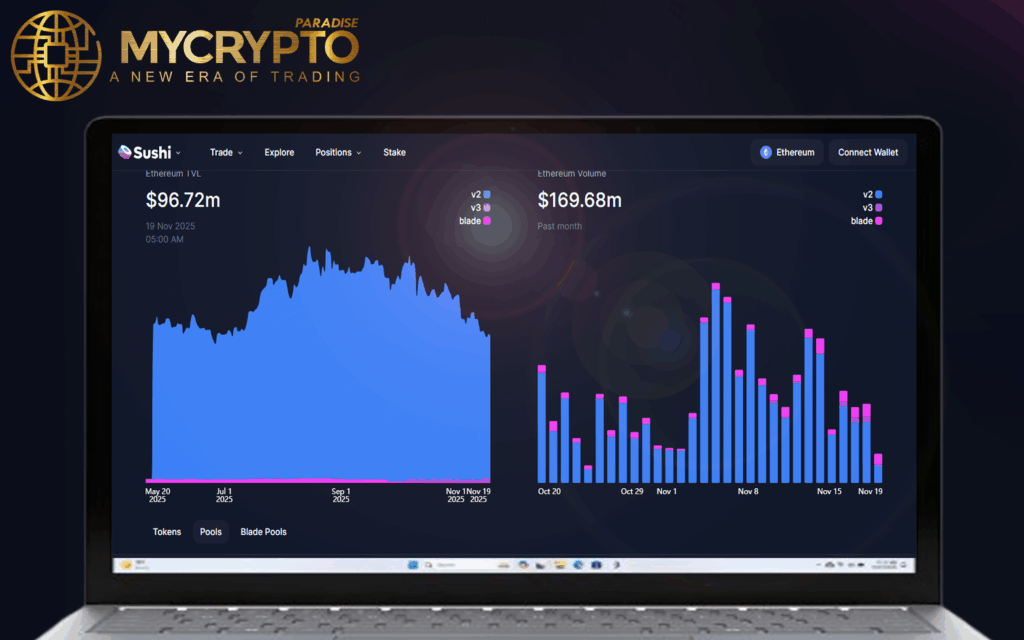
- Multi-chain footprint: Sushi operates on dozens of chains and L2s, offering a broad cross-chain reach for strategies that monitor liquidity and volume across networks. The official site lists Sushi on over 30 chains and growing.
- Protocol economics and activity: DefiLlama reports Sushi’s on-chain metrics as follows: annualized protocol fees around $78.6 million, 30-day DEX volume near $2.15 billion, and measurable token-holder revenue through xSUSHI.
Yield opportunities on Sushi
Here’s the list of yield opportunities on the Sushiswap, one of the best among 5 DeFi yield platforms:
- Liquidity provision in core AMM pools: You can provide LP tokens to earn swap fees and any protocol or partner incentives. Pools can be on Ethereum or any supported chain.
- Onsen and incentivized farming: Projects can boost rewards for targeted pools, creating rotating incentive windows that active strategies can exploit.
- xSUSHI staking: Stake SUSHI to receive xSUSHI and claim a share of protocol revenue distributed to stakers. This is a fee-capture primitive that works as a low-action, yield component.
- BentoBox/Trident composability: BentoBox acts as a vault for token efficiency and composable strategies; Trident offers concentrated liquidity primitives and more capital-efficient pools for LP strategies. These features are crucial when automating complex, signal-driven allocations.
Security and reliability
Audits and historical incidents matter for running automated strategies. Sushi has undergone multiple audits and security reviews. There have also been past incidents involving unaudited components, most notably an exploited RouteProcessor2 contract in 2023 that CertiK documented in a post-mortem.
That incident underscores the importance of monitoring the sushi contracts you interact with and whether those contracts are within the current audit scope.
Pros for signal-backed strategies
- Breadth of markets: Sushi’s presence on many chains gives signals more execution venues and cross-chain arbitrage opportunities.
- Fee capture: xSUSHI converts protocol fees into yield for stakers, a predictable revenue stream that can anchor a signal strategy.
- Incentive windows: Onsen-style or partner incentives create time-bound yield spikes that rotation signals can target.
- Composability: BentoBox and Trident allow capital-efficient LPing and vault-like behavior, which improves execution for bots and smart-contract strategies.
Risks and limitations
- Variable TVL and pool depth by chain: TVL and liquidity are distributed across many chains. Some pools are deep, others are thin; slippage risk is non-uniform. Monitor per-pool liquidity, not just aggregate TVL.
- Contract scope risk: Historical exploit examples show that newly deployed or out-of-scope contracts can present vulnerabilities. Confirm audit coverage before integrating a specific Sushi product or contract.
- Incentive dependency: Yield from Onsen or third-party incentives can evaporate when incentives end. Strategies that rely on boosted yields must include rotation rules for when incentives change.
Curve:
Curve is the dominant stablecoin automated market maker, optimized for low slippage and deep stable-asset liquidity. As of mid-2025, Curve’s Total Value Locked sits in the low billions, with TVL peaking above 2.4 billion during May 2025. Curve generates substantial fee revenue and remains central to stablecoin trading and liquid-staking swap rails.
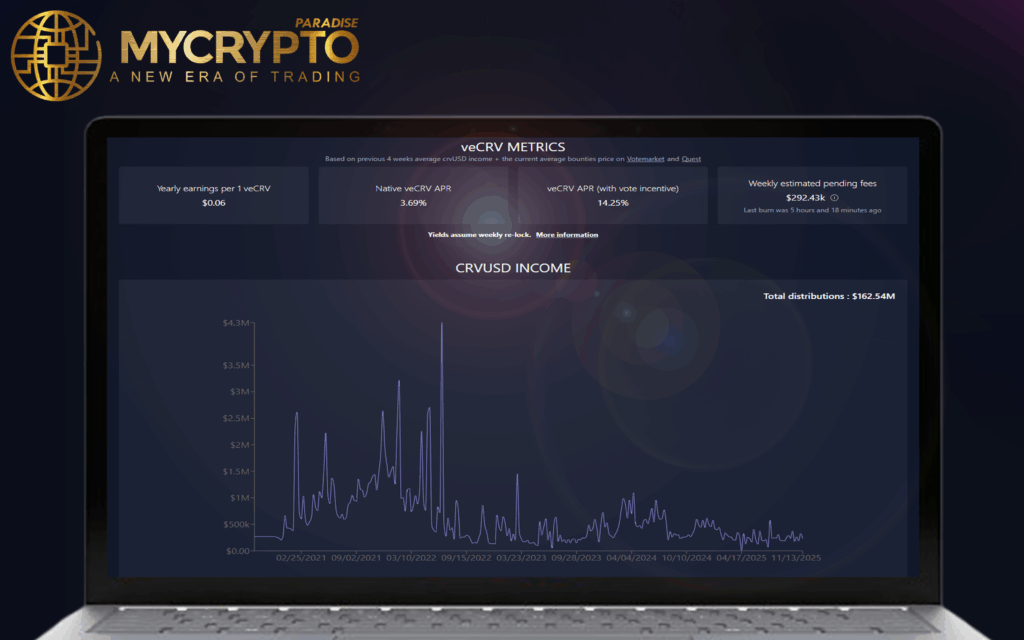
Curve remains among the best 5 Defi yield platforms list, so let’s look at why this platform is suitable for you:
Yield opportunities on Curve
Here is the list of the yield opportunities that you can avail:
- Stablecoin pools: Provide liquidity to pools such as USDC, USDT, or mixed stable baskets to earn swap fees and CRV emissions. These pools are the backbone for low-volatility fee capture.
- crvUSD and LlamaLend: Curve’s crvUSD stablecoin and the LlamaLend lending markets enable borrowing and lending strategies using stable assets, creating opportunities for rate arbitrage and leverage. Governance proposals and credit line adjustments for crvUSD continue to expand available yield primitives.
- Gauge and emissions targeting: veCRV gauge weights determine CRV incentives. Active strategies can monitor gauge votes and reallocate into pools that are likely to receive higher emissions.
Security and reliability
Curve maintains an active audit and security program and publishes audit records and incident reports in a public repository. The protocol runs a bug bounty program and has performed multiple audits on core DEX components, the crvUSD system, and related lending primitives.
Because crvUSD and LlamaLend touch borrowing logic, Curve governance has recently proposed additional emergency multi-signature mechanisms and an Emergency DAO to improve fast risk controls.
Pros for signal-backed strategies
- Deep, low-slippage liquidity: Curve’s stable pools allow large allocations to move with minimal slippage, which is essential for signal strategies that execute sizable, repeatable trades.
- Predictable fee revenue: Stablecoin swap activity produces steady fee income that can be modeled with greater confidence than many variable-yield farms.
- Composable lending primitives: crvUSD and LlamaLend permit strategies that synthesize lending and AMM exposure, such as lend stable, borrow crvUSD, and redeploy into higher yield when signals indicate favorable conditions.
- Emissions that can be anticipated: Changes in gauge weights and veCRV locking behavior are on-chain signals that can be incorporated into predictive models for emissions optimization.
Risks and limitations
- Stablecoin peg risk: A depeg event for any pool component remains a tail risk and can materially affect otherwise stable strategies. Monitoring peg health is mandatory.
- Protocol complexity: crvUSD and lending features add monetary policy and credit risk to Curve’s stack. Governance changes or credit line shifts can rapidly change available yield and risk. Recent governance discussion about an Emergency DAO highlights this sensitivity.
- Smart contract and operational risk: Curve is audited and monitored, but the protocol’s breadth means new modules require continuous review. Strategies that use the lending or crvUSD rails should validate current audit coverage and any outstanding issues.
Aave:
Aave is among the best 5 DeFi yield platforms for crypto traders. Let’s see why it is good for you:
Overview and key metrics
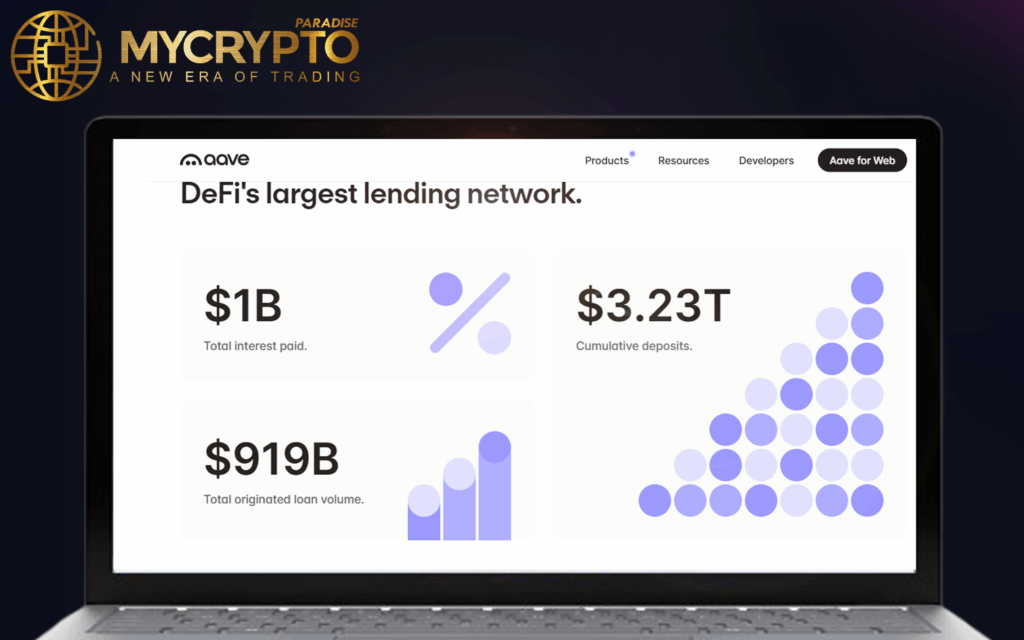
- What it is: Aave is the largest non-custodial lending and borrowing protocol in DeFi. It offers money-market style liquidity markets where users can supply assets to earn interest or borrow against supplied collateral. The protocol is deployed across many chains and is governed by AAVE token holders.
- Protocol scale: Aave reached a significant TVL milestone in 2025 with reports showing Total Value Locked above 40 billion US dollars, reflecting its central role in DeFi lending markets. DefiLlama also reports large annualized fee and revenue figures for the protocol. Use these numbers as a reference point because they update frequently.
- Core features relevant to traders: Aave v3 introduced several features that materially affect strategy design, including Isolation Mode, Efficiency Mode, and Portals. Isolation Mode limits risk by restricting which assets a newly listed collateral can borrow against and by setting debt ceilings.
- Core features: Efficiency Mode improves capital efficiency for correlated asset pairs. Portals enable cross-pool liquidity transfers between chains. These features increase capital efficiency and improve risk compartmentalization for automated strategies.
Yield opportunities on Aave
Following is the list of the yield opportunities on Aave:
- Supply interest: Provide assets such as stablecoins or ETH to earn supply APY based on market utilization and demand. Supply APY is a predictable baseline yield for many strategies.
- Borrow to leverage yield: You can borrow against supplied collateral to deploy into higher-yield protocols or LPs. Borrowing can amplify returns when signals indicate favorable spread or fee opportunities.
- Rate-driven rotations: You can monitor on-chain utilization, borrow rates, and supply rates to rotate between markets or simulate lending arbitrage across chains using Portals.
- Isolation Mode strategies: Use assets listed in Isolation Mode for targeted strategies where risk can be isolated to a specific debt ceiling, enabling experimental or opportunistic deployments without threatening the entire position set.
Security and reliability
- Audit history: Aave maintains a public security program and posts audit reports and security reviews. The project has undergone multiple audits and security assessments for v3 components. The Aave security page lists recent audits and formal security reviews in 2025.
- Operational reliability: Aave is widely used by professional DeFi operators and market makers. Its markets tend to have deep liquidity and predictable behavior, which supports automated execution. That reliability is an important consideration for signal-backed strategies that must execute without manual intervention.
Pros for signal-backed strategies
- Deep liquidity and market depth: Aave’s large TVL provides substantial depth for supply and withdrawal operations, reducing execution friction for sizeable algorithmic allocations.
- High composability: Aave integrates with most DeFi composable stacks, allowing strategies to combine lending, borrowing, staking, and LPing in automated flows.
- Advanced risk controls: Isolation Mode and other v3 features allow traders to compartmentalize risk by putting speculative positions into bounded lanes. This is valuable when running many automated signals in parallel.
- Interest-rate signalability: On-chain supply and borrow utilization metrics are clear signals that can be used to adapt allocation weights dynamically. These signals are reliable inputs for automated models.
Risks and limitations
- Liquidation risk when borrowing: Levered strategies must manage collateral ratios carefully. Rapid price moves can trigger liquidations and cause outsized losses for automated systems.
- Rate volatility: Interest rates change with utilization. Sudden shifts in demand or liquidity can make previously profitable borrow-to-deploy paths loss-making. Automated strategies must monitor rate dynamics continuously.
- Cross-chain and portal risk: Portals and cross-pool liquidity transfers increase capital efficiency but add operational complexity and potential bridge or bridging-contract risk. Test and monitor these flows closely before scaling.
Lido:
Lido is the dominant liquid staking protocol for Ethereum and other PoS chains. Users deposit ETH and receive stETH, an ERC-20 token that accrues staking rewards and remains usable across DeFi.
Lido also issues liquid staking tokens for other chains, such as Polygon and Solana, through separate modules. Let’s take a look at one platform among the 5 DeFi yield platforms list:
Overview and key metrics:
- Lido’s TVL has grown substantially in 2025 and is large enough to make stETH a primary building block in yield portfolios. DefiLlama and analytics providers report TVL figures in the tens of billions, and multiple outlets recorded a record high TVL of about 41 billion US dollars on August 13, 2025.
- TVL fluctuates with ETH price, staking inflows and outflows, and how providers count cross-chain staked assets, so use live sources when you need an exact number.
- Lido applies a fee to staking rewards that is split between node operators and the DAO treasury. Protocol revenue and the trailing staking yield for stETH are published on analytics sites and Lido’s dashboard.
- For example, analytics snapshots in 2025 show daily fees measured in the millions and 7 day annualized staking yields for stETH in the low single digits, depending on validator rewards and protocol parameters.

Yield opportunities on Lido
Here is the list of the yield opportunities for you:
- Receive staking yield directly by holding stETH: stETH accrues rewards automatically and provides a steady base yield that is not subject to the same volatility as many AMM farms.
- Use stETH as a composable asset: Deposit stETH into lending markets, stable liquidity pools, or LP positions to layer additional yield. Common stacks include stETH in Curve stETH pools or supplying stETH to lending markets like Aave.
- Leverage stETH in tactical overlays: Borrow against stETH to redeploy capital into higher yield strategies when signals show attractive spreads after accounting for borrowing costs and liquidation risk.
Security and reliability
Lido maintains a public security page that lists audits and reports. The project runs continuous audits and bug bounty programs and publishes many audit artifacts for its smart contracts and staking modules. Recent audits and post-audit fixes are recorded on the Lido documentation site.
Lido distributes stake across many node operators to reduce single operator risk. Even so, staking carries validator and slashing risk. There are documented analyses and occasional reports on edge cases such as withdrawal finalization and how mass slashing could affect withdrawal timing in extreme scenarios. These are real operational risks traders must monitor.
Pros for signal-backed strategies
- Reliable base yield: stETH provides a predictable, predominantly staking based yield that is easier to model than many short-term farming rewards. That makes it a strong base layer for multi-strategy portfolios.
- Deep liquidity and wide acceptance: stETH is one of the most liquid liquid staking tokens. It trades on major DEXs and is accepted as collateral across leading money markets, which reduces execution friction for signal-driven rebalancing.
- Composability for overlays: Because stETH is ERC 20, signal strategies can treat it like any other asset: lend it, farm with it, or use it in arbitrage and spread capture. That flexibility amplifies the tactical options available to signal models.
Risks and limitations
- Withdrawal and liquidity mismatch: While stETH is liquid on markets, converting very large amounts back to ETH can produce slippage or timing issues, especially when staking withdrawal mechanics and queueing are stressed. Plan sizing and exit rules accordingly.
- Validator and protocol operational risk: Slashing or validator failures are rare but possible. Large coordinated events could reduce expected staking rewards or delay withdrawals. Strategies that rely on uninterrupted staking reward accrual should include contingency rules.
- Smart contract and composition risk: Using stETH in third party protocols adds the third party’s smart contract risk. When layering yields, multiply your audit and counterparty checks accordingly.
Which is the Best DeFi Yield platform For You?
Signal-backed strategies are reshaping how professional traders earn yield in DeFi. Instead of relying on hype-driven farming cycles, traders now depend on data, automation, and disciplined execution. The platforms you choose matter just as much as the signals themselves. PancakeSwap, Sushi, Curve, Aave, and Lido each offer a different blend of liquidity, stability, and yield design, making them valuable tools for modern strategy builders.
- Curve and Aave stand out for traders who need predictable execution and deep liquidity.
- Lido provides a dependable base layer of staking yield that can support more complex overlays.
- PancakeSwap and Sushi remain flexible options for traders who thrive in dynamic, fast-moving markets.
Each platform has strengths, limitations, and unique risk profiles, and the best choice ultimately depends on the structure of your model and your personal risk tolerance.
Signal-backed strategies work best when paired with platforms that are reliable, well-audited, and built for automation. DeFi rewards the traders who remain informed, adaptive, and strategic in every decision they make.
Final Thoughts:
The DeFi landscape is evolving faster than ever, shaped by new protocols, higher competition, and a growing demand for smarter yield strategies. The best 5 DeFi yield platforms discussed in this guide represent the most reliable, efficient, and strategically valuable options used by professional traders.
To strengthen this foundation, MCP University FREE provides the essential training every trader needs. From technical analysis to trading psychology and risk management, our free education platform helps you build the mindset and skill set.
For traders who want to take their performance even further, ParadiseFamilyVIP🎖️ offers direct access to elite market insights to an exclusive inner circle. It is the environment where serious traders sharpen their edge, refine their process, and learn to operate with discipline, results vary and capital is always at risk.
DeFi Yield Platforms FAQ
What makes a DeFi platform suitable for signal-backed strategies?
Five traits matter: deep liquidity for low-slippage entries and exits, reliable execution during market stress, audited security, stable and predictable yields, and strong automation support. Signal-driven trading depends on precise timing, so a platform that lags on any of these can break a model before it starts.
Which yield options does PancakeSwap offer?
PancakeSwap offers liquidity-provision farms such as CAKE/BNB that earn CAKE plus a share of trading fees, and Syrup Pools for single-token staking. Auto-CAKE pools compound earnings automatically, while Manual CAKE pools are harvested by hand. Note an unstaking fee applies to Auto-CAKE within 72 hours.
What are the main risks of using these DeFi platforms?
Key risks include impermanent loss when providing liquidity in volatile pairs, smart-contract and bridging risk on cross-chain systems, changing token emissions and reward schedules, and slippage on low-volume pools. Past incidents, such as SushiSwap's 2023 RouteProcessor2 exploit, show why monitoring audit scope matters.
How does SushiSwap let users earn yield?
SushiSwap supports liquidity provision in AMM pools to earn swap fees, Onsen incentivized farming with rotating reward windows, and xSUSHI staking that distributes a share of protocol revenue. Its BentoBox vault and Trident concentrated-liquidity tools add composability for automated, signal-driven allocations across many chains.
Crypto trading involves substantial risk of loss. This article is educational and is not financial advice. Past performance does not guarantee future results. Always do your own research.
What is different here
Most guides stop at the theory. The MyCryptoParadise team shares the live trades, and the reasoning behind each one, inside ParadiseFamilyVIP. Everything here is education, not financial advice.
Crypto trading involves substantial risk and is not suitable for everyone. Nothing here is financial advice; it is education only. Never risk more than you can afford to lose.








Join the discussion
No comments yet. Members, share how you are reading this.