

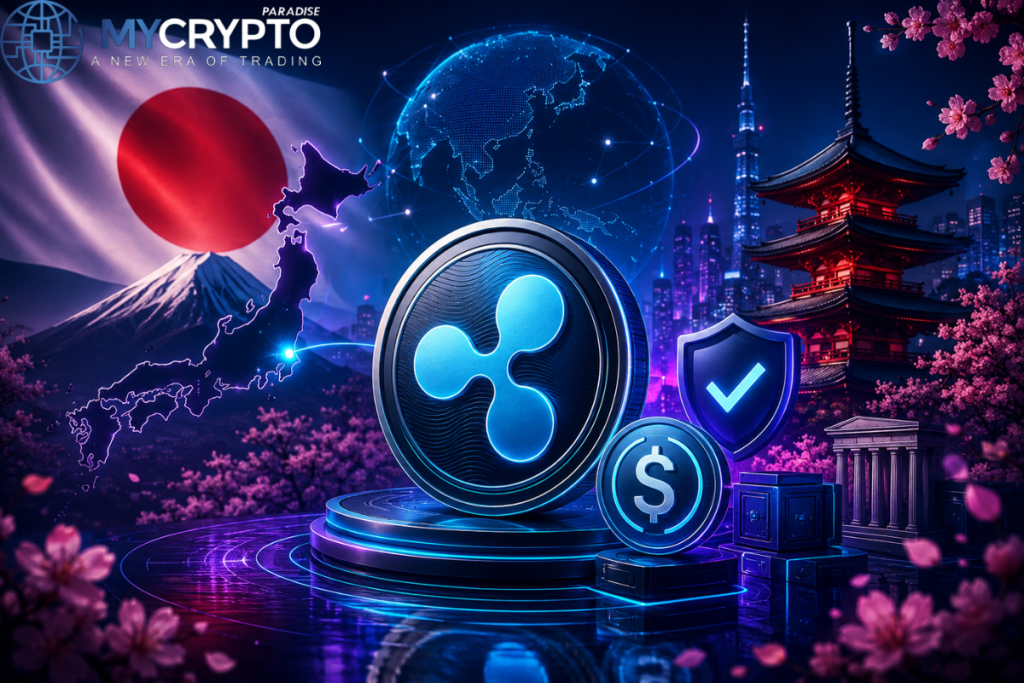
- Japan approved Ripple’s RLUSD as an electronic payment instrument.
- SBI VC Trade will offer RLUSD to institutions and retail users.
- RLUSD remains smaller than USDT and USDC at about $1.7B.
Japan just gave Ripple’s stablecoin a serious regulatory passport. Ripple RLUSD stablecoin now enters a strict market where approval matters. Can usage follow?
Ripple’s RLUSD stablecoin is now live in Japan after receiving approval from the country’s Financial Services Agency, giving the U.S. dollar backed token a regulated entry point into one of Asia’s most tightly supervised crypto markets. The approval classifies RLUSD as an electronic payment instrument under Japan’s Payment Services Act, allowing SBI VC Trade to offer the token to both institutional and retail users through its VCTRADE platform.
That is a meaningful step for Ripple because Japan is not a casual stablecoin market. The country has spent years refining its digital asset rules, including how foreign issued stablecoins can operate under local standards. RLUSD is issued through a trust company chartered by the New York State Department of Financial Services and is backed 1:1 by reserves that include cash and U.S. Treasuries.
The Japan launch gives it a dual regulatory profile, with oversight credibility on both the U.S. issuance side and the Japanese distribution side. The rollout also deepens Ripple’s long relationship with SBI Holdings, one of its most important institutional partners in Asia. SBI VC Trade already had infrastructure for dollar denominated stablecoins after supporting USDC distribution, which means RLUSD enters a market where regulated dollar stablecoin access is no longer theoretical.
The challenge is scale. RLUSD reportedly sits around $1.7 billion, far behind USDT and USDC. Approval gives it permission to compete, but liquidity still decides whether institutions actually use it.
Why Ripple RLUSD Stablecoin Matters for Crypto
Ripple RLUSD stablecoin matters because stablecoin competition is increasingly becoming a race for regulatory access, not just user attention. In the early crypto market, liquidity often followed convenience, exchange support, and speed. Now, especially for institutions, stablecoins need reserve transparency, legal clarity, distribution partners, and approval in serious jurisdictions.
Japan’s green light gives RLUSD one of the credentials that matter most permission to operate inside a strict financial framework. The main driver is regulated dollar liquidity. Japan has strong demand for dollar exposure, cross border settlement, tokenization, and institutional grade payment rails.
A compliant U.S. dollar stablecoin available through SBI VC Trade gives Japanese users another way to access dollar denominated digital settlement without relying only on offshore stablecoin channels. For BTC, the impact is indirect but constructive. More regulated stablecoin rails can make it easier for capital to move into and out of crypto markets, improving access rather than changing Bitcoin’s core narrative.
For ETH, the effect depends on where RLUSD circulates and how it is used for tokenized assets, payments, and collateral. For XRP and Ripple’s broader ecosystem, the launch strengthens Ripple’s institutional payments story, although RLUSD remains separate from XRP itself.
For altcoins, the impact is selective. Regulated stablecoin adoption usually helps infrastructure, tokenization, compliant DeFi, payment rails, and exchange liquidity before it helps speculative tokens. Japan is not opening the door to chaos. It is opening the door to controlled settlement.
Market Impact of Ripple RLUSD Stablecoin
The market impact of Ripple RLUSD stablecoin will likely start with credibility before liquidity. Approval from Japan’s Financial Services Agency gives RLUSD a stronger institutional profile, but it does not automatically close the gap with USDT and USDC. That difference matters. Regulatory approval can win trust, but trading volume, exchange integrations, market depth, and real settlement demand win market share.
The immediate effect is positive for Ripple’s stablecoin strategy. RLUSD now has access to a major Asian market through SBI VC Trade, a partner with existing regulatory and operational infrastructure. This gives Ripple a practical distribution channel instead of just a product announcement. It also positions RLUSD as a stablecoin for payments, tokenization, and collateral management, not merely another dollar token sitting on exchanges.
For BTC, stablecoin growth in Japan can improve fiat to crypto efficiency. If RLUSD becomes a trusted dollar rail, Japanese users may find it easier to rotate between local banking channels, dollar liquidity, and digital assets. For ETH and other settlement networks, the key question is whether RLUSD activity expands into tokenized asset markets or remains mostly inside controlled exchange environments.
The competitive pressure is also important. USDC already has distribution through SBI VC Trade, while USDT still dominates global stablecoin liquidity. RLUSD entering Japan does not change that hierarchy overnight. But it does add another regulated competitor in a market where compliance is becoming a feature, not a burden.
What to Watch Next After the RLUSD Japan Launch
After the RLUSD Japan launch, the first thing to watch is real usage through SBI VC Trade. Regulatory approval is the entry ticket. Volume is the proof. Traders should monitor whether RLUSD gains meaningful adoption among retail users, institutions, payment firms, tokenization platforms, and collateral management services. If the token remains available but lightly used, the market impact will stay limited.
The second signal is liquidity depth. RLUSD needs more than compliance credibility to compete with USDT and USDC. It needs strong pairs, narrow spreads, reliable redemption, visible reserves, market maker support, and broader platform integrations. Stablecoins are not won by press releases. They are won by becoming useful at the exact moment capital wants to move.
The third signal is Japan’s broader stablecoin policy direction. Japan is now allowing regulated foreign issued stablecoins under its updated framework, which could attract more competition. That is constructive for market structure because it gives users more compliant options. It also forces stablecoin issuers to compete on transparency, distribution, cost, and institutional reliability.
Traders should also watch whether RLUSD becomes connected to tokenized real world assets, cross border payments, and enterprise settlement. Ripple has framed RLUSD as a bridge for payments, tokenization, and collateral. If those use cases begin producing visible transaction demand, the Japan launch becomes more than regulatory news. It becomes a liquidity story.
Insights for Traders on Ripple RLUSD Stablecoin
For traders, the key number is $1.7 billion. That is RLUSD’s reported market value, and it shows both progress and limitation. Ripple now has regulatory momentum in Japan, but RLUSD remains tiny compared with USDT at roughly $186 billion and USDC at around $74 billion. The trade signal is not “RLUSD will dominate.” The better signal is that regulated stablecoin competition is expanding.
The first market lens is distribution. SBI VC Trade gives RLUSD a serious Japanese channel, but adoption depends on whether users actually choose it over USDC and existing dollar rails. If RLUSD starts gaining balances, transaction volume, and institutional integrations, Ripple’s stablecoin strategy becomes more credible. If usage stays small, the approval remains positive but mostly symbolic.
For XRP traders, this news may support sentiment around Ripple’s institutional credibility, but RLUSD should not be confused with direct XRP demand. The stablecoin can strengthen Ripple’s ecosystem narrative without automatically creating XRP buy pressure. That distinction matters.
For ETH and broader smart contract markets, the signal is stablecoin liquidity entering regulated Asian finance. If RLUSD supports tokenization, collateral management, or payment settlement on public networks, infrastructure demand improves. For BTC, better dollar rails in Japan can support access and market efficiency.
The confirmation signal is rising RLUSD usage in Japan. The invalidation signal is simple approval without volume. In stablecoins, trust opens the door, but liquidity decides who stays in the room.
ParadiseTeam is monitoring the market situation closely, and we are taking these developments into consideration while building our trading tactics inside ParadiseFamilyVIP.
How will Ripple's RLUSD stablecoin fare after its Japan launch?
This is how the Paradisers are calling it. Tap your call.
No calls on this one yet. Tap yours to be the first.
Free account, no password. Members just sign in.
Follow this topic: XRP news · Stablecoin news









Join the discussion
No comments yet. Members, share how you are reading this.