

Key Highlights
• PayPal is expanding its PYUSD stablecoin to 70 global markets, up from limited access in the US and UK
• Users can now send, receive, hold PYUSD and earn rewards, reducing cross-border payment costs
Yello Paradisers! PayPal is quietly turning its stablecoin into a global payments rail across 70 countries. Is this the moment stablecoins move from crypto niche to everyday finance?
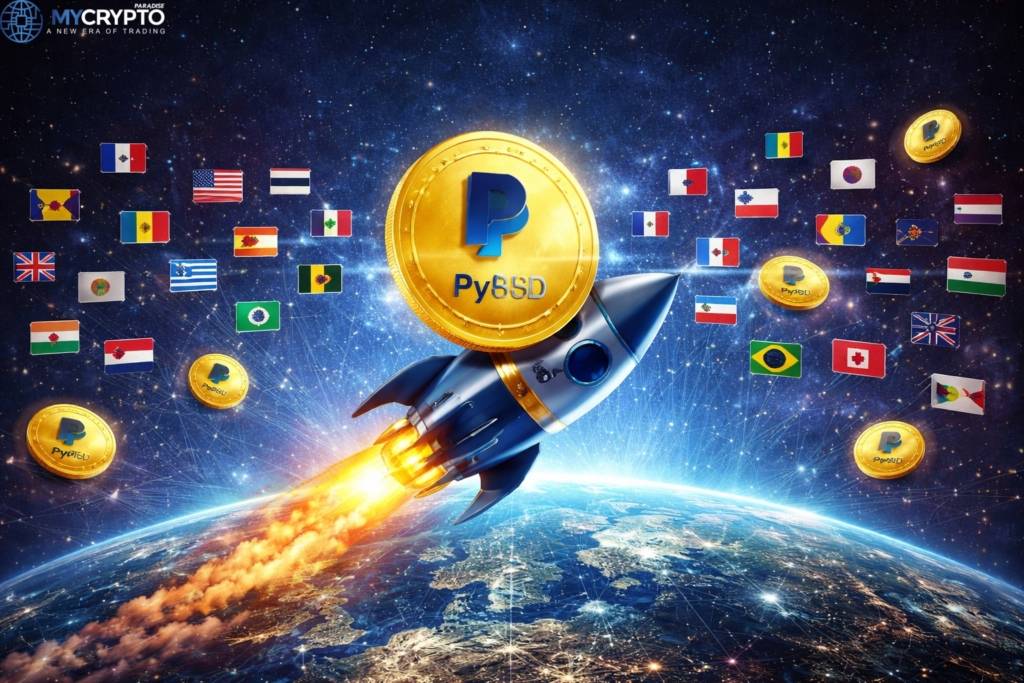
PayPal has announced the global expansion of its US-dollar-backed stablecoin, PYUSD, making it available to users in 70 countries worldwide.
Previously limited to users in the United States and the United Kingdom, the stablecoin will now be accessible across regions including Asia-Pacific, Europe, Latin America and North America.
With this rollout, PayPal users in supported markets can now receive, hold and send PYUSD directly within their accounts, as well as transfer it to third-party digital wallets.
The company also introduced a reward mechanism, allowing users in certain regions to earn returns on their PYUSD holdings, effectively turning it into a yield-generating balance inside PayPal accounts.
PYUSD, launched in August 2023 in partnership with Paxos Trust, is backed by US dollar deposits and short-term US Treasuries. The stablecoin has grown significantly, with its market capitalization rising from around $500 million in early 2025 to over $4 billion.
PayPal stated that the expansion is aimed at improving cross-border payments, reducing fees and enabling users to hold funds in US dollars rather than being forced into local currency conversions.
Why It Matters
For years, stablecoins promised faster and cheaper global payments.
Now, a payments giant with hundreds of millions of users is actually deploying that promise at scale.
PayPal is not experimenting anymore. It is integrating stablecoins into everyday financial behavior.
And when a company that already moves trillions decides to upgrade its rails, it is rarely for decoration.
Market Impact
The expansion positions PYUSD as a serious contender in the stablecoin market, currently dominated by USDT and USDC.
By embedding PYUSD directly into PayPal accounts, the company removes a major barrier to adoption, which is user friction.
Instead of asking users to learn crypto, PayPal is bringing crypto to where users already are.
This move also aligns with broader industry trends, as companies like Visa and Mastercard accelerate their own stablecoin integrations.
Faster settlement times, lower fees and improved liquidity could make stablecoins increasingly attractive for both consumers and merchants.
What to Watch Next
Watch whether PYUSD adoption grows significantly in emerging markets where cross-border fees are highest.
Monitor how competitors like USDC and USDT respond to PayPal’s distribution advantage.
Pay attention to regulatory developments, especially as global access to stablecoins expands rapidly.
Observe whether PayPal integrates PYUSD deeper into merchant payments and checkout systems.
Insights for Traders
Big players are not just building coins. They are building distribution.
PayPal’s move is less about competing on technology and more about controlling user flow.
The second-order effect is adoption velocity. When stablecoins become embedded in everyday apps, transaction volume can scale faster than most expect.
For traders, this signals a shift where stablecoins are no longer just liquidity tools inside exchanges, but global payment instruments competing with banks.
And markets tend to reward infrastructure that quietly becomes indispensable.
ParadiseTeam is monitoring the market situation closely, and we are taking these developments into consideration while building our trading tactics inside ParadiseFamilyVIP.
Follow this topic: Stablecoin news






Join the discussion
No comments yet. Members, share how you are reading this.