

Listen: the breakdown
Market briefing: Kraken's parent Payward and its clients have bought AAVE through an affiliated investment fund, deepening its DeFi push, even as BTC trades near $76,325, down 4.9% on the day.
- Payward and its asset-management clients bought AAVE on the secondary market through an affiliated fund.
- The move follows a $385 million Payward-Aave deal that collapsed months ago, with further collaboration now in talks.
- An institutional buyer accumulating AAVE while BTC and ETH both bleed 5 to 6 percent reads as idiosyncratic demand.
Kraken parent Payward just bought AAVE on the open market through its own investment fund, months after a $385M deal fell apart. So is this patient accumulation or a one off?
Kraken's parent company, Payward, and its asset-management clients have acquired AAVE tokens. The buying ran through the secondary market, via an affiliated fund called Digital Asset Special Investments I, LP. The amount stays undisclosed, but the direction does not.
This is Payward extending a push into DeFi and asset management. It is not an idle treasury allocation. The company and Aave are reportedly discussing further collaboration beyond the token purchase itself.
What makes it notable is the history. A prior $385 million deal between the two parties fell through months ago. Buying on the open market through a fund vehicle, while still talking terms, is the second attempt at the same relationship from a different angle.
The timing is the part worth staring at. The purchase landed on a day when the broader market was sharply risk-off. BTC traded near $76,325, down 4.9% on the 24 hour, with ETH off roughly 6%.
So one institutional buyer was accumulating a single DeFi token while the two majors it sits alongside were bleeding. We see no evidence linking Payward's AAVE buying to that wider decline. It reads as an idiosyncratic allocation happening on its own schedule, not a reaction to the tape.
That divergence is the story. Headlines love a clean narrative of capitulation; the actual order flow rarely files one. Here, patient buying and panic selling sat in the same hour, on different instruments, for different reasons.
Second attempt after a $385M collapse
The structure matters more than the size here. Payward did not just park tokens on a balance sheet. It bought through an affiliated fund, on the secondary market, while continuing to negotiate deeper collaboration with Aave. That is a position being built, not a press release being issued.
The collapsed $385 million deal is the context most readers will skip, and it is the key. When a large arrangement falls apart and the same buyer returns through a fund to accumulate on the open market, that is conviction expressed the expensive way. Talk is cheap; secondary-market fills are not.
For the DeFi narrative, this is a credibility input. An exchange parent moving into asset management and allocating to a lending protocol's token signals that institutions are starting to treat DeFi infrastructure as investable, not merely interesting. It also tells you who the marginal buyer can be. Not a retail wallet chasing a candle, but a fund vehicle filling patiently. Those two buyers behave very differently when price gets uncomfortable.
The honest caveat: this is one allocation, amount undisclosed, from one buyer. It does not rewrite DeFi's macro. It is a data point about institutional appetite for the sector, arriving on a day when sentiment for everything else was ugly. That contrast is precisely what gives a single allocation this much narrative weight.
AAVE demand against a bleeding tape
The first-order effect is bullish, and specific to AAVE. Fresh institutional demand, bought through a fund and backed by ongoing talks, is an adoption signal that favours the token at its centre.
The cleaner read is the divergence. BTC and ETH set the risk tone, and today that tone was risk-off, both down mid-to-high single digits. AAVE accumulation running against that backdrop is the opposite of momentum buying. It is demand that did not need a rising market to show up.
For the broader cascade, keep expectations sober. BTC leads, ETH follows, alts amplify. On a red day, a single token's institutional bid does not reverse the majors. It does not pretend to. This is an alt-specific catalyst, not a market-wide one, and we should not dress it up as the latter.
Where it can matter is relative strength. If AAVE holds firmer than the majors while they sell, that outperformance is itself the tell. It says a patient buyer is absorbing supply that panicking holders are handing over.
That is the mechanism worth watching. Not a price target, but who ends up owning the float after a week like this. Secondary-market fills from a fund tend to sit still. Leveraged retail longs tend not to. When those two groups swap tokens during a flush, the ownership base quietly gets stronger, even if the chart looks the same.
Signs the accumulation keeps building
The confirmation most of us want is more of the same. Further Payward-Aave collaboration moving from talks to terms would turn a single purchase into a programme. A second disclosed tranche, or a formal partnership, would validate the accumulation read.
Relative strength is the real-time signal. If AAVE refuses to bleed with BTC and ETH on red days, that resilience confirms a patient bid is live. Watch whether it holds ground while the majors slip.
On-chain behaviour matters too. Tokens bought through a fund vehicle that then sit untouched support the patient-accumulation thesis. Tokens that start moving back toward exchanges would undercut it fast.
Invalidation is the mirror. If the buyer or its clients begin distributing, or if collaboration talks quietly die the way the $385 million deal did, the signal weakens to a one-off trade. A stalled relationship is a familiar outcome; the first deal already showed these two can fail to close.
The wider tape frames everything. BTC near $76,325 and still heavy means the market gives AAVE little tailwind. So judge this story on AAVE's own footprint, not on whether crypto bounces this week.
And keep the base rate in mind. One fund buying one token does not make a sector. It is a credible data point about institutional appetite, worth tracking precisely because so few buyers show up when everything else is for sale.
Reading institutional AAVE demand through smart money
The ParadiseTeam reads this as a genuine, token-specific tailwind for AAVE, and keeps it separate from our standing caution on the broad market. The buyer's structure is the signal: a fund vehicle, secondary-market fills, ongoing talks. That is accumulation, not a flip.
Context still rules the majors. With BTC near $76,325 as of the day's risk-off tape, our wider lens stays defensive. We treat recovery attempts in BTC toward the upper $90k area as spots where smart money has been distributing into crowded, high-funding longs, not as confirmation of a reversal. Whale selling has been running near a 90-day extreme.
That backdrop is exactly why the AAVE buy stands out. It is demand showing up while the crowd is leveraged long on BTC and the big holders are offloading. Different asset, different buyer, different behaviour.
So we separate the two trades in our heads. The majors sit in a bearish daily and weekly structure, with the exchange-of-hands zone far below near $55,000 if selling accelerates. AAVE, meanwhile, has an identified patient buyer absorbing supply.
The practical read: relative strength in AAVE versus BTC and ETH is the thing to respect. If a fund is filling while retail panics, that float is quietly changing hands to stronger owners. We would not fade AAVE on this news; we would watch whether the accumulation footprint keeps printing, and let the majors prove their own direction separately.
The read behind this: we framed this story through our own market analysis, Bitcoin Longs Pile In While 67% of Whales Sell.
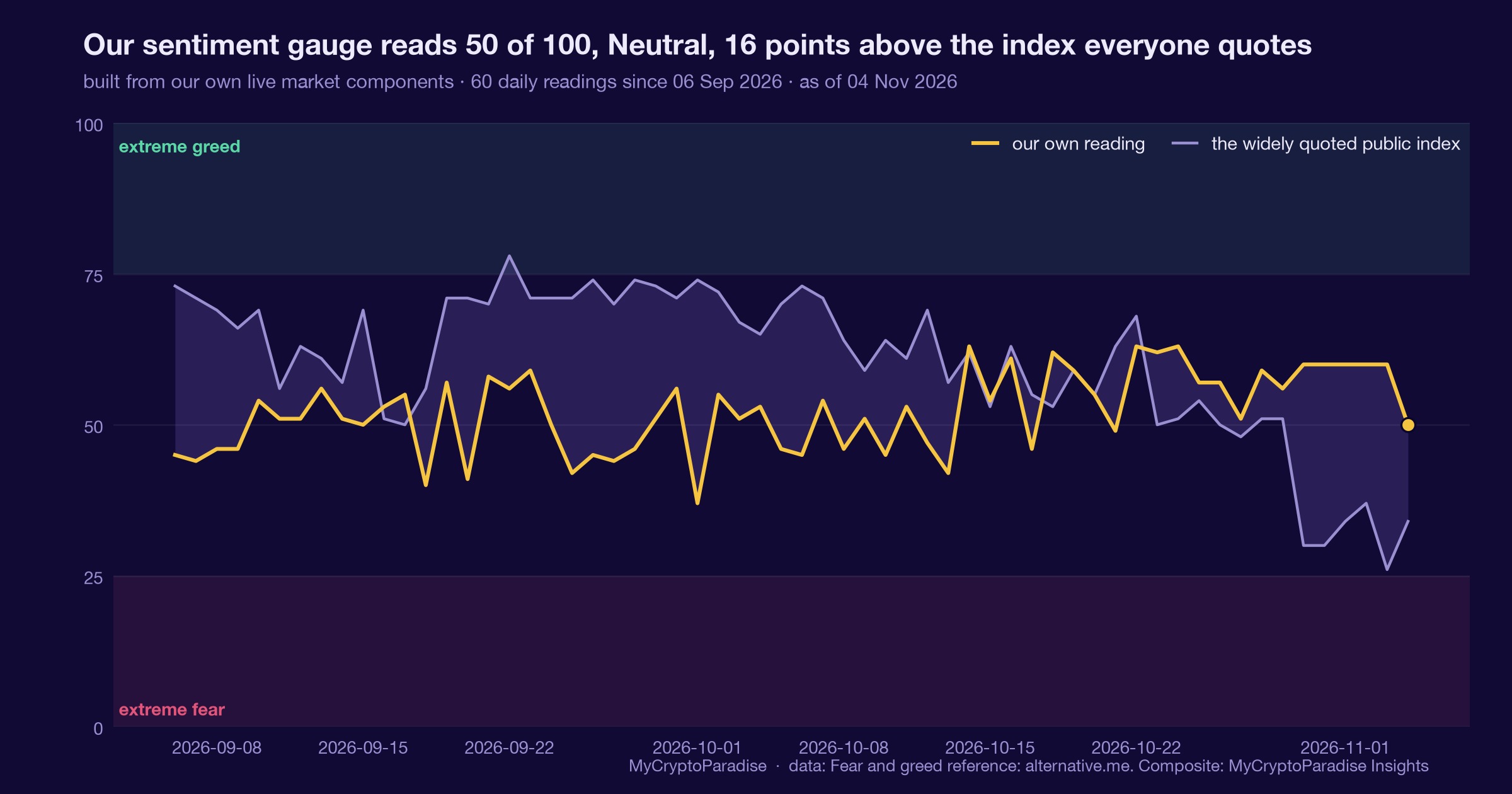
Track it live: our Crypto Fear and Greed Index and the live crypto funding rates both update in real time, so you can watch this shift for yourself.
Related coverage
For exact entries, targets, and stop losses with full risk management, that is what ParadiseFamilyVIP is for. New to reading these moves? Start with our crypto trading strategies guide.
ParadiseTeam is monitoring the market situation closely, and we are taking these developments into consideration while building our trading tactics inside ParadiseFamilyVIP.
Crypto trading involves substantial risk. Prices are volatile and you can lose money. This article is educational and is not financial advice. Past performance does not guarantee future results.
Does Payward's AAVE buy start a wave of institutional DeFi allocation?
How 1 Paradiser is calling it
The first call is still open
Free account, no password. Members just sign in.




Join the discussion
No comments yet. Members, share how you are reading this.