


Listen: the breakdown
Developing story update (October 20, 2026, 08:12 UTC):
ZEROBASE: JPMorgan’s decision to put its deposit token on Ethereum looks like a measured next step rather than a sudden shift. The bank first launched JPM Coin on Base last November after a pilot involving Coinbase and others.
Institutional clients can now move the same token on Ethereum mainnet, where more tokenized funds already trade. Clients convert dollar deposits held at the bank into tokens, send them to approved counterparties in seconds at any time, and redeem them back into cash. The underlying funds stay on JPMorgan’s balance sheet; the blockchain only records the transfer.
JPM Coin is not a freely traded stablecoin or public cryptocurrency. Access stays limited to vetted institutions through the bank’s Kinexys unit. Crypto firms already active on-chain can use it for payments without traditional wires, while asset managers holding tokenized money-market funds can treat it as cash or collateral and settle without waiting for banking hours. Putting the token on Ethereum, where many of those assets already sit, avoids extra network hops.
Kinexys has processed more than four trillion dollars in cumulative transactions, averaging roughly seven billion daily across its services. The figures cover more than just the public-chain token, yet they show institutional clients already route meaningful volume through the bank’s tools. Expanding to Ethereum meets demand where liquidity exists and gives the bank a cash instrument that sits next to the assets its clients are tokenizing.
The move fits a broader Wall Street pattern. Large firms have issued tokenized funds on public chains, often starting with short-term Treasury or money-market products. BlackRock’s BUIDL and JPMorgan’s own funds have attracted institutional money.
Deposit tokens fill the gap of moving the cash that buys or collateralizes those assets without falling back into multi-day settlement. Public chains are becoming practical infrastructure for specific high-value uses rather than purely speculative venues.
Regulation still keeps the product narrow. The tokens represent commercial bank deposits and carry JPMorgan’s credit risk inside its existing compliance framework, making them easier for supervisors to accept than instruments outside banking rules.
Moving deposits onto a public chain still raises questions about resilience, anti-money-laundering controls once tokens leave the bank’s direct view, and what happens during chain congestion or outages. Progress on stablecoin rules has reduced some uncertainty, but the framework continues to favor products tightly linked to regulated entities and limited counterparties. The result remains a hybrid system. Traditional rails still handle most large flows. For certain institutional payments already occurring on-chain, the bank can now offer near-instant settlement without clients leaving its balance sheet.
This could reduce idle money between counterparties and simplify using tokenized assets as collateral. How far it grows will depend on client adoption and how regulators treat further expansion. For now, JPMorgan is treating public chains as an extra venue for a product it controls, the cautious stance typical of the largest banks.
Developing story update (October 19, 2026, 12:13 UTC):
JPMorgan Takes JPM Coin To Ethereum As Banks Test Public-Chain Settlement. JPMorgan is taking its bank-issued deposit token onto public Ethereum, an expansion that puts an established Wall Street payments product on infrastructure traditionally associated with crypto-native finance. TL;DR: JPMorgan is expanding access to JPM Coin on Ethereum for institutional users. The token represents bank deposits rather than an independently issued stablecoin, and participation remains restricted. The significance is in who is allowed to move the money, and where. JPM Coin gives eligible customers a tokenized claim on dollars deposited with JPMorgan.
Its move onto Ethereum create
Developing story update (October 19, 2026, 11:19 UTC):
JPMorgan is bringing its JPM Coin deposit token to Ethereum, targeting crypto firms and institutional clients that need a regulated digital token for blockchain payments and trade settlement.
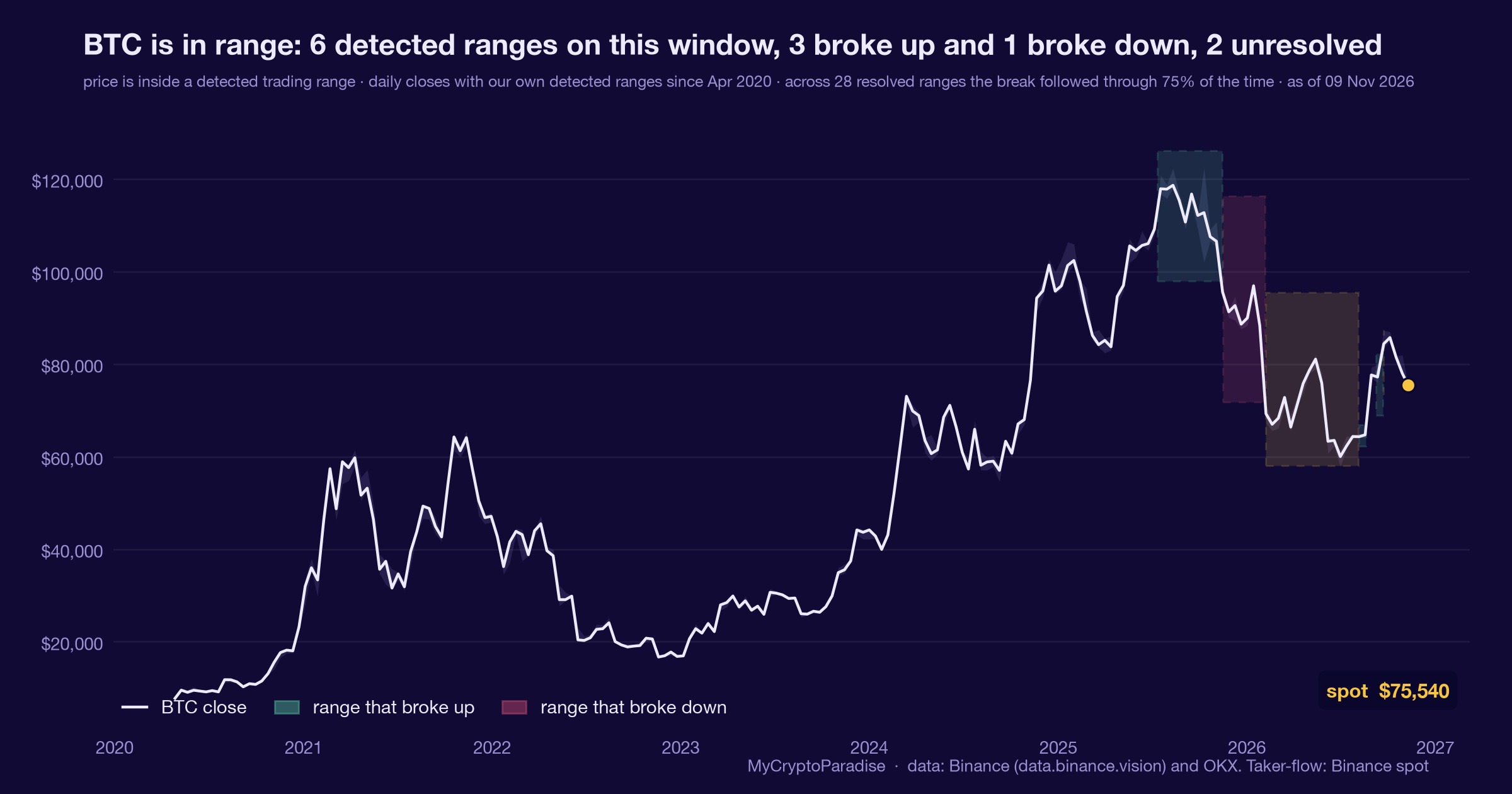
Market briefing: JPMorgan is extending its JPM Coin deposit token onto Ethereum for institutional clients, moving regulated money from a private ledger to public rails. BTC sat near $82,779 and ETH near $2,430 as the news landed quietly.
- JPMorgan is bringing JPM Coin, live since 2019, from its permissioned Kinexys chain onto Ethereum for institutional clients.
- An October 14 development signaled JPM Coin's usability was widening beyond internal settlement.
- ETH traded near $2,430 on the news, a muted reaction that reads as positioning rather than a retail chase.
JPMorgan is extending JPM Coin, its deposit token, onto Ethereum for institutional clients. A private bank ledger is stepping onto public rails. Does this quietly reprice ETH?
JPMorgan is moving JPM Coin, its deposit token, onto Ethereum for institutional clients. Until now the token lived on Kinexys, the bank's own permissioned blockchain. There it settled money between institutional accounts, out of public view.
The destination is what changed. A private ledger is stepping onto a public one.
JPM Coin itself is not new. It has handled internal institutional settlement since 2019, long before deposit tokens became fashionable. An October 14 development signaled that its usability was widening. That is the quiet part worth reading closely.
JPMorgan has tested public-market plumbing before. In October 2023 its Tokenized Collateral Network settled a live over-the-counter derivatives trade. BlackRock tokenized shares in a money-market fund and moved them to Barclays as collateral. So this is not a first experiment. It is a bank extending a working system onto infrastructure it does not own or control.
The price reaction stayed modest. ETH traded near $2,430 as the news landed, up under one percent on the day. That calm is itself a signal, and we will come back to it.
What a bank on public rails means
The signal matters more than the token. A systemically important bank chose Ethereum, a public and permissionless network, to carry regulated institutional money. That choice says the infrastructure is now considered robust enough for balance-sheet-grade settlement. For years that question stayed open.
Deposit tokens sit closer to the banking system than stablecoins. They represent a claim on a commercial bank deposit. When JPMorgan routes that claim through Ethereum, it treats the chain as settlement plumbing rather than a speculative asset. The distinction is the whole story.
TradFi does not adopt rails it expects to abandon. It integrates slowly, then all at once.
This also extends the tokenization narrative we have tracked for two years. Real-world assets, collateral networks, money-market funds: the pattern is consistent. Institutions want programmable settlement without building their own chains. Public infrastructure gives them that at scale, which is why each step compounds the last.
None of this guarantees capital floods in tomorrow. It lowers a barrier. A bank validating the base layer makes the next institution's decision easier, and the one after that easier still.
Reading the liquidity path into Ethereum
Follow the liquidity, not the headline. JPM Coin on Ethereum does not itself buy ETH. But it deepens the case for holding and using the network, which is how institutional flow usually begins.
BTC remains the macro anchor. It was trading near $82,779 as of 07:22 UTC, up 1.4 percent on the day. Risk appetite across crypto still takes its cue from Bitcoin, so any broad institutional tailwind reaches ETH through BTC first.
Ethereum is the direct beneficiary here. More regulated settlement activity means more reason to hold ETH as the network's base asset. ETH traded near $2,430 as the news crossed, a muted reaction that tells you this is positioning, not a retail chase.
Modest price, meaningful signal. That gap is often where smart money works.
Alts sit at the end of the chain. A stronger Ethereum base layer tends to lift the ecosystem built on it: layer-twos, staking tokens, real-world-asset protocols. That flow is slower and more selective. It rewards the networks with genuine institutional use, not the ones with the loudest marketing.
From pilot to measurable settlement flow
Watch for proof the usage is real, not announced. A press release is cheap; measurable settlement volume on Ethereum is not. Confirmation looks like rising on-chain institutional activity tied to deposit-token rails over the coming weeks.
The bullish case strengthens if more banks follow onto public chains. One institution is a pilot. Three or four is a trend, and trends are what repricing follows.
Invalidation is quieter but real. If activity stays confined to closed pilots, or JPMorgan keeps the bulk of flow on Kinexys, the public-chain story cools into a headline. Watch where the volume actually settles.
Keep ETH's reaction honest. A token integration that never shows up in network metrics is a narrative, not a flow. We will judge this by data, not by the announcement's tone.
Regulation is the wildcard. Deposit tokens live close to banking rules, so any supervisory pushback could slow the pace.
For now the direction of travel is clear. A major bank chose public infrastructure, and that choice is hard to walk back.
What JPM Coin changes for ETH liquidity
Institutional adoption stories reward patience, and the ParadiseTeam treats this one as structural fuel rather than a trigger. The modest ETH reaction near $2,430 fits that read. Validation like this builds a floor over months, not a candle on the day.
Bitcoin still sets the tone, and it was trading near $82,779 as of 07:22 UTC. The ParadiseTeam's standing lens stays constructive while the $78,000 to $79,800 support zone holds. Spot cumulative volume delta, CVD (cumulative volume delta), has been printing higher highs and higher lows, which reads as smart money absorbing retail selling.
That backdrop matters for how this news lands. A dip toward $79,000 could still flush overleveraged longs before any push toward $90,000. News like JPMorgan's does not stop that mechanic; it supports the case for buyers stepping in lower.
Modest reactions to strong news are a tell. They point to accumulation, not excitement.
For ETH specifically, we want the network data to confirm the story over the weeks ahead. Until flow shows up on-chain, treat the integration as a reason to respect the base case, not to chase it. The edge here is patience while retail waits for a headline that already happened.
The read behind this: we framed this story through our own market analysis, Can Bitcoin Rally Back to $90K?
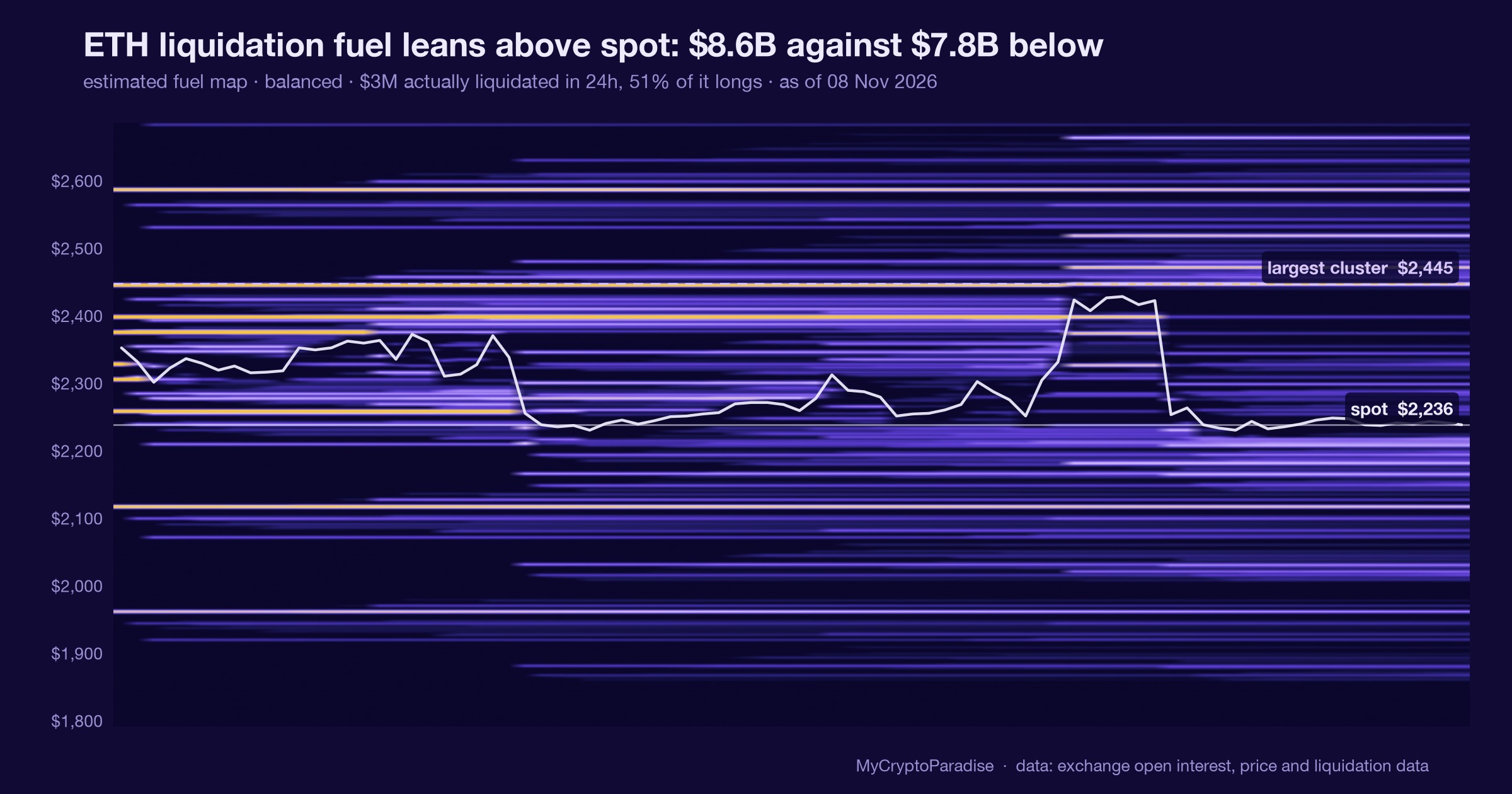
Track it live: our live crypto funding rates and the crypto liquidation heatmap both update in real time, so you can watch this shift for yourself.
Related coverage
For exact entries, targets, and stop losses with full risk management, that is what ParadiseFamilyVIP is for. New to reading these moves? Start with our crypto trading strategies guide.
ParadiseTeam is monitoring the market situation closely, and we are taking these developments into consideration while building our trading tactics inside ParadiseFamilyVIP.
Crypto trading involves substantial risk. Prices are volatile and you can lose money. This article is educational and is not financial advice. Past performance does not guarantee future results.
Does JPMorgan on Ethereum pull real institutional flow into ETH?
How 35 Paradisers are calling it
The first call is still open
Free account, no password. Members just sign in.












Join the discussion 24
JPM on ETH, sure, but the 'smart money flow' part makes me a bit 🤨. Like Stefan, my alerts for that stuff usually just stay quiet 😴. Still kicking myself for missing that OG pump of JPM, should have aped in 🔥.
carlos, yeah, jpm on eth is interesting... wonder if this is also gonna affect gas fees for us casual traders? 📈
Still watching the charts for their actual moves tho 😅, not just the news headlines 📰. Hope this brings some serious vol to ETH! 🔥⬆️
woah, i used to think JPM was all about the old ways, so this is a surprise... makes me wonder what other big players are quietly making moves too 🤔. I'm always checking the charts for these kinda ripples... 📉
So is the institutional interest like, *actually* increasing ETH liquidity? I'm sorry, I just never know how to read that part of the charts properly myself. I'm trying to learn!
I'm monitoring the volume side-by-side with institutional flows. It's the only real signal, not what Amara's brother pays for transfers.
nice, you got that institutional flow 👀. i'm just trying not to get chopped up on these 1m candles. volume's good, but timing still kills me, right?
My alerts for JPM on the main chain have been quiet for months. This might finally trigger some movement in my custom indicators.
Quiet alerts for months! 😴 I wonder what this means for actual corporate treasury use beyond the main chain? 🤔 I'm curious about the real-world settlement angle. 📈
Stefan, i think the main chain JPM alerts will stay quiet the on-chain movement is for institutions, not retail liquidity.
Quiet alerts for months is a red flag. What matters is if institutions actually use it, not just the availability.
i always thought institutional flow was more about the quantity of money moving, not necessarily its origin. does JPM coming to ETH really mean more liquidity, or just a different pipe for the same stuff??
I'm curious if this move ultimately strengthens or weakens the decentralization thesis for Ethereum, especially concerning institutional onboarding.
I wonder if this means more stablecoin volume from institutions eventually, or if they'll just stick to their own JPM Coin. It's a bit scary to think about how much control they have. 😬
Deposit token" on Ethereum for *institutional* clients. So, is this settlement still off-chain for them, or are they finally executing on L1 and eating gas like the rest of us?! Invalidated if they use private sidechains, obviously.
Mateusz dont forget the KYC side of it for institutional clients its not just about the tech stack.
Mateusz, you are right to point that out... if they are moving settlement to L1, then the impact on gas fees for the rest of us could be a concern...
so the smart money flow comes down to this then what's the one level that matters
i remember when they first said no banks would ever touch this stuff guess that changed huh wonder if it will open up more to regular people like me
JPM Coin on Ethereum for institutions? 🤔 So, the same banks that charge 5% for my brother's transfers suddenly want to be efficient with *their* money? 😂 That's a twist! 💸
Amara, it's not about them suddenly *wanting* efficiency; it's about the rules and regulations they *must* follow. Banks operate within a very different framework than your brother's transfer, and that framework matters more than you think!!
rules and regulations" huh? 🤔 so it's only when *their* balance sheets are involved that compliance suddenly makes efficient rails a priority? 🧐 funny how that works for institutional money but my brother’s remittances still get hit with those legacy fees. 😒💸
amara, those legacy fees are definitely frustrating, i agree with you there. but the point is, their regulatory obligations dont suddenly vanish; they just find new ways to meet them. the market will show us who's right here, eventually. ♟️
yeah, amara... now they want a piece of the pie they've been charging us to move... a tale as old as time.