


Listen: the breakdown
Market briefing: Six crypto trading firms backed the CFTC's authority over single-stock perps, but a judge already leans the other way. BTC sat near $74,229, down 0.6%, and barely noticed.
- Coinbase, Kalshi, Payward and three trading firms filed to support CFTC authority over single-stock perpetual futures
- A federal judge has already indicated the challengers suing the CFTC are likely to win their core claim
- This is a market-structure and product-listing fight, not a liquidity event; BTC and ETH showed no real reaction
Six of crypto's biggest trading firms just backed the CFTC on single-stock perpetual futures, even though a judge is already leaning the other way. So why does this fight matter to you?
Six of crypto's biggest trading names just backed a regulator they usually resist. Coinbase, Kalshi, Kraken parent Payward, DRW Holdings, Jump Trading and Paradigm moved for leave to file an amicus brief. The brief supports the CFTC's authority to regulate single-stock perpetual futures. In this industry, firms rallying behind their own regulator is worth a second look.
The stakes here are a product line, not a price.
Single-stock perps let traders hold leveraged, perpetual exposure to one company's shares. They sit awkwardly between commodity law and securities law. A trade group is suing the CFTC over who gets to police them. These firms want the CFTC to keep that authority, because the alternative threatens a product they can legally list.
Here is the uncomfortable part for the amicus camp. A federal judge has already indicated the challengers are likely to succeed on their core legal claim. That is a loud early signal in a case still being argued. The six firms are pushing uphill, and they appear to know it.
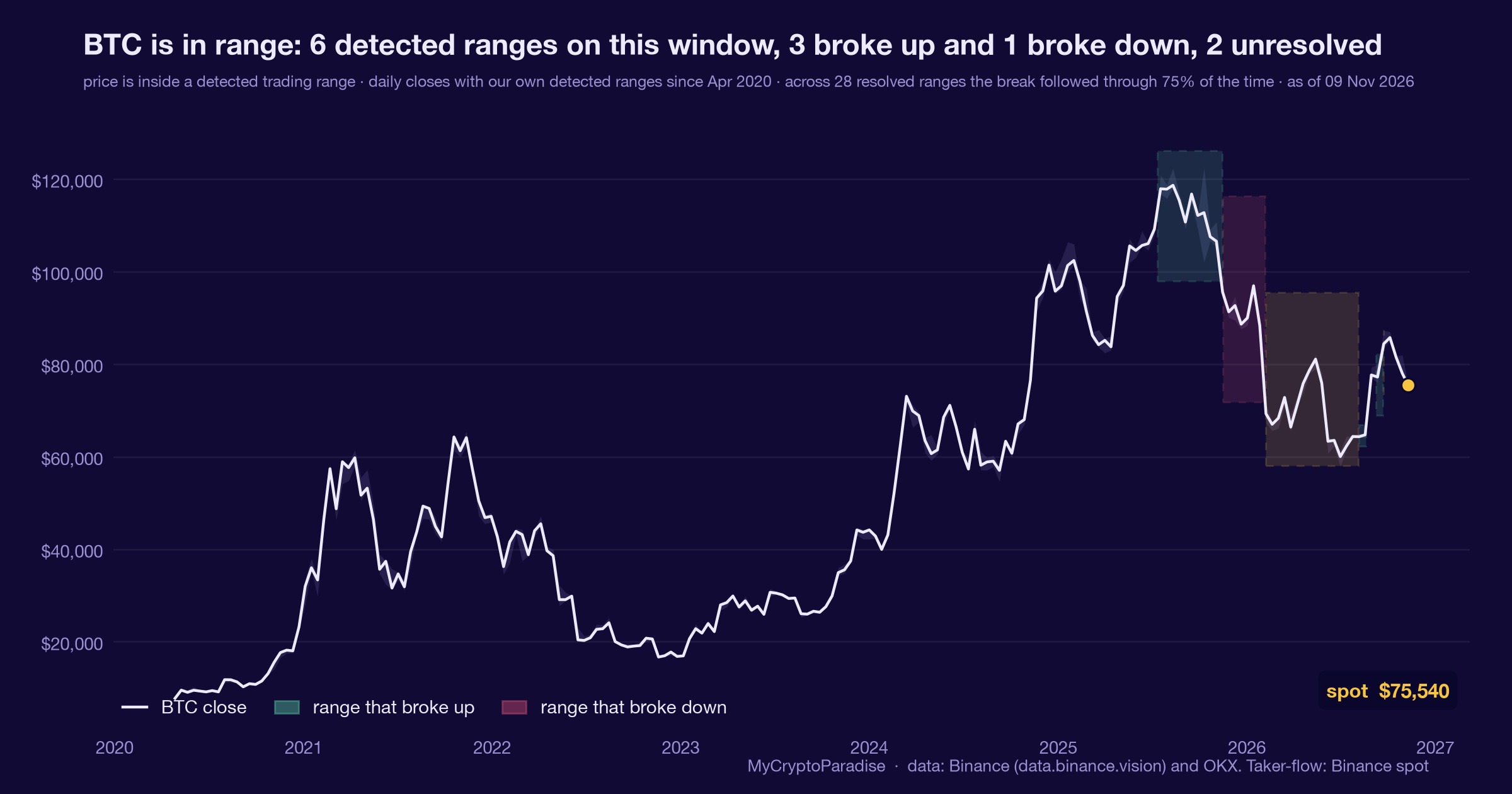
None of this touched the majors today. BTC was trading near $74,229, down about 0.6% on the day. ETH slipped a little further, off roughly 1.5%. The filing reads as a market-structure story, not a flow-driven catalyst, and the tape agreed.
A jurisdictional fight over perps law
This case decides which US regulator governs a fast-growing product. That sounds procedural. It is not. The classification of single-stock perps determines what American exchanges can legally offer at all.
If perps on one company's stock count as commodity-style contracts, the CFTC governs them. If they count as security futures, a different and stricter regime applies. The line between those two worlds decides whether Coinbase, Kalshi and others keep a product or lose it. That is why six serious firms spent legal budget defending a regulator's reach. They are protecting a revenue stream and a roadmap, not making a call on crypto prices.
The macro transmission here is thin by design. There is no supply shock, no ETF flow, no liquidity being added or drained. A ruling changes which products US exchanges list, which shapes competition and fee pools over time. It does not change how many coins exist or who is buying them this week.
Still, structure matters to traders who use these crypto exchanges. A narrower US product menu pushes some leveraged activity offshore or into gray areas. That affects where liquidity concentrates and how tightly spreads sit. Over months, product law quietly steers where the real order flow lives, even when it never shows up on a daily candle.
No flow mechanism reaching BTC or ETH
The price reaction to this filing was, in a word, nothing. BTC drifted lower by about 0.38% on the hour, ETH by roughly 0.63%, both inside normal background noise. There is no clean chain from an amicus brief to a bid or an offer in spot.
That absence is the point. A liquidity event moves money. This moves a legal argument. No capital entered or left crypto because six firms filed paperwork.
For BTC, the first-order read is neutral. Nothing in this story changes the supply, the ETF demand, or the cost of leverage on the majors. Traders watching for a catalyst here will wait a long time.
ETH and the broader alt complex inherit the same verdict. There is no second-order squeeze, no forced unwind, no sentiment shock that spills down the risk curve. The modest, broadly similar declines in both majors look like tape doing what tape does on a quiet session.
Where structure could eventually bite is the derivatives layer on US exchanges. If single-stock perps get squeezed out, product mix and fee revenue shift. That is a slow, corporate story about exchange balance sheets. It is not a reason to reposition BTC or ETH today, and we are not treating it as one.
The ruling that reshapes exchange product lines
The signal worth tracking is the ruling itself, not the daily candle. A judge has already hinted the challengers are likely to win their core claim. That early lean is the single most important fact in the story.
Confirmation, in the sense that matters here, is a final decision that strips the CFTC of authority over single-stock perps. That would validate the judge's early read and force US exchanges to rethink the product. Watch which firms quietly shelve perp roadmaps if that happens.
Invalidation is the opposite path. The amicus brief lands, the court reconsiders, and CFTC authority holds. That keeps the product alive on American crypto exchanges and hands Coinbase and Kalshi the outcome they paid for.
Either way, the thing to monitor is product availability and where leveraged volume migrates, not a BTC level. A loss for the CFTC could push single-stock leverage offshore and thin out US derivatives depth over time.
We would also watch the SEC side of this turf war. Single-stock perps sit at the border of commodity and securities law, and that border is contested well beyond this one case. A precedent here echoes into other product fights. None of this needs to touch BTC or ETH to matter to how this industry is allowed to operate.
What a losing argument means for exchanges
The ParadiseTeam frames this cleanly: it is a structural overhang on exchanges, not a signal on coins. With BTC near $74,229 as of the latest read and down about 0.6% on the day, nothing in this filing argues for repositioning the majors.
We see no accumulation or distribution footprint tied to this news. The declines in BTC and ETH are proportional and quiet. That is background noise, not a reaction, and we treat it as such.
The smart-money angle here is corporate, not directional. Six firms are defending a product line because it is worth defending, while a judge quietly signals they may lose anyway. The gap between the confidence of the filing and the early lean of the court is the honest tension in this story.
For positioning, our caution stays macro, not case-specific. Crypto still trades inside a broader risk backdrop, and strength can meet sellers at resistance regardless of how this lawsuit ends. This event does not add or remove a level for us.
So we file it under market structure and move on. Watch the ruling for its effect on exchange product menus and where leveraged flow concentrates. Do not expect it to set the next move in BTC or ETH. When a story has no flow mechanism, the risk-first answer is to respect that and not manufacture one.
Track it live: our live crypto funding rates and the Crypto Fear and Greed Index both update in real time, so you can watch this shift for yourself.
Related coverage
For exact entries, targets, and stop losses with full risk management, that is what ParadiseFamilyVIP is for. New to reading these moves? Start with our crypto trading strategies guide.
ParadiseTeam is monitoring the market situation closely, and we are taking these developments into consideration while building our trading tactics inside ParadiseFamilyVIP.
Crypto trading involves substantial risk. Prices are volatile and you can lose money. This article is educational and is not financial advice. Past performance does not guarantee future results.
How does the single-stock perps fight end for the CFTC?
How 1 Paradiser is calling it
The first call is still open
Free account, no password. Members just sign in.
Follow this topic: Crypto regulation news












Join the discussion
No comments yet. Members, share how you are reading this.