

In short
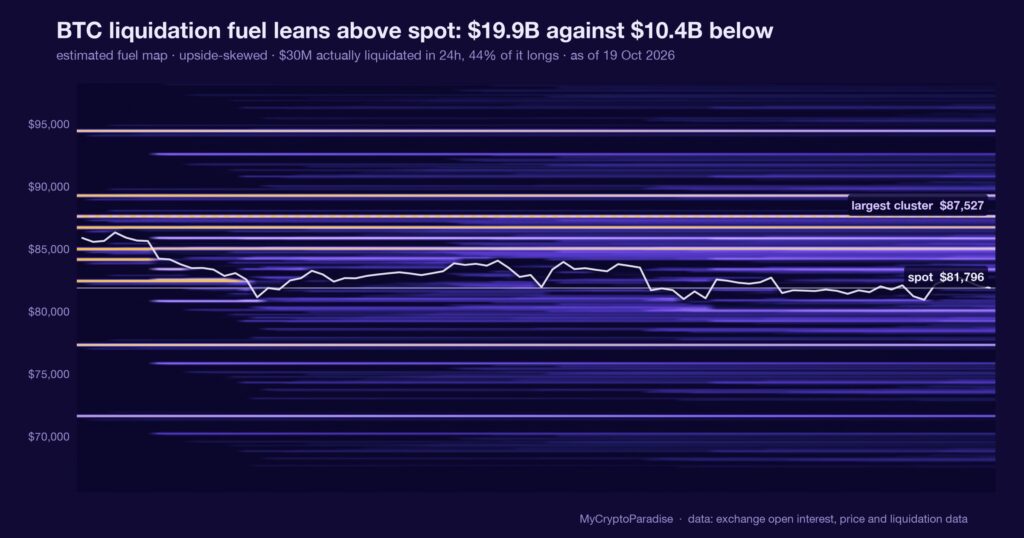
A liquidation map is a model estimate of where leveraged positions would be force-closed if price reached them, and the fuel above spot is the stack of short positions that a rally would burn. On 19 October 2026 our MCP Insights reading showed $19.9 billion of estimated fuel above spot near $81,800 against $10.4 billion below, a 1.9-to-1 upside skew. The realized side was quieter: $29.7 million liquidated over 24 hours, 56 percent of it shorts. We called this neutral with an upside tilt, not a directional call, because the map carries a model-estimate flag and has not cleared calibration. The live order book stayed near-balanced and stable, which does not confirm the skew. This piece shows you how to read a liquidation map yourself, and when to read it lightly.
Key facts
- BTC spot at the reading
- $81,796
- Estimated BTC liquidation fuel above spot
- $19.85B
- Estimated BTC liquidation fuel below spot
- $10.44B
- Fuel balance
- upside-skewed, +31 points toward the heavier side
- What would prove this read wrong
- A daily close that drags the larger estimated pocket below spot, or a calibrated print replacing the model estimate and showing heavier fuel below $81,800, either of which flips the skew underneath price.
- Reading taken
- 19 October 2026
- Source
- Our MCP Insights tools, from exchange data
What a liquidation map actually measures
A liquidation map estimates where leveraged traders would be forced out, not where anyone has chosen to buy or sell. It models the price levels at which margin breaks and an exchange closes a position against its owner.
Fuel above spot is short positions that a rally would liquidate; fuel below is long positions a decline would liquidate. The larger pocket is the one a move toward it can feed on, because each forced close pushes price the same way.
A map of forced exits is not a map of intent. It tells you where a move could accelerate, never whether the move begins.
The reading on 19 October
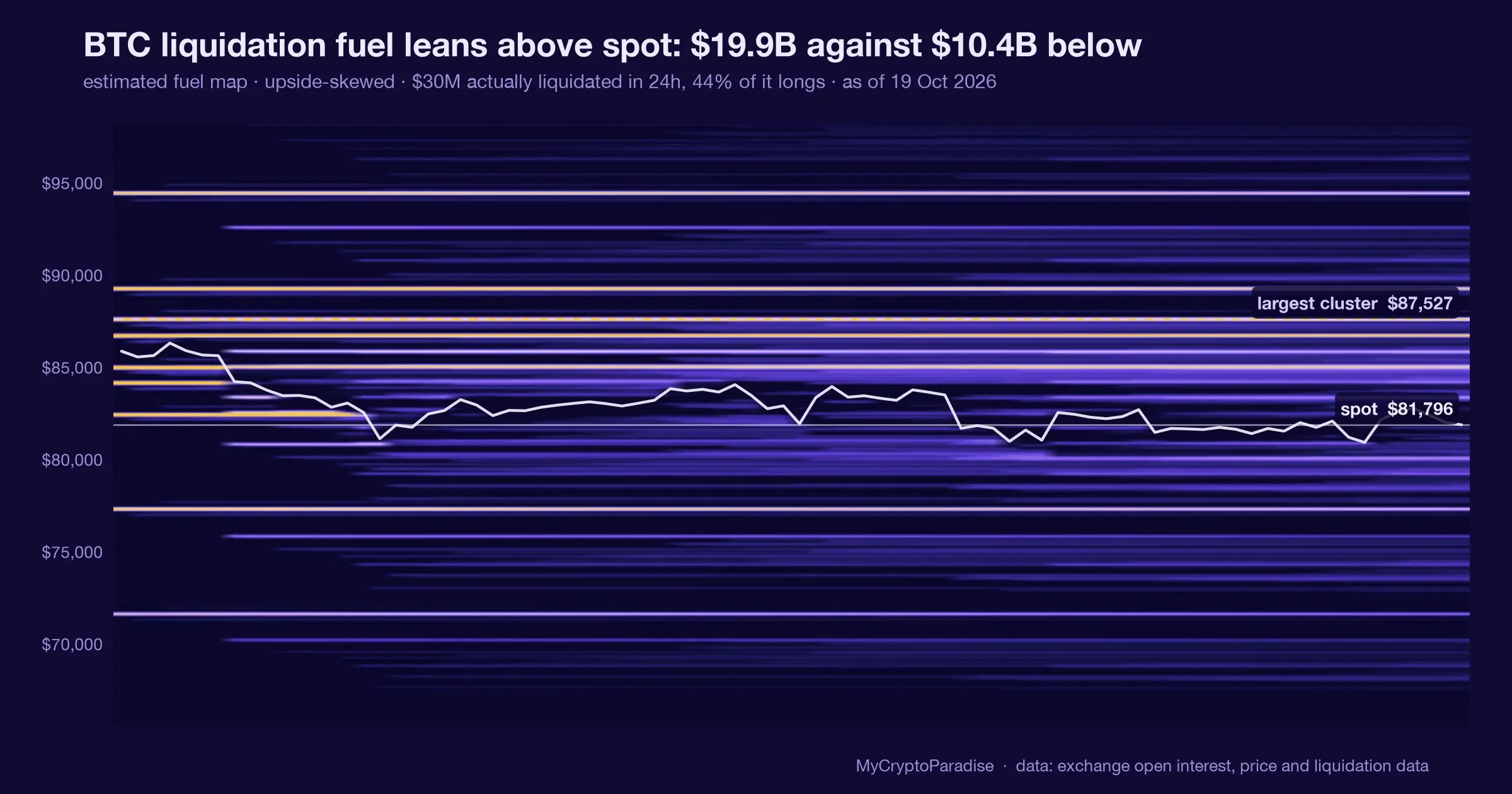
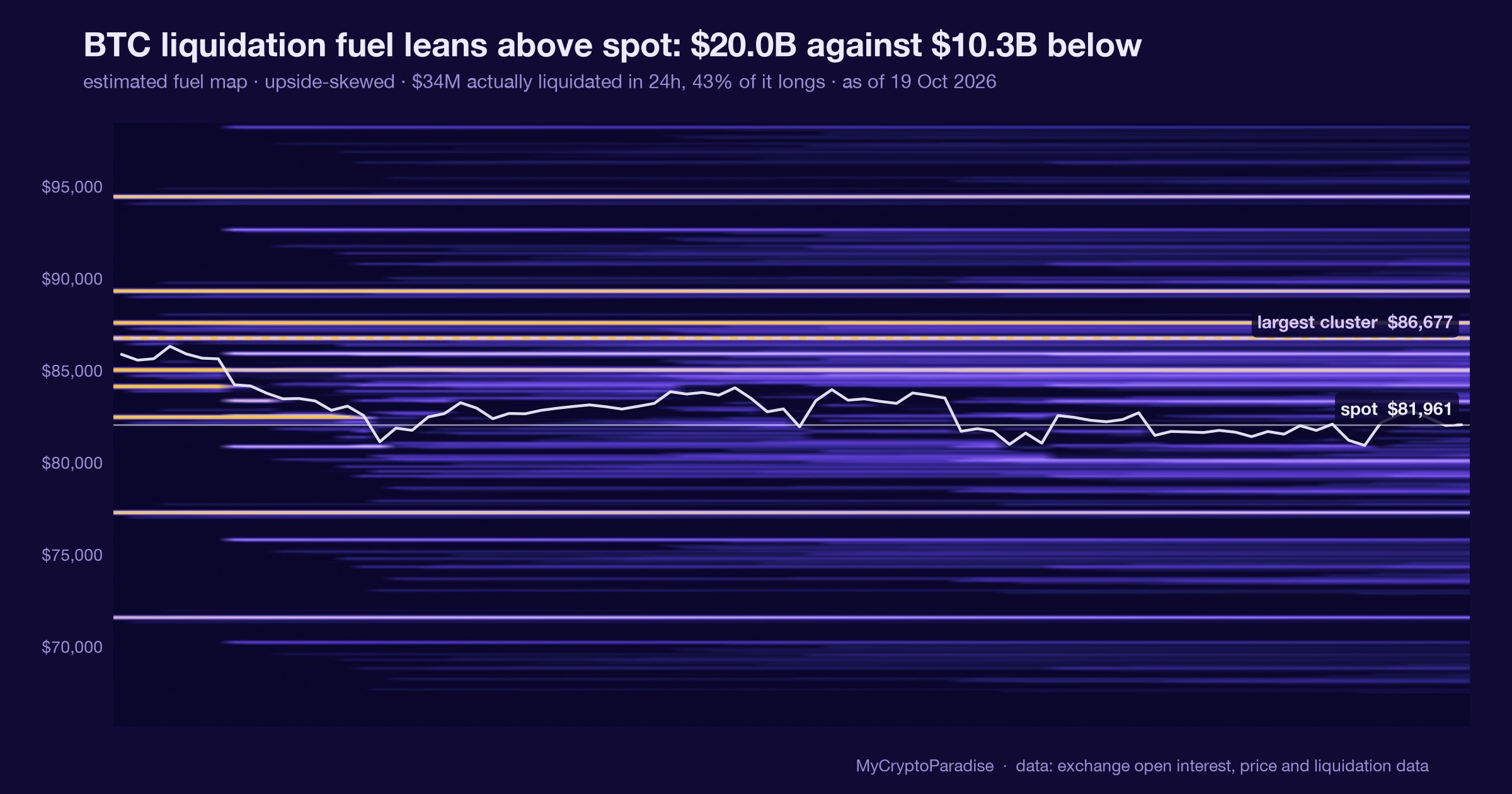
Our MCP Insights liquidation series on 19 October 2026 put $19.9 billion of estimated fuel above spot against $10.4 billion below, a 1.9-to-1 skew with an imbalance score of plus 31, labelled upside-skewed. Spot sat near $81,800.
The realized tape was thin. Over the trailing 24 hours our liquidation data logged $29.7 million closed out, $16.6 million of it shorts and $13.1 million longs, a 56 to 44 split.
The live order book told a calmer story: resting bids within 2 percent of mid came to $1.02 billion against $0.94 billion of asks, a net ratio of 0.52, and our integrity check flagged no spoofing and no icebergs.
The estimated fuel leans up, the realized damage was small and short-side, and the visible book is balanced. Three readings, one event, and they do not all point the same way.
What is different here
The ParadiseTeam reads a liquidation map as a conditional weight, not a destination: we quote the estimated fuel, flag that it is a model estimate, and set it beside the live book and realized liquidations before trusting it. The method is to let the disagreeing series size the risk.
Why the skew is a lean, not a floor
The obvious misread is to treat $19.9 billion of overhead fuel as a destination. It is not. A larger pocket above says a move upward could accelerate if it begins, not that it begins at all, and the map itself is a model estimate that has not cleared its calibration gate.
Read it as a weight on a bias, not the bias itself. The skew sits above, 1.9 to 1; the realized liquidations and the balanced book give that weight nothing to lean on yet.
This is one input. It sits alongside the order book, realized liquidations and order-flow absorption, and today it is the one reaching for a direction the others do not share.
Our order-flow absorption read sat in its no-edge zone, the 20th percentile, with no active episode. A gauge that admits it has no edge is more useful than one that always finds a signal.
What would turn the lean into a move
The skew stops being even a lean if it flips: a daily close that drags the larger estimated pocket below spot, or a calibrated print replacing the model estimate and showing heavy fuel below. Either would move the asymmetry under price.
For now the hub’s biggest mover was elsewhere: our max pain reading shifted 34 points on the day, while this heatmap did the quieter work of migrating weight overhead.
A read that only quotes the confirming half of the data is marketing. The balanced book is the disagreeing half, and it is what sizes the risk here.
Reading a liquidation map yourself, step by step
- Start with the estimated flag: if the reading has not cleared its calibration gate, treat every number as a model estimate, not a measurement.
- Compare the fuel above spot with the fuel below, and write the ratio down: that single number is the whole of the skew.
- Check the realized liquidations over the last 24 hours, and which side was forced out, to see whether the map is already resolving.
- Lay the live order book beside it: balanced resting bids and asks mean the visible market is not confirming the estimated skew.
- Set an invalidation before you act: the price level or calibrated print that would flip the larger pocket to the other side of spot.
Most readers skip the estimated flag and quote the fuel as if it were measured. A model estimate that has not cleared calibration is a hypothesis, not a reading.
Every number above is checkable against the live data. Start with the crypto liquidation heatmap, then cross-read the MCP Insights hub and the Crypto Fear and Greed Index.
Act and invalidate
| Scenario | What confirms it | What kills it |
|---|---|---|
| Upside skew feeds a squeeze | Shorts liquidate as price climbs | Daily close drags fuel below spot |
| Skew stays a dead lean | Book balanced, liquidations thin | Calibrated print shows heavy fuel below |
| Map is just noise today | No-edge absorption, stable book | Realized liquidations spike one-sided |
Posture: Defensive and patient while the map carries a model-estimate flag and the live book stays balanced. The larger pocket sits above, a weight on an upside bias worth one line of risk, not a position.
Frequently asked questions
What does an upside-skewed liquidation map mean?
It means our model estimates more leveraged fuel sits above spot than below, 1.9 to 1 on 19 October. A rally that reaches those levels could accelerate as shorts are force-closed, but the skew does not say a rally begins.
Is the liquidation map a reliable signal here?
Not on its own today. The reading carries a model-estimate flag and has not cleared its calibration gate, so we quote it as an estimate. The balanced live order book and thin realized liquidations give the skew nothing to confirm it.
Why were shorts liquidated more than longs?
Over the trailing 24 hours $16.6 million of shorts were force-closed against $13.1 million of longs, a 56 to 44 split. The total was small at $29.7 million, so this is a quiet tape, not a one-sided flush.
What would invalidate the upside-fuel lean?
A daily close that drags the larger estimated pocket below spot, or a calibrated print replacing the model estimate and showing heavier fuel underneath price. Either moves the asymmetry below, which would flip the lean rather than merely weaken it.
How should a trader use this reading?
As one weight among several, not a trigger. It sits beside the order book, realized liquidations and order-flow absorption, and today it disagrees with them. Treat the overhead skew as a single line of risk, with the invalidation attached.
Crypto trading involves substantial risk and is not suitable for everyone. Nothing here is financial advice; it is education only. Never risk more than you can afford to lose.
The private Extras feed, where the liquidation fuel map, 24-hour realized liquidations and order-book balance update with their invalidation levels attached, is part of PRO Paradiser, the intelligence layer behind the ParadiseFamilyVIP strategies.












Join the discussion
No comments yet. Members, share how you are reading this.