

In short
The spent output profit ratio (SOPR) tells you whether the coins moving on-chain today are being sold at a profit or a loss. On 21 October 2026 our MCP Insights reading puts aggregate SOPR at 1.0083, so the average spent coin banks a thin 0.83 percent gain. Underneath, the cohorts split hard: long-term holders who spend are realizing a 45 percent profit, a long-term SOPR of 1.4541, while recent buyers sit at breakeven, their seven-day SOPR just 1.0018. We read this as neutral, explicitly not a top call. Both readings carry a model-estimate flag, so we quote no calibrated frequency; our recon logs 126 reset events since August 2011, a count and not a probability. Of the last five resets our model graded, three defended and two were rejected. This piece shows you how to read the SOPR cohort split yourself, step by step.
Key facts
- Bitcoin price at the reading
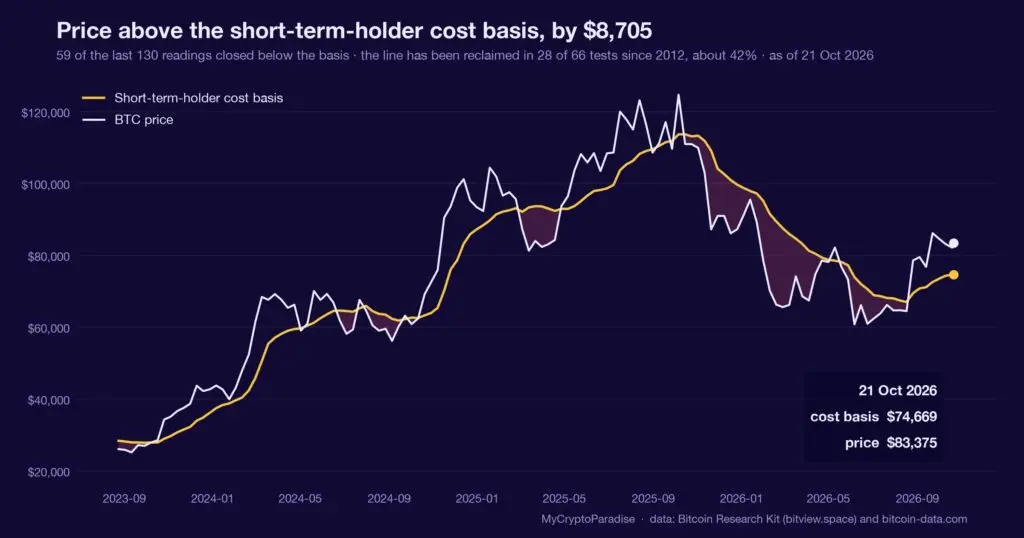
- $83,375
- Short-term holder cost basis
- $74,669
- Price against that cost basis
- $8,705 above
- Share of short-term holder supply underwater
- 13.7%
- State
- price above the short-term-holder cost basis
- What would prove this read wrong
- A daily aggregate SOPR close below 1.0 (coins moving at a net loss), or the long-term-holder SOPR compressing toward 1.0, which would drain the profit-taking that defines this read.
- Reading taken
- 21 October 2026
- Source
- Our MCP Insights tools, from Bitcoin Research Kit (bitview.space) and bitcoin-data.com. Upstream data published by the Bitcoin Research Kit
SOPR counts realized profit, not paper gains
The spent output profit ratio divides the value of coins at the moment they move by their value when they last moved. Above one, the coins leaving wallets are being sold into profit. Below one, they are being spent at a loss.
Split it by how long the coins sat still and it tells you who is doing the selling. Long-term holders and recent buyers carry very different cost bases, so they cross the profit line at very different prices.
A ratio near one is not indecision. It is the exact level where seller psychology changes, which is why it is worth watching before it moves.
The split on 21 October is a wide one
Per our own MCP Insights SOPR series, aggregate SOPR reads 1.0083 on 21 October 2026, with bitcoin at 83,375. Every coin that moved today realized an average profit of 0.83 percent: positive, but barely.
The cohorts diverge sharply. Long-term holders who spent coins booked a 45 percent profit, a long-term SOPR of 1.4541, while the seven-day short-term-holder SOPR sits at just 1.0018. Recent buyers are selling at breakeven.
Our cost-basis series frames the backdrop: price sits 54.6 percent above the aggregate realized price of 53,912, yet 28.9 percent of circulating supply is underwater and 13.7 percent of recent buyers hold at a loss.
One cohort is taking money off the table at a 45 percent gain. The other is barely whole. That gap is the whole reading.
What is different here
The ParadiseTeam does not read SOPR as a single aggregate number. We split it by cohort and watch long-term and short-term holders separately, because one average hides the fact that patient holders and recent buyers are crossing the profit line at completely different prices today.
A 45 percent profit is not a top on its own
The easy misread is that long-term holders booking 45 percent gains means the cycle is ending. Elevated long-term SOPR has run for months inside past uptrends: profitable holders spend, and that alone has never dated a top.
What matters is whether recent buyers absorb that supply or fold into it. With their SOPR at 1.0018, they are neither capitulating nor paying up: they are holding the line at cost.
This is one input. It sits alongside funding, open interest and the cost-basis cohorts, and today it is the gauge that quantifies how much profit is actually leaving versus sitting still.
Long-term holders taking profit is what a bull market looks like. It only turns dangerous when no one shows up to buy what they sell.
The recent resets graded both ways
Our model flags both readings as estimates, so we quote no calibrated rate. What we can show is recon: of the five most recent short-term SOPR resets our model logged, three defended their level and two were rejected within one to four days.
The two rejections, in July, came as SOPR dipped under one and recent sellers moved into losses. The defenses, in January, March and August, held above breakeven. Today’s 1.0018 sits on the defend side of that line, barely.
A reading that sits a fraction above its pivot is honest about being close. The number tells you where the edge is thin, not that it has vanished.
Which side is paying to be wrong
In a divergence like this, cost basis decides who is comfortable. Long-term holders bought near 49,272 and sit on deep gains, so they can spend patiently and wait for bids.
Recent buyers, at a breakeven cost near 74,669, have no such cushion. A move lower puts them straight into loss, and their 1.0018 SOPR says they are already at the hinge.
The holder with the lower cost basis sets the pace. The one at breakeven reacts. Today the patient cohort is selling and the nervous cohort is absorbing.
Reading the SOPR cohort split yourself, step by step
- Open our Bitcoin SOPR tool and read the aggregate value first: above one is net profit-taking, below one is net loss.
- Switch to the cohort view and compare the long-term-holder line against the seven-day short-term-holder line.
- Note the gap. A wide split means patient holders are selling into buyers who have no profit cushion yet.
- Cross-check the short-term-holder SOPR against one: sitting at breakeven is the hinge where seller behaviour changes.
- Mark the aggregate breakeven at one as your invalidation, and watch for a daily close through it.
The step people skip is the cohort split: they read one aggregate number near one, call it neutral, and miss that two groups are crossing opposite sides of it.
Every number above is checkable against the live data. Start with the MCP Insights hub, then cross-read the Crypto Fear and Greed Index and the live crypto funding rates.
Act and invalidate
| Scenario | What confirms it | What kills it |
|---|---|---|
| Patient distribution absorbed | STH SOPR holds above 1.0 | Aggregate SOPR closes below 1.0 |
| Profit-taking cools | LTH SOPR compresses toward 1.0 | LTH SOPR re-expands above 1.45 |
| Recent buyers fold | STH SOPR breaks under 1.0 | STH SOPR reclaims clear profit |
Posture: Defensive-neutral while recent buyers sit at breakeven: the profit-taking is orderly, not a rush. The highest-probability stance for most is no new risk until the aggregate confirms which way the breakeven line breaks.
Frequently asked questions
What does a SOPR above 1 mean?
It means the coins moving on-chain are, on average, being sold for more than they last cost. An aggregate SOPR of 1.0083 says the typical spent coin today is realizing a 0.83 percent profit, so sellers are in the black but only just.
Why split SOPR into holder cohorts?
Because one average blends very different sellers. Long-term holders bought far lower and can realize large profits, while recent buyers sit near their cost. Splitting the ratio shows which group is actually spending, which the aggregate number hides completely.
Is a 45 percent long-term holder profit bearish?
Not on its own. Long-term holders spending into profit is normal inside an uptrend and has not reliably dated past tops. It turns into pressure only when recent buyers stop absorbing that supply and start selling at a loss themselves.
What invalidates this reading?
A daily aggregate SOPR close below 1.0, which means coins are moving at a net loss rather than a profit. Compression of the long-term SOPR back toward 1.0 would also drain the profit-taking that defines the current cohort split.
How reliable is this SOPR estimate?
It is a model estimate flagged as such, not a calibrated probability, so we quote no historical frequency. Our recon has logged 126 reset events since August 2011, of which the five most recent graded three defends and two rejections.
Crypto trading involves substantial risk and is not suitable for everyone. Nothing here is financial advice; it is education only. Never risk more than you can afford to lose.
The private Extras feed, where the SOPR cohort split, the long-term profit multiple and the breakeven invalidation update intraday, is part of PRO Paradiser, the intelligence layer behind the ParadiseFamilyVIP strategies.












Join the discussion
No comments yet. Members, share how you are reading this.