

In short
Whale flow is simply the net of large on-chain and exchange orders over a rolling day: who is buying size, who is selling it. The on-chain feed flagged a single $110 million Bitcoin long opened at 40 times leverage on 18 October 2026, framed as a contrarian bet against a crash. We checked our own tape before repeating it. Over the prior 24 hours our whale radar logged net selling of $148.19 million across 61 orders, lean distribution, and the whale index sat at 46 on the sell side, the 15th percentile of its 30-day range. So we called it cautious, not a crash, and explicitly not a crowd to follow long. One leveraged position is not a cohort. This piece shows you how to read whale flow yourself, order by order.
Key facts
- Whale long share on BTC
- 48%
- Crowd long share on BTC
- 65%
- Crowd minus whales, long share
- +17 points
- Positioning read
- Crowd far ahead
- What would prove this read wrong
- Our 24-hour net whale flow flipping back to net buying with the whale index climbing out of the sell half (above roughly 60 on our 30-day scale), which would say large accounts are accumulating again.
- Reading taken
- 18 October 2026
- Source
- Our MCP Insights tools, from our own MCP Insights first-party data
Whale flow counts orders, not opinions
A whale flow reading is a tally, not a story. It watches large orders cross exchanges and on-chain, sorts them into buys and sells, and nets them over a rolling day. A single trade, however loud, is one line in that ledger.
The index that sits on top of it weighs several things at once: the direction of the net flow, how large accounts are positioned, and whether spot is leading or lagging. None of that is a forecast.
The point of the tool is scale. One position opened with borrowed size is a bet by one account. A cohort selling into every bounce is a condition. The first makes a headline; the second moves a market.
A gauge that counts every order equally is harder to fool than one that quotes the loudest trade of the day.
Our tape was selling while the feed cheered a long
On 18 October 2026, per our MCP Insights whale data, Bitcoin whales sold a net $148.19 million over 24 hours: $112.16 million bought against $260.35 million sold, across 61 orders, a lean our model marks distribution.
The single largest order was a $26.37 million sell on a perpetual, not a buy. Not one position in the window was liquidated: zero forced longs, zero forced shorts. The whale index read 46 on the sell side, the 15th percentile of its 30-day range, with flow lean at minus 0.40.
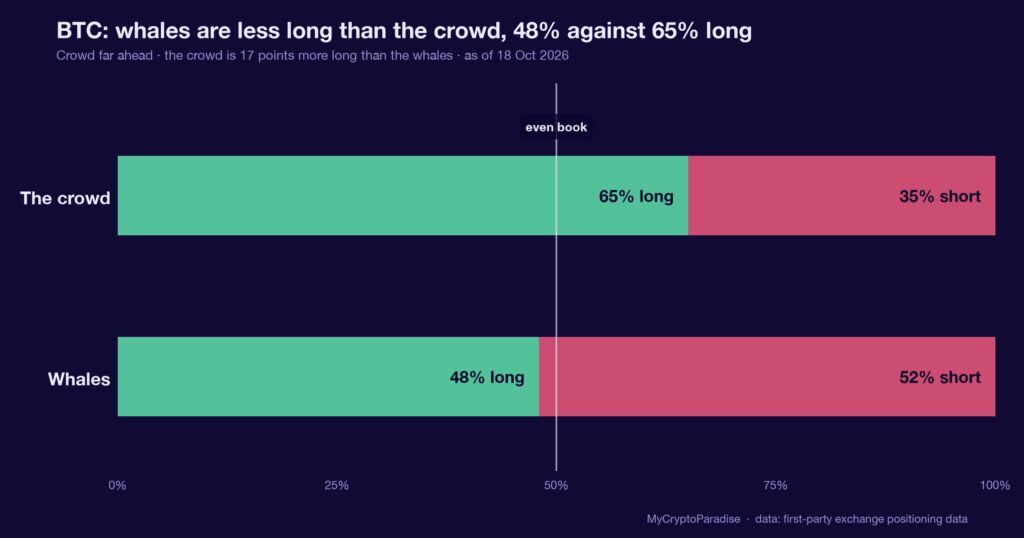
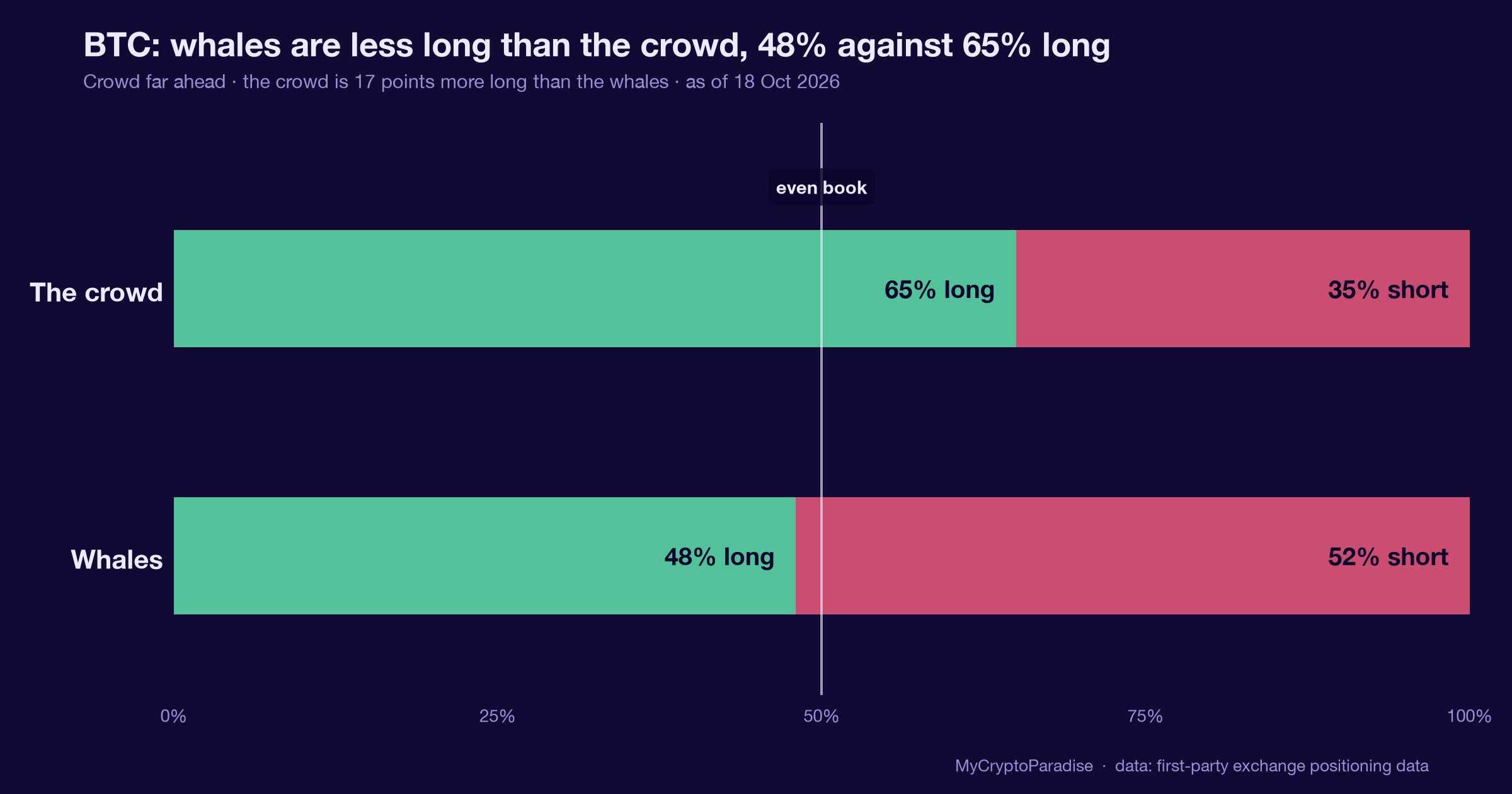
The positioning split is the other half. Our whale-versus-crowd gauge shows large accounts 48 percent long against the crowd at 65 percent long, a 17-point gap our model labels crowd far ahead. Funding ran at 3.31 percent annualized (APR) with longs paying to hold.
Against all of that, the on-chain feed reported one $110 million long opened at 40 times leverage. We cannot see that single position in our tape, so we attribute it to the source feed and weigh it against what we can count.
Loud size on one side of the book does not outvote the net of the whole book.
The 40x number is the fragile part, not the bold part
The obvious misreading is that one big long cancels the bear case. It does not. At 40 times leverage, a $110 million notional position rests on a sliver of margin that a move of roughly two to three percent against it wipes out.
That makes the leveraged long the fragile side of this tape, not the confident one. Our own net flow is going the other way, and the crowd is already 65 percent long and paying funding to stay there. The account most exposed to a flush is the one the headline is cheering.
This is one input. It sits beside funding, the whale-versus-crowd split and spot absorption, and today all of them lean the same cautious way while one borrowed position leans the other.
A position that needs price to behave within a few percent is not a conviction call. It is a margin call waiting for permission.
What is different here
The ParadiseTeam does not repeat a whale headline until our own radar confirms it. The on-chain feed quoted one $110 million long; our tape counted the net of 61 orders and found distribution. We publish the number that disagrees, because the disagreeing half is what sizes the risk.
The crowd is paying to hold the other side
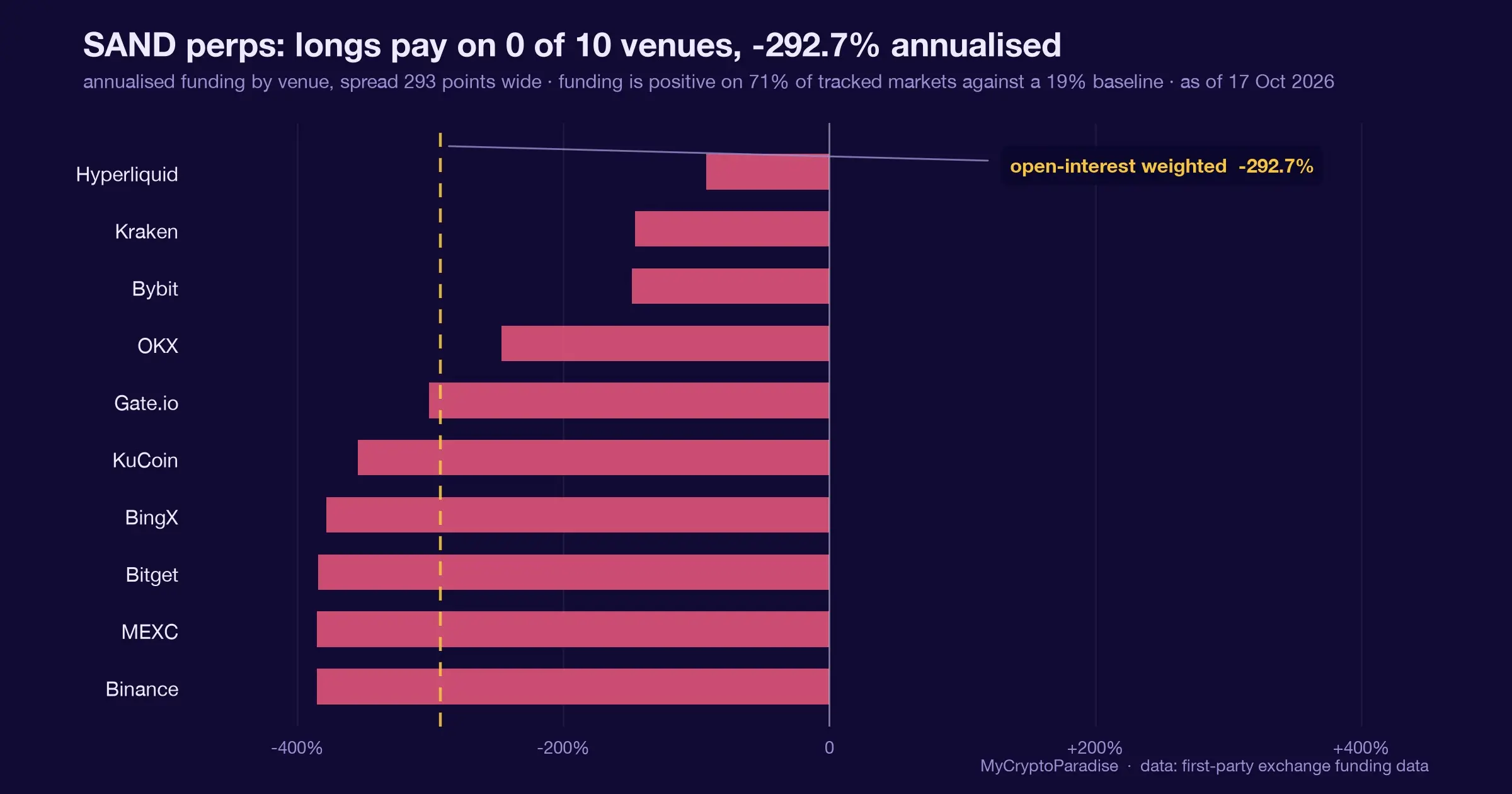
Positive funding is a toll. When the rate runs at 3.31 percent annualized (APR) with longs paying shorts, it means the long side is crowded enough that holders are being charged to keep the position open. That is the crowd at 65 percent long, not the whales at 48.
Perpetual funding (the recurring payment that tethers a perpetual future to spot) rarely stays positive and crowded for long without a shakeout. It is a slow bleed that eventually asks over-leveraged longs to either add margin or let go.
So the leveraged $110 million long is not alone: it is the loud edge of a crowd that is already paying to be long while the larger accounts step back. That is a positioning read, not a price call.
When the crowd pays to hold a side the whales are leaving, the funding meter is quietly billing the wrong people.
Six days ago our tape was buying: now it is not
Honesty about the sample first. No calibrated base rate is wired for whale-flow events here, so we claim no historical frequency: the reading stands on today’s net and the positioning split, nothing borrowed from memory.
What has changed is our own tape. On 12 October our radar logged net buying of $23.99 million with the whale index at 64, top of its range, and we leaned modestly constructive. Six days later the net is minus $148.19 million and the index has fallen to 46 on the sell side. The cohort turned.
That flip is the tell, more than any single order. When the same gauge that was buying the dip is now selling the bounce, the burden of proof sits with the bulls, not the bears.
A reading you only trust when it agrees with you is not a reading. It is a mirror.
Reading whale flow yourself, step by step
- Start with the net, not the loudest trade: take total large buys minus total large sells over a rolling 24 hours.
- Count the orders behind that net, so one giant print cannot masquerade as a crowd of accounts.
- Check the biggest single order and its side, since the headline trade is often the opposite of the net.
- Read the whale-versus-crowd split and funding together: note who is long and who is paying to stay there.
- Mark the invalidation before you act: the flow level or index flip that would turn the read around.
The step people skip is counting the orders. One giant print and a scatter of small sells can net to the same figure, yet they describe completely different markets.
Every number above is checkable against the live data. Start with the MCP Insights hub, then cross-read the Crypto Fear and Greed Index and the live crypto funding rates.
Act and invalidate
| Scenario | What confirms it | What kills it |
|---|---|---|
| Whales keep distributing | Net flow stays negative, index below 50 | Net flips positive, index back above 60 |
| Over-long crowd flushes | Funding cools as longs cut, spot holds | Funding climbs with spot, longs validated |
| The leveraged long is early | Whale index turns to buy side | Position liquidated on a two to three percent dip |
Posture: Defensive while our net flow stays negative and the crowd carries the long side; no trade is the honest default until the whale index leaves the sell half. The asymmetry is a lean, not a level, and it is worth one line of risk.
Frequently asked questions
Did a whale really open a $110M long?
The on-chain feed reported one $110 million Bitcoin long opened at 40 times leverage on 18 October 2026. We cannot verify that single position in our own data, so we attribute it to the source feed and weigh it against the net flow we can measure.
What does net whale distribution mean?
Distribution is our label for a rolling day where large accounts sell more size than they buy. On 18 October our radar netted minus $148.19 million across 61 orders, so the cohort was releasing coins rather than accumulating them.
Why does 40x leverage matter here?
Leverage sets how little the market must move to erase a position. At 40 times, a long rests on a sliver of margin that a move of a few percent against it wipes out, which makes it the fragile side, not the strong one.
Is positive funding bullish or bearish?
Neither on its own. Funding at 3.31 percent annualized (APR) with longs paying means the long side is crowded enough to be charged a toll. It is a positioning read: it says who is paying, not where price must go.
What would flip this cautious read?
Our own tape turning. If 24-hour net flow swings back to buying and the whale index climbs out of the sell half above roughly 60, the distribution read is void and the constructive case returns.
Crypto trading involves substantial risk and is not suitable for everyone. Nothing here is financial advice; it is education only. Never risk more than you can afford to lose.
The private Extras feed, where the whale flow net, the whale-versus-crowd split and funding update intraday with their invalidation levels attached, is part of PRO Paradiser, the intelligence layer behind the ParadiseFamilyVIP strategies.








Join the discussion
No comments yet. Members, share how you are reading this.