

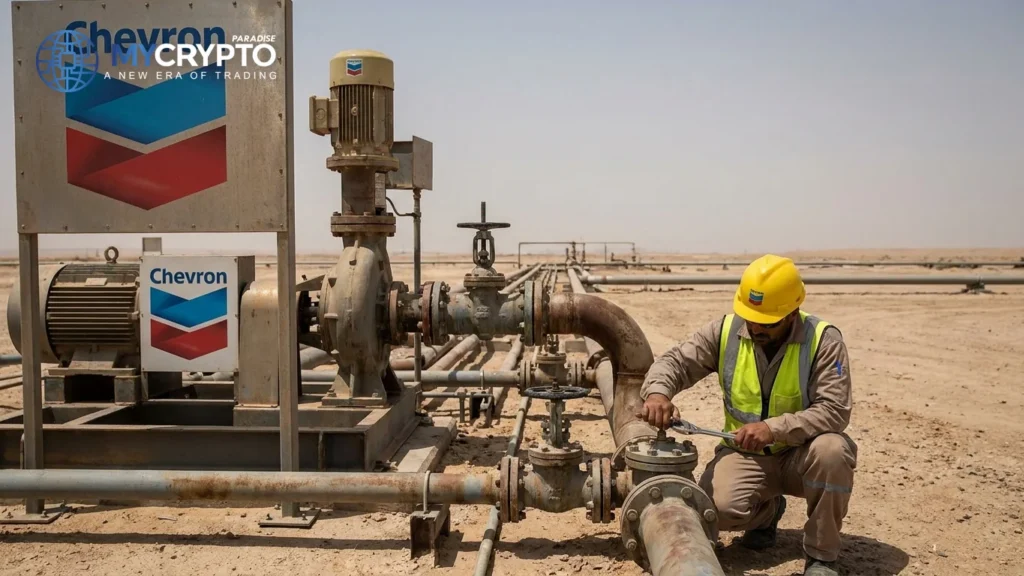
Market briefing: Market briefing: Chevron is scouting Iraqi pipeline routes to bypass the Strait of Hormuz, an energy security story with no direct crypto trigger. Bitcoin sat near $63,994, down about 0.3 percent on the day, still boxed under whale sell walls.
- Chevron is exploring new Iraqi pipeline routes to bypass the Strait of Hormuz.
- The move aims to cut the geopolitical risk premium on oil transit, a slow macro story.
- BTC held near $63,994 and ETH near $1,845, both governed by internal structure, not this headline.
The Chevron Iraq pipeline plan to bypass the Strait of Hormuz sounds huge for markets. But does an oil supply story actually move your Bitcoin trade today?
US oil giant Chevron is exploring new pipeline routes through Iraq. The goal is simple: bypass the Strait of Hormuz, the world's most sensitive oil chokepoint.
That one strait carries a large share of seaborne crude. Every time tension flares near it, traders price in a risk premium on oil. A route that sidesteps it is a quiet attempt to remove that premium at the source.
So this is an energy security move, not a crypto headline. It reads as long term supply chain planning by a company that would rather own its logistics than rent someone else's chokepoint.
For crypto, the honest answer is that the transmission is faint. Lower geopolitical risk on oil supports broad economic stability over time. It does not send fresh liquidity into Bitcoin this afternoon.
We want to be clear about what this is. There is no single confirmed same day catalyst behind today's price action. The Chevron story is real, but framing it as the reason BTC ticked lower would be storytelling, not analysis.
Bitcoin was trading near $63,994 as of the print, down about 0.3 percent on the day. Ethereum sat near $1,845, softer by roughly 1.3 percent. Both moved on their own internal structure.
The interesting part is not the pipeline. It is how reliably a macro press release gets recycled as a trading signal by people who need one.
Why an oil chokepoint rarely moves Bitcoin
The transmission chain from a pipeline plan to your BTC chart is long and leaky. It matters to understand why.
Step one is oil. Bypassing the Strait of Hormuz lowers the odds of a supply shock, which trims the geopolitical risk premium baked into crude prices over time.
Step two is macro. Calmer, cheaper energy is mildly disinflationary and supports steadier economic conditions. That is a slow, structural tailwind measured in quarters, not hours.
Step three is liquidity. This is where the chain breaks for crypto today. A pipeline study does not print new dollars, cut rates, or push institutional flows toward risk assets right now.
So the effect on Bitcoin is indirect and delayed at best. By the time any energy benefit reaches risk appetite, a dozen larger forces will have washed over the market.
This is the trap retail falls into during quiet tape. A dramatic geopolitical headline arrives, and the mind wants to connect it to the red candle on the screen.
Smart money does the opposite. It ignores the noise and watches where liquidity actually sits, because a story that cannot move dollars cannot move price.
The useful takeaway is discipline. Energy security is a genuine macro theme worth tracking for the cycle. It is not a reason to enter or exit a Bitcoin position this week.
Whale sell walls, not oil, cap the bounce
Look at the actual order flow and the picture clears up fast. The pipeline story left no fingerprint on the tape.
Bitcoin held near $63,994, a shallow 0.3 percent daily move. Notably, its one hour change was positive, up around 0.9 percent, so the intraday pulse was a small bounce, not a fresh breakdown.
That bounce is the tell. Every recovery attempt keeps running into whale sell walls stacked above current price, the same structure that has capped rallies through this correction.
Ethereum tells the weaker version of the story. It sat near $1,845, down about 1.3 percent on the day, lagging Bitcoin as it usually does when liquidity is thin and defensive.
Alts sit at the end of that queue. With BTC boxed and ETH heavy, the risk further out the curve has no engine to lift it, so most alts simply drift with the majors.
None of this connects to Chevron. The cascade here runs from Bitcoin structure into ETH and alts, driven by positioning and whale supply, not by an energy map of Iraq.
The correction looks multi stage rather than finished. Price is consolidating under supply while sellers defend higher levels, which is exactly what you would expect before any real capitulation. The oil headline is scenery, not the script.
Signals that matter while oil noise fades
Ignore the pipeline updates and watch the order book instead. That is where confirmation or invalidation will actually show up.
The first thing to track is those overhead sell walls. If Bitcoin absorbs that supply and closes convincingly above it, the corrective pressure weakens and the read improves.
The opposite matters just as much. A firm rejection at the walls, followed by a loss of the recent lows near the $63,000 area, would confirm sellers still hold the tape.
Watch retail behavior for the emotional tell. Capitulation, forced selling into fear, is often the event smart money waits for, because it hands them cheap supply from exhausted holders.
Watch ETH relative to BTC as a risk gauge. If Ethereum stops lagging and starts leading, appetite is returning; if it keeps bleeding faster, defense is still the mode.
On the macro side, give this energy story time, not urgency. If a Hormuz bypass genuinely materializes, the payoff is a slow reduction in oil risk premium, visible over months in crude, not in a crypto candle.
The practical filter is simple. Any real crypto catalyst will show up first as a shift in liquidity and flows. Until you see that shift, treat geopolitical energy headlines as context, not as a trigger to act.
What smart money sees under the walls
The ParadiseTeam reads this one plainly: a macro energy story does not touch the levels that matter for Bitcoin right now.
With BTC trading near $63,994 as of the print, price remains pinned under stacked whale sell walls. Those walls, not Iraqi pipelines, are the ceiling that keeps capping every bounce.
Our structural read stays the same. This looks like a multi stage correction where smart money defends supply overhead and prepares to absorb coins during an eventual flush lower.
The Chevron headline changes none of that. It shifts no support, moves no resistance, and adds no liquidity, so we file it as background, not as an input to positioning.
Here is who is doing what to whom. Retail is nudged toward selling into fear at lower levels, while patient capital sits below, waiting to accumulate the supply that panic releases.
What would shift our read is behavior at the walls, not in the oil market. Genuine absorption of that overhead supply, on strength, would be the first real evidence buyers are back in control.
Until then, the ParadiseTeam stance is patience over prediction. The market is telling you where the fight is, and it is happening around $63,000 to $64,000, not in the Strait of Hormuz.
Track it live: our Crypto Fear and Greed Index and the crypto liquidation heatmap both update in real time, so you can watch this shift for yourself.
Related coverage
For exact entries, targets, and stop losses with full risk management, that is what ParadiseFamilyVIP is for. New to reading these moves? Start with our crypto trading strategies guide.
ParadiseTeam is monitoring the market situation closely, and we are taking these developments into consideration while building our trading tactics inside ParadiseFamilyVIP.
Crypto trading involves substantial risk. Prices are volatile and you can lose money. This article is educational and is not financial advice. Past performance does not guarantee future results.
Where does Bitcoin go next while it sits under the whale sell walls?
This is how the Paradisers are calling it. Tap your call.
No calls on this one yet. Tap yours to be the first.
Free account, no password. Members just sign in.




Join the discussion
No comments yet. Members, share how you are reading this.