


Listen: the breakdown
Market briefing: Spot Bitcoin ETFs just logged their worst month since launch, with about $4.06 billion pulled in June as Bitcoin trades near $59,036. The headline reads like fear, but the tape near support reads like handoff.
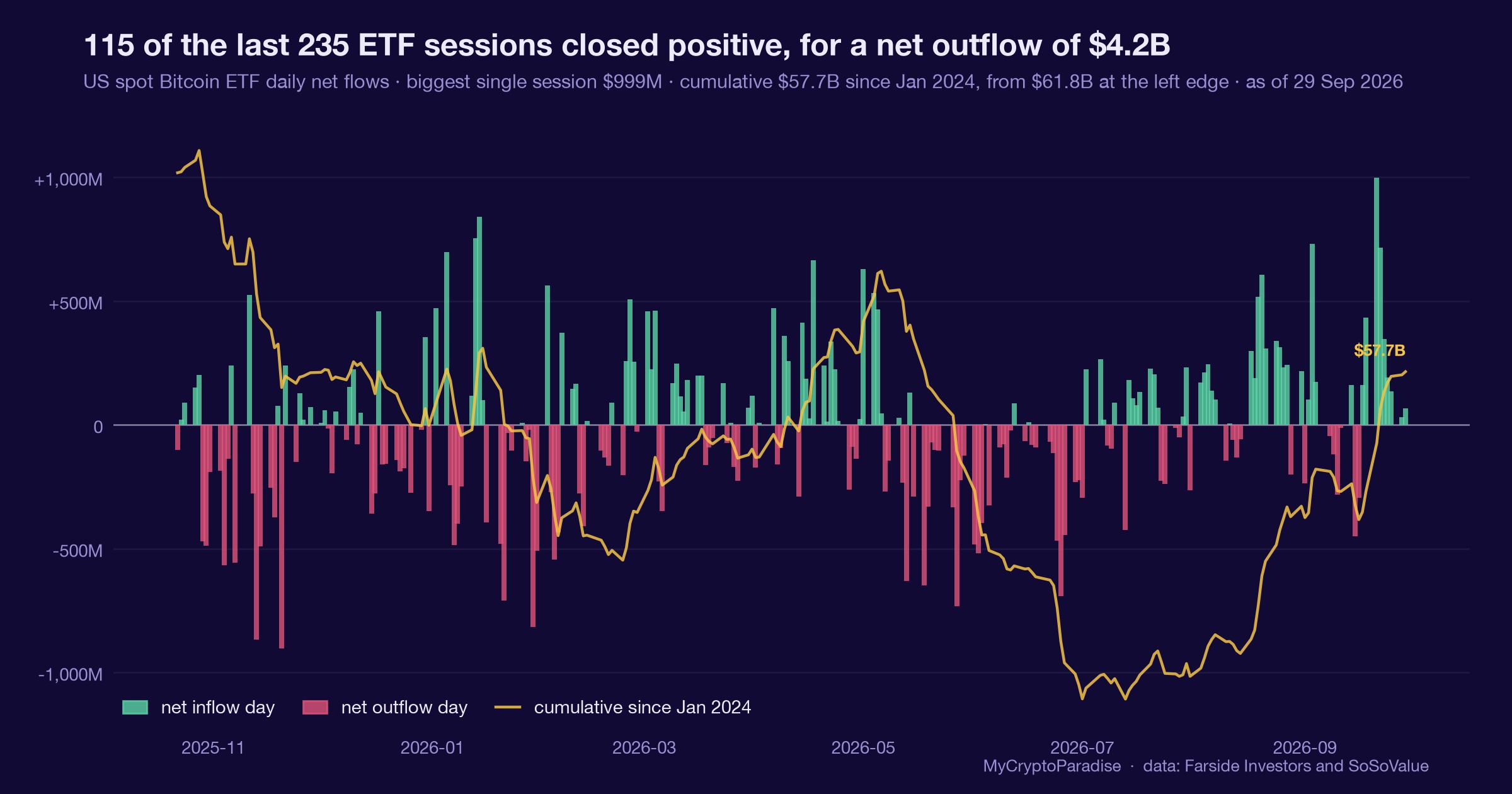
- US spot Bitcoin ETFs shed roughly $4.06 billion in June, the worst month since their January 2024 debut.
- Bitcoin printed a year-to-date low of $58,190 and is down about 33% this year while the S&P 500 gained over 9%.
- Record outflows near support look less like an exit and more like retail handing coins to patient buyers.
Spot Bitcoin ETF outflows just hit a record, with about $4.06 billion leaving in June. But if everyone is selling near support, who is quietly buying?
June closed as the worst month for US spot Bitcoin ETF flows since they launched in January 2024. Net outflows reached roughly $4.06 billion, and close to $4.3 billion has left these products since the start of the month. That is a lot of conviction leaving in one direction. Bitcoin followed the money lower. It slid below $60,000 on Tuesday and printed a year-to-date low of $58,190. As of now it trades near $59,036, down about 0.57% on the day. Zoom out and the picture stings more. Bitcoin is set to end June down more than 19%, and it has shed 33% year to date. Over the same stretch, the S&P 500 gained more than 9%. The asset built to outrun everything is, for now, losing to a boring index fund. Here is the part worth sitting with. ETF flows are not the market. They are the visible, reportable slice of it, the part that shows up in a headline. When that slice runs for the exit at the exact moment price sits on support, the interesting question is not why people are leaving. It is who is standing on the other side of every one of those sell tickets, taking the coins without complaint.
Why record outflows land differently at support
Start with the transmission chain. Record ETF outflows pull reported institutional and retail liquidity out of spot Bitcoin products. That withdrawal feeds a broader risk-off tone and a rotation of capital away from speculative assets. Thinner visible demand then lets price drift lower, which is how Bitcoin slid under $60,000 and tagged $58,190. So far, so mechanical. The macro backdrop explains the mood. Bitcoin trailing the S&P 500 by more than 40 points of relative performance this year tells you capital has preferred safety and cash flow over conviction. Profit-taking after earlier gains, plus general uncertainty, does the rest. None of that is a single confirmed same-day catalyst. We want to be honest about that. This is our interpretation of a slow, cumulative shift, not a headline event we can point to. What matters structurally is where this happens. Outflows arriving into a rising trend are distribution. Outflows arriving into support, after a 33% drawdown, with the crowd already fearful, are something else. They are capitulation. The reportable money is doing what reportable money reliably does near lows: leaving. That flushes weak hands, resets positioning, and hands supply to buyers who do not need to file a flow report. The mechanism here is liquidity moving from impatient owners to patient ones.
How the outflow selloff moves BTC then alts
The immediate impact shows in Bitcoin first. Outflows removed a steady bid, so BTC lost the $60,000 shelf and reached for the $58,190 low before stabilizing near $59,036. That is where the liquidity story gets specific. Stops from late longs and trend-followers sit just under recent lows. A slide into $58,190 is exactly the price that triggers them, and forced selling into thin books is the fuel a reversal runs on. Ethereum tends to lag Bitcoin on the way down and exaggerate it. When BTC bleeds on risk-off flows, ETH usually gives up more in percentage terms, because it carries the higher-beta reputation. Alts sit at the bottom of that waterfall. With visible liquidity draining from the largest, most liquid product in the space, smaller coins see the sharpest air pockets and the fastest wicks. The uncomfortable truth is that this cascade is normal. Every cycle features a stretch where the reported money leaves, the crowd concludes the story is over, and the assets that fell first are the ones that turn first. We are not calling a bottom to the minute. We are noting that the flush moved through BTC into ETH and alts in the usual order, and that the same order tends to run in reverse once the selling exhausts itself.
What confirms the turn versus more downside
The confirmation and invalidation lines are clean. Watch the daily close. A daily candle that closes green and back above $60,000 would mark a bullish engulfing attempt and suggest the outflow-driven flush is spent. A push and close above the $60,300 area, our 1.272 extension, would strengthen that read. We want to see it happen on real volume, above the moving average of daily volume, not on a thin, hopeful wick. Under the surface, the signals we track are already leaning. Price made a lower low while volume made a lower high, and price made a lower low while RSI made a higher low. Those are bullish divergences, the fingerprints of sellers running out of ammunition even as the headline flow screams the opposite. A MACD reclaim to the upside and a bullish stochastic RSI cross would confirm momentum turning. Now the invalidation. If Bitcoin loses $58,000, where bulls are defending the bottom, and closes below it, the accumulation thesis weakens. The next important support then sits at $54,000, and a controlled retest there is still within a bullish structure. A hard, high-volume break of $54,000 would tell us the outflows reflect genuine distribution rather than capitulation, and we would respect that. Probabilities, not promises.
What the record outflows signal for liquidity
Here is how the ParadiseTeam reads this specific print. Record ETF outflows near $58,190, with the crowd fearful, fit the accumulation template rather than the exit one. The reportable money is leaving at the low. Someone patient is absorbing it. The positioning around this move reinforces the read. An inexperienced whale is heavily short and risks liquidation near $65,836. That is a large pool of stops sitting above the market, and stops above the market are magnets. If price recovers, that short becomes fuel, and the outflow narrative flips from cause of the fall to setup for the squeeze. Previous lows this year looked more like long squeezes than genuine spot selling, which is consistent with liquidity being hunted, not distributed. For this event, the levels that matter are unchanged by the flow number. The $58,000 zone is where bulls defend. A daily close back above $60,000, ideally above $60,300, tells us the flush handed coins from weak to strong. Below $54,000 on volume, we stand aside and reassess. The point is simple. The outflow headline describes who left. The tape near support describes who stayed. Smart money rarely announces itself with a press release, and it is not filing a flow report while it buys. Position sizing and invalidation come first. This is analysis, not financial advice.
For exact entries, targets, and stop losses with full risk management, that is what ParadiseFamilyVIP is for. New to reading these moves? Start with our crypto trading strategies guide.
ParadiseTeam is monitoring the market situation closely, and we are taking these developments into consideration while building our trading tactics inside ParadiseFamilyVIP.
Crypto trading involves substantial risk. Prices are volatile and you can lose money. This article is educational and is not financial advice. Past performance does not guarantee future results.
Will Bitcoin quickly rebound after record ETF outflows?
Follow this topic: Bitcoin ETF news











Join the discussion
No comments yet. Members, share how you are reading this.