


Listen: the breakdown
Market briefing: Bitcoin spot ETFs shed $231 million and ether ETFs lost $30 million, yet BTC holds near $59,492, down under one percent. The flow looks like fear, but it is landing exactly where smart money tends to buy.
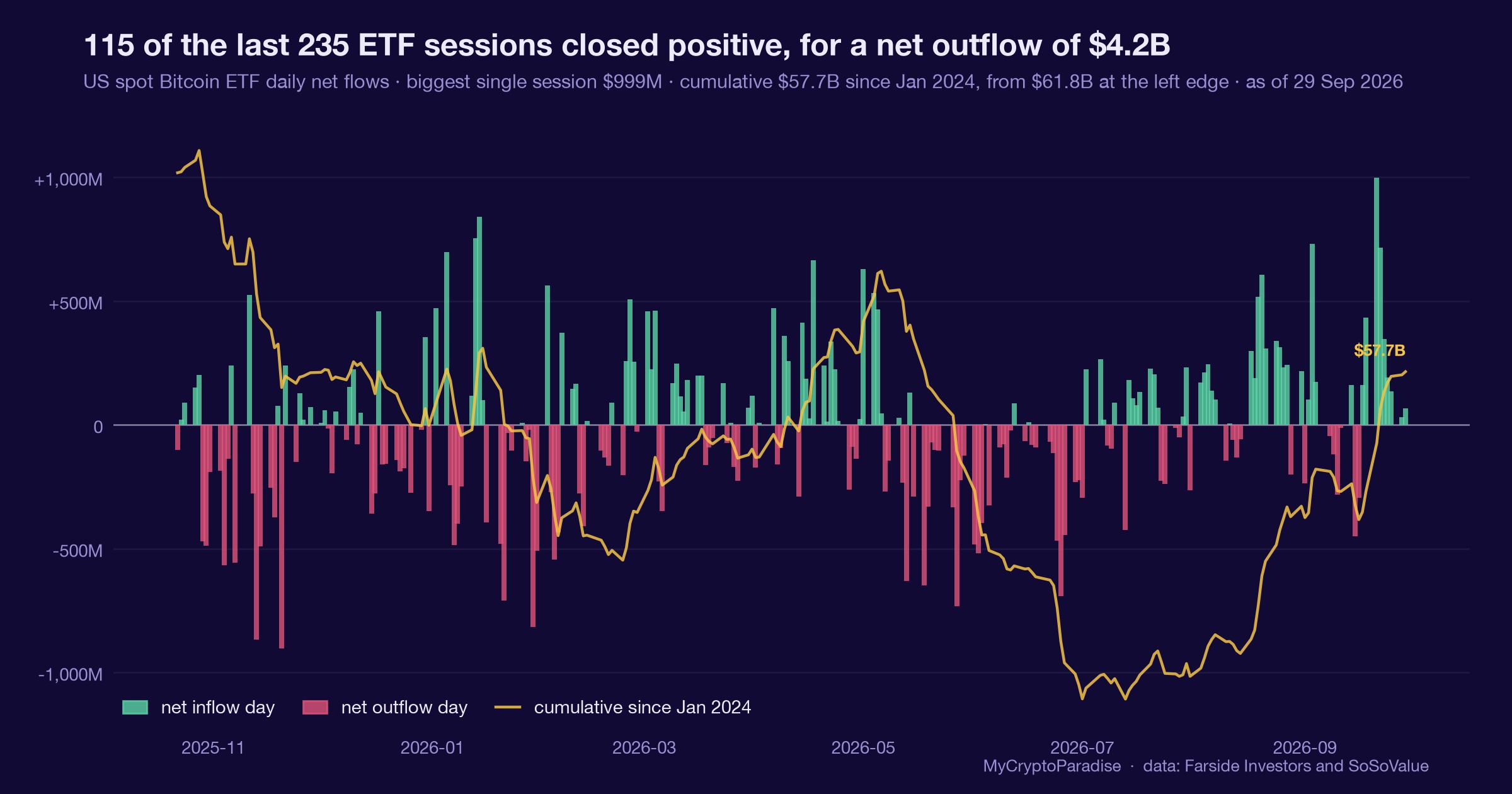
- Bitcoin spot ETFs recorded $231 million in outflows in the latest print
- Ether ETFs lost $30 million over the same window
- BTC sits at $59,492, down 0.93% on the day but up 0.32% on the hour
Bitcoin ETF outflows of $231 million read like a warning, but price barely moved at $59,492. So who is really selling here?
The headline is simple. Bitcoin spot ETFs saw $231 million leave in the latest print. Ether ETFs lost another $30 million. The instinctive read is that institutions are heading for the exit. We covered the wider trend earlier today, when monthly outflows hit their worst on record. What is new is this fresh single window of selling, and how little it has done to price. Bitcoin trades at $59,492. That is down 0.93% on the day and up 0.32% on the hour. A $231 million outflow is not nothing. It drains liquidity and it pressures market makers. Yet a flow that size, in a market this leveraged, should have left a bigger mark than a sub one percent dip. The number is loud. The price action is quiet. That gap is the whole story. ETF flows are a clean, public, lagging signal. Everyone reads the same figure at the same time. So when fear is this visible and price refuses to break, it is worth asking who is on the other side of the trade. Outflows tell you redemptions happened. They do not tell you who bought the coins those redemptions released. That distinction is where the real positioning hides, and it is the part the headline never prints.
Why a clean outflow print rarely moves price
ETF flows have become the market's most watched liquidity gauge. Money in tends to mean buying pressure. Money out tends to mean the opposite. So a $231 million outflow, paired with $30 million from ether ETFs, should drain the order book and weigh on Bitcoin. The transmission is straightforward. Redemptions force authorized participants to deliver coins back. That supply has to clear somewhere. In a thin market, it pushes price down. The macro layer matters too. Outflows often track shifting rate expectations, risk appetite, and the eternal urge to de-risk into uncertainty. When that mood spreads, capital leaves the riskiest assets first, and crypto sits near the front of that queue. But here is the part the mechanism alone misses. The selling already happened, and Bitcoin still holds $59,492. A genuine liquidity crisis does not stall politely above support. It cascades. The absence of a cascade is information. It suggests the supply released by these redemptions is being met by patient buyers rather than hitting an empty book. That is the difference between distribution and absorption. The flow figure cannot tell you which one is happening. The price reaction can. And so far the reaction says the fear is being quietly digested, not amplified, which is usually the first sign the easy part of the move is over.
How the outflow ripples from BTC into ether and alts
Start with Bitcoin, because it always leads. The $231 million outflow is the larger of the two figures, and BTC is where the deepest liquidity sits. Yet the coin is down less than one percent and is actually green on the hour. That tells you the selling is being absorbed near $59,492, not extended. Ether follows next. Its ETFs lost $30 million, a smaller drain in absolute terms but a proportionally similar signal. ETH typically amplifies whatever Bitcoin does. If BTC holds, ETH usually firms behind it with a short delay. If BTC breaks, ETH falls harder. For now, the smaller ether outflow suggests no panic rotation out of the second largest asset. Alts sit at the end of the chain. They have the thinnest books and the highest beta. They wait for Bitcoin to decide. A confirmed BTC reversal off this zone tends to send liquidity cascading down the risk curve into majors first, then into the long tail. A breakdown does the reverse and drains them fastest. The structure right now favors the patient side. Liquidity is leaving through the visible front door of ETF redemptions while price quietly defends support. That pattern, repeated across cycles, more often precedes a squeeze than a slide, because the sellers are the ones already done selling.
What confirms absorption versus a real breakdown
The next few daily candles settle this. The bullish case needs Bitcoin to hold its footing near current levels and reclaim ground on the daily timeframe. A green daily close back above $60,000 would be the first real tell that absorption is winning. A close above $60,300, the Fibonacci 1.272 level, would strengthen it. We want that move backed by volume above the average, not a thin drift higher. Momentum should agree. A MACD reclaim turning up, and a stochastic RSI bullish cross, would confirm that buyers, not just exhausted sellers, are stepping in. The invalidation is just as clear. If outflows keep coming and Bitcoin loses $58,000, the zone where bulls are defending the bottom, the absorption read weakens fast. A daily close below that opens the door toward $54,000, the next important support. That is where this thesis would need to be reconsidered, not defended. Watch the ETF figures themselves over the coming sessions. One $231 million print is a data point. A string of them with price still refusing to break is a divergence worth respecting. A string of them with price finally cracking is capitulation. The flows and the price have to be read together. Right now they disagree, and that disagreement is the entire opportunity and the entire risk.
What the outflow signals about positioning at support
Here is how the ParadiseTeam reads this print at $59,492. The outflow is real, but it lands in a zone our current lens flags as a potential reversal, not a breakdown. Bitcoin is defending the $58,000 bottom with $54,000 below as the next important support. Above sits $60,000, where a green daily close would print a bullish engulfing, and $60,300 at the Fibonacci 1.272. We see bullish divergence building: a lower low in price against a higher low in RSI, with bears looking exhausted. That backdrop changes how we weigh a $231 million outflow. Fear is visible, retail is reacting to the data, and an inexperienced whale is heavily short with liquidation risk up at $65,836. When weak hands sell into support and a crowded short sits overhead, the fuel for a squeeze is being assembled in plain sight. That is the mechanism. Outflows hand coins to patient buyers, and trapped shorts become the bid on the way up. Confirmation is a daily close above $60,000 on real volume with momentum turning. Invalidation is a daily close under $58,000. We hold a bullish lean while that structure stands, and we respect the risk if it gives way. Markets that look this obviously bearish at support are usually where the next move is quietly being set, not where it ends.
For exact entries, targets, and stop losses with full risk management, that is what ParadiseFamilyVIP is for. New to reading these moves? Start with our crypto trading strategies guide.
ParadiseTeam is monitoring the market situation closely, and we are taking these developments into consideration while building our trading tactics inside ParadiseFamilyVIP.
Crypto trading involves substantial risk. Prices are volatile and you can lose money. This article is educational and is not financial advice. Past performance does not guarantee future results.
What will be Bitcoin's price action after recent ETF outflows?
Follow this topic: Bitcoin ETF news










Join the discussion
No comments yet. Members, share how you are reading this.