

Listen: the breakdown
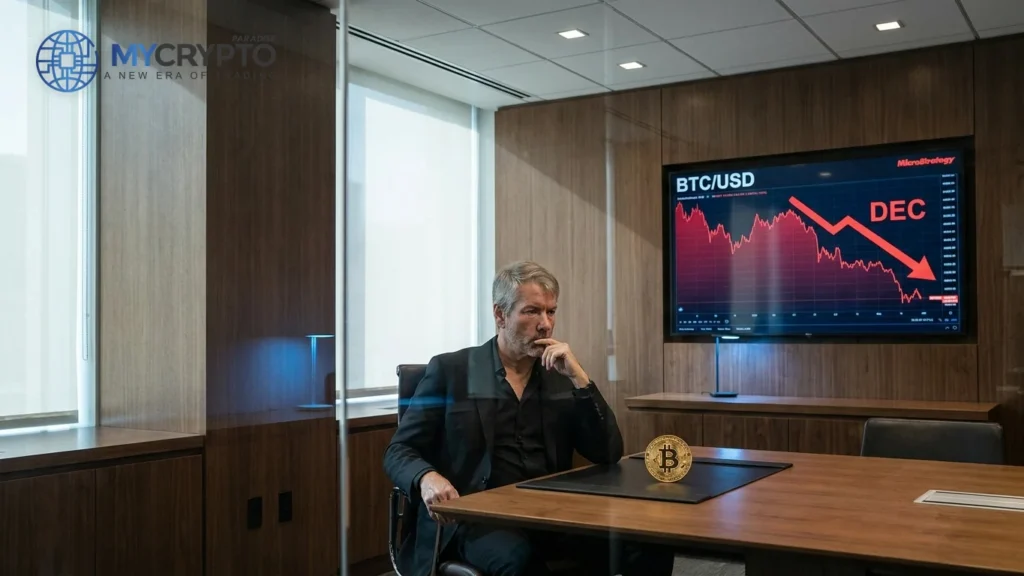
Market briefing: Market briefing. Bitcoin's realized loss gauge just hit a 43-month low, a bottom signal last seen at the FTX collapse, while Michael Saylor's Strategy sold 3,588 BTC. BTC was trading near $63,206, up about 0.9%.
- Bitcoin's realized profit and loss ratio fell to -0.35, a 43-month low last seen after the FTX collapse.
- Analytics flag it as a bottom signal, yet Michael Saylor's Strategy sold 3,588 BTC into the same narrative.
- With greed near 80 and about 78% of the market long, our read leans distribution, not a durable floor.
Bitcoin's bottom signal just flashed at FTX-era depths, even as Saylor's Strategy turns seller into the rally. Real capitulation floor, or a trap set for greedy retail longs?
Bitcoin's realized profit and loss ratio has dropped to -0.35. That is a 43-month low. The last time it sat this deep, FTX had just collapsed.
Investors, in other words, are locking in losses at a scale we have not seen since the market's darkest recent moment.
A blockchain analytics platform calls this a bottom signal. Historically, that kind of capitulation has marked exhaustion. Sellers run out, and price finds a floor.
So the bulls have their story. The chart, they argue, is screaming buy.
Then there is the other half of the tape. Michael Saylor's Strategy, long the loudest corporate buyer, has sold 3,588 BTC. The most patient hands in the room chose this moment to trim.
Bitcoin, meanwhile, was trading near $63,206, up roughly 0.9% on the day. Calm on the surface.
Two signals, one price. A capitulation gauge flashing green while the market's most famous accumulator quietly steps the other way.
This is where narratives get expensive. A bottom signal feels like permission to buy. Everyone can read the same indicator at the same time.
That is exactly the problem. When a bullish reading arrives into extreme greed, the question stops being what the indicator says. It becomes who is on the other side of your order.
Why greed changes what capitulation means
The mechanism here is not the indicator. It is the crowd reading it.
A bottom signal only works when few people believe it. Capitulation marks a floor because sellers are exhausted and buyers are scarce. That is the setup that ends downtrends.
This time, the mood is inverted. The Fear and Greed reading sits near 80, deep in greed. Roughly 78% of the market is positioned long. Retail is not fearful.
Retail is crowded and confident.
That changes what the same data means. A loss gauge at FTX-era depths, arriving while everyone is already greedy, is not obvious capitulation. It is a headline that invites the last buyers in.
Add Saylor's Strategy selling 3,588 BTC. The corporate hand that told a bullish story for years chose to reduce into this exact narrative.
When the patient money sells while retail buys the dip, that is the textbook shape of distribution. Supply moves from strong hands to weak ones.
The macro effect follows the positioning. Extreme long crowding builds fuel below price, not above it. Every leveraged dip-buyer is a stop waiting to be hit.
So the bottom signal matters, but perhaps not the way its fans hope. It is doing the job of a magnet, pulling in liquidity that a larger move can later use.
Where the crowded longs sit now
Liquidity, not headlines, decides where price goes next. Right now the liquidity is stacking beneath the market.
With 78% long and greed running hot, the crowded side is up. That leaves a pool of stop orders sitting under current price, exactly where a flush would travel.
Bitcoin is the trigger. If BTC loses momentum near this zone, those retail longs become forced sellers. Their liquidations feed the very move they bet against.
Ethereum tends to amplify it. ETH carries higher beta and heavier leverage, so a Bitcoin slip usually shows up faster and harder on ETH.
Then come the alts, always last and always loudest. Thin books and maximum leverage mean altcoin longs get flushed in a cascade once BTC and ETH lead lower.
This also rhymes with the tape we flagged earlier today, when the Coinbase premium stayed negative for a record stretch. Spot demand has been quietly soft while the headline mood stayed bright.
None of this is guaranteed. A bottom signal can mark a real floor, and price could grind higher and trap the shorts instead.
But the balance of evidence leans one way. Distribution into greed, patient money selling, and a wall of longs below price is not the profile of a durable bottom. It is the profile of a market being set up to hunt its own liquidity.
What confirms the trap versus a floor
Watch what price does with the current zone, not what the indicator claims.
Confirmation of the bearish read is simple. If Bitcoin fails to push higher and starts losing ground near $63,000, the distribution thesis gains weight. A break lower that liquidates crowded longs would confirm the trap.
Watch the Fear and Greed reading too. If greed stays elevated while price stalls, the setup for a flush stays intact. Complacency at the top is the fuel.
Watch whether large holders keep selling. Saylor's Strategy trimming 3,588 BTC is one data point. Continued selling from patient hands would tell you the smart-money exit is not finished.
Invalidation matters just as much. We stay honest about what would break this view.
If Bitcoin absorbs the selling, reclaims momentum, and pushes cleanly above resistance, the bottom signal earns its name. That would flip the odds and squeeze the shorts.
A cooling Fear and Greed reading paired with rising price would also weaken the bearish case. That combination points to healthy accumulation, not distribution.
For now the tell is straightforward. Rejection here favors the sellers. Acceptance above favors the bulls. The indicator is loud, but price is the referee.
Reading the bottom signal through smart money
The ParadiseTeam reads this event through one lens: who is trapped.
We anchor to what the tape shows now. Bitcoin near $63,206, greed near 80, and roughly 78% of the market long. That is a crowded book into a bullish headline.
Our medium-term stance stays cautious. A bottom signal arriving during extreme greed is not the contrarian gift it looks like. Real contrarian bottoms form in fear, not in a room full of dip-buyers.
The mechanism is distribution. Saylor's Strategy selling 3,588 BTC while retail buys the signal is supply moving from strong hands to weak ones. Smart money rarely announces the exit. It just sells into demand.
Stops now sit below current price, under every leveraged long that bought the bottom call. That is where the liquidity lives, and liquidity is what a larger move goes to collect.
So we treat strength here as suspect until proven otherwise. Rejection near this zone keeps the downside flush in play.
We would respect the other outcome only on real acceptance above resistance with cooling greed. Absent that, the risk-first read is that this bottom signal is bait.
Manage size, define invalidation, and never confuse a loud indicator with a safe entry. This is education, not financial advice.
For exact entries, targets, and stop losses with full risk management, that is what ParadiseFamilyVIP is for. New to reading these moves? Start with our crypto trading strategies guide.
ParadiseTeam is monitoring the market situation closely, and we are taking these developments into consideration while building our trading tactics inside ParadiseFamilyVIP.
Crypto trading involves substantial risk. Prices are volatile and you can lose money. This article is educational and is not financial advice. Past performance does not guarantee future results.









Join the discussion
No comments yet. Members, share how you are reading this.