

DeFi 2.0 Tokenomics
In short
DeFi 2.0 changes crypto tokenomics by shifting from inflationary token emissions to protocols sharing real revenue with token holders. This model allows tokens to function more like ownership stakes, with value tied to a platform's actual cash flow through mechanisms like protocol fee sharing, real yield, and buybacks. It aims to align the interests of users, liquidity providers, and investors by providing direct value to token holders.
For many years, people who invested in cryptocurrency heard a similar narrative. They were told to buy tokens, wait for more people to adopt them, and hope that the price would rise. This was the business model that many followed.
Looking back, it seems a bit odd. In traditional businesses, shareholders usually receive dividends, cash flow exposure, or a share of profits. But early crypto tokenomics often operated differently. Tokens turned into speculative assets linked to ecosystems that generated significant revenue without necessarily providing value to those who held the tokens. Protocols collected fees while users created activity, and investors mainly received a sense of optimism. DeFi 2.0 is changing this situation.
By 2026, several key decentralized finance protocols are moving away from pure speculation and toward models that resemble actual digital economies. Instead of relying solely on inflationary incentives and hype, newer models are focusing more on protocol fee sharing, sustainable revenue, and mechanisms that allow for value accumulation, which are designed to reward those who participate over the long term.
This shift is very important. When token holders start sharing in the cash flow generated by protocols, the dynamics between users, investors, and the platform change completely. Crypto begins to function less like a casino and more like infrastructure, which tends to last longer than mere hype.
What Is DeFi 2.0?
DeFi 2.0 signifies the next phase of decentralized finance protocols. The initial generation of DeFi concentrated on liquidity mining, aggressive token emissions, and rapid user acquisition. It managed to draw attention and liquidity but also revealed significant flaws such as unsustainable annual percentage yields, mercenary liquidity, inflation-heavy tokenomics, and weak long-term value capture. Many protocols effectively paid users to engage while aggressively diluting the holdings of token holders.
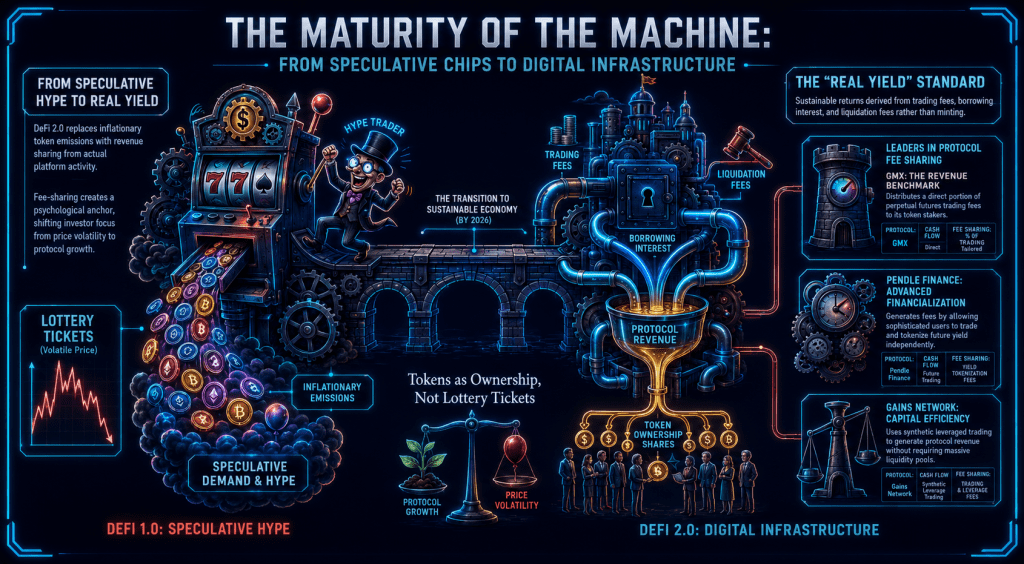
DeFi 2.0 arose in response to these structural issues. Instead of posing the question, “How do we attract liquidity quickly?” the newer generation asks, “How do we create sustainable digital economies?” This change has led protocols to adopt models that include protocol-owned liquidity, fee sharing, revenue distribution, real yield, buyback mechanisms, and treasury optimization.
In simple terms, DeFi 2.0 seeks to align users, liquidity providers, and token holders in a more effective manner. Increasingly, that alignment centers on one crucial idea: cash flow.
Why Protocol Fee Sharing Matters
Protocol fee sharing fundamentally alters token behavior. In earlier crypto cycles, token holders often relied entirely on speculative demand for returns. The value of the token was primarily based on the hope that someone else would buy it later at a higher price. Fee-sharing models introduce a different approach. They link token ownership directly to the activity of the protocol.
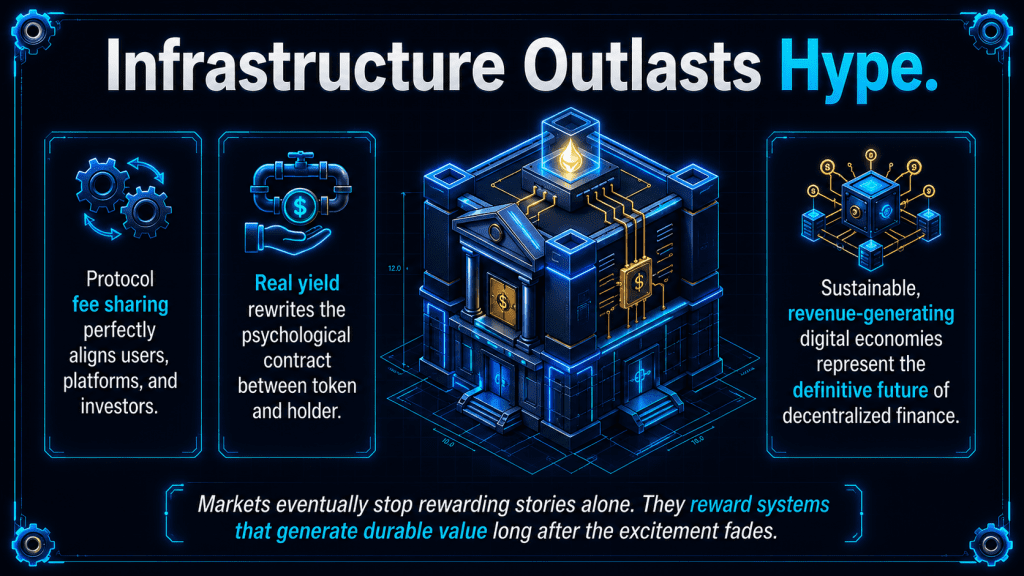
When the platform generates trading fees, borrowing fees, staking revenue, or other income sources, a portion may be returned to token holders. This results in several significant consequences.
First, it encourages long-term holding behaviors because investors have an incentive to maintain exposure to the revenue generated by the protocol.
Second, it lessens reliance on pure speculation. Third, it creates measurable valuation frameworks similar to traditional financial analysis. Suddenly, traders start asking questions such as how much revenue the protocol generates, what percentage goes to token holders, whether growth is sustainable, and how sticky user activity is. These inquiries sound surprisingly conventional, which is exactly why DeFi 2.0 is gaining importance. The industry is gradually maturing.
How “Real Yield” Changed DeFi Psychology
One of the most impactful concepts within DeFi 2.0 has been the idea of “real yield.” Earlier DeFi platforms frequently rewarded users with newly minted tokens.
Technically, users earned yield, but much of it stemmed from inflation rather than actual economic activity. Real yield alters this situation. Instead of distributing newly created tokens, protocols share revenue generated from real platform usage. This includes trading fees, borrowing interest, liquidation fees, protocol revenue, and swap fees.
Psychologically, this is significant because investors become less reliant on endless cycles of hype since returns are partially linked to real economic output. The token starts to behave less like a lottery ticket and more like an ownership stake. Ownership typically fosters stronger conviction than mere speculation.
1. GMX
GMX has emerged as one of the most clear examples of effective fee-sharing tokenomics. Initially built on Arbitrum and Avalanche, GMX functions as a decentralized perpetual futures exchange. Rather than depending heavily on inflationary emissions, the platform allocates a portion of trading fees directly to token stakers.
This model has changed how many traders perceive DeFi protocols. GMX holders are not just speculating on future adoption; they are actively participating in trading activities generated by the platform. This distinction is important. As trading volume in perpetual futures increases, fee generation rises accordingly. This establishes a direct link between the success of the protocol and the rewards for token holders.
GMX also benefits from another key factor: it addresses a genuine use case. Crypto traders consistently seek leveraged trading infrastructure. As long as derivatives markets remain active, platforms that facilitate such activities can continue to generate revenue. This positions GMX as one of the strongest examples of sustainable DeFi tokenomics in 2026.
2. Pendle Finance
Pendle represents one of the more intellectually intriguing developments in DeFi 2.0. The protocol focuses on tokenized yield markets, allowing users to separate and trade future yield independently from the underlying asset. At first glance, this may appear complex, and it is. However, complexity often leads to opportunities in crypto, especially when it addresses real capital efficiency issues.
Pendle gains from increasing participation from institutional and sophisticated traders because it allows market participants to speculate directly on future yield conditions. The protocol also generates substantial fee activity from these markets, creating strong value accumulation mechanisms for participants. Pendle’s significance goes beyond yield trading alone. It signifies a broader transition within crypto: financialization.
As DeFi matures, more products begin to resemble advanced traditional financial instruments, but they operate on decentralized infrastructure. This evolution creates entirely new categories of revenue generation for protocols.
3. Gains Network
Gains Network has grown increasingly important in the realm of decentralized leveraged trading. Its main product, gTrade, enables users to access synthetic leveraged markets without the massive liquidity pools typically required by perpetual exchanges. This significantly enhances capital efficiency. More importantly, Gains Network incorporates fee-sharing mechanisms that align protocol activity with the incentives of token holders. The more trading activity the platform attracts, the more revenue enters the ecosystem. This fosters structural sustainability instead of reliance on endless token inflation.
Gains Network also reflects another significant trend in DeFi 2.0: protocols becoming more specialized. Instead of striving to be universal financial ecosystems, newer projects are increasingly focusing on excelling in one specific area. This specialization often leads to stronger long-term defensibility.
4. Curve Finance
Curve Finance may not always be labeled directly as “DeFi 2.0,” but many of its mechanisms have significantly influenced the movement. Curve was a pioneer in governance-driven liquidity incentives and became deeply integrated into the liquidity infrastructure for stablecoins. Its fee-sharing dynamics demonstrated that DeFi protocols could generate sustainable revenue through real utility rather than speculation alone.
While stablecoin trading may seem dull compared to meme coins or AI narratives, such boring infrastructure can become highly profitable over time. Every market cycle eventually rediscovers the same reality: those who provide tools and support often outperform those chasing the latest trend. Curve effectively became one of DeFi’s liquidity highways, and highways tend to collect tolls consistently.
5. Aerodrome Finance
Aerodrome has emerged as one of the most robust ecosystem-focused DeFi platforms in 2026. Operating significantly within the Base ecosystem liquidity, Aerodrome combines liquidity incentives, governance participation, and protocol fee distribution. Its model illustrates how modern DeFi protocols increasingly seek to align all stakeholders simultaneously. Users provide liquidity, protocols generate activity, and token holders share in revenue. This creates greater ecosystem stickiness because participants become economically connected to the growth of the platform. Aerodrome also benefits from a broader trend shaping DeFi 2.0: the rise of ecosystem-centric liquidity hubs.
As blockchain ecosystems become more competitive, protocols that manage liquidity coordination gain increasing strategic significance.
Why DeFi 2.0 Is Changing Crypto Valuation Models
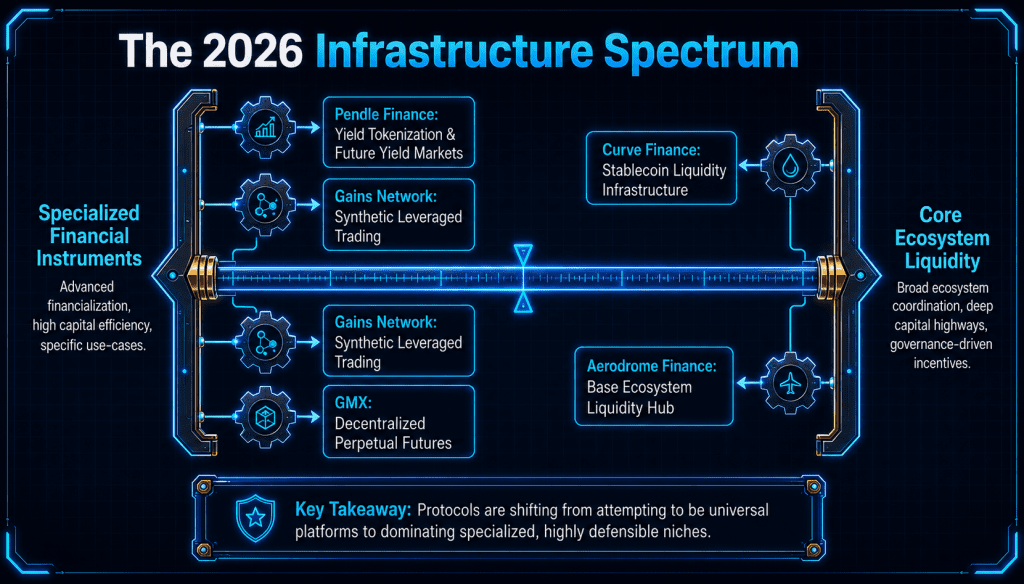
Earlier methods of crypto valuation often relied heavily on narratives. The stronger the hype, the more intense the price movement. DeFi 2.0 introduces more measurable frameworks. Investors are increasingly assessing revenue generation, fee distribution, treasury growth, capital efficiency, and protocol usage. This leads to more sustainable long-term investor behavior. This behavior is not perfectly rational, of course, since this is still crypto.
However, it is noticeably more rational than before. This evolution is significant because mature markets eventually reward systems that generate consistent cash flow rather than just temporary excitement.
The Hidden Psychological Advantage of Fee Sharing
There exists a significant behavioral aspect to fee-sharing models. When token holders gain direct involvement in protocol activities, their perspective on volatility undergoes alteration. Tokens that are purely speculative often lead to emotional instability since price serves as the sole source of reward.
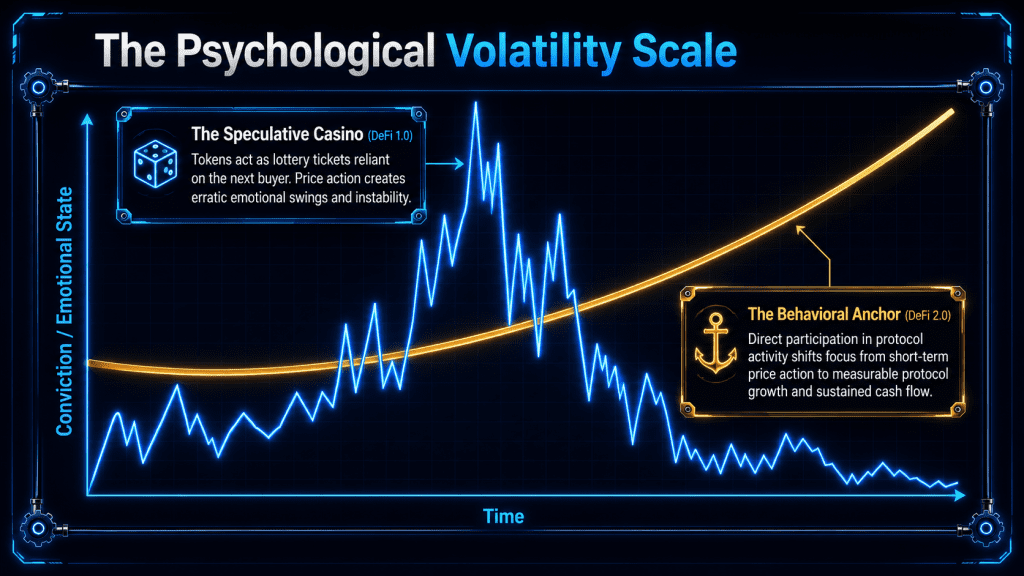
The introduction of fee-sharing provides an additional psychological anchor for investors. This causes them to shift their focus toward the growth of the protocol instead of merely the short-term fluctuations in price. That slight change promotes a mindset oriented towards the long term. Longer-term thinking generally reduces the tendency for emotional decision-making. This development could be viewed as one of the more positive changes within the crypto space.
Comparison: Best DeFi 2.0 Protocols in 2026
| Protocol | Core Focus | Fee Sharing Model | Main Strength |
| GMX | Decentralized perpetual trading | Trading fee distribution | Sustainable derivatives revenue |
| Pendle Finance | Yield tokenization | Yield market fees | Advanced financial infrastructure |
| Gains Network | Synthetic leveraged trading | Protocol fee participation | Capital efficiency |
| Curve Finance | Stablecoin liquidity | Swap fee distribution | Deep liquidity infrastructure |
| Aerodrome Finance | Ecosystem liquidity coordination | Governance and fee sharing | Ecosystem dominance |
Final Thoughts
DeFi 2.0 signifies more than just a new approach to tokenomics. It indicates a shift in philosophy. The crypto space is gradually transitioning from systems that prioritize speculation to digital economies that generate revenue. This shift is important because systems that are sustainable draw in stronger capital over the long term.
The sharing of protocol fees alters incentives. The concept of real yield modifies investor psychology. The generation of revenue impacts valuation frameworks.
Over time, these transformations may become more significant than many traders currently understand. Ultimately, markets will cease to reward narratives alone. They will begin to recognize systems that consistently deliver value, even after the initial excitement has diminished.
DeFi 2.0 FAQ
What is DeFi 2.0?
DeFi 2.0 is the next generation of decentralized finance protocols that move away from aggressive token emissions and liquidity mining toward sustainable digital economies. It emphasizes protocol fee sharing, real yield, protocol-owned liquidity, buybacks, and treasury optimization to better align users, liquidity providers, and token holders.
What is protocol fee sharing?
Protocol fee sharing links token ownership directly to a platform's activity by returning a portion of its income to token holders. When a protocol earns trading fees, borrowing fees, or staking revenue, holders can receive a share, which encourages long-term holding and reduces reliance on pure speculation.
How does real yield differ from earlier DeFi rewards?
Earlier DeFi platforms often paid users with newly minted tokens, so yield came largely from inflation rather than economic activity. Real yield instead distributes revenue from actual platform usage, such as trading fees, borrowing interest, and swap fees, so returns are tied to genuine output.
Which protocols are examples of DeFi 2.0 fee sharing?
The article highlights GMX, Pendle Finance, Gains Network, Curve Finance, and Aerodrome Finance. Each uses mechanisms that distribute real protocol revenue to participants rather than depending on endless token inflation.
Crypto trading involves substantial risk of loss. This article is educational and is not financial advice. Past performance does not guarantee future results. Always do your own research.
What is different here
Most guides stop at the theory. The MyCryptoParadise team shares the live trades, and the reasoning behind each one, inside ParadiseFamilyVIP. Everything here is education, not financial advice.
Crypto trading involves substantial risk and is not suitable for everyone. Nothing here is financial advice; it is education only. Never risk more than you can afford to lose.


Join the discussion
No comments yet. Members, share how you are reading this.