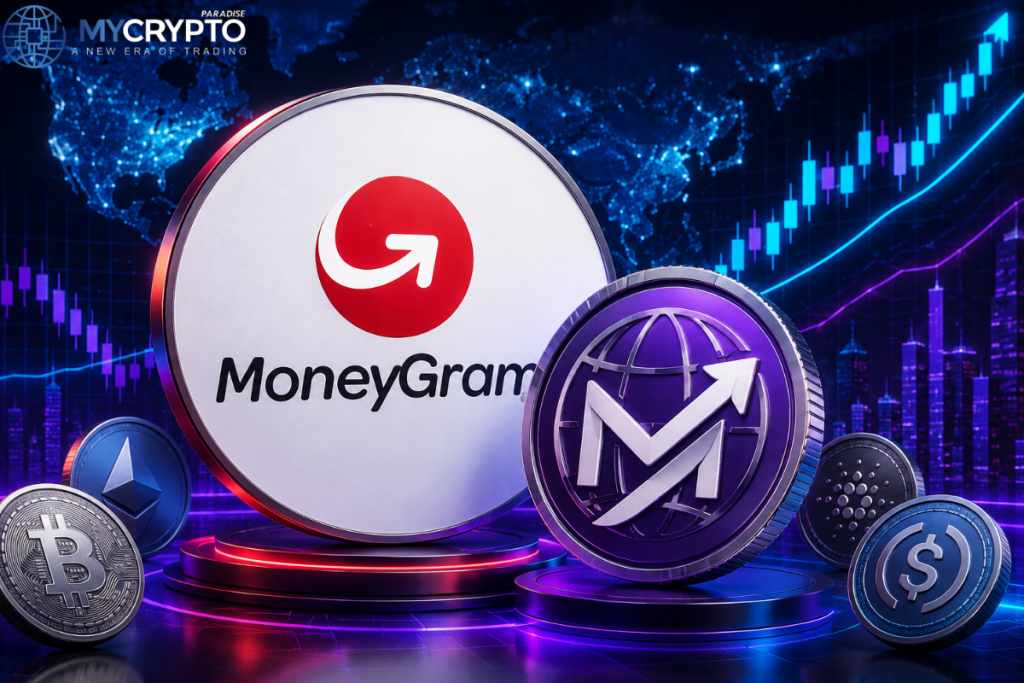
• MoneyGram launched MGUSD, a U.S. dollar stablecoin on Stellar.
• MGUSD will support app balances, transfers, settlement, and currency movement.
• The rollout starts in the U.S. before expanding across MoneyGram’s global network.
Stablecoin payments just moved closer to the cash counter. MoneyGram MGUSD turns Stellar into a payments rail for real users, but can it reshape global transfers?
MoneyGram just launched MGUSD, a U.S. dollar stablecoin built on the Stellar blockchain, aiming to fit into its global payments system. This stablecoin will be part of MoneyGram’s app, letting users hold USD balances in self-custody wallets and transfer value across borders via MoneyGram’s network. MGUSD is issued by Bridge, a Stripe company, while M0 handles the smart contracts and Fireblocks provides the wallet infrastructure.
The launch kicks off in the U.S., with a plan for a global rollout to MoneyGram’s roughly 60 million users and nearly 500,000 physical locations. That’s significant because this isn’t just another stablecoin on a crypto exchange. It’s a remittance company embedding a dollar stablecoin in an existing payment system. MoneyGram stated that MGUSD will first be used for treasury management, settlement, and currency trading, with wider customer use expected throughout its network.
Why MoneyGram MGUSD Matters for Crypto
MoneyGram MGUSD matters since stablecoins are shifting from crypto trading pairs to payment systems. This shifts the discussion from speculation to real utility.
The key factor here is payment access. With MoneyGram’s physical reach, Stellar’s low-cost settlement, Bridge managing issuance, M0 providing smart contract support, and Fireblocks ensuring wallet security, users can hold digital dollars, transfer value internationally, and potentially cash out through a known remittance network. The interesting part isn’t just that it sounds advanced, it’s that it might actually feel simple and boring enough for normal people to use.
For crypto, the way forward is adoption. Greater stablecoin payment use boosts real-world transaction demand, enhancing blockchain settlement significance and providing institutions with another instance of tokenized dollars flowing through regulated infrastructures. This doesn’t need to push BTC’s price today to be meaningful. Railroads were handy long before anyone thought of a railway meme coin.
Market Impact of MoneyGram MGUSD
For BTC, the effect is a bit indirect. While MoneyGram MGUSD won’t create instant Bitcoin demand, it bolsters the argument that blockchain systems can facilitate mainstream financial movements. If stablecoins gain traction in remittances and payments, Bitcoin stands to gain from enhanced crypto credibility among institutions.
For ETH, the signal is mixed. Ethereum remains central to stablecoin liquidity, but this launch is built on Stellar, which means payment specific chains can compete for real world stablecoin utility. ETH benefits from the stablecoin growth narrative, yet MoneyGram MGUSD serves as a reminder that utility can shift toward chains that are optimized for quick, low-cost payments.
As for altcoins, Stellar clearly stands to gain since MGUSD enhances its position in the global remittance space. Traders of XLM will be keeping an eye on whether this results in actual volume or if it just remains a strong announcement. Other payment focused chains may also reprice if the market starts rewarding stablecoin distribution, cash out networks, and merchant style utility over pure narrative.
What to Watch Next After MoneyGram’s MGUSD Launch
First off, there’s rollout speed. MGUSD kicks off in the U.S., but the real market signal comes from how fast MoneyGram can broaden access worldwide, especially in areas where dollar demand, remittance flows, and currency volatility are high.
Then, we have app adoption. If users actually keep MGUSD balances, send transfers, and cash out at MoneyGram locations, this becomes a working stablecoin payment network rather than a press release. MoneyGram operates in over 200 countries and territories, boasting nearly 500,000 retail spots through its Stellar partnership.
Next up is settlement usage. MoneyGram’s CEO mentioned that MGUSD aims to be the backbone for transactions among its users. Earlier reports also pointed out that it’ll kick off with treasury management, settlement, and currency trading. If internal settlement volume increases first, customer adoption might follow more smoothly.
Insights for Traders on MoneyGram MGUSD
The bullish confirmation signal is pretty straightforward. MGUSD needs to see actual app usage, Stellar activity has to rise, and MoneyGram needs to extend stablecoin support beyond just the early U.S. launch. That would indicate a shift from stablecoin debut to real payment flow.
The cautious signal? Weak user adoption or a sluggish global rollout. Stablecoins succeed based on distribution, trust, liquidity, and reliable cash-out options. A token that doesn’t get daily action is just a dollar in disguise.
Then there’s the second-order effect is competition. MoneyGram MGUSD puts the heat on banks, remittance companies, payment apps, and other stablecoin issuers to boost speed, cut costs, and enhance accessibility. For traders, this means keeping an eye on Stellar activity, stablecoin supply increases, transaction numbers, and updates on regional rollouts. Usage provides confirmation, while a lack of customer demand could mean MGUSD stays an internal settlement asset.
ParadiseTeam is monitoring the market situation closely, and we are taking these developments into consideration while building our trading tactics inside ParadiseFamilyVIP.